

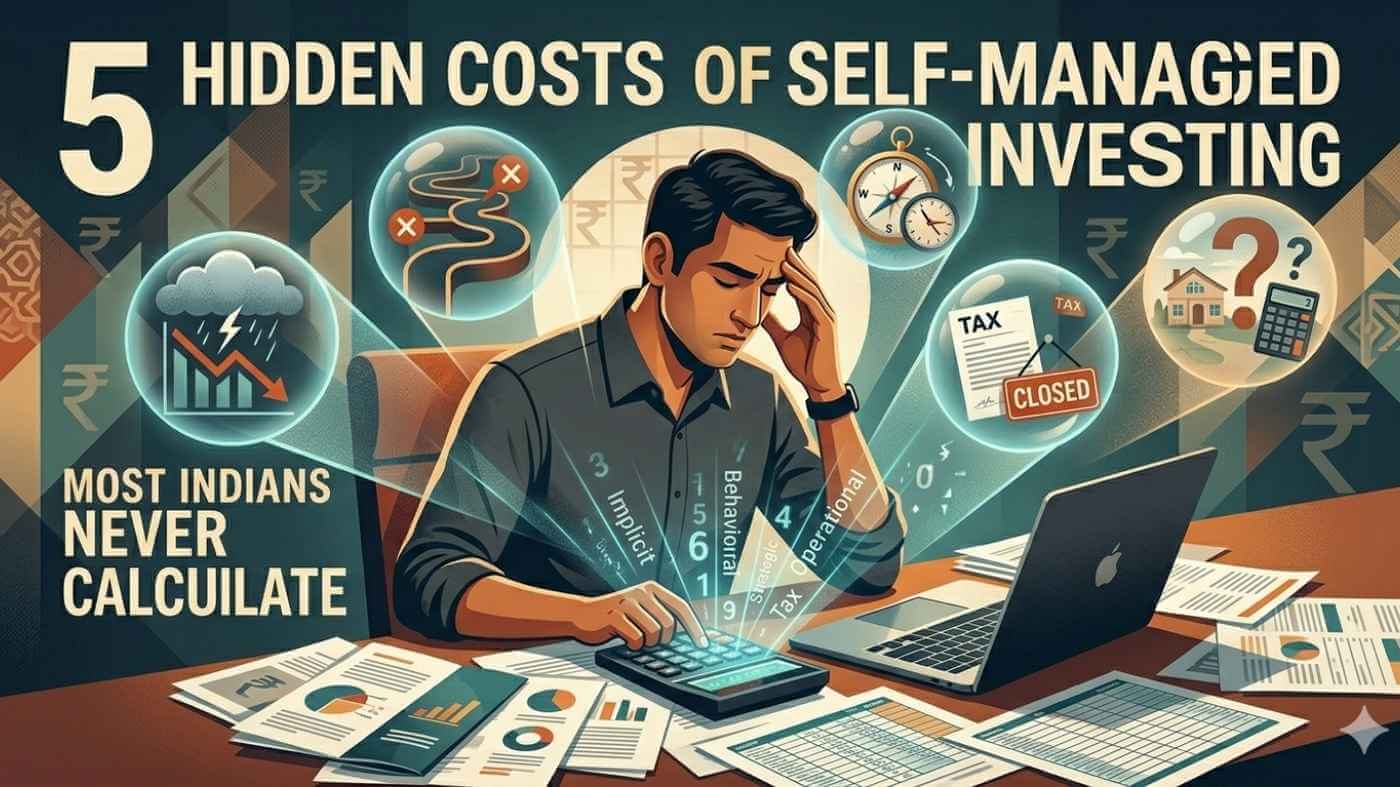
Why “Saving on Fees” Can Cost You Far More
Mutual fund investing in India has never been more accessible. Paperless onboarding, instant transactions, and a growing library of financial content have made it easy for anyone to start investing independently. And with that, accessibility has come a popular assumption: that managing your own investments is always the cheaper, smarter option.
But there is a number that rarely appears in this conversation. Not the expense ratio. Not the commission a distributor earns. The number that matters most is the one most self-managed investors never calculate: what poor timing, wrong fund selection, and unguided decision-making actually costs them in real rupees over 10, 15, and 20 years.
This article examines five hidden costs of self-managed investing in India, why each one matters, and what the research says about investor behaviour over full market cycles. The numbers are not theoretical. They show up in the actual outcomes of real investors.
The Gap Between Fund Returns and Investor Returns
Here is a fact that surprises most investors: the average mutual fund investor in India earns significantly less than the funds they invest in.
The fund earns 12%. The investor earns 8 or 9%. The gap is not theoretical. It is the measurable result of the decisions investors make along the way: when they enter, when they exit, which funds they choose, and whether they stay the course during downturns.
This gap has been documented globally by Dalbar Inc. in their annual Quantitative Analysis of Investor Behaviour report, and by SEBI’s own investor education research in India. The pattern is consistent across markets and decades: investors systematically underperform the very funds they hold.
The reason is not intelligence or information. It is behaviour. And behaviour, unlike expense ratios, cannot be fixed by investing independently.
| The Core Question: Before asking how much you save by managing your investments yourself, ask: What does managing your investments yourself actually cost you? For most investors, the honest answer to that second question is the more important number. |
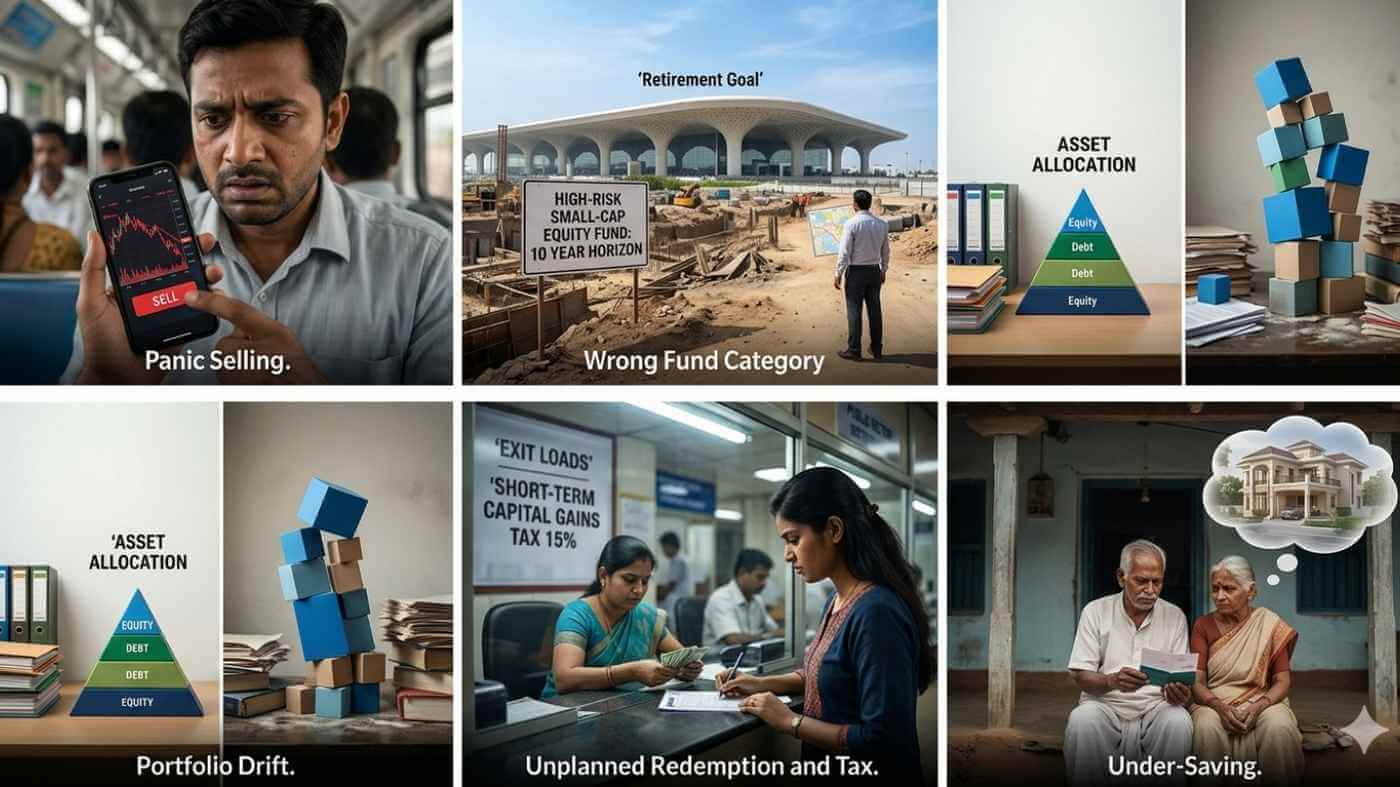
Hidden Cost 1: Behavioural Drag from Panic Selling
The single largest hidden cost in self-managed investing is the return destroyed by emotionally driven decisions during market downturns.
When the NIFTY fell roughly 38% in March 2020, millions of retail investors redeemed their equity mutual funds. Those who stayed invested recovered fully and then some within 12 months. Those who exited at the bottom locked in permanent losses, then typically re-entered near the recovery peak, buying back at prices significantly higher than where they sold.
One cycle of panic selling and late re-entry can destroy 3 to 5 years of compounding gains. Over a 20-year investment journey, most investors face at least three or four such cycles.
| SIP Rs. 10,000 per month, 20 years at 12% (disciplined) | Rs. 99.9 lakh corpus |
| Same SIP with 2 behavioural exits and late re-entries | Rs. 72 to 78 lakh corpus |
| Wealth destroyed by behaviour alone | Rs. 22 to 28 lakh |
| Typical expense ratio difference (annual) | 0.5 to 1.0% |
| Value of that fee over 20 years on Rs. 10,000 SIP | Rs. 8 to 12 lakh |
| NET COST: Behaviour vs. fee saved | Rs. 10 to 20 lakh more lost to behaviour |
A trusted adviser who keeps you invested through the crash is worth more than the commission they earn in the entire previous decade. This is not an opinion. It is arithmetic.
Hidden Cost 2: Wrong Fund Category for Your Goal
Selecting a mutual fund without guidance often means selecting based on past 1 to 3-year returns. High recent performance drives inflows into funds at precisely the point when their category is overheated, and drives outflows when a category is beaten down and due for recovery.
More importantly, many self-managed investors end up in the wrong category entirely for their goal. A small-cap fund for a 3-year savings goal. A thematic fund held as a core position. An international fund in a rising-rupee environment with a 5-year horizon. The wrong category is not a minor error. It is a structural misalignment that compounds against the investor for years.
| Right category for a 5-year goal at 10.5% p.a. | Rs. 10,000 per month grows to Rs. 7.8 lakh |
| Wrong category (e.g., small-cap for 5yr) at 6% p.a. | Rs. 10,000 per month grows to Rs. 6.9 lakh |
| Difference from one wrong category decision | Rs. 90,000 on just Rs. 6 lakh invested |
| Across 3 goals over 15 years | Rs. 3 to 8 lakh cumulative gap |
| Expense ratio saving over the same 5 years | Rs. 15,000 to Rs. 30,000 |
| NET COST: Wrong category vs. fee saved | Rs. 2.5 to 7.5 lakh net loss from wrong selection |
Fund category selection requires understanding your specific goal timeline, risk tolerance, and the current market cycle. Generic online tools and star ratings are not designed for individual goal matching. That matching is precisely what a good adviser does.
Hidden Cost 3: Portfolio Drift from Skipping Annual Reviews
A well-constructed portfolio has a target asset allocation: say, 70% equity and 30% debt, calibrated to the investor’s goals and risk profile. After a strong equity bull market, that allocation drifts. The same portfolio might now be 88% equity and 12% debt, carrying far more risk than the investor originally intended or currently needs.
Most self-managed investors review their portfolios infrequently. Life is busy, the portfolio is growing, and the temptation is to leave it alone. The result: allocation drift that creates hidden risk, revealed only when the next correction arrives.
| Target allocation: 70% equity, 30% debt | Calibrated to the investor’s risk profile |
| Portfolio after 3yr bull run (no review) | Drifted to 88% equity, 12% debt |
| Risk vs. original profile | Significantly over-exposed to equity |
| Impact of a 30% equity correction | Portfolio falls approximately 26% instead of 21% |
| Additional drawdown from drift | 5% extra loss on the full portfolio |
| On a Rs. 25 lakh portfolio | Rs. 1.25 lakh additional loss vs. rebalanced portfolio |
Annual rebalancing is a known, proven mechanism for reducing risk without sacrificing returns. It requires knowing when and how to rebalance, and then actually doing it. For most investors, this task disappears in the noise of daily life without a structured reminder and a process to follow.
Hidden Cost 4: Unplanned Redemptions and Avoidable Tax
When investors redeem from equity mutual fund investments without a plan, they frequently trigger avoidable tax liability. LTCG on equity mutual funds is taxed at 12.5% on gains above Rs. 1.25 lakh per financial year (post July 2024 Budget). A self-managed investor who redeems a large corpus in a single year, without understanding tax harvesting or staggered redemption, can pay Rs. 2 to 4 lakh more in taxes than necessary on a Rs. 30 to 50 lakh portfolio.
| Corpus at redemption (equity fund, 10yr SIP) | Rs. 38 lakh |
| Cost of investment | Rs. 12 lakh |
| Total LTCG (gain above Rs. 1.25 lakh exemption) | Rs. 25.75 lakh taxable |
| Tax without any planning | Rs. 3.2 lakh |
| Tax with annual LTCG harvesting over 10 years | Rs. 0 (spread across years within exemption) |
| COST OF SKIPPING TAX PLANNING | Rs. 3.2 lakh in avoidable tax |
Annual LTCG harvesting, redeeming up to Rs. 1.25 lakh of gains each financial year and reinvesting immediately, legally eliminates most LTCG liability over a long investment horizon. It takes 30 minutes per year to execute. Most self-managed investors either do not know about it or never get around to doing it. An adviser builds it into the annual review as a matter of course.
Hidden Cost 5: Under-Saving Because No One Calculated the Target
Perhaps the most expensive hidden cost of self-managed investing is also the least visible: investing without knowing how much you actually need.
Most investors pick a SIP amount based on what feels affordable, not what their goal actually requires. Without a proper goal-based financial plan, the SIP amount is essentially a guess. A comfortable-feeling Rs. 10,000 per month for retirement might be half of what you actually need to retire with dignity at 60.
| Retirement corpus actually needed (illustrative) | Rs. 3.5 crore at age 60 |
| SIP amount chosen without goal calculation | Rs. 10,000 per month from age 30 |
| Projected corpus at 12% p.a. over 30 years | Approximately Rs. 3.5 crore (coincidentally enough) |
| But if lifestyle inflation means Rs. 5 crore needed | Shortfall: Rs. 1.5 crore |
| Required SIP with proper goal mapping | Rs. 14,300 per month instead of Rs. 10,000 |
| COST OF NO GOAL PLANNING | Rs. 1.5 crore shortfall at retirement |
A goal-based financial plan calculates the exact corpus needed, adjusts for inflation, accounts for existing savings, and works backward to the monthly SIP required today. This is not a complex calculation, but it requires doing it and doing it correctly. Without it, most investors are either over-saving (unlikely) or quietly building toward a retirement that will not meet their own expectations.
The 5 Behaviour Patterns That Cost Investors the Most
These are the most common and most costly investor behaviours observed across Indian equity mutual fund investors over the last two decades. Each is preventable with proper guidance.
| Behaviour Pattern | What Actually Happens | Annual Return Impact |
| Panic selling after a 25 to 35% correction | Locks in losses; re-entry happens near the recovery peak | Minus 3 to 5% per year over a full market cycle |
| Buying after a strong 2 to 3-year performance | Entering near cycle highs, suffers a full correction | Minus 2 to 4% per year compared to systematic SIP |
| Stopping SIP when the market falls | Misses the cheapest units of the whole cycle; breaks compounding | Minus 1.5 to 3% per year in long-run CAGR |
| Holding an underperforming fund for 4 to 5 years | Category benchmark delivers 12%, held fund delivers 8% | Minus 3 to 4% per year over the holding period |
| Switching to “safer” funds in volatility | Loses equity upside; re-enters too late for recovery | Minus 2 to 3% per year over a 10-year horizon |
What a Good Distributor or Adviser Actually Does for You
The conversation about investing often focuses on what advisers earn. The more important conversation is about what they deliver. Here is the concrete value a good AMFI-registered distributor or financial adviser provides over a full investment lifecycle.
| What a Good Adviser Does | Why It Matters | What Is It Worth |
| Keeps you invested during market crashes | Panic selling in a 30% crash, then re-entering late, destroys years of compounding | 3 to 5% return saved in one bear market alone |
| Matches funds to your actual goals and timeline | Wrong category selection (e.g., small-cap for a 3-year goal) costs more than any fee difference | Avoiding one wrong fund = Rs. 10 to 20 lakh over 15 years |
| Reviews and rebalances your portfolio annually | An unreviewed portfolio drifts from its target allocation, creating hidden risk | 5% less drawdown in the next correction |
| Guides tax-efficient withdrawals | Unplanned redemptions can trigger large, avoidable LTCG tax bills | Rs. 2 to 4 lakh saved on a Rs. 40 lakh corpus |
| Maps investments to specific rupee goals | Investing without knowing your target number means you may be saving too little | Avoids a Rs. 50 lakh to Rs. 1 crore shortfall at retirement |
| Available when you have questions or anxiety | Financial stress is one of the top causes of poor decisions; access to a trusted person reduces it. | Incalculable, but real and consistent |
Notice that none of these benefits appear in an expense ratio comparison. They are delivered through relationships, conversations, and timely guidance. That is why they are invisible in the metrics most investors use when deciding whether to manage investments independently.
At VSJ FinMart, every client gets a clearly mapped investment plan tied to specific life goals, with regular reviews and honest guidance during the moments that matter most. The goal is not to manage your portfolio for you. It is to make sure the decisions you make are the right ones for where you are and where you want to go.
5 Questions to Ask Before Deciding to Self-Manage
Before managing your mutual fund investments independently, answer these questions honestly.
1. Do you have a written financial plan with specific rupee targets for each of your major life goals? Not a mental plan. A written one with numbers.
2. Did you stay invested and continue your SIPs through the March 2020 crash? Your actual behaviour during a past downturn is the most reliable predictor of your behaviour in the next one.
3. Have you reviewed your portfolio in the last 12 months and made any changes based on what you found, including rebalancing or replacing underperforming funds?
4. Do you know your current asset allocation by percentage, and whether it still matches your risk profile and goal timelines?
5. Have you calculated whether your current SIP amounts are sufficient to meet your actual goal numbers at your planned retirement age?
If you answered no to any of these, the hidden costs of self-managed investing are likely already active in your portfolio. They are not visible yet. But they compound, just like returns do.
The Fee You Can See vs. the Costs You Can’t
Every rupee of guidance a good adviser or distributor provides is visible in the expense ratio. What they prevent is invisible: the panic exit that did not happen, the wrong fund that was never bought, the SIP that continued through the crash, the retirement plan that actually has enough in it.
The investors who build the most wealth over 20 and 30 years are rarely the ones who minimise every fee. They are the ones who made consistently good decisions over full market cycles, stayed invested when it was hardest, and had a clear plan from the start.
None of that requires paying more than necessary. It requires investing with the right support.
If you want to start investing with a plan built around your actual goals, a conversation with VSJ FinMart is the right first step. We are an AMFI-registered distributor based in Ahmedabad, and every client portfolio is built from a written goal plan, reviewed annually, and guided through every market cycle.
Frequently Asked Questions
Is self-managed mutual fund investing a good idea in India?
Self-managed investing can work well for investors who have a written goal-based financial plan, a proven track record of staying invested through market downturns, and the time and discipline to review their portfolio annually. However, research consistently shows that most retail investors significantly underperform the funds they hold because of behavioural errors, wrong fund selections, and skipped reviews. For most investors, the hidden costs of self-managed investing exceed any fee advantage.
What is behavioural drag in mutual fund investing?
Behavioural drag is the return lost due to emotionally driven investment decisions: primarily panic selling during market downturns and over-eager entry during bull runs. Dalbar’s annual research shows this gap is typically 3 to 5% per year between what a fund earns and what its average investor earns. Over a 20-year horizon, this gap compounds into a very significant difference in final wealth.
How much can poor fund selection cost an investor?
Wrong category selection, such as investing in an aggressive fund for a short-term goal or a highly volatile sector fund as a core holding, can cost 3 to 5% per year in returns compared to the right category. On a 15-year horizon with a Rs. 10,000 per month SIP, a 3% annual return gap compounds to a difference of Rs. 15 to 25 lakh in the final corpus. This far exceeds any fee difference between investment options.
What is LTCG harvesting, and how does it help investors?
LTCG harvesting is the practice of redeeming equity mutual fund units with gains up to Rs. 1.25 lakh per financial year and immediately reinvesting the proceeds, resetting the cost basis. Since gains below Rs. 1.25 lakh per year are exempt from Long-Term Capital Gains tax, this annual exercise over a 10 to 15-year SIP horizon can reduce or eliminate the LTCG tax bill at final redemption. A good adviser builds this into the annual portfolio review automatically.
How does goal-based financial planning improve investment outcomes?
Goal-based planning starts with the specific rupee amount needed for each major life goal, adjusts for inflation, accounts for existing savings and expected contributions, and calculates exactly how much needs to be invested monthly to reach the target on time. Without this calculation, most investors pick an SIP amount based on what feels affordable rather than what is actually required. The result is a retirement or education corpus that falls significantly short of real needs.
Disclaimer
The information provided in this blog is for educational and informational purposes only and should not be construed as investment advice. Please consult a qualified financial advisor before making any investment decisions. Shashikant Chanderkumar Mudaliar (ARN: 319377), operating under the brand name VSJ FinMart, is an AMFI-registered Mutual Fund Distributor (MFD) and does not provide investment advisory services. Mutual fund investments are subject to market risks. Past performance is not indicative of future results. All figures mentioned are illustrative estimates based on historical data and are not guaranteed. Please read all scheme-related documents carefully before investing. Registration details can be verified at www.amfiindia.com/locate-distributor.