

How Most Indian Portfolios Are Actually Built
Priya works in IT in Pune. Three years ago, a colleague mentioned a fund that had returned 42% in the previous year. Priya downloaded an app, searched the fund name, and started a Rs. 3,000 SIP. Six months later, her father-in-law’s accountant suggested two ELSS funds for tax saving. She added them. A YouTube channel put out a ‘Top 5 Small Cap Funds for 2022’ video. She added two. Last Diwali, a WhatsApp message recommended a thematic ESG fund. She added it.
Today, Priya’s portfolio has nine mutual funds, three funds still paying distributor commissions she does not know about, and no coherent investment strategy. She cannot explain what any fund is doing in her portfolio, how to evaluate whether it is working, or what she would do if the market fell 30%.
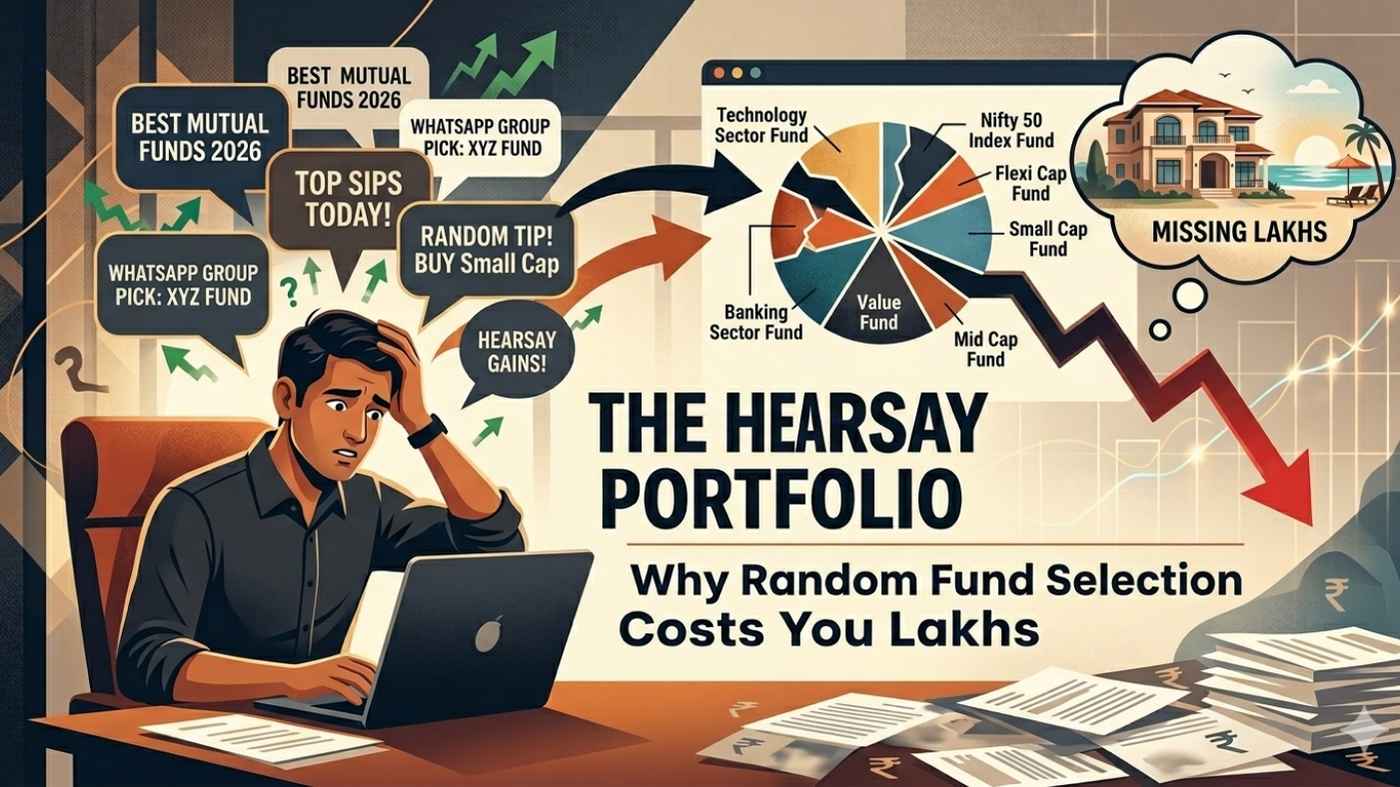
Priya’s portfolio is a Hearsay Portfolio: a collection of funds assembled through tips, forwards, recommendations, and impulse rather than through any systematic framework. It is the most common type of mutual fund portfolio in India, and it is among the most expensive.
What Is a Hearsay Portfolio?
A Hearsay Portfolio is a mutual fund portfolio where each fund was added in response to a recommendation, tip, or piece of information from an unverified source, rather than as the result of systematic evaluation against the investor’s goals, risk profile, and existing holdings. The defining characteristic is not the source itself. It is the absence of a systematic evaluation framework: no check on expense ratio, no check on portfolio overlap with existing funds, no check on whether the fund category matches the investment goal, and no defined exit criteria.
| The 3 Questions a Hearsay Portfolio Cannot Answer: Why is each of your funds in your portfolio? What specific purpose does it serve that is not already served by another fund you hold? Under what conditions will you exit each fund? What criterion, specific and measurable, would tell you it is time to stop this SIP? If the market fell 30% tomorrow, what would you do with each fund? Do you have a written, pre-committed answer, or would you decide in the panic of the moment? If you cannot answer all three for every fund you hold, you have a Hearsay Portfolio to some degree. |
6 Dangerous Sources of Hearsay in Indian Mutual Fund Investing
Source 1: The WhatsApp Forward
Your phone rings. Someone has identified the next big opportunity: ‘XYZ Smallcap Fund has given 68% in the last year. Must invest before March 31. Forward to 10 people.’ WhatsApp investment forwards are always based on past performance (the worst predictor of future returns), create false urgency, have no personalisation to your situation, and are never followed by monitoring or exit recommendations. The fund may genuinely have returned 68%, but past one-year equity returns have near-zero predictive power for future returns.
Source 2: The YouTube Top Performer List
A video titled ‘Top 5 Funds for 2024’. The host ranks funds by 1 to 3-year returns, sometimes with star ratings. No mention of your goals, risk profile, existing portfolio, or tax situation. By the time you watch a ‘Top 5’ video, those funds are already at cycle peaks. The best predictor of which funds will underperform over the next 5 years is which funds topped the charts in the previous 3 years.
Source 3: The Colleague’s Success Story
A friend at work mentions they made 50% on a fund last year. You ask for the name. You add it. What you do not know: when they bought it, whether they sold near the top, what percentage of their portfolio it represented, whether they are still in it, or whether it fits your situation at all.
Source 4: The Commission-Driven Distributor
An agent calls, suggesting Fund X because ‘it has great returns’. What they do not mention: Fund X pays a higher commission than Fund Y in the same category, which has a better 10-year track record. Or they suggest switching from one fund to another, generating a fresh commission on the switch.
Source 5: The Star Rating Trap
You filter funds by 4 or 5-star ratings on aggregator websites. Star ratings are typically backward-looking, heavily influenced by 1 to 3-year performance. By the time a fund earns 5 stars, its outperformance period is often over. Funds lose stars as quickly as they gain them. A rating system optimised for clicks is not optimised for long-term returns.
Source 6: The Thematic Hype Cycle
A new theme gains media attention: ESG funds in 2021, Infra funds during infrastructure announcements, and Pharma during COVID. Everyone starts talking about it. You add a thematic fund. Thematic funds are among the highest-risk equity categories. They concentrate sector risk dramatically, perform extremely well when the theme is in favour, and underperform sharply when it is not. Holding a thematic fund requires deep conviction in the theme for 10+ years. Most hearsay investors exit at the first correction.
What a Hearsay Portfolio Actually Costs You
Cost 1: Overlap and Wasted Diversification
A typical hearsay portfolio holds 7 to 12 funds. When analysed, 60 to 70% of the underlying stock holdings overlap across those funds. You think you are diversified because you own 9 different fund names. In reality, you own the same 40 to 50 stocks 3 to 4 times over, paying 3 to 4 expense ratios for exposure you are getting anyway. A professionally constructed 3 to 4 fund portfolio would deliver the same or better diversification at half the cost and complexity.
Cost 2: Category Mismatch to Goal Timeline
The most expensive error in hearsay portfolios: aggressive funds held for short-term goals, conservative funds held for long-term goals. A small-cap fund for a 3-year home down payment. A debt fund for a 25-year retirement corpus. The wrong fund in the wrong timeline costs far more than any expense ratio difference. On a Rs. 5 lakh corpus over 5 years, a category mismatch can cost Rs. 1 to 2 lakh in lost returns or excess risk.
Cost 3: Churning from Constant Switching
Hearsay portfolios have high turnover. Every 6 to 12 months, a new ‘hot fund’ appears. The investor exits Fund A and enters Fund B, triggering exit loads, capital gains tax, and loss of compounding. Each switch costs 1 to 3% in combined exit load and tax. On a Rs. 10 lakh portfolio switched twice, that is Rs. 20,000 to 60,000 lost, which would never have been lost in a hold-and-forget strategy.
Cost 4: Panic Selling During Corrections
Investors with no systematic framework are far more likely to panic-sell during corrections. When the market falls 25 to 30%, the hearsay investor has no written plan, no trusted adviser to call, and no conviction in why they own what they own. They sell near the bottom. One panic exit and late re-entry can destroy 3 to 5 years of gains. On a Rs. 20 lakh portfolio, this behavioural cost is Rs. 3 to 6 lakh in permanently lost wealth.
Cost 5: High Aggregate Expense Ratios
Hearsay portfolios tend to gravitate toward actively managed funds with high expense ratios. The average hearsay portfolio has a blended TER of 1.2 to 1.6%. A systematic portfolio constructed around index funds and low-cost active funds can run at 0.4 to 0.8%. That 0.6 to 1.0% annual difference compounds into Rs. 8 to 15 lakh on a Rs. 50 lakh corpus over 20 years.
What a Systematic Portfolio Looks Like Instead
A systematic portfolio is the opposite of a hearsay portfolio. It is built from a written financial plan, not from tips. Here is the framework:
• Goal mapping first: every rupee is assigned to a specific goal with a specific timeline. Retirement, child education, home down payment, and emergency fund.
• Asset allocation by goal: each goal gets the right equity-debt split based on its timeline. 3-year goals go into conservative hybrid or debt funds. 20-year goals go into equity index or diversified equity funds.
• Fund selection by evidence: funds are chosen by long-term track record (5 to 10 years), expense ratio, portfolio quality, and fund manager stability. Not by last year’s returns.
• Minimal overlap: 3 to 4 funds deliver complete diversification. Each fund serves a distinct purpose. No fund is redundant.
• Written exit criteria: before buying a fund, the investor writes the conditions under which they will exit. The fund underperforms the benchmark for 2 consecutive years. Goal timeline shortens to under 3 years. Fund manager changes.
• Annual review and rebalancing: once a year, the portfolio is reviewed against goals. Allocation drift is corrected. Underperformers are replaced. No emotional decisions in between.
This is what VSJ FinMart builds for every client: a goal-mapped, evidence-based portfolio with clear reasons for every fund, written exit criteria, and annual reviews. The result is lower cost, lower complexity, and dramatically better long-term outcomes.
How to Diagnose If You Have a Hearsay Portfolio
Answer these 5 questions honestly:
• Can you name the specific goal each of your mutual funds is serving? If not, you have a hearsay portfolio.
• Did you choose each fund based on a written comparison of its 5 to 10-year track record versus the category average, or based on a recommendation? If a recommendation, you have a hearsay portfolio.
• Do you know the total expense ratio of your portfolio (blended across all funds)? If not, you have a hearsay portfolio.
• Have you reviewed your portfolio in the last 12 months and made a conscious decision to keep every fund you hold? If not, you have a hearsay portfolio.
• If the market fell 30% tomorrow, do you have a written plan for what you would do with each fund? If not, you have a hearsay portfolio.
What to Do If You Have a Hearsay Portfolio
If you recognised your own portfolio in this article, here is the path forward:
• Stop adding new funds immediately. Freeze all hearsay-driven purchases until you have a written plan.
• List every fund you currently hold with: purchase date, current value, goal it serves (if any), and why you bought it.
• Identify duplicates and overlaps. Use a portfolio overlap tool or consult an adviser to see which funds hold the same stocks.
• Map each fund to a specific goal. If a fund cannot be mapped to a goal, it does not belong in your portfolio.
• Decide: fix it yourself with discipline, or get professional help. If you have the time and knowledge to rebuild systematically, do it. If not, work with a registered AMFI distributor who will build a goal-based portfolio for you from scratch.
At VSJ FinMart, we help investors clean up hearsay portfolios every month. The process is: list your goals, calculate the required corpus for each, map existing investments to those goals where they fit, exit or consolidate redundant funds, and fill gaps with the right category and fund. You end with 3 to 4 funds, each serving a clear purpose, with a written annual review schedule.
Frequently Asked Questions
What is a hearsay portfolio in mutual fund investing?
A hearsay portfolio is a collection of mutual funds assembled through tips, recommendations, YouTube videos, WhatsApp forwards, and impulse decisions rather than through a systematic, goal-based framework. The defining characteristic is the absence of evaluation criteria: no check on whether each fund serves a specific goal, no written exit plan, and no annual review. Most retail investors in India have some degree of hearsay in their portfolio.
How much does a hearsay portfolio cost compared to a systematic one?
A hearsay portfolio typically costs 2 to 4% more per year in combined hidden costs: overlap and wasted diversification (0.5 to 1%), category mismatch to goal timeline (1 to 2%), churning from constant switching (0.5 to 1%), and high aggregate expense ratios (0.6 to 1%). On a Rs. 20 lakh portfolio over 15 years, this difference compounds to Rs. 8 to 15 lakh in lost wealth. Behavioural costs from panic selling during corrections add another Rs. 3 to 6 lakh.
What is the best way to build a systematic mutual fund portfolio?
Start with goal mapping: write down your major financial goals with specific rupee targets and timelines. Assign an asset allocation to each goal based on its timeline (equity for 7+ years, debt for under 3 years). Choose 1 to 2 funds per allocation using 5 to 10-year track records, not 1 to 3-year returns. Aim for 3 to 4 total funds across all goals. Write exit criteria for each fund before buying. Review annually. If you need help, work with a registered AMFI distributor who builds goal-based portfolios.
How do I fix a hearsay portfolio without losing my existing investment gains?
List every fund you hold with its current value and the goal it serves. Identify which funds overlap heavily with each other. Decide which funds genuinely fit your goals and which do not. Exit funds that do not fit or are redundant, accepting the tax and exit load cost as the price of correcting past errors. Consolidate into 3 to 4 funds that cover your goals cleanly. The tax cost of exiting a wrong fund is almost always less than the ongoing cost of holding it for 10 more years.
Should I use YouTube or WhatsApp recommendations to choose mutual funds?
No. YouTube videos and WhatsApp forwards optimise for clicks and forwards, not for your long-term returns. They are almost always based on recent performance, which is the worst predictor of future returns. They have no personalisation to your goals, risk profile, or existing portfolio. They never provide exit criteria or monitoring guidance. Systematic fund selection requires comparing 5 to 10-year track records, checking expense ratios, evaluating fund manager stability, and matching the fund category to your goal timeline. These inputs do not fit in a viral message or a 10-minute video.
Disclaimer
The information provided in this blog is for educational and informational purposes only and should not be construed as investment advice. Please consult a qualified financial advisor before making any investment decisions. Shashikant Chanderkumar Mudaliar (ARN: 319377), operating under the brand name VSJ FinMart, is an AMFI-registered Mutual Fund Distributor (MFD) and does not provide investment advisory services. Mutual fund investments are subject to market risks. Past performance is not indicative of future results. All cost estimates and return figures mentioned are illustrative and based on historical ranges. Please read all scheme-related documents carefully before investing. Registration details can be verified at www.amfiindia.com/locate-distributor.