


The Pattern Beneath Every Market Crash
Every Indian market crash in recorded history has been followed by full recovery and eventual new highs. The 2008 global financial crisis saw NIFTY fall 52%, then recover and hit new highs by 2010. The 2020 COVID crash dropped NIFTY 38% in 40 days, followed by a recovery within 7 months. The pattern repeats because the underlying reality is structural: the Indian economy grows, companies generate profits, and equity markets eventually reflect that growth.
The crash is temporary. The growth is structural. But recovery timelines vary wildly: 7 months for COVID, 4 years for the dot-com bust. Your personal timeline determines whether you benefit from recovery or suffer through it, needing the money before it arrives.
These 12 lessons distil what separates long-term wealth builders (equity mutual fund investor) from those who repeatedly buy high, panic low, and miss the compounding that equity delivers to patient investors.
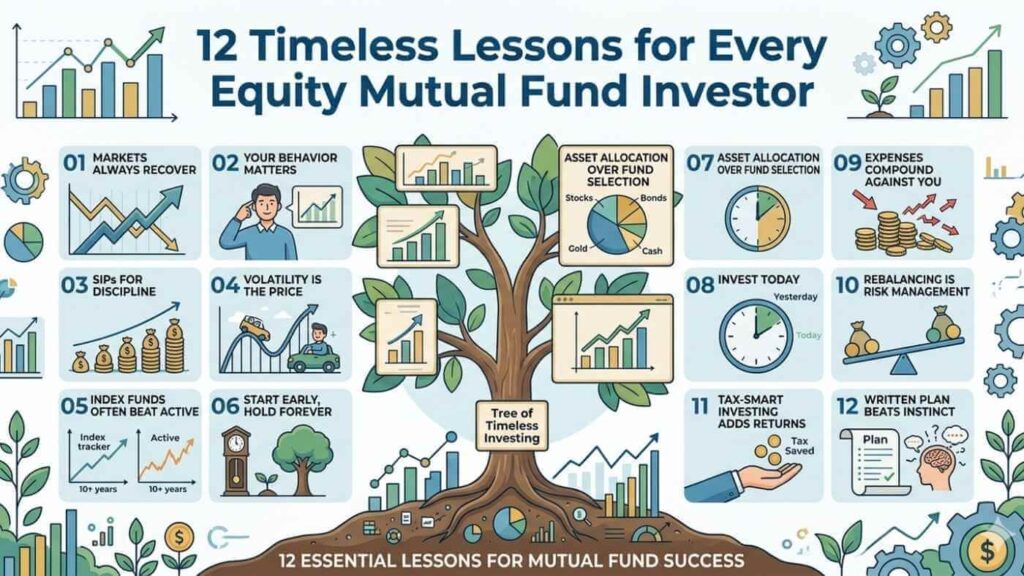
Lesson 01: Markets Always Recover, But Not Always on Your Timeline
Every crash eventually recovers. But ‘eventually’ can mean 7 months or 4 years. If your goal is 2 years away and the market crashes tomorrow, you may need to sell before the market recovers. Equity is the right vehicle only when your timeline can absorb a full market cycle: 7 to 10 years minimum.
Your Action: Never invest money in equity mutual funds that you will need within 5 years. Use debt funds, liquid funds, or FDs for goals with a time horizon of under 5 years.
Lesson 02: Your Behaviour Determines Your Return Far More Than Your Fund Selection
Dalbar’s annual research shows the average equity investor earns 3 to 5% less per year than the fund they hold, purely due to poor timing: buying after strong performance, selling after sharp falls. On a Rs. 10 lakh portfolio over 20 years, behavioural drag costs Rs. 15 to 25 lakh compared to simply holding through the cycle. Fund selection matters. Behaviour matters far more.
Your Action: Write a one-page investment policy before you invest: I will stay invested through all corrections under 40%. I will not check my portfolio more than once per quarter. I will review only annually. When you panic, read the policy first.
Lesson 03: SIPs Work Because They Force Discipline, Not Because of Rupee Cost Averaging Magic
SIPs are effective not because of the mathematical elegance of rupee cost averaging but because they remove the need to time the market and enforce discipline automatically. Most lump-sum investors wait for the ‘right time’ and never invest. Most SIP investors invest regardless. Over 15 to 20 years, consistent investment at imperfect times beats perfect timing with inconsistent investment.
Your Action: Set up SIPs on auto-debit the day after salary credit. Never pause them during market falls. That is when they deliver the most value.
Lesson 04: Equity Volatility Is the Price of Equity Returns
Equity mutual funds deliver 12 to 15% annualised returns over long horizons because they accept 20 to 40% drawdowns along the way. You do not get the 12 to 15% without accepting the 20 to 40% volatility. Investors who want equity returns without equity volatility end up churning between equity and debt at precisely the wrong times, destroying long-run returns.
Your Action: Accept volatility as the cost of long-term returns. If a 30% fall in your portfolio value would cause you genuine distress, you are over-invested in equity relative to your risk capacity.
Lesson 05: Index Funds Beat Most Active Funds Over 10+ Year Horizons
In India, approximately 60 to 70% of large-cap actively managed funds underperform the NIFTY 50 index over 10-year rolling periods after accounting for fees. The longer the horizon, the worse active funds look. For large-cap equity, index funds should form the core of your allocation.
Your Action: For large-cap equity allocations, use NIFTY 50 or NIFTY 100 index funds. Reserve actively managed funds for mid-cap and small-cap, where active selection can add value.
Lesson 06: Start Early, Invest Consistently, Hold Forever
The mathematics of compounding rewards time more than amount. A Rs. 5,000 per month SIP started at age 25 and held for 35 years at 12% becomes approximately Rs. 1.76 crore at age 60. The same SIP started at age 35 becomes Rs. 64 lakh. The 10-year head start is worth Rs. 1.12 crore in the final corpus. Time is the most valuable input in compounding, and it cannot be bought later.
Your Action: Start your first SIP today, not next month. Work with a registered AMFI distributor to set up systematic investments aligned to your long-term goals. At VSJ FinMart, we help investors map SIPs to specific goals with clear timelines and review them annually.
Lesson 07: Asset Allocation Matters More Than Fund Selection
The right 70:30 equity: debt portfolio with average funds will outperform the wrong 100:0 equity portfolio with the best funds when your goal is 5 years away, and a correction arrives. Asset allocation to match goal timeline and risk capacity determines 80 to 90% of long-term outcomes. Fund selection within categories is secondary.
Your Action: Map every SIP to a specific goal. Assign an equity: debt allocation based on the goal timeline. 10+ years: 80 to 100% equity. 5 to 7 years: 50 to 70% equity. Under 5 years: debt or liquid funds.
Lesson 08: The Best Time to Invest Was Yesterday. The Second-Best Time Is Today.
Waiting for the market to correct before investing is a strategy that sounds prudent and performs poorly. Markets spend more time at all-time highs than in corrections. Investors who wait for a 20% fall to invest often wait years, missing 30 to 40% gains while waiting. Time in the market beats timing the market, because markets rise more often than they fall.
Your Action: If you have a lump sum to invest and are worried about market levels, use a Systematic Transfer Plan (STP): park the lump sum in a liquid fund, then transfer a fixed amount monthly into equity over 12 months. This averages your entry while keeping you invested.
Lesson 09: Expenses Compound Against You as Powerfully as Returns Compound for You
A 1% difference in annual expense ratio compounds into a 20 to 25% difference in final corpus over 30 years. On a Rs. 50 lakh portfolio, that is, Rs. 10 to 12 lakh lost purely to higher fees. Choosing low-cost funds, especially in categories where active management rarely adds value (large-cap equity), is one of the highest-value decisions an investor makes.
Your Action: Check the expense ratio of every fund you hold. For large-cap equity, stay under 0.50% (index funds). For mid-cap and small-cap, stay under 1.00%. Exit funds with expense ratios significantly above category averages unless performance justifies it.
Lesson 10: Rebalancing Is Not Optional. It Is How Risk Is Managed.
A 70:30 equity: debt portfolio drifts to 85:15 after a strong bull run, exposing you to far more risk than intended. When the correction comes, your portfolio falls harder than you planned for. Rebalancing once a year brings the allocation back to target, systematically selling high and buying low.
Your Action: Set an annual calendar reminder for portfolio review and rebalancing. Sell equity when allocation exceeds the target by 10 percentage points. Buy equity when it falls below the target by 10 points.
Lesson 11: Tax-Smart Investing Adds 0.5 to 1.0% to Annual Returns
LTCG on equity mutual funds is taxed at 12.5% on gains above Rs. 1.25 lakh per financial year. Investors who redeem a large corpus in a single year pay Rs. 2 to 4 lakh in avoidable tax. Annual LTCG harvesting, redeeming up to Rs. 1.25 lakh of gains each year, and reinvesting, legally eliminates this liability over a long SIP horizon.
Your Action: Every March, review your equity holdings. Redeem units with gains up to Rs. 1.25 lakh, reinvest immediately. This resets your cost basis higher and reduces future LTCG liability at final redemption.
Lesson 12: A Written Plan Beats Instinct Every Time
Investors without a written financial plan guess at SIP amounts, allocate randomly, panic during corrections, and exit equity prematurely. Investors with a written plan know their retirement corpus target, the monthly SIP required to reach it, the allocation needed for each goal, and the conditions under which they will rebalance or exit. In bear markets, the written plan is the guardrail that prevents emotional decisions.
Your Action: Write a one-page financial plan: list your 3 major goals with timelines and target corpus. Calculate the required monthly SIP for each. Assign an equity: debt allocation to each. Commit to an annual review date. If you need help building this, work with a registered AMFI distributor who structures goal-based portfolios.
The One Meta-Lesson That Unites All 12
Every lesson above rewards patience, discipline, and systematic behaviour. None rewards cleverness, timing, or reacting to news. The investors who build the most wealth over 20 and 30 years are rarely the smartest. They are the most patient, the most systematic, and the most willing to ignore noise.
Financial success in equity investing is not about finding the perfect fund or timing the perfect entry. It is about starting early, investing consistently, holding through volatility, rebalancing when needed, and never panicking. These lessons cost nothing to apply. Over the decades, they compound into everything.
If you want to build a goal-based equity portfolio with clear SIP amounts, systematic reviews, and guidance through market cycles, VSJ FinMart (ARN: 319377) is an AMFI-registered distributor. We help investors map their goals, choose appropriate funds, and stay on track for 20-year horizons.
Frequently Asked Questions
What are the most important lessons for equity mutual fund investors in India?
The 12 most important lessons are: markets recover but not always on your timeline (invest only for 7+ years); behaviour matters more than fund selection; SIPs enforce discipline; volatility is the price of equity returns; index funds beat most active funds long-term; start early and invest consistently; asset allocation determines 80 to 90% of outcomes; time in market beats timing the market; expenses compound against you powerfully; rebalancing manages risk; tax-smart investing adds returns; and a written plan beats instinct every time.
How long should I hold equity mutual funds to see good returns?
Equity mutual funds require a minimum 7 to 10 year investment horizon to absorb full market cycles and deliver their historical 12 to 15% annualised returns reliably. Shorter horizons expose you to the risk of needing to redeem during a correction before recovery arrives. For goals under 5 years, use debt funds or liquid funds instead of equity.
What is the biggest mistake equity mutual fund investors make?
The biggest mistake is panic selling during market corrections and missing the subsequent recovery. Research shows the average equity investor earns 3 to 5% less per year than the fund they hold, purely due to poor timing decisions. Behavioural mistakes cost far more than fund selection errors over 20-year horizons.
Should I use index funds or actively managed funds for equity investing?
For large-cap equity, use index funds (NIFTY 50 or NIFTY 100). In India, 60 to 70% of large-cap actively managed funds underperform the index over 10-year periods after fees. For mid-cap and small-cap equity, actively managed funds can add value through stock selection. The longer your horizon, the stronger the case for index funds in large-cap allocations.
How much should I invest in equity mutual funds every month?
The right amount depends on your goals, not on what feels affordable. Work backward from your goal corpus: calculate how much you need for retirement, child education, or home purchase, then determine the monthly SIP required to reach that target by your goal date at assumed 12% returns. If you are guessing at SIP amounts without goal mapping, you are likely under-investing.
Disclaimer
The information provided in this blog is for educational and informational purposes only and should not be construed as investment advice. Please consult a qualified financial advisor before making any investment decisions. Shashikant Chanderkumar Mudaliar (ARN: 319377), operating under the brand name VSJ FinMart, is an AMFI-registered Mutual Fund Distributor (MFD) and does not provide investment advisory services. Mutual fund investments are subject to market risks. Past performance is not indicative of future results. All return figures mentioned are illustrative estimates based on historical data and are not guaranteed. Please read all scheme-related documents carefully before investing. Registration details can be verified at www.amfiindia.com/locate-distributor.