

Invest 70% in equity and 30% in fixed deposits. Start SIPs at 25, and you will retire a crorepati. These statements sound reasonable. They are also dangerously incomplete.
A 25-year-old software engineer in Bengaluru and a 45-year-old factory owner supporting elderly parents face completely different financial realities. Applying the same formula to both is like prescribing the same diet to a growing teenager and a senior citizen.
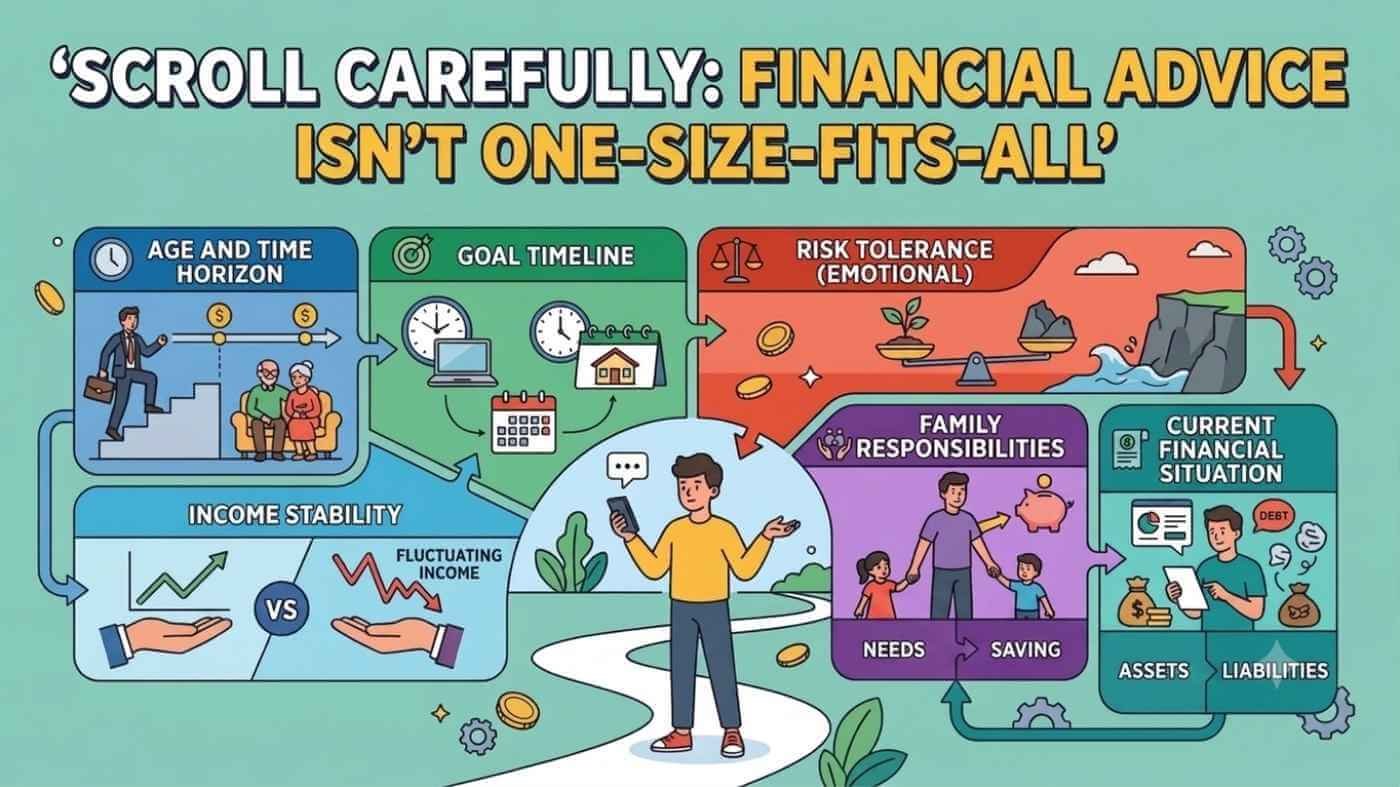
This is the core problem with generic financial advice: it ignores everything that actually determines whether a strategy works. Personalized investing starts from your specific age, goals, risk tolerance, income stability, and family responsibilities, not from a one-line rule that sounds good on social media.
Why Generic Financial Advice Fails
Generic financial advice fails because it averages away exactly the differences that matter most.
Life stage. A 25-year-old has 40 years to recover from a downturn. A 55-year-old has 10. The same portfolio cannot serve both without being wrong for one of them.
Risk tolerance. During the COVID-19 crash of March 2020, some investors stayed calm and bought more. Others sold at the bottom. Their actual emotional risk tolerance, not their age or income, determined the outcome.
Goals. A Rs. 50 lakh home down payment needed in 3 years requires conservative, predictable growth. A Rs. 3 crore retirement corpus needed in 25 years can absorb volatility. Same investor, two completely different strategies, if both goals exist simultaneously.
Income stability. A government employee with guaranteed income can invest aggressively. A freelancer with the same average income but high month-to-month variability needs a larger buffer and more caution.
Family responsibilities. A single person with no dependents can absorb more risk than someone supporting parents, children’s education, and a spouse simultaneously.
6 Factors That Determine Your Personalized Financial Strategy
These six factors interact. No single one determines your strategy alone, but ignoring any one of them produces a plan that does not fit your actual life.
| Factor | What It Changes in Your Personalized Financial Strategy |
| Age and Time Horizon | 20-30: 80-90% equity. 40-50: 60-70% equity. 60+: 20-30% equity. A longer horizon allows more risk and more time to recover from downturns. |
| Goal Timeline | 0-2 years: liquid funds and FDs only. 5-10 years: balanced funds. 10+ years: aggressive equity. A 5-year goal cannot share a portfolio with a 25-year goal. |
| Risk Tolerance (Emotional) | Can you hold through a 30% drop without selling? If news of a market fall keeps you up at night, you need a more conservative portfolio regardless of age. |
| Income Stability | Stable salaried income allows aggressive investing. Variable income (freelance, business) needs a larger emergency fund (6-12 months) and more conservative positioning. |
| Family Responsibilities | Supporting parents, children’s education, or multiple dependents reduces your flexibility for risk and requires comprehensive insurance alongside investments. |
| Current Financial Situation | High-interest debt and no emergency fund must be addressed before aggressive investing. Existing health issues require insurance review first. |
3 Investors, 3 Completely Different Strategies
The same generic advice (invest 70% in equities) would be wrong for two of these three investors.
| Investor | Situation | Risk Tolerance | Strategy |
| Priya, 26 | Software engineer, single, no dependents | High; never panicked in a downturn | 90% equity for 30-yr retirement goal; 60:40 for a 10-yr home goal. Two separate SIPs, Rs. 60,000/month combined. |
| Rajesh, 48 | Business owner, family of 4, variable income, home loan | Low; stressed during the last correction | 50:50 equity-debt. 12-month emergency fund (variable income). Term and health insurance prioritised. NPS for tax benefit. |
| Meera, 58 | Retired, guaranteed pension, no active income | Very low; no income to recover lost capital | 25:75 equity-debt. Lives entirely off pension; investment corpus untouched. Will and estate planning updated. |
The pattern: Priya’s high risk tolerance and long horizon support an aggressive approach. Rajesh’s variable income and family obligations demand caution despite being only 48. Meera’s lack of active income makes capital preservation the priority over growth, even with 15+ years of life expectancy remaining. None of the three would be well served by the other’s portfolio.
How to Build Your Own Personalized Strategy in 5 Steps
Step 1: Define specific goals, not generic wishes. ‘I want to be rich’ produces no plan. ‘Rs. 25 lakh home down payment in 5 years, starting from Rs. 5 lakh saved, with Rs. 30,000 monthly investment capacity’ produces an exact strategy.
Step 2: Assess your risk tolerance honestly. Picture your Rs. 10 lakh investment dropping to Rs. 8 lakh. Do you stay invested, partially sell, or sell everything? If your honest answer leans toward selling, you need a more conservative portfolio regardless of your age.
Step 3: Calculate your real emergency fund need. Salaried with stable income: 3-4 months of expenses. Freelancer, business owner, or supporting multiple dependents: 6-12 months. Build this before any aggressive investing.
Step 4: Match each goal to its own time horizon. Run separate portfolios for separate goals. Short-term (0-2 years): liquid funds and FDs. Medium-term (2-5 years): debt mutual funds. Long-term (10+ years): equity mutual funds and SIPs. One goal, one portfolio, one timeline.
Step 5: Review and rebalance every year. Has your income changed? Has your family situation changed? Are any goals approaching their deadline? Marriage, children, a job change, or an inheritance all warrant a strategy update. An AMFI-registered distributor like VSJ FinMart can help you review your allocation annually with personalised guidance matched to your evolving situation.
5 Common Mistakes That Undo Personalization
• ‘My friend did this, so I should too.’ Your friend’s income, expenses, and goals are not yours. What works for him may not work for you.
• ‘Experts say this is the right way.’ Experts give general frameworks, not personal prescriptions. ‘Invest 70% in equities’ is guidance, not your plan.
• ‘I’ll do at 40 what I did at 25.’ Aggressive equity made sense at 25. The same allocation at 55 might be reckless. Update the strategy as life stages change.
• ‘All my goals can share one investment.’ A 3-year goal and a 25-year goal cannot share a portfolio without one of them being poorly served.
• Ignoring your own emotional risk tolerance. A theoretically correct portfolio fails if you panic-sell during every downturn. Your emotional tolerance matters as much as your financial capacity.
When to Seek Professional Financial Advice
This guide gives you a framework. Consider professional help if you have a complex situation (multiple income sources, inheritance, business assets), a large corpus needing optimisation, several goals with different timelines, or you struggle with emotional discipline during volatility. Here is how to tell a good adviser from a bad one.
| A Good Adviser | A Bad Adviser |
| Asks detailed questions about your goals, risk tolerance, and full financial situation | Recommends the same portfolio to every client |
| Creates a written, specific plan tied to your named goals | Pushes high-commission products regardless of fit |
| Reviews and adjusts your strategy at least annually | Uses fear-based pitches (‘the market will crash, buy now’) |
| Explains the reasoning behind every recommendation clearly | Never discusses your specific goals or situation in depth |
Final Words: Your Personalized Strategy Is Your Advantage
A 25-year-old investing Rs. 25,000 monthly via SIP will likely accumulate over Rs. 1 crore by retirement. A 55-year-old doing the same will not reach the same figure, because time, not effort, is the variable working against them. Yet generic advice treats both identically.
The most successful investors are not the ones following the same advice as everyone else. They are the ones who understand their unique situation, age, goals, risk tolerance, income stability, and family responsibilities, and build a strategy around it.
Start this week: write down your specific goals with rupee amounts and dates, and honestly answer how you would react to a 20% portfolio drop. That is the real starting point of a personalized strategy. An AMFI-registered distributor like VSJ FinMart can help translate your specific situation into a personalised, goal-based investment plan.
Frequently Asked Questions
Q: Can one portfolio work for multiple goals with different timelines?
No. A 3-year goal requires a fundamentally different portfolio than a 25-year goal. Create separate investments for separate timelines: fixed deposits or liquid funds for short-term goals, debt funds for medium-term goals, and equity mutual funds or SIPs for long-term goals. Mixing timelines in one portfolio means at least one goal will be poorly served.
Q: My friend is my age but follows different financial advice. Who is right?
You may both be right, because your situations differ even at the same age. Your friend might have lower risk tolerance and need a conservative strategy, while you may have higher risk capacity and stable income that supports an aggressive one. Compare your actual financial situations, not just the strategies, before assuming either of you is wrong.
Q: Is there a universal asset allocation rule that works for everyone?
No single rule fits all. The 100 minus age guideline (a 30-year-old holding 70% equity) is a reasonable starting point, but it ignores your specific goals, risk tolerance, income stability, and family situation. Treat it as a rough framework to adjust, not a fixed rule to follow exactly.
Q: How often should I review and adjust my investment strategy?
Review at least annually. Adjust sooner after any major life event: marriage, a child’s birth, a significant income change, a job change, or an inheritance. Also revisit your allocation as any goal’s deadline approaches, since the appropriate risk level for a goal decreases as the target date gets closer.
Q: Does everyone need a financial adviser to build a personalized strategy?
Not necessarily. If your situation is simple- a single income source, a few clear goals, and a defined timeline- you can build a reasonable strategy yourself using a goal-based framework. If your situation is more complex- multiple income sources, a large corpus, or several overlapping goals- working with an AMFI-registered distributor like VSJ FinMart adds meaningful value through personalised, ongoing guidance.
Disclaimer
The information provided in this blog is for educational and informational purposes only and should not be construed as investment advice. Please consult a qualified financial advisor before making any investment decisions.
Shashikant Chanderkumar Mudaliar (ARN: 319377), operating under the brand name VSJ FinMart, is an AMFI-registered Mutual Fund Distributor (MFD) and does not provide investment advisory services. Mutual fund investments are subject to market risks. Past performance is not indicative of future results. Please read all scheme-related documents carefully before investing. Registration details can be verified at www.amfiindia.com/locate-distributor.