

If you have a home loan and are wondering whether the home loan interest new tax regime rules still allow you to save tax on home loan interest, you are not alone. Thousands of Indian borrowers ask this question every year while choosing between the old and new tax regimes or filing their income tax returns. The answer matters because it directly affects your tax liability and overall cost of borrowing. In this blog, we explain what changed, which home loan tax benefits are no longer available, what benefits still remain, and how to choose the tax regime that best suits your financial situation.
The new tax regime was introduced in Budget 2020 and became the default tax regime from Assessment Year 2024–25. While it offers lower tax rates and a simplified tax structure, it also removes several popular deductions, including the deduction for home loan interest on self-occupied properties under Section 24(b). Many taxpayers are still unsure how these changes affect them for FY 2025–26 (AY 2026–27). Let us break it down step by step.
What Is the New Tax Regime?
The new tax regime is a simplified income tax structure introduced in Budget 2020 and made the default tax regime from Assessment Year 2024–25 onwards. It offers lower tax slab rates in exchange for giving up most of the deductions and exemptions that were available under the old tax regime.
In simple terms, you pay tax at lower rates but cannot claim many popular tax benefits such as deductions under Sections 80C, 80D, and the home loan interest deduction on self-occupied property under Section 24(b). However, a few benefits, such as the standard deduction for salaried employees and eligible pensioners and the employer’s contribution to NPS under Section 80CCD(2), continue to be available.
The new tax regime is designed to simplify tax compliance. Whether it results in lower tax depends on your income, deductions, home loan, and overall financial situation, so comparing both regimes before making a choice is always advisable.
| Old Tax Regime Slabs (FY 2025–26) | |
| Annual Taxable Income | Tax Rate |
| Up to ₹2,50,000 | Nil |
| ₹2,50,001 – ₹5,00,000 | 5% |
| ₹5,00,001 – ₹10,00,000 | 20% |
| Above ₹10,00,000 | 30% |
Note: Rebate under Section 87A applies for eligible income up to ₹5 lakh (as per old regime rules).
| New Tax Regime Slabs (FY 2025–26) | |
| Annual Taxable Income | Tax Rate |
| Up to ₹4,00,000 | Nil |
| ₹4,00,001 – ₹8,00,000 | 5% |
| ₹8,00,001 – ₹12,00,000 | 10% |
| ₹12,00,001 – ₹16,00,000 | 15% |
| ₹16,00,001 – ₹20,00,000 | 20% |
| ₹20,00,001 – ₹24,00,000 | 25% |
| Above ₹24,00,000 | 30% |
Note: Section 87A rebate may apply for eligible resident individuals, reducing tax liability at lower income levels.
The new tax regime also provides a rebate under Section 87A for eligible resident individuals with a taxable income of up to Rs 12 lakh (subject to the applicable conditions and marginal relief provisions), which can reduce their income tax liability to zero. Once taxable income exceeds the rebate threshold, the comparison between the old and new tax regimes becomes more nuanced and depends on your income, deductions, exemptions, and overall financial situation.
Home Loan Interest New Tax Regime: The Big Change
Here is the most important thing to understand about the home loan interest new tax regime relationship: under the new regime, you cannot claim a deduction on home loan interest paid on a self-occupied property.
Under the old regime, Section 24(b) of the Income Tax Act allowed you to deduct up to ₹2,00,000 per year on the interest paid for a home loan on a self-occupied property. That deduction is simply not available if you choose the new tax regime.
This is one of the largest deductions that salaried individuals used to rely on. Losing it can significantly increase your taxable income, depending on how much interest you pay annually.
What About Principal Repayment?
Under the old regime, Section 80C allowed a deduction of up to ₹1,50,000 per year on the principal repayment of a home loan. Under the new tax regime, this deduction is also not available.
Therefore, a home loan borrower who previously claimed both Section 24(b) and Section 80C benefits could reduce taxable income by up to ₹3,50,000. Under the new regime, that benefit is entirely gone for self-occupied property owners.
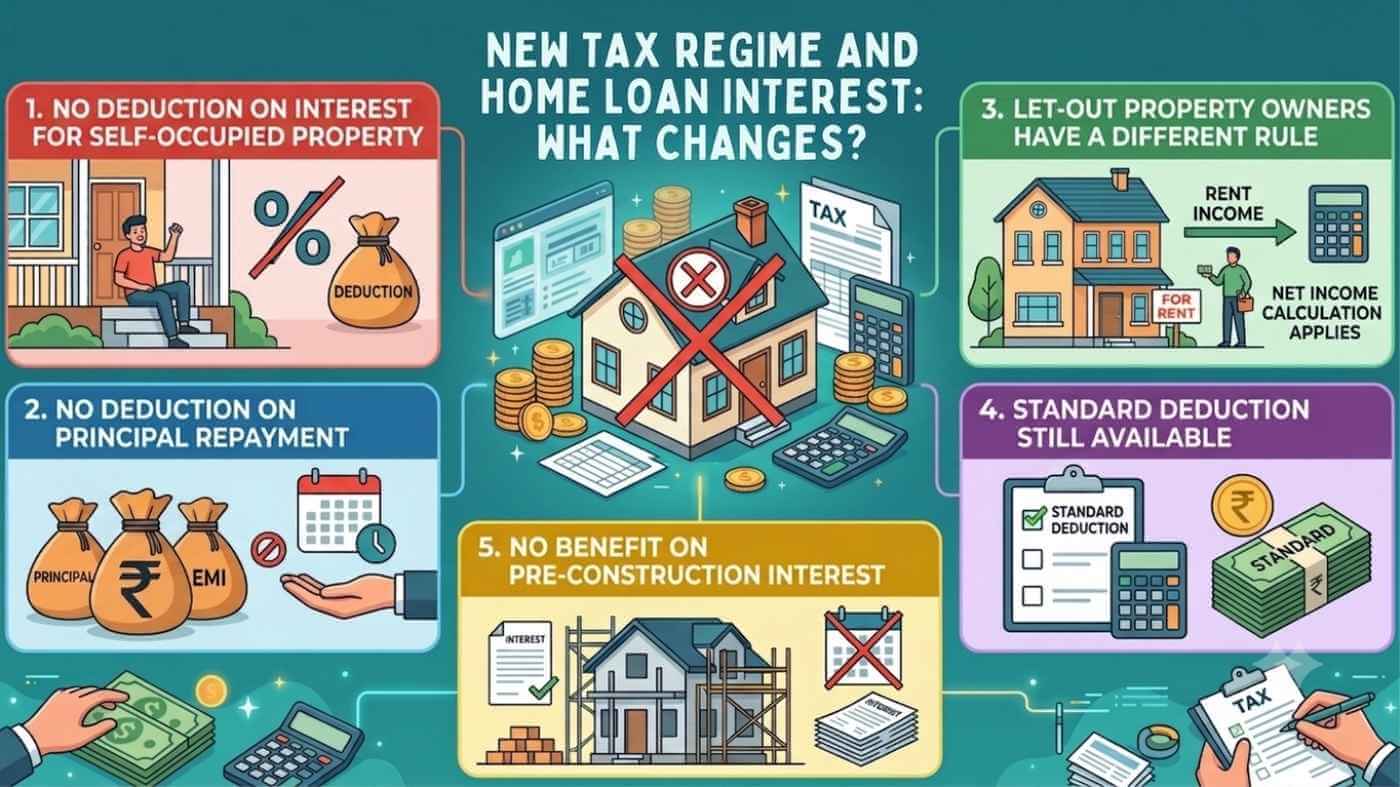
5 Key Changes for Home Loan Borrowers
Let us now look at the five most important changes that affect home loan borrowers under the new tax regime.
1. No Deduction on Interest for Self-Occupied Property
As mentioned above, the ₹2,00,000 deduction under Section 24(b) is not available for a self-occupied house under the new regime. If you live in the home you borrowed for, you get no tax relief on the interest you pay.
2. No Deduction on Principal Repayment
Section 80C benefits, including principal repayment on home loans, are unavailable under the new regime. This affects not just home loan borrowers but also those investing in PPF, ELSS, and life insurance premiums.
3. Let-Out Property Owners Have a Different Rule
This is where it gets interesting. If your property is rented out, the rules are slightly different. Under both regimes, you can deduct the actual home loan interest paid against the rental income you earn. However, there is a key difference.
Under the old regime, if your interest payment exceeds your rental income, the resulting “loss from house property” of up to ₹2,00,000 can be set off against your salary income. Under the new regime, you cannot set off this loss against any other income head. The loss can only be carried forward to future years.
4. Standard Deduction Still Available
The good news is that the new regime still offers a standard deduction of ₹75,000 for salaried employees (enhanced from ₹50,000 in Budget 2024–25). This provides some relief, though it does not compensate fully for the loss of home loan deductions.
5. No Benefit on Pre-Construction Interest
Under the old regime, the interest paid during the construction period of a property could be claimed in five equal instalments after construction is complete. This pre-construction interest deduction under Section 24(b) is also unavailable under the new regime.
Old Regime vs New Regime: Home Loan Impact
To make this practical, consider the case of Ramesh, a salaried employee in Mumbai earning ₹15,00,000 per year. He has a home loan with an annual interest payment of ₹1,80,000 and a principal repayment of ₹1,20,000. His property is self-occupied.
| Particulars | Old Regime (₹) | New Regime (₹) |
|---|---|---|
| Gross Salary | 15,00,000 | 15,00,000 |
| Standard Deduction | 50,000 | 75,000 |
| Section 24(b) – Interest | 1,80,000 | Nil |
| Section 80C – Principal + Other | 1,50,000 | Nil |
| Taxable Income | 11,20,000 | 14,25,000 |
*Assumes only the home loan principal qualifies under Section 80C. If Ramesh also invests in PPF, ELSS, EPF, LIC, etc., the deduction may be higher, subject to the overall Section 80C limit of ₹1.5 lakh.
In this example, the old tax regime results in a substantially lower taxable income because Ramesh can claim deductions for both home loan interest under Section 24(b) and principal repayment under Section 80C. Whether this also translates into a lower tax liability depends on the applicable tax slabs, rebates, and the taxpayer’s overall income and deductions. A personalised comparison is therefore essential before choosing a tax regime.
When the New Tax Regime Still Makes Sense for Home Loan Borrowers
Despite the loss of deductions, the new tax regime can still be the better choice in certain situations. Here is when the new regime might work in your favour, even with a home loan.
- Low loan outstanding: If your home loan is nearly repaid and your interest outgo is small (say, below ₹50,000 per year), the deduction benefit is minimal. The lower slab rates of the new regime may compensate adequately.
- High income with limited deductions: If your gross income is above ₹15,00,000 and you have limited investments or other deductions beyond the home loan, the new regime’s flat 30% rate combined with the standard deduction may result in lower overall tax.
- Let-out property with low interest: If the rental income roughly matches or exceeds the interest cost, the new regime’s inability to set off losses may not hurt you significantly.
- Early career professionals: Those who have just started earning and are yet to take a home loan may find the new regime simple and beneficial before they accumulate deductions.
Therefore, the decision is never one-size-fits-all. It depends on your unique financial picture.
How to Decide: Old Regime or New Regime?
Most tax experts recommend doing a side-by-side calculation every year before filing. Here is a practical approach to follow.
- List all your deductions: Include home loan interest (Section 24b), principal (Section 80C), health insurance (Section 80D), NPS (Section 80CCD), HRA, and any other applicable deductions.
- Calculate tax under the old regime: Apply applicable slab rates after subtracting all deductions from gross income.
- Calculate tax under the new regime: Apply new slab rates after deducting only the standard deduction of ₹75,000.
- Compare the final tax liability: Pick the regime where the net tax outgo is lower.
- Factor in ease of compliance: The new regime requires less documentation. If the tax difference is small, some prefer the simplicity of the new regime.
In addition, remember that salaried employees can switch between the two regimes every year. Business owners, however, can switch only once after opting out of the new regime. This makes timing and planning even more important for the self-employed.
Important Deductions Still Available Under the New Regime
Not everything disappears under the new regime. Here is a quick list of what you can still claim.
- Standard deduction of ₹75,000 for salaried employees
- Employer’s contribution to NPS under Section 80CCD(2)
- Transport allowance for specially-abled employees
- Leave encashment exemption at the time of retirement
- Gratuity exemption
- Interest on home loan for let-out property (against rental income only, no set-off against salary)
- Agniveer Corpus Fund deduction under Section 80CCH
Most importantly, Section 80CCD(2) allows employees to claim a deduction on the employer’s NPS contribution, which is a significant benefit for those working at organisations that offer NPS. This is one deduction worth maximising even under the new regime.
Planning Your Home Loan and Tax Strategy Together
A home loan is not just a borrowing decision. It is also a tax planning decision. Most importantly, the two cannot be separated. Here is how a combined approach can help you.
Consider Timing of Loan Repayment
If you are on the old regime and making large prepayments to reduce interest, be aware that reducing your interest outgo also reduces your Section 24(b) deduction. For some borrowers in higher tax brackets, a slower repayment with steady deduction claims can sometimes be more efficient. A financial advisor can help you model this scenario.
Review Your Regime Choice Annually
Your income, loan balance, and deductions change every year. As your loan reduces and your income grows, the optimal regime choice may shift. Review both calculations every April before submitting your investment declaration to your employer.
Do Not Ignore the Bigger Financial Picture
Tax saving is just one piece of financial planning. The goal is to build long-term wealth, not just minimise taxes for one year. Sometimes, choosing the new regime and investing the tax savings in the right mutual fund can generate more long-term wealth than chasing deductions alone.
At VSJ FinMart, we look at your complete financial picture: your income, your home loan, your investment goals, and your risk appetite. This helps us recommend a plan that is not just tax-efficient but genuinely wealth-building for the long term.
Frequently Asked Questions
Can I claim home loan interest deduction under the new tax regime?
No. If your property is self-occupied, you cannot claim the Section 24(b) deduction on home loan interest under the new tax regime. This deduction of up to ₹2,00,000 per year is only available under the old regime. For let-out properties, you can deduct interest against rental income under both regimes, but you cannot set off any resulting loss against salary income under the new regime.
Is the new tax regime better for home loan borrowers?
It depends entirely on your income level and the size of your home loan. If your interest and other deductions add up to more than ₹3,00,000–₹3,50,000, the old regime often saves more tax. However, for borrowers with smaller loans or limited deductions, the lower slab rates of the new regime can still result in lower tax. Always calculate both before deciding.
Can I switch between old and new tax regimes every year?
Yes, salaried employees can switch between the old and new tax regimes every financial year at the time of filing their income tax return. Business owners have a more restricted option to switch and should consult a tax professional before making changes.
What happens to my home loan principal repayment deduction under the new regime?
The Section 80C deduction, which covers home loan principal repayment among other investments, is not available under the new tax regime. You lose up to ₹1,50,000 in deductions from principal repayment alone. This is one of the significant trade-offs when choosing the new regime.
Should I prepay my home loan if I switch to the new tax regime?
If you switch to the new regime and lose the Section 24(b) and Section 80C benefits, prepaying your home loan can make financial sense because the interest saved is a guaranteed return. However, whether to prepay or invest the surplus elsewhere depends on your loan interest rate, expected investment returns, and liquidity needs. This is a decision best made with personalised guidance rather than a generic rule.
Disclaimer
The information provided in this blog is for educational and informational purposes only and should not be construed as investment advice. Please consult a qualified financial advisor before making any investment decisions. Shashikant Chanderkumar Mudaliar (ARN: 319377), operating under the brand name VSJ FinMart, is an AMFI-registered Mutual Fund Distributor (MFD) and does not provide investment advisory services. Mutual fund investments are subject to market risks. Past performance is not indicative of future results. Please read all scheme-related documents carefully before investing. Registration details can be verified at www.amfiindia.com/locate-distributor.