

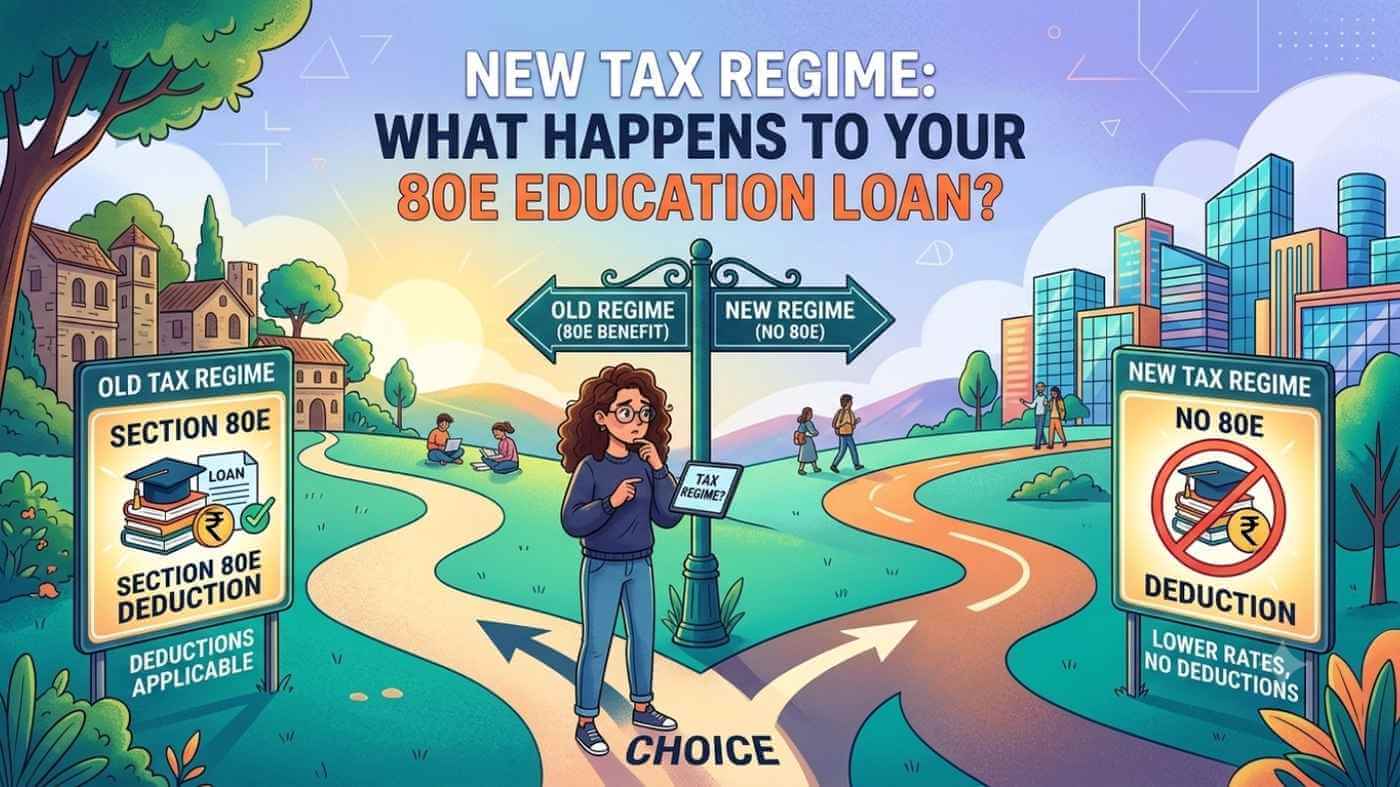
If you have an education loan and are filing your income tax return this year, one question is probably on your mind: can you still claim the 80E deduction under the new tax regime? The answer matters a great deal, especially if you are repaying a high-value loan for a degree in India or abroad. In this guide, we break down exactly how Section 80E works, what changes under the new tax regime, and how you can make the smartest choice for your finances.
Many taxpayers assume that switching to the new tax regime means they lose every deduction they ever enjoyed. That is mostly true, but not entirely. Section 80E has its own specific rules, and understanding them clearly can save you from making a costly tax filing mistake.
What Is Section 80E? A Quick Recap
Section 80E of the Income Tax Act allows you to claim a deduction on the interest paid on an education loan. This deduction is available only on the interest component, not the principal repayment. There is no upper limit on the deduction amount, which makes it particularly useful for students who have taken large loans for professional courses or overseas education.
Who Can Claim Section 80E?
- An individual taxpayer who has taken a loan for their own higher education.
- A parent, spouse, or legal guardian who has taken the loan on behalf of a student.
- The loan must be taken from a financial institution or an approved charitable institution, not from friends or family.
For How Long Can You Claim It?
You can claim the deduction for a maximum of 8 consecutive years, starting from the year you begin repaying the interest. Once those 8 years pass, you can no longer claim the deduction, even if the loan is still outstanding.
For example, if Riya from Pune starts repaying her education loan interest in FY 2022-23, she can claim the 80E deduction up to FY 2029-30. After that, no deduction is available, regardless of how much interest she still pays.
The New Tax Regime Explained Simply
India currently has two income tax regimes. The old tax regime offers higher tax slabs but allows a wide range of deductions and exemptions, including 80C, 80D, HRA, LTA, and Section 80E. The new tax regime, introduced in Budget 2020 and significantly revised in Budget 2023, offers lower tax rates but removes most deductions.
From FY 2023-24 onwards, the new tax regime is the default regime. If you do not actively choose the old regime, the government will apply the new one automatically when processing your return.
New Tax Regime Slab Rates (FY 2025-26)
| Annual Taxable Income | Tax Rate |
| Up to ₹4,00,000 | Nil |
| ₹4,00,001 – ₹8,00,000 | 5% |
| ₹8,00,001 – ₹12,00,000 | 10% |
| ₹12,00,001 – ₹16,00,000 | 15% |
| ₹16,00,001 – ₹20,00,000 | 20% |
| ₹20,00,001 – ₹24,00,000 | 25% |
| Above ₹24,00,000 | 30% |
Note: Section 87A rebate may apply for eligible resident individuals, reducing tax liability at lower income levels.
The new tax regime also provides a rebate under Section 87A for eligible resident individuals with a taxable income of up to Rs 12 lakh (subject to the applicable conditions and marginal relief provisions), which can reduce their income tax liability to zero. Once taxable income exceeds the rebate threshold, the comparison between the old and new tax regimes becomes more nuanced and depends on your income, deductions, exemptions, and overall financial situation.
Section 80E Deduction Under the New Tax Regime: The Honest Answer
Here is the part that most people search for: you cannot claim the Section 80E deduction if you choose the new tax regime. Section 80E is listed among the deductions that are not available under the new regime. The lower tax rates in the new regime come at the cost of giving up most deductions, and 80E is one of them.
Therefore, if you are repaying an education loan and paying significant interest every year, opting for the old tax regime may allow you to offset that interest payment against your taxable income. This could result in meaningful tax savings depending on your income level and the size of your loan.
A Practical Example
Suppose Arjun, a software engineer in Bengaluru, earns Rs. 12 lakh per year and pays Rs. 1.5 lakh as interest on his education loan each year. Under the old tax regime, he can deduct this Rs. 1.5 lakh from his taxable income, reducing it to Rs. 10.5 lakh. This lowers his total tax outgo.
Under the new tax regime, Arjun gets no deduction for this Rs. 1.5 lakh interest. He pays tax on the full Rs. 12 lakh. Depending on his other deductions (80C, HRA, etc.), the old regime may actually save him more money overall. However, this comparison changes case by case.
Old Regime vs New Regime: Which One Saves You More?
The right answer depends entirely on your personal situation. There is no single regime that works better for everyone. However, the following comparison can help you think through the decision clearly.
| Factor | Old Tax Regime | New Tax Regime |
|---|---|---|
| Tax Rates | Higher slabs | Lower slabs |
| Section 80C (Rs. 1.5 lakh) | Available | Not available |
| Section 80E (Education Loan Interest) | Available | Not available |
| HRA Exemption | Available | Not available |
| Standard Deduction | Rs. 50,000 | Rs. 75,000 (from FY 2024-25) |
| Section 87A Rebate (Zero tax) | Up to Rs. 5 lakh income | Up to Rs. 7 lakh income |
| Best suited for | High deductions (80C, HRA, 80E combined) | Low deductions or simpler finances |
As a general rule, the old tax regime tends to be more beneficial for taxpayers who can claim substantial deductions and exemptions, such as those under Sections 80C and 80D, House Rent Allowance (HRA), and home loan interest under Section 24(b). On the other hand, the new tax regime often works better for individuals with fewer deductions, as it offers lower tax rates and an enhanced rebate under Section 87A for eligible taxpayers.
Most importantly, do not rely on general rules alone. Compare your tax liability under both regimes using your actual income, deductions, and exemptions before making a decision.
5 Key Points About the 80E Deduction New Tax Regime Choice
Before you decide which regime to file under, keep these five points in mind.
- You must actively opt for the old regime. Since the new regime is the default from FY 2023-24, you need to explicitly select the old regime in your ITR to claim Section 80E. If you forget, you lose the deduction for that year.
- Salaried employees can switch every year. If you are a salaried individual, you can switch between the old and new regime each financial year. Therefore, you can choose the regime that gives you a better outcome based on your deductions that year.
- Business owners have less flexibility. If you have income from business or profession, you can only switch to the old regime once. After reverting to the new regime, you cannot go back to the old one again (with some exceptions).
- No upper limit on 80E is both a benefit and a responsibility. Because there is no cap, even high loan amounts qualify for the deduction. However, it is easy to overlook proper documentation. Always keep your bank’s interest certificate ready before filing.
- The 8-year clock starts from repayment, not disbursement. Many people confuse the two. The deduction window begins the year you start paying interest, not the year the loan was taken. Plan accordingly so you do not lose out on any eligible years.
What Documents Do You Need to Claim Section 80E?
Claiming Section 80E is clear and requires minimal paperwork. However, having the right documents in order is essential to avoid any issues during processing.
Documents Required
- Interest certificate from your lender: This is the most important document. Your bank or financial institution must issue a certificate clearly stating the interest amount paid during the financial year.
- Loan sanction letter: This shows the purpose of the loan (higher education), the sanctioned amount, and the repayment terms.
- Proof of admission or enrollment: This may be required to establish that the loan was taken for a recognised course at a recognised institution.
- Relationship proof (if loan is taken for a dependent): If you are a parent claiming the deduction for a child’s loan, carry proof of the relationship.
You do not need to attach these documents to your ITR, but keep them safely stored in case the tax department requests them later.
How VSJ FinMart Can Help You Make the Right Tax and Investment Decision
Choosing between the old and new tax regime is not just a tax filing exercise. It is a financial planning decision that affects how much money you keep in your hands every year, and therefore, how much you can invest toward your goals.
At VSJ FinMart, we work with clients across different income levels and life stages, including salaried professionals, business owners, first-time investors, and retirees. A quick conversation with our team can help you figure out which tax regime works better for your specific situation, and then channel those savings into a personalised investment plan built around your goals, timeline, and risk appetite.
The right financial decision is rarely one-size-fits-all. The value of personalised guidance is far greater than any generic calculator or rule of thumb.
Common Mistakes to Avoid When Claiming 80E
Many taxpayers either miss out on valid deductions or make errors that cause complications later. Here are the most common mistakes and how to avoid them.
- Filing under the new regime without realising 80E is unavailable: Always check your regime selection before submitting your ITR. If you have significant education loan interest, compare both regimes first.
- Claiming deduction beyond 8 years: The window is fixed. Claiming in year 9 or beyond is not valid and can attract scrutiny.
- Claiming on principal repayment: Section 80E covers only the interest paid, not the EMI principal. Claiming the full EMI amount is an error.
- Taking a loan from a non-approved source: If you borrowed from a relative or an informal lender, the deduction is not available. The loan must be from a scheduled bank or an approved charitable institution.
- Not keeping the interest certificate: Without this document, supporting your deduction claim becomes difficult. Request it from your bank well before the filing deadline.
Should You Prepay Your Education Loan Early?
If you are in the first few years of repayment and the old tax regime saves you money because of Section 80E, prepaying your loan aggressively may not always be the best financial move. Here is why.
Consider that your education loan interest rate is, say, 9% per annum. If you are in the 30% tax bracket under the old regime, the effective cost of that interest drops to around 6.3% after the 80E deduction. Meanwhile, well-chosen mutual funds have the potential to deliver higher long-term returns. In such a scenario, investing surplus funds rather than prepaying the loan could make more financial sense.
However, this calculation depends heavily on your risk tolerance, interest rate, remaining loan tenure, and investment horizon. There is no universal answer. In addition, carrying debt has a psychological cost that numbers alone cannot capture.
Speak with an advisor who can map out both scenarios clearly before you decide. At VSJ FinMart, we help clients run exactly these kinds of comparisons so that every rupee of their income is working as hard as possible.
Final Words: Choose Your Regime Wisely
The 80E deduction under the new tax regime is simply not available. If you want to claim the benefit of Section 80E on your education loan interest, you must choose the old tax regime when filing your return. This is a clear, non-negotiable rule under current income tax law.
However, choosing the old regime is not always the right answer. It depends on your total deductions, income level, and overall tax liability. The smartest approach is to calculate your tax under both regimes, compare the numbers, and then decide. Do not default to either regime blindly.
Finally, remember that the money you save on taxes every year is money that can go toward building your future. Whether it is a SIP in a mutual fund, an emergency corpus, or your child’s education fund, every saving matters. If you would like help structuring your finances around your tax situation, the team at VSJ FinMart is here to guide you with a clear, personalised mutual fund investment plan that fits your life.
Frequently Asked Questions
1. Can I claim Section 80E if I choose the new tax regime?
No. Section 80E is not available under the new tax regime. To claim this deduction on education loan interest, you must opt for the old tax regime when filing your income tax return.
2. Is there any cap on the amount I can deduct under Section 80E?
No, there is no upper limit. You can deduct the entire interest paid during the year on your education loan. However, only the interest component qualifies, not the principal repayment.
3. Can I switch from the new regime to the old regime just to claim 80E?
Yes, salaried individuals can switch between the old and new regime every financial year. If your education loan interest is substantial and the old regime saves you more tax overall, you can opt for it while filing that year’s ITR.
4. My parents took an education loan in their name for my studies. Can they claim Section 80E?
Yes. Section 80E allows a parent, spouse, or legal guardian to claim the deduction if the loan was taken on behalf of the student. The student themselves can also claim it if the loan is in their own name.
5. What happens if I forget to switch to the old regime and file under the new regime by mistake?
If you file under the new regime, you cannot retroactively claim the 80E deduction for that year. You may have the option to file a revised return before the deadline, provided you have not yet received an intimation order. Always double-check your regime selection before submitting your return.
Disclaimer
The information provided in this blog is for educational and informational purposes only and should not be construed as investment advice. Please consult a qualified financial advisor before making any investment decisions. Shashikant Chanderkumar Mudaliar (ARN: 319377), operating under the brand name VSJ FinMart, is an AMFI-registered Mutual Fund Distributor (MFD) and does not provide investment advisory services. Mutual fund investments are subject to market risks. Past performance is not indicative of future results. Please read all scheme-related documents carefully before investing. Registration details can be verified at www.amfiindia.com/locate-distributor.