

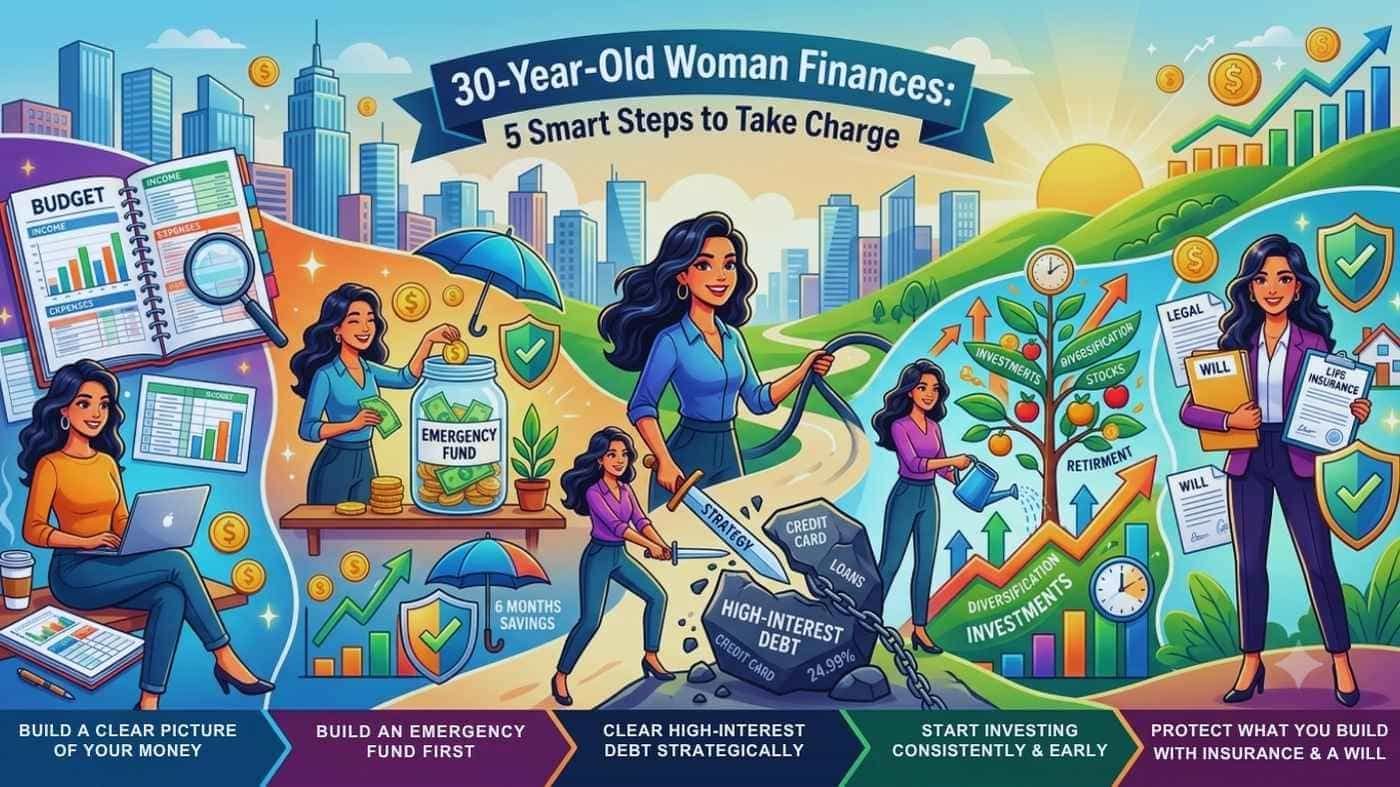
Managing 30-year-old woman finances can feel overwhelming, especially when life throws so many big decisions at you all at once. Marriage, career growth, EMIs, family responsibilities, and retirement planning all seem to compete for your attention at the same time. However, your 30s are not a time to panic. They are actually the most powerful decade you have for building lasting financial security. Every smart money decision you make now will compound over the next 30 years, giving you real freedom later in life.
In this guide, you will find five practical, actionable steps designed specifically for women in their 30s who want to take full control of their money. No complicated jargon. No vague advice. Just clear, honest steps that actually work.
Why Your 30s Are the Most Important Financial Decade
Most women reach their 30s with some financial baggage, such as student loans, credit card debt, or simply the habit of spending first and saving later. At the same time, income is usually higher in your 30s than it was in your 20s. This combination makes your 30s a turning point.
Consider this: if you invest Rs. 5,000 per month starting at age 30, and earn an average annual return of 12%, you could accumulate over Rs. 1.76 crore by age 60. Wait until 35 to start, and that number drops to roughly Rs. 95 lakhs. That difference of five years costs you nearly Rs. 80 lakhs. Time is your most valuable asset, and your 30s are the time to use it wisely.
In addition, women in India face specific financial challenges: career breaks for childcare, lower negotiated salaries on average, and longer life expectancy than men. These factors make early, deliberate financial planning even more critical for women.
Step 1: Build a Clear Picture of Your Money
Before you can take charge of your 30-year-old woman’s finances, you need to know exactly where you stand. Most people skip this step because it feels uncomfortable. Do it anyway.
Calculate Your Net Worth
Your net worth is the difference between what you own and what you owe. List every asset you have, including savings accounts, fixed deposits, gold, mutual funds, and property. Then list every liability: home loan, car loan, personal loan, credit card outstanding. Subtract the liabilities from the assets. The number you get, whether positive or negative, is your starting point.
Track Your Monthly Cash Flow
Write down your total monthly income after tax. Then list every expense: rent or EMI, groceries, utilities, dining out, subscriptions, and any other spending. The gap between income and expenses is what you have available to save and invest. If the gap is small or negative, that is the first problem to fix.
Follow a Simple Budget Framework
A practical budgeting approach for women in their 30s is the 50-30-20 rule:
- 50% of take-home income goes toward needs: rent, groceries, utilities, EMIs.
- 30% goes toward wants: dining, travel, entertainment.
- 20% goes toward savings and investments. This is non-negotiable.
If your current split looks very different from this, adjust gradually. Even moving from 5% savings to 10% in the first month is a meaningful step forward.
Step 2: Build an Emergency Fund First
Before investing a single rupee in mutual funds or any other instrument, you must have an emergency fund in place. This is the single most important financial safety net you can build.
How Much Is Enough?
Financial planners generally recommend keeping three to six months of essential living expenses in a liquid, easily accessible account. For women in their 30s who may have dependents or variable income, six months is the safer target.
For example, if your monthly essential expenses are Rs. 35,000, your emergency fund target should be between Rs. 1.05 lakhs and Rs. 2.1 lakhs. This money should sit in a savings account or a liquid mutual fund, not in a fixed deposit that locks your funds for months.
Why Women Need This More Than They Realise
Women are statistically more likely to take career breaks, face medical emergencies alone, or find themselves as the primary caregiver in a family crisis. Without an emergency fund, any of these events can derail years of financial progress in weeks. Therefore, build this fund before anything else.
Once your emergency fund is in place, you can invest with confidence, knowing that a sudden expense will not force you to break your investments at the wrong time.
Step 3: Clear High-Interest Debt Strategically
Debt is one of the biggest obstacles to strong 30-year-old woman finances. Not all debt is equal, however. A home loan at 8–9% interest is very different from a credit card balance at 36–42% per year.
Identify and Prioritise Your Debt
| Debt Type | Typical Interest Rate | Priority to Clear |
|---|---|---|
| Credit Card Outstanding | 36–42% per annum | Highest – clear immediately |
| Personal Loan | 12–20% per annum | High – clear as fast as possible |
| Car Loan | 8–12% per annum | Medium – pay as scheduled |
| Home Loan | 8–9.5% per annum | Low – continue EMIs, enjoy tax benefit |
| Education Loan | 7–12% per annum | Medium – check for tax deduction first |
Two Proven Debt Repayment Methods
- Avalanche Method: Pay the minimum on all debts. Put every extra rupee toward the highest-interest debt first. This saves the most money over time.
- Snowball Method: Pay off the smallest debt first, regardless of interest rate. Each debt you clear gives you a psychological boost to keep going.
Most importantly, stop using credit cards as a spending tool if you cannot pay the full balance every month. The interest on unpaid credit card balances is one of the fastest ways to destroy financial progress.
Step 4: Start Investing Consistently and Early
Once your emergency fund is ready and high-interest debt is under control, it is time to put your money to work. Investing consistently is the heart of a strong 30-year-old woman’s finances. The good news is that you do not need a large lump sum to begin. A Systematic Investment Plan, or SIP, lets you invest as little as Rs. 500 per month.
Understanding Key Investment Options
| Investment Type | Risk Level | Expected Return (Long-Term) | Best For |
|---|---|---|---|
| Equity Mutual Funds (SIP) | High | 10–14% per annum | Long-term wealth building (5+ years) |
| ELSS Funds | High | 10–13% per annum | Tax saving under Section 80C |
| Debt Mutual Funds | Low to Medium | 5–8% per annum | Short to medium-term goals |
| PPF (Public Provident Fund) | Very Low | 7–7.5% per annum | Safe, tax-free long-term savings |
| NPS (National Pension System) | Low to Medium | 8–10% per annum | Retirement planning |
| Gold (SGBs or Gold ETFs) | Medium | 7–10% per annum | Portfolio diversification, inflation hedge |
A Practical SIP Example
Priya is 30 years old, working in Pune, and earns Rs. 75,000 per month. She decides to start three SIPs totalling Rs. 10,000 per month: Rs. 5,000 in a large-cap equity fund, Rs. 3,000 in an ELSS fund for tax saving, and Rs. 2,000 in a flexi-cap fund for diversification. Over 25 years, assuming a 12% average annual return, her Rs. 10,000 monthly SIP could grow to approximately Rs. 1.88 crore.
She did not need to start with a large amount. She only needed to start.
The Power of Goal-Based Investing
Rather than investing randomly, link every investment to a specific goal. Goals make investing purposeful and help you stay on track during volatile markets.
- Short-term goal (1–3 years): Vacation, car purchase, home renovation. Use debt funds or recurring deposits.
- Medium-term goal (3–7 years): Home down payment, children’s education. Use balanced or hybrid mutual funds.
- Long-term goal (7+ years): Retirement corpus, financial independence. Use equity mutual funds via SIP.
Choosing the right fund for your specific goal matters far more than chasing the highest returns. At VSJ FinMart, we work with you to match each investment to your exact timeline, risk appetite, and financial situation, so every rupee you invest has a clear purpose.
Step 5: Protect What You Build with Insurance and a Will
Building wealth is only half the picture. Protecting it is equally important. Many women in their 30s overlook insurance and estate planning, and this oversight can undo years of hard work in a single event.
Health Insurance: Non-Negotiable
Even if your employer provides group health cover, buy a personal health insurance policy in your own name. Group policies end when your job ends. A personal policy of at least Rs. 5–10 lakhs of coverage gives you continuous protection regardless of your employment status.
If you have dependents, consider a family floater plan that covers your spouse and children as well. Compare premiums, waiting periods, and claim settlement ratios carefully before choosing a plan.
Term Life Insurance: Essential If Others Depend on You
If your spouse, children, or parents depend on your income, a term life insurance policy is essential. A pure term plan gives a large sum assured at a very affordable premium. As a general rule, your coverage should be at least 10 to 15 times your annual income.
For example, if you earn Rs. 9 lakhs per year, aim for a term cover of Rs. 90 lakhs to Rs. 1.35 crores. The premium for such a policy at age 30 is usually very affordable.
Write a Will and Nominate Wisely
This is a step most people delay for decades. Do not wait. A simple, legally valid will ensures that your assets go to the people you intend, without family disputes or court delays. In addition, make sure all your bank accounts, mutual funds, insurance policies, and provident fund accounts have updated nominations.
Many women discover too late that nominations were left blank or filled in incorrectly during account opening. Review all your nominations today.
How to Stay on Track: Habits That Make the Difference
Financial success is less about knowing the right information and more about building consistent habits. Here are the habits that separate women who thrive financially from those who always feel behind.
- Automate savings and SIPs: Set up auto-debit on the 1st or 2nd of every month, right after your salary credits. Pay yourself first, before discretionary spending.
- Review your finances quarterly: Spend one hour every three months checking your net worth, budget, and investment performance. Adjust if needed.
- Increase SIP amounts with every increment: Each time your salary increases, increase your SIP by at least 10%. This habit alone can transform your retirement corpus.
- Stay invested during market downturns: Markets will fall. That is normal. Stopping your SIP during a market fall is like stopping shopping because a sale started. Stay the course.
- Keep learning: Read one personal finance book per quarter, follow credible financial content, and ask questions. Financial literacy is the best investment you can make in yourself.
Common Financial Mistakes Women in Their 30s Make with Money
Knowing what to avoid is just as valuable as knowing what to do. Here are the most common financial mistakes women in their 30s make, and how to sidestep them.
- Leaving financial decisions entirely to a spouse or parent: Every woman must understand and participate in her own financial decisions. Dependence on another person is a serious risk.
- Under-insuring or skipping insurance: Thinking “it won’t happen to me” is a costly belief. One medical emergency without adequate insurance can wipe out years of savings.
- Waiting for the “right time” to invest: There is no perfect time. The right time is always now, even if the amount is small.
- Chasing high returns without understanding risk: Random stock tips, cryptocurrency speculation, and pyramid schemes all promise high returns. They deliver losses far more often than gains.
- Ignoring retirement planning until your 40s: Women live longer on average, which means they need a larger retirement corpus. Starting in your 30s gives you a massive advantage.
Final Words: Your 30s Are a Gift. Use Them Well.
Taking control of your 30-year-old woman’s finances is not about perfection. It is about progress. You do not need to fix everything in one month. Start with one step: calculate your net worth today. Then build your emergency fund. Then start a SIP, even a small one.
Each step builds on the last. Each good decision today makes the next decision easier. The woman who starts at 30 and invests consistently will always have more freedom, more options, and more security than the woman who waits for the perfect moment.
At VSJ FinMart, we understand that every woman’s financial journey is unique. Whether you are just starting, managing a career break, or planning for early retirement, our team is here to help you build a clear, personalised investment plan that fits your goals and your life. A simple conversation today can put you on a path that changes your financial future completely.
Frequently Asked Questions
How much should a 30-year-old woman save every month?
A general guideline is to save and invest at least 20% of your take-home income. If your monthly income is Rs. 60,000, aim to save and invest at least Rs. 12,000 per month. Start with whatever you can and increase the amount steadily over time.
What is the best investment for a 30-year-old woman in India?
There is no single “best” investment. The right choice depends on your goals, risk tolerance, and time horizon. For long-term wealth building, equity mutual funds via SIP are widely considered effective. For safe, guaranteed returns, PPF is a strong option. A combination of these, tailored to your specific goals, works best.
Should I pay off debt or invest first?
Clear high-interest debt first, especially credit card balances and personal loans. Once those are cleared, start investing. If you have a home loan with a relatively lower interest rate, you can invest and repay the loan simultaneously, as the returns from equity investments over the long term can exceed the home loan interest rate.
How much health insurance do I need at 30?
A minimum coverage of Rs. 5 lakhs is recommended. Given rising healthcare costs in India, Rs. 10 lakhs or more is better, especially in metro cities. If you have dependents, consider a family floater plan.
Is it too late to start investing at 30?
Absolutely not. In fact, 30 is an excellent time to start. You have at least 25–30 working years ahead of you, and the power of compounding over that period can build significant wealth. The only mistake is waiting longer. Start today, even if it is a small amount.
Disclaimer
The information provided in this blog is for educational and informational purposes only and should not be construed as investment advice. Please consult a qualified financial advisor before making any investment decisions. Shashikant Chanderkumar Mudaliar (ARN: 319377), operating under the brand name VSJ FinMart, is an AMFI-registered Mutual Fund Distributor (MFD) and does not provide investment advisory services. Mutual fund investments are subject to market risks. Past performance is not indicative of future results. Please read all scheme-related documents carefully before investing. Registration details can be verified at www.amfiindia.com/locate-distributor.