

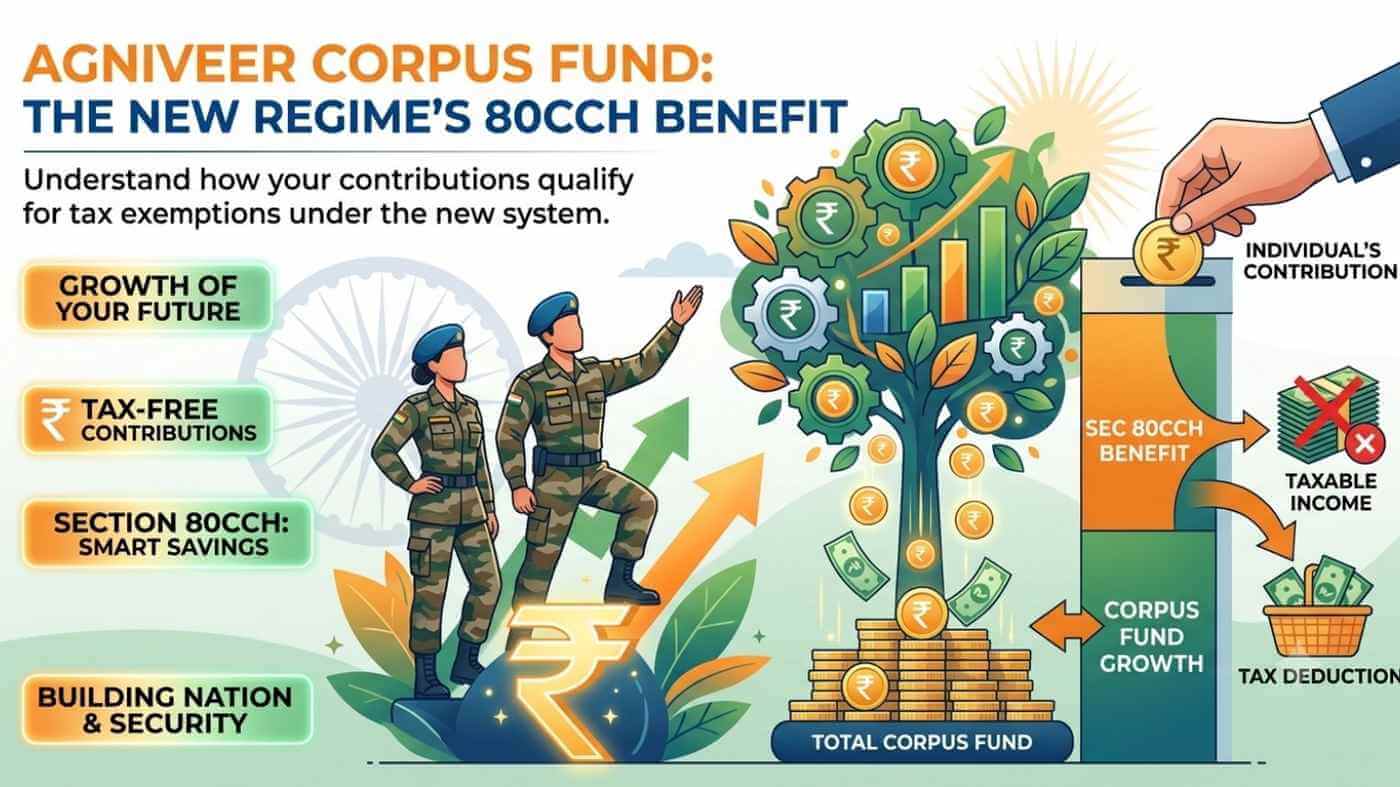
The Section 80CCH Agniveer deduction is one of the most significant tax benefits introduced for personnel enrolled under the Agnipath Scheme. Section 80CCH of the Income-tax Act, 1961, allows eligible Agniveers to claim a deduction for their own contribution to the Agniveer Corpus Fund, as well as the Central Government’s matching contribution, subject to the prescribed conditions. If you or someone you know has enrolled as an Agniveer, understanding this provision can help you make informed tax and financial planning decisions. In this guide, we explain how the deduction works, who is eligible, and how it can benefit you in simple, easy-to-understand language.
What Is the Agnipath Scheme and Who Is an Agniveer?
The Agnipath Scheme was launched by the Government of India in June 2022 as a recruitment programme for the Indian Army, Indian Navy, and Indian Air Force. Under this scheme, eligible young individuals are enrolled as Agniveers for a service period of four years. The age eligibility is prescribed in the respective recruitment notifications issued by the armed forces.
At the end of the four-year engagement, up to 25% of Agniveers from each batch may be enrolled into the regular cadre of the armed forces, subject to organisational requirements, merit, and the applicable selection process. The remaining Agniveers exit the scheme with the Seva Nidhi package, which is accumulated through contributions made during their service.
What Is the Agniveer Corpus Fund?
The Agniveer Corpus Fund (also referred to as the Seva Nidhi Fund) is a dedicated fund established under the Agnipath Scheme. During the four-year service period:
- The Agniveer contributes 30% of the monthly customised package to the fund.
- The Central Government contributes an equal matching amount.
- The corpus accumulates with the applicable interest and other accretions as provided under the scheme.
On completion of the engagement period, the Agniveer receives the accumulated Seva Nidhi amount, comprising the individual’s contribution, the Government’s matching contribution, and the applicable accretions. Subject to the provisions of the Income-tax Act, this amount is exempt from income tax under Section 10(12C).
For many young individuals, this corpus can provide valuable financial support for higher education, skill development, entrepreneurship, or other long-term financial goals after completing their service.
Understanding the 80CCH Agniveer Deduction
Section 80CCH was introduced by the Finance Act, 2022, to provide tax benefits to individuals enrolled under the Agnipath Scheme. The deduction is available from Assessment Year 2023–24 onwards.
The tax benefits under the Agnipath Scheme operate at three levels, making it one of the most comprehensive tax concessions available to eligible individuals.
Level 1: Deduction on Agniveer’s Own Contribution
The amount contributed by an Agniveer to the Agniveer Corpus Fund (Seva Nidhi Fund) during the financial year is fully deductible under Section 80CCH. Unlike Section 80C, this deduction is not subject to the Rs. 1.5 lakh limit. The entire eligible contribution qualifies for deduction.
Level 2: Deduction on Government’s Matching Contribution
The Central Government contributes an amount equal to the Agniveer’s contribution to the Agniveer Corpus Fund. This matching contribution is also eligible for deduction under Section 80CCH, subject to the provisions of the Income-tax Act.
As a result, both the Agniveer’s contribution and the Government’s matching contribution receive favourable tax treatment, making Section 80CCH a unique provision within the Income-tax Act.
Level 3: Tax-Free Lump Sum on Exit
On completion of the engagement period under the Agnipath Scheme, the Seva Nidhi amount received from the Agniveer Corpus Fund is exempt from income tax under Section 10(12C) of the Income-tax Act. This exemption covers the eligible amount received under the scheme in accordance with the applicable provisions.
How Does 80CCH Compare with Other Tax-Saving Sections?
Many taxpayers are familiar with Section 80C, which allows eligible investments and expenses to qualify for a deduction of up to Rs. 1.5 lakh in a financial year. Similarly, Section 80CCD(1B) provides an additional deduction of up to Rs. 50,000 for eligible contributions to the National Pension System (NPS). By contrast, Section 80CCH is a separate provision created specifically for Agniveers and is not subject to the Section 80C limit.
| Feature | Section 80C | Section 80CCD(1B) | Section 80CCH |
|---|---|---|---|
| Maximum Deduction | Up to Rs. 1.5 lakh | Up to Rs. 50,000 | Eligible contribution (no separate monetary ceiling specified) |
| Government/Employer contribution eligible for deduction | No | No (Employer contribution is covered separately under Section 80CCD(2), subject to limits) | Yes, subject to the provisions of Section 80CCH |
| Tax treatment of maturity/withdrawal | Depends on the nature of the investment | Depends on the applicable NPS withdrawal provisions | Eligible Seva Nidhi amount is exempt under Section 10(12C) |
| Eligible Taxpayers | Eligible individuals and HUFs | Eligible individuals | Agniveers enrolled under the Agnipath Scheme |
| Clubbed with 80C Limit? | Yes | No | No |
Section 80CCH is a specialised provision designed exclusively for Agniveers. Unlike Section 80C, it operates independently of the Rs. 1.5 lakh deduction limit and provides tax benefits for both the eligible contribution to the Agniveer Corpus Fund and the tax-exempt Seva Nidhi amount received under the Agnipath Scheme, subject to the applicable provisions of the Income-tax Act.
Is 80CCH Available Under the New Tax Regime?
Yes. Section 80CCH is one of the few deductions that remain available under the new tax regime.
Under Section 115BAC of the Income-tax Act, most deductions under Chapter VI-A, such as Sections 80C, 80D, and 80G, are generally not available to taxpayers who opt for the new tax regime. However, Section 80CCH is a specific exception and continues to be available to eligible Agniveers.
This means an eligible Agniveer can claim the deduction under Section 80CCH even while paying tax under the new tax regime. In other words, an Agniveer does not have to choose between the lower tax rates available under the new regime and the tax benefit provided by Section 80CCH.
Why This Matters
For most salaried taxpayers, opting for the new tax regime means giving up many commonly claimed deductions and exemptions, including those under Sections 80C and 80D, in exchange for lower tax rates. Eligible Agniveers, however, continue to enjoy the benefit of Section 80CCH even after opting for the new regime.
This special treatment ensures that the tax benefits available under the Agnipath Scheme are preserved regardless of the tax regime chosen. As a result, Section 80CCH remains one of the very few deductions under Chapter VI-A that can still be claimed under the new tax regime.
A Practical Example: How Much Tax Does an Agniveer Actually Save?
Let us look at a simple example to understand how the Section 80CCH deduction is calculated.
Scenario: Agniveer in Year 1
Assume an Agniveer has the following contributions during the financial year:
- Monthly customised package: Rs. 30,000
- Agniveer’s monthly contribution (30%): Rs. 9,000
- Central Government’s monthly matching contribution: Rs. 9,000
Over one year:
- Agniveer’s annual contribution: Rs. 1,08,000
- Government’s annual matching contribution: Rs. 1,08,000
- Total amount eligible under Section 80CCH: Rs. 2,16,000
Since both the Agniveer’s contribution and the Central Government’s matching contribution qualify under Section 80CCH, the eligible deduction for the year is Rs. 2,16,000, subject to the provisions of the Income-tax Act.
The actual tax saving depends on the Agniveer’s taxable income and the applicable income tax slab. If the individual has little or no tax liability for the year, the deduction may not result in immediate tax savings. However, it continues to provide valuable tax relief whenever taxable income arises.
What Does the Exit Corpus Look Like?
Based on the current structure of the Agnipath Scheme, an Agniveer who completes the four-year engagement receives the Seva Nidhi package, comprising the individual’s contribution, the Central Government’s matching contribution, and the applicable interest and accretions.
According to the Government’s announced framework, the estimated Seva Nidhi amount at the end of four years is approximately Rs. 11.71 lakh. Subject to the provisions of Section 10(12C) of the Income-tax Act, this amount is exempt from income tax.
5 Key Benefits of the 80CCH Agniveer Deduction
Here is why Section 80CCH is an important tax benefit for eligible Agniveers.
- No cap on deduction: Unlike Section 80C, which has an overall deduction limit of Rs. 1.5 lakh, Section 80CCH does not prescribe a separate monetary ceiling. Eligible contributions made to the Agniveer Corpus Fund can be claimed as a deduction in accordance with the provisions of the Income-tax Act.
- Available in the new tax regime: Section 80CCH is one of the few deductions that continue to be available under the new tax regime. Eligible Agniveers can claim this deduction without giving up the lower tax rates available under Section 115BAC.
- Tax-free exit corpus: On completion of the Agnipath engagement, the Seva Nidhi amount received by the Agniveer is exempt from income tax under the applicable provisions of the Income-tax Act.
- Double deduction structure: Section 80CCH provides tax relief for both the Agniveer’s own contribution and the Central Government’s matching contribution to the Agniveer Corpus Fund, subject to the provisions of the Act.
- Applies even in death or disability cases: Where the Agnipath Scheme provides for payment of the Seva Nidhi amount in eligible cases such as death or disability, the applicable tax exemption continues to be available under the law.
What Should Agniveers Do After Receiving the Corpus?
Receiving the Seva Nidhi amount after completing the Agnipath engagement is an important financial milestone. For many Agniveers, it will be the first substantial lump sum they have ever received. Using it wisely can help lay a strong foundation for long-term financial security.
Some may choose to pursue higher education, start a business, prepare for competitive examinations, or support their family. Others may prefer to invest a portion of the corpus to build wealth over the long term.
Options to Consider
- Mutual funds via SIP: Starting a systematic investment plan with even a portion of the corpus can generate meaningful growth over 10 to 15 years through the power of compounding.
- Term insurance: Now that the Agniveer is a civilian, adequate life cover becomes important, especially for those with dependents.
- Emergency fund: Keeping three to six months of expenses in a liquid instrument provides a financial cushion before making longer-term decisions.
- Skill development or education: Investing in skills or education can significantly improve long-term earning potential.
Every Agniveer’s financial situation is different. The right approach depends on your goals, family responsibilities, future career plans, and comfort with investment risk. Taking time to prepare a well-thought-out financial plan before investing the Seva Nidhi amount can help you make better long-term decisions.
How to Claim the 80CCH Deduction While Filing ITR
Claiming the Section 80CCH deduction is straightforward if you keep the necessary records ready. Follow these steps while filing your Income Tax Return (ITR).
- Obtain Form 16: If tax has been deducted at source, your employer will issue Form 16. Review it carefully to see whether the Section 80CCH deduction has been considered while computing your taxable income. Do not rely solely on Form 16. Always verify the figures with your own records.
- Verify the deduction amount: Cross-check the amount of your own contribution and the Central Government’s matching contribution to the Agniveer Corpus Fund. Ensure that the eligible deduction claimed under Section 80CCH matches the applicable provisions of the Income-tax Act.
- Select the Appropriate ITR Form: Most Agniveers with only salary income and who satisfy the prescribed conditions can generally file ITR-1 (Sahaj). If you have additional income or circumstances that make ITR-1 inapplicable, choose the appropriate ITR form as prescribed by the Income Tax Department.
- Enter deduction under 80CCH: While completing your return, enter the eligible deduction under Section 80CCH in the relevant schedule of the ITR form.
- Verify and submit: Review all the information carefully before submitting your return. Complete the verification process using an approved method, such as Aadhaar OTP, net banking, or any other option available on the Income Tax e-filing portal.
If your income includes multiple sources or you are unsure about your eligibility, consider consulting a qualified tax professional before filing your return.
Common Misconceptions About Section 80CCH
Several misconceptions surround Section 80CCH. Here are some of the most common ones.
Misconception 1: It is clubbed with the 80C limit
This is incorrect. Section 80CCH is a separate deduction and is not counted within the Rs. 1.5 lakh limit available under Section 80C. If an Agniveer is eligible and is taxed under the old regime, deductions under both sections may be claimed subject to the applicable provisions of the Income-tax Act.
Misconception 2: Only the Agniveer’s own contribution is deductible
This is incorrect. Section 80CCH provides for deductions in respect of both the Agniveer’s eligible contribution and the Central Government’s matching contribution, in accordance with the provisions of the Income-tax Act.
Misconception 3: The exit corpus is taxed like a salary
This is incorrect. The Seva Nidhi amount received by an eligible Agniveer is exempt from income tax under the applicable provisions of the Income-tax Act.
Misconception 4: You have to opt for the old tax regime to claim 80CCH
This is incorrect. Section 80CCH is one of the few deductions that continue to be available under the new tax regime. Eligible Agniveers can claim the deduction regardless of whether they opt for the old or the new tax regime.
Why Agniveers Need a Financial Plan Beyond the Corpus
The Seva Nidhi amount provides a valuable financial foundation, but it should be viewed as the beginning of your financial journey rather than the final destination. Receiving a substantial lump sum at a young age presents an opportunity to build long-term financial security through thoughtful planning.
Many Agniveers complete their service in their early twenties and have several decades of working life ahead of them. Decisions made during the first few years after receiving the Seva Nidhi amount can have a significant impact on future financial well-being. Investing without a clear plan or making impulsive financial decisions can reduce the long-term benefits of this valuable corpus.
Whether your goal is higher education, starting a business, buying a home, or building long-term wealth through investments, having a structured financial plan can help you make informed decisions. A qualified financial advisor can help you evaluate your options and create an investment strategy that aligns with your goals, time horizon, and risk tolerance.
Final Words: The 80CCH Agniveer Deduction Is a Rare Full-Circle Tax Benefit
Section 80CCH is one of the most comprehensive tax benefits available under the Income-tax Act for eligible Agniveers. It provides tax relief on eligible contributions made to the Agniveer Corpus Fund, allows a deduction for the Central Government’s matching contribution, and ensures that the Seva Nidhi amount received on completion of the Agnipath engagement is exempt from income tax under the applicable provisions of the Act.
To summarise the key points:
- Section 80CCH is available only to eligible Agniveers.
- Eligible deductions are available for both the Agniveer’s contribution and the Central Government’s matching contribution, subject to the provisions of the Income-tax Act.
- The deduction is available under both the old and the new tax regimes.
- The Seva Nidhi amount received on completion of the engagement is exempt from income tax under the applicable provisions.
- Section 80CCH is separate from the deduction available under Section 80C and is not subject to the Rs. 1.5 lakh limit under that section.
Receiving the Seva Nidhi amount is an important financial milestone. Whether you choose to pursue higher education, start a business, prepare for a new career, or begin investing for long-term wealth creation, taking informed financial decisions can help you make the most of this opportunity. A well-planned investment strategy aligned with your financial goals, time horizon, and risk tolerance can provide long-term financial security.
Frequently Asked Questions
1. Is Section 80CCH available under the new tax regime?
Yes. Section 80CCH is one of the few deductions that continue to be available under both the old and the new tax regimes. Eligible Agniveers can claim this deduction even if they opt for the new tax regime.
2. Is the government’s matching contribution also deductible under 80CCH?
Yes. Section 80CCH provides deductions in respect of both the Agniveer’s eligible contribution and the Central Government’s matching contribution, subject to the provisions of the Income-tax Act. The Act does not prescribe a separate monetary ceiling for this deduction.
3. What happens to the 80CCH deduction if an Agniveer exits early due to injury or death?
Where the Agnipath Scheme provides for payment of the Seva Nidhi amount in eligible cases such as death or disability, the applicable tax exemption continues to apply under the provisions of the Income-tax Act.
4. Does claiming 80CCH reduce the Rs 1.5 lakh limit under Section 80C?
No. Section 80CCH is separate from Section 80C. Claiming a deduction under Section 80CCH does not reduce the deduction limit available under Section 80C. If eligible, both deductions can be claimed under the old tax regime, subject to the applicable provisions of the Income-tax Act.
5. How should an Agniveer invest the exit corpus after completing four years?
The right approach depends on your financial goals, future career plans, family responsibilities, and risk tolerance. Common options include building an emergency fund, pursuing higher education, investing for long-term wealth creation through suitable mutual funds, purchasing adequate life insurance if required, or developing new skills. A well-planned financial strategy is generally more beneficial than making investment decisions without a clear objective.
Disclaimer
The information provided in this blog is for educational and informational purposes only and should not be construed as investment advice. Please consult a qualified financial advisor before making any investment decisions. Shashikant Chanderkumar Mudaliar (ARN: 319377), operating under the brand name VSJ FinMart, is an AMFI-registered Mutual Fund Distributor (MFD) and does not provide investment advisory services. Mutual fund investments are subject to market risks. Past performance is not indicative of future results. Please read all scheme-related documents carefully before investing. Registration details can be verified at www.amfiindia.com/locate-distributor.