

Money is the second-leading cause of divorce in India, after infidelity. Yet it is the one subject most couples are least prepared to discuss.
Financial disagreements in Indian marriages rarely start as a single large argument. They build slowly: unspoken assumptions about family obligations, different instincts about spending, unilateral decisions about large purchases, and the low-grade resentment that follows when money is treated as one person’s domain rather than a shared responsibility.
The 10 money and marriage strategies below are not theoretical. They are a practical framework for how couples can build financial transparency, respect personal autonomy, and avoid the conflicts that derail otherwise strong marriages.
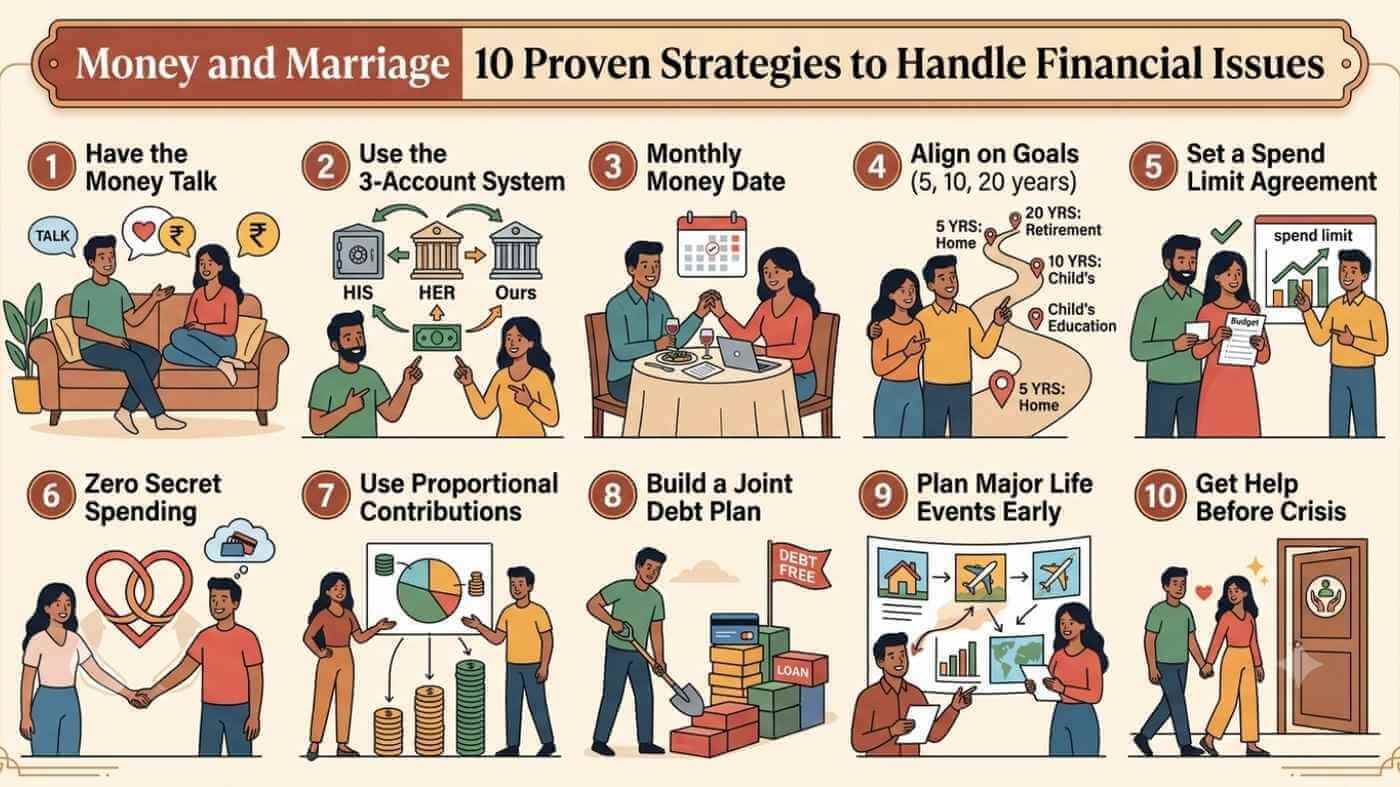
The 10 Money and Marriage Strategies at a Glance
The table below maps each strategy to when it applies and what it does. Strategies 1, 2, and 3 are the foundation. Everything else builds on them.
| # | Strategy | When | What to Do and Why |
| 01 | Have the Money Talk | Before marriage or right now | Both partners share income, debt, financial obligations, family support commitments, spending habits, and risk tolerance. Do not assume alignment. Surprises in any of these areas cause 80% of money conflicts. |
| 02 | Use the 3-Account System | First month of marriage | One joint account for shared expenses. Individual accounts for personal spending. A separate investment folio for shared goals. Balances transparency with autonomy. |
| 03 | Monthly Money Date | Same day every month | A fixed 15-minute meeting covering joint account balance, major expenses, SIP progress, and one financial concern per session. No phones. No blame. Document decisions together. |
| 04 | Align on Goals (5, 10, 20 years) | Year 1 and annually | Map each partner’s goals independently, then find the overlap. Where goals conflict, negotiate early. Where they align, fund jointly. Goals without a map drift. |
| 05 | Set a Spend Limit Agreement | Month 1 | Any purchase above an agreed amount (typically Rs. 5,000 to Rs. 25,000) needs a brief discussion. Below: full personal autonomy. Above: joint decision. Prevents the biggest source of daily financial resentment. |
| 06 | Zero Secret Spending | Always | Hidden purchases destroy trust faster than any other financial behaviour. If either partner is afraid to disclose a purchase, that fear is the real problem to address. |
| 07 | Use Proportional Contributions | Month 1 | When incomes are unequal, each partner contributes a percentage of joint expenses proportional to their income, not a 50-50 split. Equal contribution from unequal incomes creates resentment. |
| 08 | Build a Joint Debt Plan | Month 1-3 | List all pre-marriage debts together. Prioritise by interest rate. Both partners track progress at every Money Date. Debt is not one partner’s private problem in a financial partnership. |
| 09 | Plan Major Life Events Early | Before each event | Children, parent care, career breaks: each requires a financial plan before it arrives, not after. The cost of a baby, a parent’s surgery, or a career gap is always a surprise only to couples who avoided the conversation. |
| 10 | Get Help Before Crisis | When patterns repeat | If the same money argument repeats three or more times without resolution, a financial adviser or couples counsellor is not a last resort. It is the most efficient tool available. |
3 Strategies Worth Going Deeper On
Strategy 01: The Money Talk — What to Cover and When
Most Indian couples never have a structured money conversation before marriage. They assume alignment on spending, saving, family obligations, and risk tolerance. In almost every case, the assumption is partially wrong, and the gaps surface as conflict after the wedding.
The Money Talk covers ten areas: each partner’s family financial background, all existing debt and obligations, current income and career plans, spending habits, financial goals, family financial support commitments (parents, siblings), risk tolerance for investments, decision-making preferences for large purchases, debt philosophy, and how joint finances will be managed.
Example: Anjali and Rohit married after two years of dating without discussing money. Post-marriage: Anjali wanted to send Rs. 50,000 per month to her parents; Rohit had Rs. 8 lakh in credit card debt; Anjali was comfortable with equity; Rohit wanted zero risk. These were not incompatible positions. But discovering them in Month 2 instead of before the wedding cost them 18 months of unnecessary conflict.
The conversation does not need to produce perfect agreement. It needs to produce complete information. Differences that are known can be navigated. Differences that are hidden become resentment.
Strategy 07: The Proportional Contribution Model
The most common source of financial resentment in marriages with unequal incomes is a 50-50 expense split. Equal contribution from unequal incomes is not fairness. It is a structural imbalance that makes the lower earner feel financially pressured, and the higher earner feel disproportionately burdened.
The proportional model calculates each partner’s contribution to joint expenses as a percentage of their individual income versus combined income.
Example: Priya earns Rs. 20 lakh, and Arjun earns Rs. 8 lakh. Combined: Rs. 28 lakh. Priya contributes 71%, Arjun 29%. Joint annual expenses of Rs. 15 lakh: Priya pays Rs. 10.65 lakh, Arjun pays Rs. 4.35 lakh. Both retain equal personal discretionary money. Neither earner controls decisions by virtue of income. The arrangement is reviewed annually as incomes change.
Equal discretionary spending after proportional contributions is the key detail. It preserves dignity and prevents the dynamic where the higher earner’s income becomes a source of authority rather than just a financial input.
Strategy 10: Get Help Before Crisis
Financial counselling in Indian marriages is sought almost exclusively in crisis. By that point, the trust damage is usually layered over months or years of unresolved conflict, which makes the counsellor’s job significantly harder.
The more productive approach is to engage a financial adviser or counsellor at the first sign of a recurring pattern: the same argument about the same topic three or more times without resolution. At that stage, the underlying disagreement is almost always about values and goals, not the specific purchase or expense that triggered the argument.
Who can help: SEBI-registered fee-only advisers, AMFI-registered distributors like VSJ FinMart who offer goal-based financial planning for couples, and couples counsellors who specialise in financial conflict. A structured plan costs a fraction of what recurring money fights extract from a marriage over the years.
The 3-Account Income Distribution Model
For most dual-income Indian couples, this allocation framework works as a starting point. Adjust based on city, income level, and existing obligations.
| Account | What It Covers | Suggested Allocation |
| Joint Account | Rent, utilities, groceries, EMIs, insurance | 50-60% of combined income |
| Individual Accounts (each) | Personal clothing, hobbies, gifts, discretionary | 10-15% each |
| Joint Investments and SIPs | Home down payment, child education, emergency fund | 20-25% of combined income |
| Festival and Event Buffer | Diwali, travel, weddings, family events | 5-8% of combined income |
The Spend Limit Agreement
The spend limit agreement eliminates the single most common daily money argument: I did not know you were buying that. Set the thresholds once; review annually.
| Amount | Category | Required Process |
| Below Rs. 5,000 | Personal discretionary | Individual decision. No consultation needed. |
| Rs. 5,000 to Rs. 25,000 | Moderate personal purchase | Inform the partner the same day. |
| Rs. 25,000 to Rs. 1 lakh | Major personal purchase | Brief discussion before buying. |
| Above Rs. 1 lakh | Significant shared impact | Joint planning conversation required. |
| Above Rs. 5 lakh | Major financial decision | Both partners must fully agree. |
Quick Formula For Financial Harmony: Proportional Contribution
Step 1: Add both incomes to get the combined income.
Step 2: Divide each partner’s income by the combined income to get their percentage.
Step 3: Multiply joint monthly expenses by each partner’s percentage.
Step 4: Each partner pays their proportional share into the joint account. Personal spending accounts remain equal for both.
Final Words: Money Is the Medium, Not the Problem
When couples say they fight about money, they are usually fighting about control, trust, respect, and shared values. Money is the surface. The strategies above address the surface, but they work because they are built on the same foundation as any healthy relationship: transparency, equity, and communication.
Pick one strategy to implement this week. The Monthly Money Date is the fastest to start and delivers the most immediate impact. Everything else becomes easier once the conversation is a habit.
Start today: put a 15-minute meeting in both calendars for the same day next week. Label it Money Date. That single action begins the shift.
For AMFI-registered mutual fund distributor guidance for couples planning, visit AMFI India.
Frequently Asked Questions
Q: Should married couples combine all finances or keep them separate?
Neither extreme is ideal for most couples. The 3-account system, one joint account for shared expenses, individual accounts for personal spending, and a joint investment folio for shared goals, gives transparency on what matters while preserving autonomy on personal choices. This hybrid approach works for most Indian married couples regardless of income level.
Q: My spouse spends too much. How do I address it without sounding controlling?
Use data, not blame. Instead of ‘you spend too much’, say: ‘our discretionary spending was Rs. 18,000 over budget last month. Can we look at it together?’ This is an observation, not an accusation. Then problem-solve together. Setting a spend limit agreement in advance removes the need for this conversation in most months.
Q: I earn much more than my spouse. Do I get the final say on money decisions?
No. Income does not buy decision-making authority in a financial partnership. Use the proportional contribution model for expense sharing so both partners contribute fairly based on their income. But financial decisions remain joint. When higher income becomes a source of control rather than a shared resource, resentment follows reliably.
Q: Is it acceptable to hide personal spending from a spouse?
Only if it is within the agreed personal discretionary amount from the individual account. Beyond that threshold, hidden spending is a trust issue, not a financial one. If either partner feels the need to hide a purchase, the problem is either the purchase itself or the agreed spending framework is too restrictive and needs renegotiation.
Q: My spouse refuses to discuss money. What should I do?
Set a specific, low-stakes entry point: ‘I need 15 minutes this Saturday to review our joint account. Just 15 minutes.’ Frame it as a shared responsibility, not a confrontation. If even a single structured meeting is refused consistently, that avoidance pattern is itself the issue to address, ideally with the help of a financial adviser or couples counsellor.
Disclaimer
The information provided in this blog is for educational and informational purposes only. Please consult a qualified financial advisor before making investment decisions. VSJ FinMart is an AMFI-registered Mutual Fund Distributor (MFD) and does not offer investment advisory services. Mutual fund investments are subject to market risks. Please read all scheme-related documents carefully before investing.