

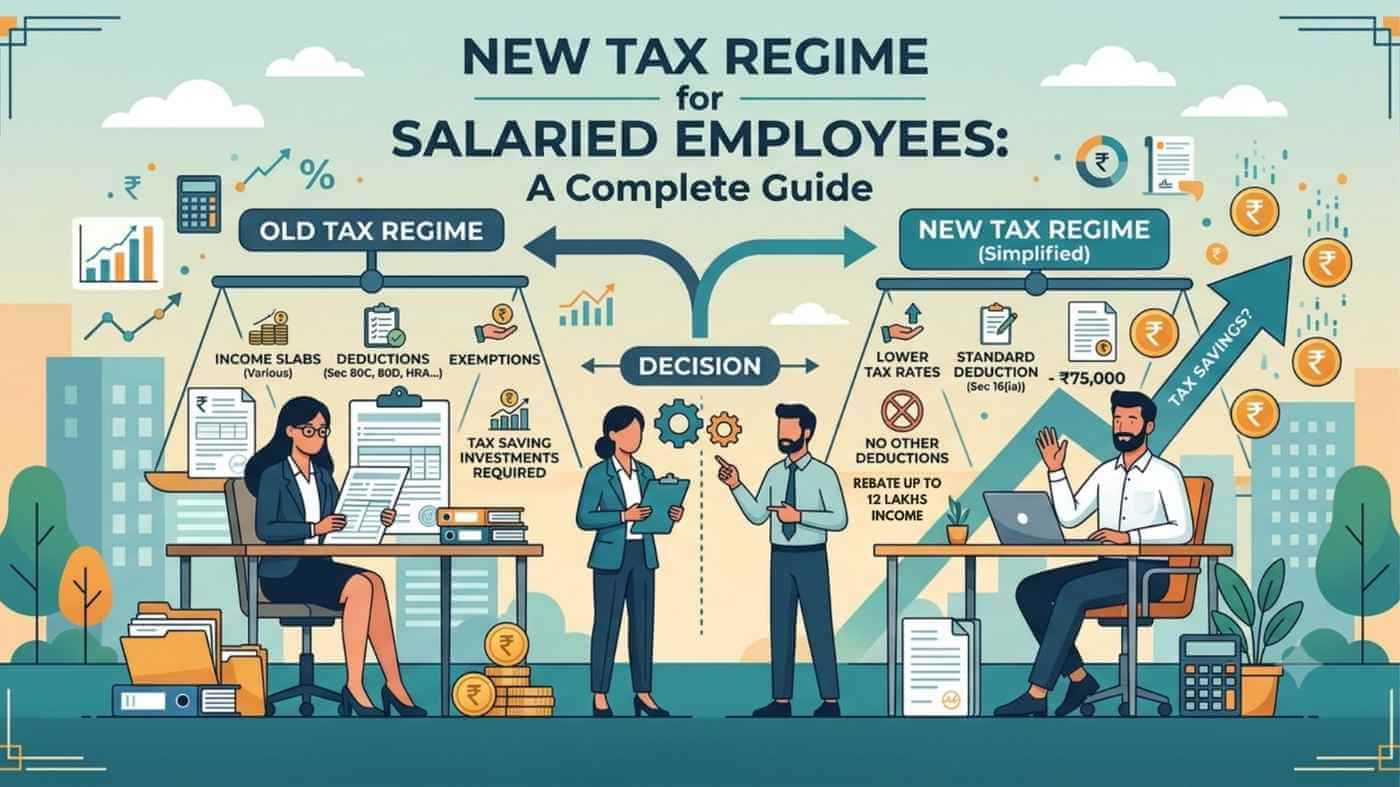
Every year, millions of salaried employees across India face the same question: Which tax regime should I choose? The new tax regime for salaried employees has transformed the way individuals approach tax planning. It offers lower income tax rates, a simplified tax structure, and fewer deductions and exemptions to track. Since the financial year 2023–24, it has also been the default tax regime for most individual taxpayers, although eligible taxpayers can still opt for the old regime if it is more beneficial.
However, lower tax rates do not always translate into a lower tax liability. The right choice depends on several factors, including your salary, eligible deductions and exemptions, home loan benefits, investment pattern, and long-term financial goals.
In this comprehensive guide, we explain how the new tax regime works, compare it with the old tax regime, discuss its advantages and limitations, and help you understand which option may be more suitable for your individual circumstances.
What Is the New Tax Regime for Salaried Employees?
The new tax regime was introduced in Budget 2020 as an optional tax system offering lower income tax rates with fewer deductions and exemptions. From the financial year 2023–24, the Government made it the default tax regime for most individual taxpayers, including salaried employees. If an eligible salaried employee does not opt for the old tax regime in the prescribed manner, the new tax regime generally applies by default.
The core idea is simple. You pay tax at lower slab rates, but in return, you forgo many of the deductions and exemptions that were available under the old tax regime. In other words, the new tax regime exchanges tax-saving deductions for a simpler tax structure.
Key Features at a Glance
- Lower income tax slab rates compared with the old tax regime.
- Standard deduction of Rs. 75,000 for salaried employees and pensioners (from FY 2024–25 onwards).
- Most exemptions and deductions, such as House Rent Allowance (HRA), Leave Travel Allowance (LTA), and deductions under Section 80C, are not available.
- Deduction under Section 24(b) for interest on a home loan relating to a self-occupied house property is generally not available.
- Eligible resident individuals can claim the Section 87A rebate, resulting in zero tax where the net taxable income does not exceed Rs. 7 lakh, subject to the applicable provisions.
- The new tax regime is the default tax regime for most individual taxpayers unless the old tax regime is chosen in accordance with the Income-tax Act.
This simplified structure is intended to benefit taxpayers who do not claim substantial deductions or exemptions and prefer a straightforward method of computing their tax liability.
New Tax Regime Slab Rates for FY 2025–26
The revised tax slabs under the new tax regime are intended to provide greater relief to middle-income taxpayers by applying lower tax rates across multiple income brackets.
The following slab rates apply for Financial Year 2025–26 (Assessment Year 2026–27).
| Income Slab | New Tax Regime Rate |
|---|---|
| Up to Rs. 4,00,000 | Nil |
| Rs. 4,00,001 to Rs. 8,00,000 | 5% |
| Rs. 8,00,001 to Rs. 12,00,000 | 10% |
| Rs. 12,00,001 to Rs. 16,00,000 | 15% |
| Rs. 16,00,001 to Rs. 20,00,000 | 20% |
| Rs. 20,00,001 to Rs. 24,00,000 | 25% |
| Above Rs. 24,00,000 | 30% |
In addition, salaried employees and pensioners are eligible for a standard deduction of Rs. 75,000 under the new tax regime.
For example, if a resident salaried employee has a gross salary of Rs. 12,75,000 and has no other taxable income or adjustments, the standard deduction reduces the net taxable income to Rs. 12,00,000. Subject to the conditions of Section 87A, the resulting income tax liability is nil.
The revised slab structure, together with the enhanced rebate under Section 87A, makes the new tax regime particularly beneficial for many salaried employees with moderate incomes who do not claim substantial deductions under the old tax regime.
New Regime vs Old Regime: A Side-by-Side Comparison
Understanding the differences between the two tax regimes is the first step towards making an informed decision. The new tax regime generally benefits salaried employees who do not claim substantial deductions or exemptions. The old tax regime, on the other hand, may be more suitable for individuals who regularly claim deductions for investments, insurance, home loans, or house rent.
| Feature | New Tax Regime (FY 2025–26) | Old Regime |
|---|---|---|
| Basic Exemption Limit | Rs 4,00,000 | Rs 2,50,000 |
| Standard Deduction | Rs 75,000 | Rs 50,000 |
| Section 80C (up to Rs 1.5 lakh) | Not available | Available |
| HRA Exemption | Not available | Available |
| Home Loan Interest (Sec 24b) | Not available (self-occupied) | Up to Rs 2,00,000 |
| Section 80D (Health Insurance) | Not available | Available |
| NPS Employer Contribution (Sec 80CCD(2)) | Available | Available |
| Default Regime | Yes (from FY 2023-24) | No (opt-in required) |
The old tax regime provides a wider range of deductions and exemptions, which can significantly reduce taxable income for individuals with eligible investments and expenses. In contrast, the new tax regime offers lower tax rates and a simplified structure but restricts most deductions and exemptions.
There is no universally better option. The right choice depends on factors such as your salary, eligible deductions, home loan benefits, investment pattern, and overall financial objectives. Comparing your tax liability under both regimes before filing your Income-tax Return is the best way to determine which regime is more beneficial for your situation.
Who Benefits Most from the New Tax Regime for Salaried Employees?
The new tax regime is not automatically the best choice for everyone. Whether it saves you more tax depends on your income, deductions, exemptions, and overall financial situation. Here is a practical way to think about it.
The New Regime Suits You If:
- Your gross salary is up to about Rs. 12,75,000, you have no significant additional taxable income, and you qualify for the Section 87A rebate.
- You do not have a home loan for a self-occupied property.
- You pay little or no rent, so the HRA exemption is minimal.
- You do not make substantial investments eligible under Section 80C.
- You are early in your career and have not yet built a large portfolio of tax-saving investments.
- You prefer a simpler tax structure with fewer deductions and exemptions to track.
The Old Regime Suits You If:
- You claim a substantial HRA exemption, particularly if you live in a metro city.
- You have a self-occupied home loan and claim interest deduction under Section 24(b).
- You fully utilise deductions under Section 80C through investments such as PPF, ELSS, EPF, or life insurance premiums.
- You claim deductions under Section 80D for health insurance premiums.
- Your combined deductions and exemptions are substantial enough to reduce your tax liability below what you would pay under the new tax regime.
A Practical Indian Example: Rahul’s Tax Calculation
Let us look at a practical example to understand how the two tax regimes compare.
Rahul is a 32-year-old software engineer in Pune with a gross annual salary of Rs. 12,00,000. He lives in rented accommodation, claims House Rent Allowance (HRA), invests the full Rs. 1.5 lakh under Section 80C through ELSS and PPF, and pays Rs. 25,000 towards health insurance premiums eligible under Section 80D.
| Particulars | New Regime (Rs) | Old Regime (Rs) |
|---|---|---|
| Gross Salary | 12,00,000 | 12,00,000 |
| Standard Deduction | 75,000 | 50,000 |
| HRA Exemption | Not available | 1,20,000 |
| Section 80C | Not available | 1,50,000 |
| Section 80D | Not available | 25,000 |
| Taxable Income | 11,25,000 | 8,55,000 |
| Approximate Tax (before cess) | Rs 52,000 | Rs 80,600 |
In this example, Rahul pays less tax under the new tax regime, even after claiming HRA, Section 80C, and Section 80D deductions under the old regime. This outcome is driven by the revised slab rates introduced for FY 2025–26.
However, the result will not be the same for everyone. Taxpayers with larger HRA exemptions, higher home loan interest deductions, or additional eligible deductions may still find the old tax regime more beneficial.
The key takeaway is simple: always calculate your tax liability under both regimes before making your choice. The right option depends on your income, deductions, and overall financial situation.
7 Smart Tips to Make the Most of the New Tax Regime
If you have decided that the new tax regime is right for you, or if you are still evaluating your options, these practical tips can help you make an informed decision.
Tip 1: Use the Section 87A Rebate Fully
If you are a resident individual and your net taxable income does not exceed Rs. 12,00,000, you may be eligible for a rebate under Section 87A that reduces your income tax liability to nil, subject to the applicable conditions. Salaried employees should also remember that the standard deduction of Rs. 75,000 can help reduce taxable income.
Tip 2: Ask Your Employer for NPS Contribution
Employer contributions to the National Pension System (NPS) under Section 80CCD(2) remain deductible even under the new tax regime. If your employer offers this benefit, it can reduce your taxable income while allowing you to continue enjoying the lower slab rates.
Tip 3: Review Your Tax Regime Before Filing Your Return
Salaried employees can generally choose between the old and new tax regimes every financial year. Although you may intimate your preferred regime to your employer for TDS purposes, you can make your final choice while filing your Income-tax Return, subject to the applicable provisions of the Income-tax Act.
Tip 4: Continue Investing for Your Financial Goals
The absence of a deduction under Section 80C in the new tax regime should not discourage you from investing. Mutual funds, PPF, NPS, and other investments should be selected based on your long-term financial objectives rather than tax savings alone.
Tip 5: Compare Both Tax Regimes Every Year
There is no fixed income level or deduction amount at which one tax regime always becomes better than the other. Your salary, deductions, exemptions, home loan benefits, and investment pattern can change over time. Compare your tax liability under both regimes every financial year before making your decision.
Tip 6: Keep Home Loan Strategy in Mind
If you have a self-occupied home financed through a home loan, remember that the interest deduction under Section 24(b) is generally available only under the old tax regime. This benefit can significantly influence which regime is more tax-efficient for you.
Tip 7: Review Your Choice Every Year
Your income, family responsibilities, investments, and tax-saving opportunities evolve. Reviewing your tax regime at the beginning of every financial year helps ensure that you continue to pay only the tax that is legally required while aligning your tax planning with your long-term financial goals.
What Deductions Are Still Allowed Under the New Regime?
Although the new tax regime removes most deductions and exemptions, several important tax benefits continue to be available. Understanding these can help you reduce your tax liability while enjoying the lower slab rates.
- Standard Deduction: Salaried employees and pensioners can claim a standard deduction of Rs. 75,000 under the new tax regime.
- Employer NPS Contribution: Employer contributions to the National Pension System (NPS) under Section 80CCD(2) continue to be deductible, subject to the prescribed limits.
- Gratuity Exemption: Gratuity received on retirement remains exempt under Section 10(10), subject to the applicable conditions and monetary limits.
- Leave Encashment Exemption: Leave encashment received at retirement continues to qualify for exemption under Section 10(10AA), subject to the prescribed conditions and limits.
- VRS Compensation: Compensation received under an approved Voluntary Retirement Scheme (VRS) continues to be exempt under Section 10(10C), up to Rs. 5,00,000, subject to the prescribed conditions.
- Specified Allowances
- Certain allowances continue to be available, including:
- Transport allowance for differently abled employees.
- Conveyance allowance granted to meet official duties.
- Allowances for travel, transfer, or tour undertaken for official purposes.
- Daily allowance received while away from the normal place of duty for official work.
- Certain allowances continue to be available, including:
- Family Pension Deduction: Family pension continues to qualify for a deduction under Section 57(iia). The deduction is the lower of:
- One-third of the family pension received, or
- The prescribed monetary limit applicable for the relevant financial year.
- Agniveer Corpus Fund Deduction: Eligible Agniveers can continue to claim a deduction under Section 80CCH, even under the new tax regime.
While the new tax regime removes most deductions such as Section 80C, Section 80D, HRA, and LTA, the above benefits continue to be available. Before choosing a tax regime, consider these available deductions along with your salary structure and financial goals to determine which option results in the lowest overall tax liability.
How Mutual Fund Investments Fit Into Your Tax Plan
Choosing between the old and new tax regime is only one part of financial planning. Building long-term wealth through disciplined investing is equally important, regardless of the tax regime you select.
Under the new tax regime, investments in Equity Linked Savings Schemes (ELSS) no longer qualify for a deduction under Section 80C. However, ELSS continues to be a legitimate equity mutual fund investment option for investors whose financial goals and risk profile make it suitable. The absence of a tax deduction should not be the sole reason to avoid or select any investment.
One advantage of the new tax regime is that it allows you to focus on goal-based investing rather than tax-driven investing. Instead of choosing investments primarily for tax benefits, you can build a portfolio based on your financial objectives, investment horizon, liquidity needs, and risk tolerance.
Whether you are investing for retirement, your child’s education, wealth creation, or any other long-term goal, selecting the right mix of mutual funds is far more important than chasing short-term tax savings.
At VSJ FinMart, we help salaried employees build personalised mutual fund investment plans based on their income, financial goals, and overall tax situation. Our objective is to help you choose investments that align with your long-term financial plan rather than focusing only on tax-saving opportunities.
Common Mistakes Salaried Employees Make with the New Tax Regime
Switching regimes is not always as simple as it looks. Here are the most common errors people make, and how to avoid them.
Mistake 1: Assuming the New Regime Is Always Better
The new tax regime offers lower tax rates, but that does not automatically mean it results in lower tax for everyone. If you claim substantial deductions or exemptions under the old regime, it may still be the more tax-efficient option. Compare your tax liability under both regimes before making a decision.
Mistake 2: Not Informing the Employer on Time
Employers deduct Tax Deducted at Source (TDS) based on the tax regime you declare for payroll purposes. If you do not communicate your preferred regime or if your estimated deductions change during the year, the TDS deducted may differ from your final tax liability. While most salaried employees can choose the appropriate regime when filing their Income-tax Return, keeping your employer informed helps minimise large refunds or additional tax payments.
Mistake 3: Stopping SIPs and Long-Term Investments
Moving to the new tax regime does not mean you should stop investing. Tax saving is only one aspect of financial planning. Continue investing for long-term goals such as retirement, children’s education, or wealth creation, even if certain tax deductions are no longer available.
Mistake 4: Forgetting to Recalculate Every Year
Your financial situation can change over time. A salary increase, a home loan, changes in rent, or new investments may alter which tax regime is more beneficial. Reviewing your tax position at the beginning of each financial year can help you make a more informed choice.
The new tax regime has simplified income tax for many salaried employees by offering lower tax rates and reducing the need to track multiple deductions and exemptions. For many individuals, especially those with limited tax-saving investments, it can result in lower tax liability and a simpler filing process.
However, the right choice depends on your individual circumstances. Your salary, deductions, exemptions, investment strategy, and financial goals should all be considered before selecting a tax regime.
Frequently Asked Questions
1. Is the new tax regime better than the old regime for salaried employees?
There is no one-size-fits-all answer. The new tax regime generally benefits salaried employees who have limited deductions and exemptions, while the old tax regime may be more beneficial for those claiming substantial deductions such as HRA, home loan interest, Section 80C investments, and Section 80D. The best approach is to calculate your tax liability under both regimes before filing your Income-tax Return.
2. Can I switch between the new and old tax regime every year?
Yes. Most salaried individuals who do not have business or professional income can choose between the old and new tax regimes each financial year. Your employer may ask you to declare your preferred regime for TDS purposes, but your final choice can generally be made while filing your Income-tax Return. Taxpayers having business or professional income are subject to different switching rules.
3. Can I pay zero tax under the new tax regime?
Yes, subject to the conditions of Section 87A. For FY 2025–26, a resident individual whose net taxable income does not exceed Rs. 12,00,000 may be eligible for a rebate that reduces the income tax liability to nil. Salaried employees should also remember that the standard deduction of Rs. 75,000 can further reduce their taxable income.
4. Can I claim HRA under the new tax regime?
No. The House Rent Allowance (HRA) exemption is generally not available under the new tax regime. If you receive a substantial HRA exemption, it is worth comparing your tax liability under both regimes before making your choice.
5. Should I stop my ELSS SIP if I switch to the new regime?
No. Although ELSS investments no longer qualify for a deduction under Section 80C in the new tax regime, they remain equity mutual funds designed for long-term wealth creation. Your investment decisions should be guided by your financial goals, investment horizon, and risk tolerance rather than tax benefits alone. A personalised mutual fund investment plan can help you determine the most suitable investment strategy for your needs.
Disclaimer
The information provided in this blog is for educational and informational purposes only and should not be construed as investment advice. Please consult a qualified financial advisor before making any investment decisions. Shashikant Chanderkumar Mudaliar (ARN: 319377), operating under the brand name VSJ FinMart, is an AMFI-registered Mutual Fund Distributor (MFD) and does not provide investment advisory services. Mutual fund investments are subject to market risks. Past performance is not indicative of future results. Please read all scheme-related documents carefully before investing. Registration details can be verified at www.amfiindia.com/locate-distributor.
════════════════════════════════════════
SEO META INFO  (RankMath)
════════════════════════════════════════


                       (57 characters)

                       (152 characters)

Focus Keyword:         new tax regime for salaried employees

Secondary Keywords:    new tax regime vs old tax regime,
                       income tax slabs 2024-25 India,
                       section 80C deductions new regime,
                       how to save tax on salary India

Word Count (approx):   2,210 words