

Every year, millions of Indian taxpayers face the same question: should I stick with the old tax regime or switch to the new one? With the Union Budget 2025 bringing significant changes, the new tax regime vs old regime 2026 debate has become more important than ever. The choice you make directly affects how much money stays in your pocket, and how much flows to the government. In this guide, we break down both regimes clearly, compare the slab rates side by side, and help you figure out which option actually saves you more.
What Changed in the New Tax Regime for 2026?
The government has continued to push taxpayers toward the new tax regime by making it more attractive. From the financial year 2025–26 (Assessment Year 2026–27), the new regime is now the default option. If you do not actively choose the old regime, the new regime applies automatically.
Here are the key updates for 2026:
- The basic exemption limit under the new regime has been raised to Rs. 4 lakh (up from Rs. 3 lakh).
- The rebate under Section 87A now covers income up to Rs. 12 lakh, effectively making tax zero for most salaried individuals earning up to Rs. 12 lakh.
- A standard deduction of Rs. 75,000 is now available under the new regime for salaried employees and pensioners.
- The surcharge on income above Rs. 5 crore has been reduced.
These changes make the new regime sound very appealing. However, the story does not end there. Whether it is actually better for you depends entirely on your deductions and financial situation.
New Tax Regime vs Old Regime 2026: Slab Rate Comparison
Let us look at the tax slabs for both regimes side by side. This is the foundation of any comparison between the new tax regime vs old regime 2026.
| Income Slab | New Tax Regime Rate (FY 2025–26) | Old Tax Regime Rate (FY 2025–26) |
|---|---|---|
| Up to Rs. 4,00,000 | Nil | Nil (up to Rs. 2.5 lakh) |
| Rs. 4,00,001 to Rs. 8,00,000 | 5% | 5% (Rs. 2.5L–5L) / 20% (Rs. 5L–8L) |
| Rs. 8,00,001 to Rs. 12,00,000 | 10% | 20% |
| Rs. 12,00,001 to Rs. 16,00,000 | 15% | 30% |
| Rs. 16,00,001 to Rs. 20,00,000 | 20% | 30% |
| Rs. 20,00,001 to Rs. 24,00,000 | 25% | 30% |
| Above Rs. 24,00,000 | 30% | 30% |
On paper, the new regime slabs look significantly lower. However, the old regime allows you to reduce your taxable income through deductions and exemptions. This is where the real calculation begins.
Key Deductions Available Only Under the Old Regime
The old tax regime allows a wide range of deductions that are simply not available under the new regime. If you claim several of these, the old regime may actually put more money back in your hands.
Section 80C Deductions (up to Rs. 1.5 lakh)
This is the most popular deduction in India. It covers:
- ELSS mutual funds (tax-saving funds)
- PPF contributions
- Life insurance premiums
- Home loan principal repayment
- EPF contributions
- NSC and 5-year fixed deposits
- Tuition fees for children
Other Key Deductions Under the Old Regime
- Section 80D: Health insurance premiums (up to Rs. 25,000 for self and family; Rs. 50,000 for senior citizens)
- Section 24(b): Home loan interest deduction (up to Rs. 2 lakh)
- HRA Exemption: House Rent Allowance, based on city and rent paid
- LTA Exemption: Leave Travel Allowance for domestic travel
- Section 80CCD(1B): Additional NPS contribution (up to Rs. 50,000)
- Section 80G: Donations to approved charities
- Standard Deduction: Rs. 50,000 for salaried individuals (the new regime now offers Rs. 75,000)
If you claim most of these deductions, your taxable income under the old regime can drop significantly. This is what makes it competitive even with higher slab rates.
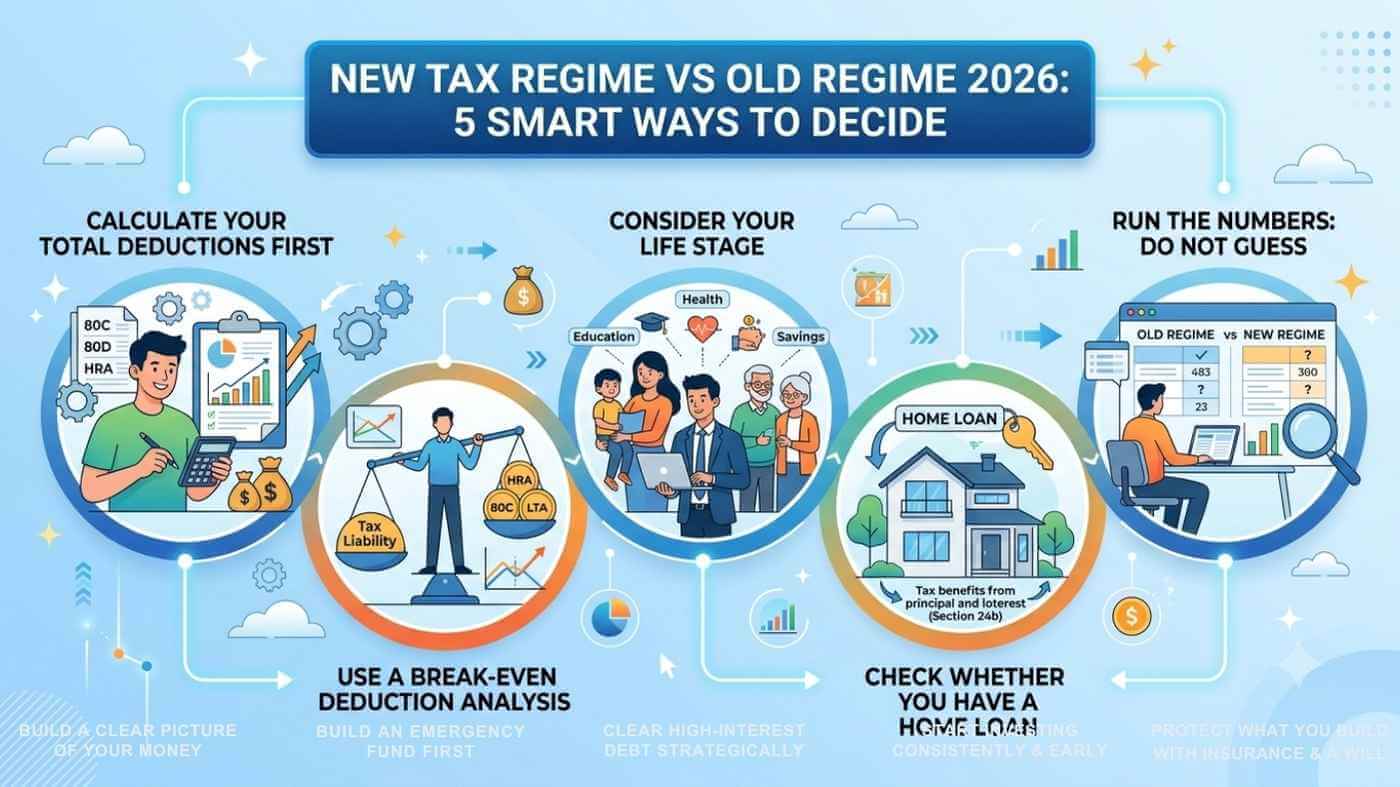
5 Smart Ways to Decide Which Regime Saves You More
Here are five clear, practical ways to make the right choice between the new tax regime vs old regime in 2026.
1. Calculate Your Total Deductions First
Start by adding up every deduction you currently claim or plan to claim. If your total deductions exceed approximately Rs. 3.75 lakh (including standard deduction), the old regime is likely to save you more. If your deductions are lower than this threshold, the new regime usually wins.
Most young salaried professionals with no home loan and minimal 80C investments will benefit from the new regime. However, someone with a home loan, HRA, 80C investments, and health insurance is likely better off in the old regime.
2. Use a Break-Even Deduction Analysis
The break-even point is the level of deductions at which both regimes produce the same tax liability. For most income levels in 2026, this break-even is roughly between Rs. 3.5 lakh and Rs. 4.5 lakh of total deductions.
- If your deductions are above the break-even, choose the old regime.
- If your deductions are below the break-even, choose the new regime.
Therefore, calculating this number for your exact income level is the most reliable way to decide.
3. Consider Your Life Stage
Your life stage matters enormously in this decision.
- Early career (20s, no home loan, low investments): New regime is usually better. Lower tax rates with minimal paperwork.
- Mid-career (30s, home loan, HRA, 80C fully used): Old regime often saves more because multiple deductions apply simultaneously.
- Senior employees or business owners: Case-by-case. Must calculate carefully based on actual deductions.
4. Check Whether You Have a Home Loan
A home loan is one of the most powerful factors in this decision. Under the old regime, you can claim:
- Up to Rs. 1.5 lakh on principal repayment (Section 80C)
- Up to Rs. 2 lakh on interest paid (Section 24b)
That is Rs. 3.5 lakh in deductions from a home loan alone. In addition to standard deduction (Rs. 50,000) and 80D (Rs. 25,000), you are already well past the break-even point. For most home loan borrowers in the 30% bracket, the old regime saves significantly more.
5. Run the Numbers: Do Not Guess
Many taxpayers make this decision based on gut feel or what a colleague told them. That is a costly mistake. Always compute your actual tax liability under both regimes using the current slab rates and your specific deductions.
Consider this example:
Ramesh, aged 35, Pune. Annual salary: Rs. 15 lakh.
| Parameter | Old Regime | New Regime |
|---|---|---|
| Gross Income | Rs. 15,00,000 | Rs. 15,00,000 |
| Standard Deduction | Rs. 50,000 | Rs. 75,000 |
| Section 80C | Rs. 1,50,000 | Not available |
| Home Loan Interest (Sec 24b) | Rs. 2,00,000 | Not available |
| Section 80D (Health Insurance) | Rs. 25,000 | Not available |
| NPS (80CCD 1B) | Rs. 50,000 | Not available |
| Taxable Income | Rs. 10,25,000 | Rs. 14,25,000 |
| Approximate Tax (incl. cess) | ~Rs. 1,07,100 | ~Rs. 1,56,000 |
In this case, Ramesh saves approximately Rs. 48,900 by sticking with the old regime. The numbers speak clearly. Most importantly, no two taxpayers have the same profile — so the math must be done individually.
Who Should Choose the New Tax Regime in 2026?
The new regime works well for specific types of taxpayers. In general, you should seriously consider it if:
- Your annual income is below Rs. 12 lakh (with the Section 87A rebate, tax liability may be zero)
- You have no home loan or HRA benefit
- You do not invest in 80C instruments actively
- You prefer simplicity and lower paperwork
- You are a freelancer or self-employed person without significant allowances
For many first-time earners and young professionals, the new regime offers a clean, low-rate structure without the need to lock money into specific investments just for tax saving.
Who Should Stick With the Old Tax Regime in 2026?
The old regime remains highly competitive for those who maximise available deductions. Consider staying with it if:
- You have a home loan and claim both principal and interest deductions
- You pay HRA and live in a rented property in a metro city
- You consistently max out your 80C limit (Rs. 1.5 lakh)
- You have health insurance for self, family, and parents (80D)
- You invest in NPS under the additional Rs. 50,000 deduction
- Your total deductions comfortably exceed Rs. 3.75 lakh
For such individuals, the old regime can still reduce taxable income so substantially that even the higher slab rates result in a lower overall tax outgo compared to the new regime.
ELSS and Tax Saving Investments: Still Worth It?
Under the old regime, ELSS mutual funds remain one of the most efficient tax-saving tools. They qualify for the Section 80C deduction, come with the shortest lock-in period among 80C options (three years), and historically offer returns that tend to outperform fixed income alternatives over a long horizon.
However, if you opt for the new regime, the 80C deduction disappears. In that case, ELSS funds still make sense as an equity investment, but the immediate tax saving benefit is no longer a factor in your decision.
Choosing between tax-saving instruments requires careful thought about your tax regime, your investment timeline, and your overall financial goals. At VSJ FinMart, we help you evaluate your full financial picture and recommend the right mix of mutual fund investments aligned with your specific income, goals, and tax situation. A personalised approach saves far more than any generic rule of thumb.
Common Mistakes to Avoid When Choosing Your Tax Regime
Many taxpayers make avoidable errors when picking a regime. Here are the most common ones:
- Choosing based on peer advice: Your colleague’s tax situation is not yours. Always calculate individually.
- Ignoring the default: The new regime is now the default. If you want the old regime, you must actively opt for it when filing your return or submitting Form 10-IEA (for non-salaried).
- Forgetting to include all deductions: Many people claim 80C but forget HRA, 80D, or home loan interest. Add everything before deciding.
- Not revisiting each year: Your income, deductions, and life circumstances change. Review your regime choice every financial year; it is not a one-time decision.
- Assuming the new regime is always simpler: While it involves fewer deductions to track, you still need to compute your actual liability. Simplicity does not automatically mean savings.
How to Switch Between Regimes
Salaried employees can switch between regimes each financial year by informing their employer at the start of the year. For TDS purposes, you declare your choice to HR or the accounts team. At the time of filing your ITR, you can also revise your choice.
For self-employed individuals and business owners, the rules are slightly different. Once you opt out of the new regime, you can only switch back once. Therefore, self-employed taxpayers must be especially careful before making any regime change.
In addition, remember that certain deductions like leave encashment, gratuity, and voluntary retirement scheme receipts have specific exemptions that need separate evaluation regardless of which regime you choose.
Making the Right Choice With Personalised Guidance
The new tax regime vs old regime 2026 debate does not have one universal answer. It depends on your income, your deductions, your life stage, and your financial goals. For some taxpayers, the new regime saves thousands. For others, the old regime saves even more.
If you are unsure where you stand, a quick review with a trusted advisor can make a meaningful difference. At VSJ FinMart, we go beyond just helping you choose a tax regime. We look at your complete financial profile: income, investments, liabilities, and goals, and help you build a plan that works across both taxes and wealth creation. Reach out to us and let us help you make an informed, confident decision this financial year.
Final Words
The new tax regime vs old regime in 2026 is not a one-size-fits-all decision. The new regime offers lower slab rates and simplicity, and it now comes with a higher rebate limit and an enhanced standard deduction. For those with limited deductions, it is clearly the smarter pick. However, for taxpayers with a home loan, HRA, and a full suite of 80C and 80D investments, the old regime still delivers superior savings.
The five ways we covered calculating deductions, finding the break-even point, considering your life stage, factoring in your home loan, and running the actual numbers give you a clear framework to decide confidently. Do not leave this to guesswork. Review your numbers every year, and if you need a second opinion, the team at VSJ FinMart is here to help you navigate every aspect of your financial planning with clarity and care.
Frequently Asked Questions
1. Is the new tax regime better for everyone in 2026?
No. The new regime works well for those with fewer deductions, particularly those without a home loan or significant 80C investments. If your total deductions exceed roughly Rs. 3.75 lakh, the old regime often saves more tax.
2. Can I switch between old and new tax regimes every year?
Salaried employees can switch every year by informing their employer and choosing accordingly at the time of ITR filing. Self-employed individuals face more restrictions and should evaluate carefully before switching.
3. What happens if I do not choose a regime?
From FY 2025–26, the new tax regime is the default. If you do not actively choose the old regime, the new regime applies automatically to your income tax computation.
4. Does the new regime allow any deductions at all?
Yes. The new regime allows a standard deduction of Rs. 75,000 for salaried employees and pensioners, employer NPS contributions under Section 80CCD(2), and a few other specific exemptions. However, most popular deductions like 80C, HRA, and home loan interest are not available.
5. What is the tax liability for someone earning Rs. 12 lakh under the new regime?
For a salaried individual earning Rs. 12 lakh, the standard deduction of Rs. 75,000 reduces taxable income to Rs. 11.25 lakh. However, with the Section 87A rebate extended to cover income up to Rs. 12 lakh (before deductions), the effective tax liability may be zero or very low. Always verify with the latest official computation for your specific case.
Disclaimer
The information provided in this blog is for educational and informational purposes only and should not be construed as investment advice. Please consult a qualified financial advisor before making any investment decisions. Shashikant Chanderkumar Mudaliar (ARN: 319377), operating under the brand name VSJ FinMart, is an AMFI-registered Mutual Fund Distributor (MFD) and does not provide investment advisory services. Mutual fund investments are subject to market risks. Past performance is not indicative of future results. Please read all scheme-related documents carefully before investing. Registration details can be verified at www.amfiindia.com/locate-distributor.