

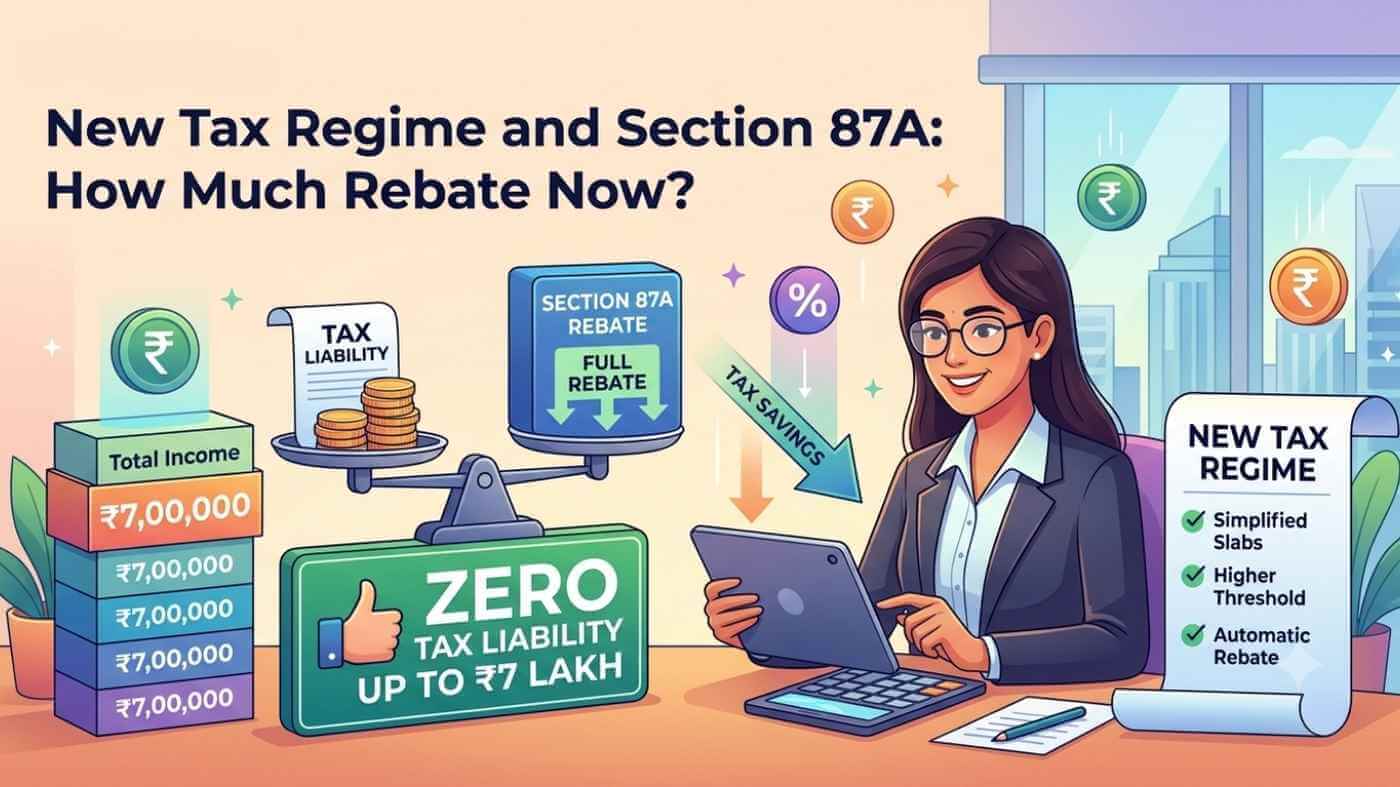
The Section 87A rebate under the new tax regime is one of the most valuable tax benefits available to eligible individual taxpayers in India. If your taxable income falls within the prescribed limit, you could reduce your income tax liability to zero, entirely within the provisions of the Income-tax Act. Yet many taxpayers miss out simply because they do not fully understand how the rebate works or whether they qualify. In this guide, we explain the Section 87A rebate, with practical examples, so you can understand the eligibility conditions, how the rebate is calculated, and how it can help lower your tax liability for FY 2025–26 (AY 2026–27).
What Is Section 87A and Why Does It Matter?
Section 87A of the Income-tax Act allows eligible resident individual taxpayers to claim a rebate from their income tax liability. In simple terms, if your total income falls within the prescribed limit, the rebate can reduce your income tax liability, potentially bringing it down to zero.
A rebate is different from a deduction. A deduction reduces your taxable income before tax is calculated, whereas a rebate reduces the tax payable after it has been computed. Understanding this distinction is important when planning your taxes.
For FY 2025–26 (AY 2026–27), under the new tax regime, eligible resident individuals with total income up to Rs. 12 lakh can claim a rebate of up to Rs. 60,000 under Section 87A, subject to the conditions prescribed in the Income-tax Act. As a result, many taxpayers within the eligible income limit may have no income tax liability under the new regime.
87A Rebate New Tax Regime vs Old Tax Regime: Key Differences
Section 87A provides a tax rebate under both the old and the new tax regimes, but the eligibility limits and maximum rebate amount differ considerably. Understanding these differences can help you compare the two regimes more effectively.
| Feature | Old Tax Regime | New Tax Regime (FY 2025–26) |
|---|---|---|
| Total income eligible for rebate | Up to Rs. 5,00,000 | Up to Rs. 12,00,000 |
| Maximum rebate under Section 87A | Rs. 12,500 | Rs. 60,000 |
| Potential income tax liability after rebate | Nil (subject to eligibility) | Nil (subject to eligibility and the provisions of Section 87A) |
| Standard deduction (salaried employees and eligible pensioners) | Rs. 50,000 | Rs. 75,000 |
| Section 80C, 80D and most other deductions | Available, subject to conditions | Generally not available, except for certain specified deductions |
| Generally more suitable for | Taxpayers with substantial eligible deductions and exemptions | Taxpayers who prefer lower tax rates and have limited deductions to claim |
The higher rebate threshold under the new tax regime has made it significantly more attractive for many taxpayers. However, the choice between the old and new regimes should be based on your overall tax position, taking into account your eligible deductions, exemptions, and income profile rather than the rebate alone.
Who Qualifies for the 87A Rebate Under the New Tax Regime?
Not every taxpayer automatically qualifies for the rebate under Section 87A. To claim the benefit under the new tax regime, you must satisfy the prescribed eligibility conditions.
Eligibility Conditions
- You must be a resident individual. Non-Resident Indians (NRIs) and other non-resident taxpayers are not eligible.
- Your total income under the new tax regime must not exceed Rs. 12 lakh for FY 2025–26 (AY 2026–27).
- You must compute your tax under the new tax regime and satisfy the conditions prescribed under Section 87A.
- You should file your Income Tax Return (ITR) correctly to claim the rebate and report your income accurately.
Who Does Not Qualify
- Non-Resident Indians (NRIs) and other non-resident individuals.
- Resident individuals whose total income exceeds Rs. 12 lakh, subject to the provisions relating to marginal relief.
- Companies, partnership firms, LLPs, Hindu Undivided Families (HUFs), trusts, and other non-individual taxpayers.
- Individuals in respect of tax payable on certain income taxed at special rates where the rebate under Section 87A is not available in accordance with the provisions of the Income-tax Act.
One important point to remember is that Section 87A does not provide relief from tax on all types of income. Certain incomes that are taxed at special rates, such as specified capital gains, are subject to separate provisions. If your income includes such items, or if your total income is close to the eligibility threshold, it is advisable to verify the applicable tax rules or seek professional guidance before filing your return.
How to Calculate Your Section 87A Rebate: A Practical Indian Example
Understanding the calculation with a real example makes things far clearer. Let us walk through a scenario that many salaried Indians will recognise.
Example 1: Salaried Employee Earning Rs. 12,75,000
Rahul is a 28-year-old software professional in Pune. His gross annual salary is Rs. 12,75,000, and he opts for the new tax regime for FY 2025–26 (AY 2026–27).
- Gross Salary: Rs. 12,75,000
- Less: Standard Deduction: Rs. 75,000
- Total Income: Rs. 12,00,000
Since Rahul’s total income does not exceed Rs. 12 lakh, he qualifies for the rebate under Section 87A.
| Particulars | Amount |
| Gross Salary | Rs. 12,75,000 |
| Less: Standard Deduction | Rs. 75,000 |
| Total Income | Rs. 12,00,000 |
| Income Tax (before rebate) | As per the applicable new tax regime slabs |
| Less: Section 87A Rebate | Up to the eligible rebate amount (subject to the prescribed limit) |
| Final Tax Payable | Rs. 0 (excluding any tax on income taxable at special rates, where applicable) |
Although Rahul’s gross salary exceeds Rs. 12 lakh, the standard deduction reduces his total income to Rs. 12 lakh, making him eligible for the rebate. As a result, he has no income tax liability under the normal tax provisions of the new tax regime.
Example 2: What Happens When Your Income Exceeds Rs. 12 Lakh?
Now suppose Rahul receives a performance bonus that increases his total income to Rs. 12,10,000.
Since his total income exceeds Rs. 12 lakh, the normal rebate under Section 87A is no longer fully available. However, the law provides marginal relief so that the additional tax payable does not exceed the amount by which his income exceeds the prescribed threshold.
This ensures that a small increase in income does not result in a disproportionately large increase in tax liability. If your income is only slightly above Rs. 12 lakh, marginal relief can substantially reduce the additional tax otherwise payable. The exact amount depends on your total income and tax computation for the year.
New Tax Regime Slabs for FY 2025–26: A Complete Picture
To understand the Section 87A rebate under the new tax regime, it is important to first know the applicable tax slabs for FY 2025–26 (AY 2026–27).
| Income Slab | New Tax Regime Rate |
|---|---|
| Up to Rs. 4,00,000 | Nil |
| Rs. 4,00,001 to Rs. 8,00,000 | 5% |
| Rs. 8,00,001 to Rs. 12,00,000 | 10% |
| Rs. 12,00,001 to Rs. 16,00,000 | 15% |
| Rs. 16,00,001 to Rs. 20,00,000 | 20% |
| Rs. 20,00,001 to Rs. 24,00,000 | 25% |
| Above Rs. 24,00,000 | 30% |
Salaried employees and eligible pensioners can also claim the standard deduction of Rs. 75,000 under the new tax regime. As a result, a salaried individual with a gross salary of up to Rs. 12,75,000 may have a total income of Rs. 12,00,000 after the standard deduction and, subject to the conditions of Section 87A, may be eligible for the rebate that can reduce their income tax liability to zero. If the total income exceeds Rs. 12 lakh only by a small amount, marginal relief may further reduce the additional tax payable, subject to the prescribed conditions.
5 Smart Ways to Make the Most of the 87A Rebate
Understanding the rebate is only the first step. With a little planning, eligible taxpayers can make the most of the benefits available under Section 87A. Here are five practical tips.
1. Compare the Old and New Tax Regimes Before You Decide
Although the new tax regime is the default option, eligible taxpayers can choose the old regime where permitted if it results in lower tax. Compare your tax liability under both regimes after considering your income, deductions, exemptions, and investments. Do not assume that one regime is always better than the other.
2. Use the Standard Deduction to Your Advantage
The Rs. 75,000 standard deduction available to salaried employees and eligible pensioners under the new tax regime can significantly reduce your taxable income. For example, a gross salary of Rs. 12,75,000 becomes Rs. 12,00,000 after the standard deduction, potentially making you eligible for the Section 87A rebate, subject to the prescribed conditions.
3. Plan Your Income Timing
If you expect a bonus, incentive, or other variable income that could push your total income above the rebate threshold, consider whether there are legitimate ways to manage the timing of that income, where permitted by your employer or the applicable tax rules. Thoughtful planning may help improve your tax efficiency.
4. Be Careful with Capital Gains
Certain types of income, such as specified capital gains, are taxed at special rates and are subject to separate provisions. The availability of the Section 87A rebate for such income may be restricted under the Income-tax Act. If you have significant capital gains, review the tax implications before redeeming investments or consult a tax professional.
5. Work with a Financial Advisor for Personalised Tax Planning
Tax laws and thresholds can change from one Budget to the next. An annual review of your income, investments, and financial goals can help you choose the most suitable tax regime and avoid paying more tax than necessary.
At VSJ FinMart, we help investors understand how tax planning fits into their broader mutual fund investment plan. Any investment recommendation is made only after considering your financial goals, investment horizon, and risk profile.
Common Mistakes to Avoid When Claiming the 87A Rebate
Many taxpayers miss out on the benefits of Section 87A because of simple and avoidable mistakes. Here are some of the most common ones.
- Not filing a return: Even if your tax liability becomes nil after claiming the rebate, you should file your Income Tax Return (ITR) if you are required to do so under the Income-tax Act. Filing your return correctly ensures that your tax computation and rebate claim are properly reflected.
- Confusing gross income with net taxable income: The eligibility limit for the rebate is based on your total income, not your gross salary. For salaried employees and eligible pensioners, the Rs. 75,000 standard deduction can reduce total income and help determine eligibility for the rebate.
- Assuming the rebate covers capital gains tax: Certain categories of income, such as specified capital gains that are taxed at special rates, are governed by separate provisions. The rebate under Section 87A may not be available against tax payable on such income. If you have capital gains or other special-rate income, review the applicable tax rules carefully.
- Missing the marginal relief provision: If your total income exceeds Rs. 12 lakh only by a small amount, you may be eligible for marginal relief, which ensures that the additional tax payable does not exceed the amount by which your income exceeds the prescribed threshold. Many taxpayers overlook this important provision.
- Choosing the wrong regime by default: The new tax regime is the default tax regime. However, depending on your eligibility and the nature of your income, you may still be able to opt for the old tax regime. Before making your choice, compare the tax liability under both regimes after considering deductions, exemptions, and other relevant factors.
Should You Combine Tax Planning with Mutual Fund Investments?
Tax planning and investment planning should complement each other, but they should not be driven by tax savings alone.
If you are eligible for and choose the old tax regime, investments in Equity Linked Savings Schemes (ELSS) can qualify for a deduction of up to Rs. 1.5 lakh under Section 80C, while also offering the potential for long-term wealth creation. As with all equity investments, returns are market-linked and not guaranteed.
Under the new tax regime, deductions under Section 80C are generally not available. This means mutual fund investments are typically made to achieve long-term financial goals such as retirement planning, children’s education, or wealth creation rather than primarily for tax savings.
The most suitable investment strategy depends on factors such as your financial goals, investment horizon, cash flow requirements, and risk tolerance. Tax considerations are important, but they should form only one part of your overall financial planning.
Frequently Asked Questions
1. Is the 87A rebate available for senior citizens under the new tax regime?
Yes. Resident senior citizens (aged 60 years or above) are eligible to claim the rebate under Section 87A if they satisfy the prescribed conditions. Under the new tax regime for FY 2025–26 (AY 2026–27), eligible resident individuals with total income up to Rs. 12 lakh may claim the rebate, subject to the provisions of Section 87A. Before choosing a tax regime, senior citizens should compare the overall tax liability under both the old and new regimes, taking into account the basic exemption limit, eligible deductions, and exemptions.
2. Can I claim the 87A rebate if I have income from both salary and capital gains?
It depends on the nature of your capital gains. Certain capital gains are taxed at special rates under the Income-tax Act, and the rebate under Section 87A may not be available against the tax payable on such income. If you have capital gains in addition to salary income, review the applicable tax provisions carefully or seek professional advice before filing your return.
3. What is marginal relief under Section 87A?
Marginal relief ensures that if your total income exceeds Rs. 12 lakh only by a small amount, the additional tax payable does not exceed the amount by which your income exceeds the prescribed threshold. This prevents a disproportionate increase in tax liability due to a marginal increase in income. The amount of marginal relief depends on your total income and the applicable tax computation.
4. Is Section 87A a deduction or a rebate?
Section 87A provides a rebate, not a deduction. A deduction reduces your taxable income before tax is calculated, whereas a rebate reduces the income tax payable after it has been computed. Understanding this distinction is important for accurate tax planning.
5. Do I need to declare or apply for the 87A rebate separately?
No. There is no separate application process for claiming the rebate. If you are eligible and file your Income Tax Return correctly, the rebate is generally computed automatically by the income tax utility based on the information provided in your return.
Final Words
The Section 87A rebate under the new tax regime is one of the most significant tax benefits available to eligible resident individual taxpayers. For FY 2025–26 (AY 2026–27), individuals whose total income does not exceed Rs. 12 lakh may be able to reduce their income tax liability to zero, subject to the conditions and provisions of Section 87A, including the rules relating to marginal relief.
The key is to understand the eligibility conditions, calculate your total income correctly, choose the tax regime that works best for your situation, and file your Income Tax Return accurately and on time.
Tax planning, however, is only one part of sound financial planning. Decisions about your investments, retirement planning, insurance, and long-term financial goals should work together rather than in isolation.
At VSJ FinMart, we help investors understand how tax planning fits into a broader goal-based mutual fund investment strategy. If you would like to evaluate which tax regime suits you best or build an investment plan aligned with your financial objectives, our team would be happy to assist.
Disclaimer
The information provided in this blog is for educational and informational purposes only and should not be construed as investment advice. Please consult a qualified financial advisor before making any investment decisions. Shashikant Chanderkumar Mudaliar (ARN: 319377), operating under the brand name VSJ FinMart, is an AMFI-registered Mutual Fund Distributor (MFD) and does not provide investment advisory services. Mutual fund investments are subject to market risks. Past performance is not indicative of future results. Please read all scheme-related documents carefully before investing. Registration details can be verified at www.amfiindia.com/locate-distributor.