

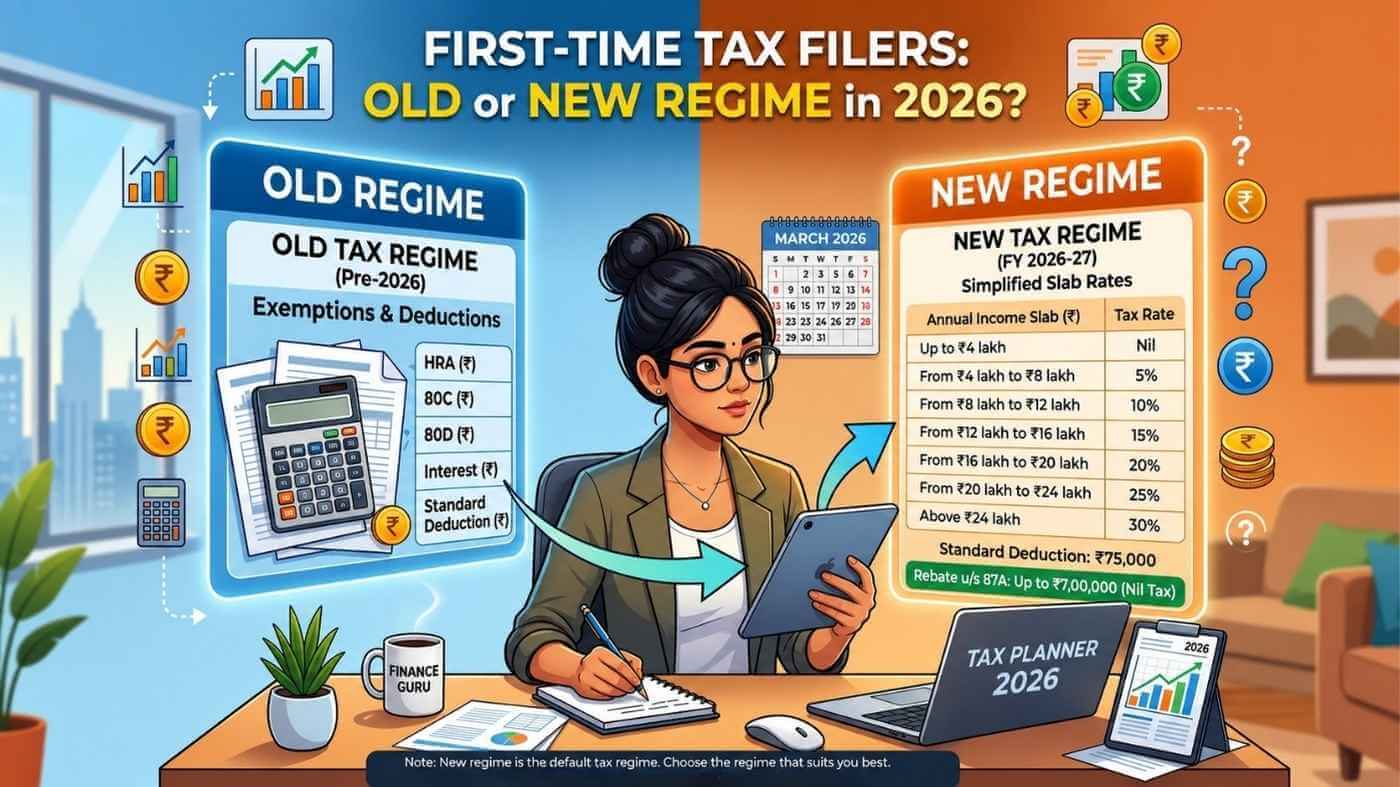
Filing your income tax return for the first time can feel overwhelming. One of the very first questions you will face is: which tax regime for first-time tax filers is the better choice? The old regime or the new one? Your answer can mean the difference between a bigger refund and a bigger tax bill.
In this guide, we break down both regimes. No complicated jargon. Just clear numbers, practical examples, and honest advice to help you decide with confidence.
What Is the Old Tax Regime?
The old tax regime is the traditional income tax system that allows taxpayers to reduce their taxable income by claiming a wide range of deductions and exemptions before calculating their tax liability.
It is generally more beneficial for individuals who make tax-saving investments, pay health insurance premiums, receive House Rent Allowance (HRA), or are repaying a home loan.
Some of the most commonly claimed deductions and exemptions under the old regime include:
- Section 80C: Deduction of up to Rs. 1.5 lakh for eligible investments and expenses such as PPF, ELSS mutual funds, EPF contributions, life insurance premiums, Sukanya Samriddhi Yojana, NSC, tax-saving fixed deposits, and repayment of the principal amount of a home loan.
- Section 80D: Deduction for health insurance premiums. Individuals can generally claim up to Rs. 25,000 for premiums paid for themselves, their spouse, and dependent children, with an additional deduction for parents subject to the applicable limits. A higher deduction is available if the insured person is a senior citizen.
- House Rent Allowance (HRA): Salaried employees living in rented accommodation can claim HRA exemption, subject to the prescribed conditions and calculation rules.
- Leave Travel Allowance (LTA): Exemption for eligible travel expenses incurred for travel within India, subject to the conditions specified under the Income-tax Act.
- Standard Deduction: A flat deduction of Rs. 75,000 is available to salaried employees and pensioners.
- Home Loan Interest (Section 24(b)): Deduction of up to Rs. 2 lakh per financial year on interest paid for a home loan relating to a self-occupied residential property, subject to the applicable conditions.
In short, if you actively claim deductions such as Section 80C, Section 80D, HRA, LTA, and home loan interest, the old tax regime can significantly reduce your taxable income and, in many cases, result in a lower overall tax liability than the new tax regime.
What Is the New Tax Regime?
The new tax regime was introduced to simplify income tax compliance by offering lower tax slab rates while removing most deductions and exemptions available under the old regime.
Unlike the old regime, you generally cannot claim deductions such as Section 80C, Section 80D, HRA, LTA, or the home loan interest deduction for a self-occupied property. In return, you benefit from lower tax rates and a simplified tax calculation.
Under the new tax regime for FY 2026-27, resident individuals with taxable income up to Rs. 12 lakh can effectively pay zero income tax because of the enhanced Section 87A rebate. Salaried employees and pensioners also receive a standard deduction of Rs. 75,000, allowing a gross salary of up to Rs. 12.75 lakh to qualify for zero tax, subject to the applicable conditions.
This makes the new tax regime particularly attractive for first-time taxpayers and individuals who do not claim substantial deductions under the old regime.
New Tax Regime Tax Slabs (FY 2026-27)
| Annual Taxable Income | Tax Rate |
|---|---|
| Up to Rs. 4,00,000 | Nil |
| Rs. 4,00,001 to Rs. 8,00,000 | 5% |
| Rs. 8,00,001 to Rs. 12,00,000 | 10% |
| Rs. 12,00,001 to Rs. 16,00,000 | 15% |
| Rs. 16,00,001 to Rs. 20,00,000 | 20% |
| Rs. 20,00,001 to Rs. 24,00,000 | 25% |
| Above Rs. 24,00,000 | 30% |
Under Section 87A, eligible resident individuals can claim a rebate of up to Rs. 60,000, resulting in zero tax liability on taxable income up to Rs. 12 lakh (excluding income taxed at special rates such as certain capital gains). In addition, marginal relief ensures that taxpayers whose income slightly exceeds Rs. 12 lakh are not subject to a disproportionate increase in tax liability.
As a result, the new tax regime has become the preferred option for many first-time taxpayers, young professionals, and individuals with limited deductions and exemptions. to Rs 60,000 in tax for income up to Rs 12 lakh. Therefore, most first-time filers earning under Rs 12 lakh will pay zero tax under the new regime.
Old Regime vs New Regime: A Side-by-Side Comparison
Choosing the right tax regime as a first-time taxpayer becomes much easier when you compare both options side by side. Each regime has its own advantages, and the better choice depends on your deductions, exemptions, and overall financial situation.
| Feature | Old Tax Regime | New Tax Regime |
|---|---|---|
| Tax Slab Rates | Higher | Lower |
| Standard Deduction | Rs. 75,000 | Rs. 75,000 |
| Section 80C Deduction | Yes (up to Rs. 1.5 lakh) | No |
| HRA Exemption | Yes | No |
| Home Loan Interest [Section 24(b)] (Self-Occupied Property) | Yes (up to Rs. 2 lakh) | No |
| Section 80D (Health Insurance) | Yes | No |
| Employer’s NPS Contribution [Section 80CCD(2)] | Yes | Yes |
| Most Other Chapter VI-A Deductions | Available | Not Available |
| Tax Filing Complexity | Higher | Lower |
| Best Suited For | Taxpayers with substantial deductions and exemptions | Taxpayers with limited deductions who prefer a simpler tax structure |
| Default Regime | No (must opt for it) | Yes |
The new tax regime continues to be the default tax regime. If you do not opt for the old regime (where permitted), your income will generally be taxed under the new regime.
However, default does not always mean better. If you actively claim deductions such as Section 80C, Section 80D, HRA, home loan interest, or other eligible exemptions, the old regime may still result in a lower tax liability. On the other hand, if you have few deductions, the new regime’s lower tax rates, enhanced Section 87A rebate, and simplified compliance may make it the more tax-efficient choice.
Tip for first-time taxpayers: Before filing your Income Tax Return, calculate your tax liability under both regimes using your actual income and eligible deductions. A quick comparison can help you choose the option that minimizes your tax liability.
Who Should Choose the New Regime?
The new tax regime is often the better choice for first-time taxpayers and young professionals who have limited deductions and prefer a straightforward tax structure. Here are some situations where the new regime may work in your favour.
You Earn Up to Rs. 12.75 Lakh as a Salaried Employee
If your gross salary is up to Rs. 12.75 lakh, the standard deduction of Rs. 75,000 reduces your taxable income to Rs. 12 lakh. Eligible resident individuals can then claim the Section 87A rebate, resulting in zero income tax liability, provided the applicable conditions are satisfied.
This means many first-time salaried taxpayers can legally pay zero tax without making tax-saving investments simply to reduce their tax bill.
You Have Limited Tax-Saving Investments
Many first-time earners have not yet started investing in instruments such as PPF, ELSS, NSC, or tax-saving fixed deposits. If you are not claiming significant deductions under Section 80C, Section 80D, or other provisions available under the old regime, the lower tax rates under the new regime often make it the more tax-efficient choice.
You Prefer a Simpler Tax Filing Process
The new regime eliminates most deductions and exemptions, reducing the paperwork involved in filing your Income Tax Return. You generally do not need to collect investment proofs, rent receipts, or other documents required for claiming deductions under the old regime.
For first-time taxpayers, this simpler approach makes tax filing easier while reducing the chances of errors.
You Want More Flexibility in Your Investments
Under the new regime, you are not required to invest in specific tax-saving products merely to reduce your tax liability. Instead, you can choose investments based on your financial goals, investment horizon, and risk appetite, rather than tax considerations alone. This allows you to build a more personalised financial plan.
Who Should Choose the Old Regime?
The old tax regime continues to be a better choice for many taxpayers who claim substantial deductions and exemptions. Although the new regime offers lower tax rates, the old regime can still result in a lower tax liability if your eligible deductions are significant.
You Pay Significant Rent and Claim HRA
If you receive House Rent Allowance (HRA) as part of your salary and pay substantial rent, especially in metropolitan cities, the HRA exemption can considerably reduce your taxable income.
For example, a salaried employee earning Rs. 15 lakh per year and paying Rs. 20,000 per month as rent may be eligible for a substantial HRA exemption, depending on factors such as basic salary, HRA received, and city of residence.
You Regularly Claim Tax Deductions
The old regime is generally more beneficial if you actively claim deductions such as:
- Section 80C: Up to Rs. 1.5 lakh through investments in PPF, ELSS, EPF, life insurance premiums, NSC, Sukanya Samriddhi Yojana, and eligible principal repayment on a home loan.
- Section 80D: Health insurance premium deduction.
- Section 80CCD(1B): Additional deduction of up to Rs. 50,000 for contributions to the National Pension System (NPS).
- Other eligible deductions available under Chapter VI-A.
When these deductions add up, the old regime can produce a lower overall tax liability despite its higher slab rates.
You Have a Home Loan on a Self-Occupied Property
If you are repaying a home loan for a self-occupied house, the old regime allows you to claim a deduction of up to Rs. 2 lakh per financial year on home loan interest under Section 24(b).
For many taxpayers in the middle and higher income brackets, this deduction can significantly reduce taxable income and make the old regime more tax-efficient.
You Have Large Overall Deductions
If your combined deductions and exemptions, including HRA, Section 80C, Section 80D, Section 80CCD(1B), home loan interest, and other eligible benefits, are substantial, the old regime may continue to offer greater tax savings than the new regime.
The best approach is to calculate your tax liability under both regimes using your actual income and deductions before filing your Income Tax Return. What works for one taxpayer may not necessarily be the best choice for another.
A Practical Example: Veena’s First Tax Filing
Let us look at a practical example to understand how the two tax regimes compare for a first-time taxpayer.
Veena is 24 years old and has recently started her first job in Bengaluru. Her gross annual salary is Rs. 10 lakh. She pays Rs. 10,000 per month as rent, invests Rs. 5,000 per month (Rs. 60,000 annually) in an ELSS mutual fund, and pays Rs. 12,000 per year towards health insurance.
| Particulars | Old Regime (Rs.) | New Regime (Rs.) |
|---|---|---|
| Gross Salary | 10,00,000 | 10,00,000 |
| Standard Deduction | 50,000 | 75,000 |
| HRA Exemption (approx.) | 72,000 | Not available |
| Section 80C (ELSS) | 60,000 | Not available |
| Section 80D (Health Insurance) | 12,000 | Not available |
| Taxable Income | 8,06,000 | 9,25,000 |
| Income Tax | Payable as per old regime slab rates | Nil (after Section 87A rebate, subject to eligibility) |
Which Regime Is Better for Veena?
Although the old regime allows Veena to claim deductions for HRA, ELSS investments, and health insurance, her total deductions are not large enough to offset the advantage of the new regime.
Under the new regime, her taxable income is Rs. 9.25 lakh, which is below the Rs. 12 lakh rebate threshold. As a result, she is eligible for the Section 87A rebate, making her income tax liability zero, subject to the applicable conditions.
For Veena, the new tax regime is the more tax-efficient option. As her income grows and she begins claiming larger deductions, such as home loan interest or higher investments under the old regime, it would be worthwhile to compare both regimes again before filing her return. are free to reassess your choice every year as your income grows and your investments build up.
Smart Steps Before You File for the First Time
Filing your first Income Tax Return (ITR) may seem overwhelming, but a little preparation can make the process smooth and error-free.
Collect Form 16
Your employer will issue Form 16, which contains details of your salary, tax deducted at source (TDS), and eligible deductions considered while computing your taxable income. Keep it handy before you begin filing your return.
Verify Your Annual Information Statement (AIS)
Log in to the Income Tax e-Filing portal and review your Annual Information Statement (AIS) and Form 26AS. Verify that your salary, TDS, bank interest, and any other reported income match your records. If you find any discrepancies, get them corrected before filing your return.
Gather Your Investment and Expense Details
If you are opting for the old tax regime, keep records of all eligible deductions, such as:
- Section 80C investments (EPF, PPF, ELSS, life insurance, etc.)
- Health insurance premiums under Section 80D
- Home loan interest certificate
- HRA-related documents, if applicable
- Any other eligible deductions or exemptions
If you plan to opt for the new tax regime, you may still need details of deductions that continue to be available, such as the employer’s contribution to NPS under Section 80CCD(2), if applicable.
Compare Both Tax Regimes
Before submitting your return, calculate your tax liability under both the old and the new tax regime using your actual income and deductions. Even a simple comparison can help you identify the option that results in a lower tax liability.
Choose Your Tax Regime Carefully
The new tax regime is the default option. However, that does not necessarily mean it is the most beneficial for you. Make an informed decision based on your income, deductions, and financial situation rather than accepting the default automatically.
File Your Return Before the Due Date
For most individuals who are not subject to a tax audit, the due date for filing the Income Tax Return is generally 31 July following the end of the financial year, unless the Government extends the deadline. Filing your return on time helps you avoid late filing fees, interest, and compliance issues.
Common Mistakes First-Time Tax Filers Make
Many first-time taxpayers make avoidable mistakes that can lead to additional tax, notices from the Income Tax Department, or delays in receiving refunds. Here are some of the most common errors and how to avoid them.
Not Reporting All Sources of Income
Do not report only your salary. Interest earned on savings accounts, fixed deposits, recurring deposits, freelance income, rental income, capital gains, or any other taxable income should also be disclosed in your Income Tax Return (ITR). The Income Tax Department receives much of this information through the Annual Information Statement (AIS), so omitting income can result in notices.
Choosing the Wrong ITR Form
Selecting the correct ITR form is essential. Many salaried individuals with simple income can file ITR-1 (Sahaj). However, if you have capital gains, multiple house properties, foreign assets, business income, or other specified types of income, you may need a different ITR form. Filing the wrong form can make your return defective or invalid.
Missing the Due Date
For most individuals who are not subject to a tax audit, the due date for filing the ITR is generally 31 July following the end of the financial year, unless extended by the Government.
Missing the deadline can result in:
- A late filing fee under Section 234F
- Interest on any unpaid tax under applicable provisions
- Delay in receiving your tax refund
- Loss of certain benefits, such as carrying forward specific losses, where permitted by law
Not Verifying TDS Details
Before filing your return, compare the Tax Deducted at Source (TDS) reflected in Form 26AS, the Annual Information Statement (AIS), and your Form 16. Any mismatch should be resolved before filing to avoid refund delays or additional tax demands.
Assuming Zero Tax Means No Need to File
Even if your tax liability is nil due to the rebate under Section 87A or because your income is below the taxable limit, filing your ITR can still be beneficial. A filed return serves as proof of income and is often required when applying for loans, credit cards, visas, scholarships, or certain government schemes.
Not Verifying the Return After Filing
Submitting your ITR is only part of the process. You must also verify it electronically through Aadhaar OTP, net banking, a Digital Signature Certificate (DSC), or any other approved method within the prescribed time. An unverified return is treated as not filed.
Avoiding these common mistakes can make your first tax filing smooth and hassle-free. If you are unsure about the correct ITR form, tax regime, or reporting requirements, seeking professional guidance before filing can help you stay compliant and maximise your eligible tax benefits.
How Tax Regime Choice Connects to Your Investments
Choosing the right tax regime is not only about reducing your tax liability. It also influences how you approach investing and long-term financial planning.
If You Choose the Old Tax Regime
The old tax regime rewards taxpayers who actively use eligible deductions and exemptions. If you opt for this regime, you are likely to invest regularly in tax-saving instruments to maximise the benefits available under Section 80C and other provisions.
Common investment options include:
- ELSS (Equity Linked Savings Scheme) mutual funds
- Public Provident Fund (PPF)
- Employees’ Provident Fund (EPF)
- National Savings Certificate (NSC)
- Five-year tax-saving fixed deposits
- Life insurance premiums
Among these, ELSS mutual funds are often preferred by investors seeking long-term wealth creation because they combine equity market exposure with the Section 80C deduction and have the shortest lock-in period of three years among tax-saving investments.
If You Choose the New Tax Regime
The new tax regime removes most tax-saving deductions, including those under Section 80C. However, this does not mean investing becomes less important. Instead, it gives you greater flexibility to select investments based on your financial goals rather than their tax benefits.
For example, instead of choosing an investment simply because it qualifies for a tax deduction, you can build a portfolio that aligns with objectives such as:
- Creating an emergency fund
- Buying a home
- Funding higher education
- Planning for retirement
- Building long-term wealth
This goal-based approach often results in more disciplined and meaningful financial planning.
Focus on Your Goals, Not Just Tax Savings
A common mistake among first-time investors is selecting products solely to reduce taxes. While tax efficiency is important, it should never be the only reason to invest.
Your investment decisions should consider:
- Your income and cash flow
- Financial goals
- Investment horizon
- Risk tolerance
- Asset allocation requirements
A well-planned investment portfolio can continue to support your financial goals regardless of whether you choose the old or the new tax regime.
Final Words: Which Tax Regime Is Right for You in 2026?
There is no single tax regime that works best for everyone. The right choice depends on your income, eligible deductions, investments, and overall financial goals.
For many first-time taxpayers in FY 2025-26 (AY 2026-27), the new tax regime is likely to be the better starting point. If your taxable income qualifies for the enhanced Section 87A rebate and you have limited deductions under the old regime, you could significantly reduce or even eliminate your tax liability while enjoying a simpler filing process.
However, if you actively claim deductions such as Section 80C, Section 80D, HRA, or home loan interest, the old tax regime may still result in a lower tax outgo. The only way to know for certain is to compare your tax liability under both regimes using your actual income and deductions.
Your tax regime should also evolve as your financial life changes. A higher salary, a home loan, increased investments, marriage, or other life events can all influence which regime is more beneficial. Reviewing your choice before the start of every financial year is a good financial habit.
Most importantly, avoid selecting a tax regime simply because it is the default option or because someone else recommends it. Spend a few minutes comparing both regimes each year. That small effort can lead to meaningful tax savings and better financial decisions.
Frequently Asked Questions
1. Is the new tax regime mandatory for first-time filers in 2026?
No. The new tax regime is the default tax regime, but it is not mandatory. If you are eligible and the old tax regime is more beneficial based on your deductions and exemptions, you can choose it while filing your Income Tax Return (ITR).
2. Can I change my tax regime next year if I choose the wrong one this year?
Yes, if you are a salaried taxpayer and do not have business or professional income, you can switch between the old and new tax regimes every financial year. If you have business or professional income, the switching rules are more restrictive, so choose carefully.
3. Will I pay zero tax under the new tax regime if I earn Rs 12 lakh?
For FY 2025-26 (AY 2026-27), most salaried individuals with a gross salary up to Rs 12.75 lakh can have zero tax liability under the new tax regime because of:
- Standard deduction of Rs 75,000, and
- Section 87A rebate, which provides relief for eligible taxpayers with taxable income up to Rs 12 lakh.
However, if you have income taxed at special rates, such as certain capital gains, or other income that does not qualify for the rebate, your tax liability may differ.
4. Which tax regime is better for someone earning Rs 15 lakh?
There is no universal answer. The better option depends on your eligible deductions and exemptions.
- If you claim substantial deductions under Section 80C, Section 80D, HRA, home loan interest, and other eligible provisions, the old tax regime may result in lower tax.
- If your deductions are relatively low, the new tax regime will generally be more beneficial because of its lower tax slab rates.
Comparing your tax under both regimes before filing your return is the best approach.
5. Do I need to file an Income Tax Return even if my tax liability is zero?
In many cases, yes. Even if no tax is payable, filing an ITR offers several benefits:
- Creates an official record of your income.
- Helps while applying for home loans, personal loans, or visas.
- Enables you to claim any eligible tax refund.
- Allows you to carry forward eligible capital losses for future set-off.
- Supports financial documentation for various purposes.
Filing your return on time is a good financial practice, even when your tax liability is nil.
Disclaimer
The information provided in this blog is for educational and informational purposes only and should not be construed as investment advice. Please consult a qualified financial advisor before making any investment decisions. Shashikant Chanderkumar Mudaliar (ARN: 319377), operating under the brand name VSJ FinMart, is an AMFI-registered Mutual Fund Distributor (MFD) and does not provide investment advisory services. Mutual fund investments are subject to market risks. Past performance is not indicative of future results. Please read all scheme-related documents carefully before investing. Registration details can be verified at www.amfiindia.com/locate-distributor.