
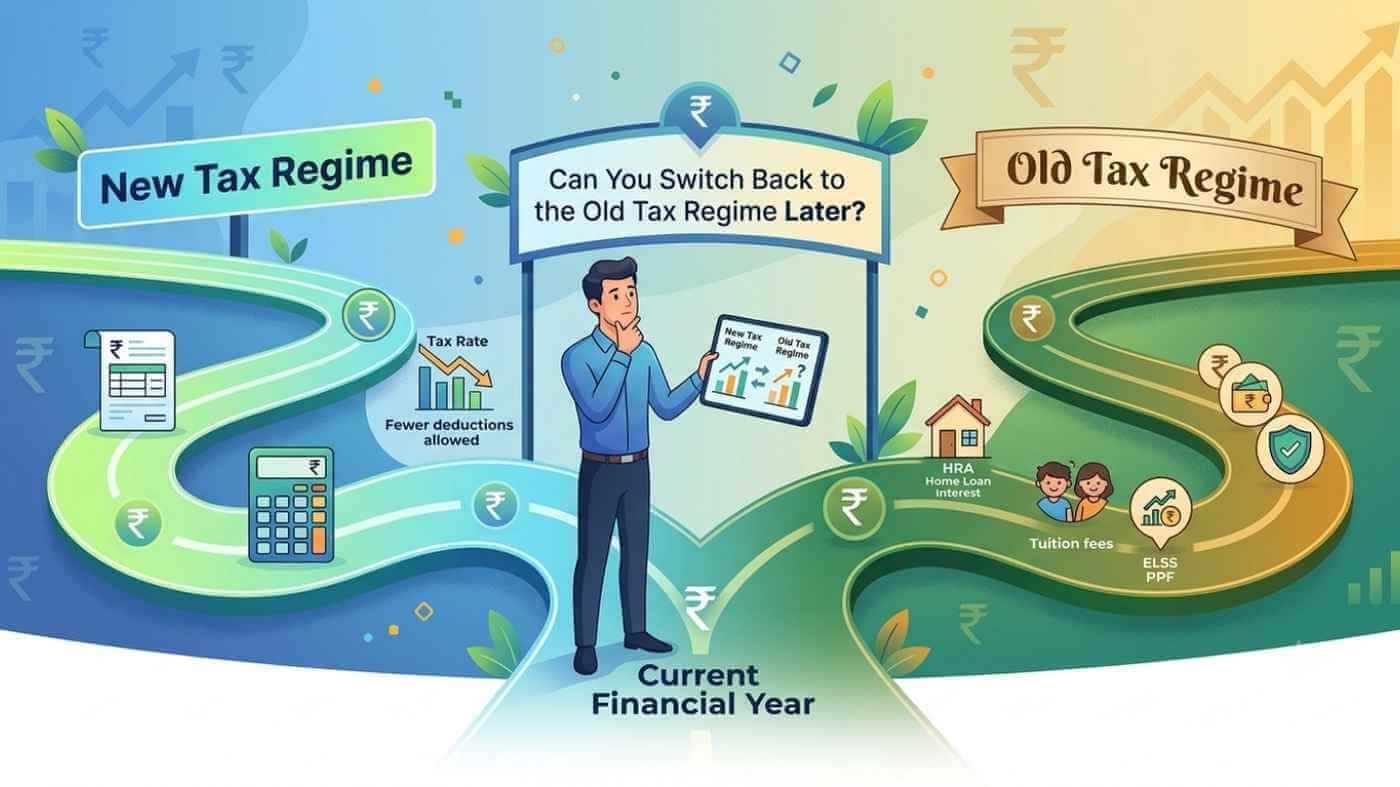
Every financial year, many taxpayers reassess whether they have chosen the most tax-efficient income tax regime. If you opted for the new tax regime in the previous year and are now wondering whether you can switch back to the old tax regime, you’re not alone. The answer depends largely on the nature of your income. The rules for salaried individuals are different from those for taxpayers with business or professional income.
With the tax changes applicable for FY 2025-26 (AY 2026-27), including revised tax slabs and enhanced rebate under the new tax regime, reviewing your choice has become even more important. Choosing the wrong regime could mean paying more tax than necessary.
What Are the Two Tax Regimes in India?
Before understanding whether you can switch back to the old tax regime, it is important to know how the two tax regimes differ. India currently offers taxpayers a choice between the old tax regime and the new tax regime. Each has its own advantages, and the better option depends on your income, deductions, and financial commitments.
The Old Tax Regime
The old tax regime allows taxpayers to reduce their taxable income by claiming a variety of deductions and exemptions. It is generally more beneficial for individuals who make regular tax-saving investments or receive tax-efficient salary components.
Some of the major benefits available under the old regime include:
- Standard deduction of Rs. 50,000 for salaried employees and pensioners.
- Section 80C deduction of up to Rs. 1.5 lakh for investments such as PPF, EPF, ELSS, life insurance premiums, NSC, and home loan principal repayment.
- Section 80D deduction for health insurance premiums.
- House Rent Allowance (HRA) exemption.
- Leave Travel Allowance (LTA) exemption.
- Home loan interest deduction under Section 24(b) for self-occupied property (up to Rs. 2 lakh).
- Various other deductions and exemptions available under the Income-tax Act.
If you actively claim these deductions, the old regime can significantly reduce your taxable income.
The New Tax Regime
The new tax regime was introduced in Budget 2020 and has been progressively enhanced. From FY 2023-24, it became the default tax regime, and Budget 2025 further increased its attractiveness by revising tax slabs and enhancing the rebate under Section 87A.
The new regime offers:
- Lower tax slab rates.
- Standard deduction of Rs. 75,000 for salaried employees and pensioners.
- Simplified tax compliance with minimal documentation.
- Most deductions and exemptions are not available, except a limited number such as the employer’s NPS contribution under Section 80CCD(2) and certain specified exemptions.
For taxpayers who have few deductions or prefer a simpler tax filing process, the new regime may result in lower overall tax liability.
Old Tax Regime vs New Tax Regime (FY 2025-26)
| Feature | Old Tax Regime | New Tax Regime (FY 2025-26) |
|---|---|---|
| Tax Slabs | Higher slab rates | Lower slab rates |
| Basic Exemption Limit | Rs. 2.5 lakh (Rs. 3 lakh for senior citizens, Rs. 5 lakh for super senior citizens) | Rs. 4 lakh for all individuals |
| Standard Deduction | Rs. 50,000 | Rs. 75,000 |
| Section 80C Deduction | Available (up to Rs. 1.5 lakh) | Not available |
| HRA Exemption | Available | Not available |
| Home Loan Interest (Section 24(b)) | Available for self-occupied property | Not available for self-occupied property |
| Section 80D (Health Insurance) | Available | Not available |
| Employer’s NPS Contribution [Section 80CCD(2)] | Available | Available |
| Section 87A Rebate | Up to Rs. 12,500 (subject to conditions) | Up to Rs. 60,000 for eligible taxpayers under FY 2025-26 provisions |
| Default Regime | Optional | Default regime |
The key difference is simple: the old regime rewards taxpayers who claim substantial deductions and exemptions, while the new regime rewards taxpayers with lower deductions by offering lower tax rates and a simpler filing process. Understanding this distinction is the first step before deciding whether switching back to the old tax regime makes financial sense.
Can You Switch Back to Old Tax Regime? The Core Rules
Whether you can switch back to the old tax regime depends on the type of income you earn. The Income-tax Act provides different rules for salaried individuals and taxpayers with business or professional income. Understanding these rules is essential before making your choice.
For Salaried Individuals
If you earn income primarily from salary or pension and do not have business or professional income, you have complete flexibility.
You can:
- Choose either the old or new tax regime every financial year.
- Change your tax regime while filing your Income Tax Return (ITR), even if your employer deducted TDS under a different regime.
- Review your tax liability annually and select the regime that results in the lowest tax.
For example, suppose you opted for the new tax regime for TDS purposes during FY 2025-26. While filing your ITR for AY 2026-27, you calculate that the old regime results in a lower tax liability because you claimed HRA, Section 80C investments, and home loan interest. In that case, you can simply file your return under the old regime and claim any eligible refund if excess TDS has been deducted.
For salaried taxpayers, this flexibility is available every financial year, allowing you to make a fresh decision based on your actual income and deductions.
For Self-Employed Individuals, Freelancers, and Business Owners
The rules are different if you have income under the head “Profits and Gains of Business or Profession.”
If you have business or professional income:
- The new tax regime is the default regime.
- If you wish to opt for the old tax regime, you must exercise the option by filing Form 10-IEA before the prescribed due date.
- Once you opt out of the default new regime, the Income-tax Act places restrictions on changing your choice in future years.
Because these switching rules are significantly more restrictive than those applicable to salaried taxpayers, freelancers, consultants, professionals, and business owners should carefully compare both tax regimes before exercising the option.
Quick Comparison
| Taxpayer Type | Can you switch every year? |
|---|---|
| Salaried employees and pensioners (without business income) | Yes. You can choose either regime every financial year while filing your ITR. |
| Business owners, professionals and freelancers | Restricted. The provisions of the Income-tax Act and Form 10-IEA govern the option. Once exercised, future switching is subject to statutory restrictions. |
The key takeaway is simple: salaried taxpayers enjoy annual flexibility, while taxpayers with business or professional income should make their decisions carefully, as changing regimes later is subject to stricter legal provisions.
How to Exercise the Switch: Step-by-Step
Understanding the rules is only half the job. You also need to know how and when to exercise your choice. The process differs for salaried taxpayers and those with business or professional income.
For Salaried Employees
If you earn only salary or pension income, switching between tax regimes is straightforward.
- Inform your employer of your preferred tax regime at the beginning of the financial year (generally in April) so that TDS can be deducted accordingly.
- Review your tax position before filing your Income Tax Return (ITR). Your actual deductions, exemptions, and income may differ from your initial estimates.
- Choose the most beneficial regime while filing your ITR. Even if your employer deducted TDS under one regime, you can select the other regime in your return, provided you are eligible.
- File your ITR within the prescribed due date. Filing on time ensures you can exercise your choice under the applicable provisions of the Income-tax Act.
For Self-Employed Individuals, Freelancers, and Business Owners
If you have income under the head “Profits and Gains of Business or Profession,” the process is different.
- Calculate your tax liability under both the old and new tax regimes.
- If you wish to opt for the old tax regime instead of the default new regime, file Form 10-IEA on or before the due date prescribed under Section 139(1) for filing your Income Tax Return.
- File your Income Tax Return under the chosen regime.
- Remember that the Income-tax Act places restrictions on switching between regimes for taxpayers with business or professional income. Therefore, evaluate your long-term tax position before exercising the option.
Important Points to Remember
- Salaried taxpayers can choose the tax regime each financial year while filing their ITR.
- Your employer’s choice for TDS deduction is not your final tax regime choice. The final selection is made while filing your return.
- Business and professional taxpayers must file Form 10-IEA (not Form 10-IE) wherever applicable and should be mindful of the statutory restrictions on changing regimes.
- Always compare your tax liability under both regimes before making a decision rather than relying on general assumptions.
A few minutes spent comparing both tax regimes each year can help ensure you pay only the tax that is legally required, and not more.
When Does Switching Back to the Old Tax Regime Make Sense?
Choosing between the old and new tax regimes should always be based on your actual income, deductions, and financial commitments. While the new regime offers lower tax rates, the old regime can still result in lower overall tax if you regularly claim deductions and exemptions.
Here are some situations where switching back to the old tax regime may be the better choice.
You Have a Home Loan
If you have a home loan for a self-occupied property, the old regime allows you to claim:
- Up to Rs. 2 lakh per year as a deduction for home loan interest under Section 24(b).
- Deduction for principal repayment under Section 80C, subject to the overall limit of Rs. 1.5 lakh.
These deductions are not available for a self-occupied property under the new tax regime. If your home loan interest is substantial, the old regime can significantly reduce your taxable income.
You Pay Significant Rent
If your salary includes House Rent Allowance (HRA) and you live in rented accommodation, the HRA exemption under the old regime can provide considerable tax savings.
This benefit is especially valuable for employees living in cities with high rental costs such as Mumbai, Delhi, Bengaluru, Hyderabad, Chennai, or Pune.
You Regularly Claim Section 80C Deductions.
The old regime is often beneficial if you already invest in eligible tax-saving instruments, such as:
- Employee Provident Fund (EPF)
- Public Provident Fund (PPF)
- Equity Linked Savings Scheme (ELSS)
- National Savings Certificate (NSC)
- Life insurance premiums
- Five-year tax-saving fixed deposits
- Home loan principal repayment
- Children’s tuition fees
Since many taxpayers make these investments for long-term financial goals anyway, claiming the deduction under the old regime becomes an additional benefit.
You Pay Health Insurance Premiums
The old regime also allows deductions under Section 80D, including:
- Up to Rs. 25,000 for health insurance premiums paid for yourself, your spouse, and dependent children.
- An additional deduction of up to Rs. 50,000 for premiums paid for senior citizen parents, subject to the provisions of the Income-tax Act.
For families with comprehensive health insurance, these deductions can meaningfully reduce taxable income.
You Claim Other Exemptions and Deductions
The old regime may also be more advantageous if you regularly claim deductions or exemptions such as:
- Leave Travel Allowance (LTA)
- Interest on education loans under Section 80E
- Eligible donations under Section 80G
- Certain allowances available as part of your salary structure
The more deductions you can legitimately claim, the stronger the case for the old regime becomes.
Practical Example
Consider Ramesh, a salaried employee earning Rs. 18 lakh per year. He:
- Pays rent and claims HRA.
- Has a home loan on a self-occupied property.
- Invests the full Rs. 1.5 lakh under Section 80C.
- Pays health insurance premiums for his family.
After considering all eligible deductions, his taxable income under the old regime reduces significantly. In his case, the tax saved through deductions is greater than the benefit of the lower slab rates available under the new regime.
Now consider Priya, who earns Rs. 10 lakh annually. She has no home loan, pays no rent, and has only limited tax-saving investments. Since she has very few deductions to claim, the lower tax rates under the new regime result in a lower overall tax liability.
The Bottom Line
Switching back to the old tax regime generally makes sense when your eligible deductions and exemptions are substantial enough to offset the higher tax slab rates. If your deductions are limited, the new regime is often the more tax-efficient option.
Rather than relying on general rules, compare your tax liability under both regimes each financial year. A simple calculation based on your actual income and deductions is the most reliable way to determine which regime saves you more tax.
Common Mistakes to Avoid When Switching Tax Regimes
Switching between the old and new tax regimes can help reduce your tax liability, but a few common mistakes can lead to unnecessary taxes, compliance issues, or missed opportunities. Here are the most important ones to avoid.
Not Informing Your Employer on Time
If you are a salaried employee, your employer will calculate Tax Deducted at Source (TDS) based on the tax regime you declare at the beginning of the financial year. If you do not communicate your preference, the employer will generally deduct TDS under the default regime.
Although you can still choose a different regime while filing your Income Tax Return (ITR), incorrect TDS during the year may affect your monthly cash flow and could result in either additional tax payable or a refund later.
Missing the ITR Filing Due Date
Filing your return within the prescribed due date is important, particularly if you wish to exercise your tax regime option in accordance with the Income-tax Act.
Missing the due date may affect your ability to exercise certain options and could also result in interest, late fees, or other compliance consequences. Filing on time helps preserve your choices and avoids unnecessary complications.
Assuming One Regime Is Always Better
No tax regime is universally superior.
Your ideal choice can change from year to year depending on factors such as:
- Salary increases
- Home loan repayments
- HRA eligibility
- Health insurance premiums
- Section 80C investments
- Changes in family or financial circumstances
Review your tax position every financial year instead of assuming last year’s decision will continue to be the best.
Not Comparing Tax Under Both Regimes
Many taxpayers simply accept the default regime without calculating the alternative.
Before filing your return, prepare a tax calculation under both the old and new regimes using your actual income and eligible deductions. Spending a few minutes on this comparison could result in significant tax savings.
Business Income Taxpayers Making a Hasty Decision
If you have income from a business or profession, switching between tax regimes is subject to statutory restrictions.
Before filing Form 10-IEA or exercising your option, consider not only your current year’s tax liability but also your expected income, deductions, and long-term financial plans. Since future flexibility is limited, the decision deserves careful evaluation.
How Your Investments Affect the Regime Decision
One of the biggest differences between the two tax regimes is how they treat investments.
Under the old tax regime, eligible investments can reduce your taxable income. Common examples include:
- ELSS mutual funds
- Public Provident Fund (PPF)
- Employee Provident Fund (EPF)
- National Savings Certificate (NSC)
- Life insurance premiums
- Tax-saving fixed deposits
These investments qualify for deduction under Section 80C, subject to the prescribed limit.
Under the new tax regime, these investments continue to help you build long-term wealth, but they generally do not provide a tax deduction. This means your investment decisions should be driven primarily by your financial goals rather than tax savings alone.
For example:
- If you already invest regularly in ELSS or PPF for retirement or wealth creation, the old regime may provide additional tax benefits.
- If you prefer flexibility and do not rely on tax-saving investments, the new regime may offer a lower overall tax burden with simpler compliance.
The most effective approach is to align your tax planning and investment planning rather than treating them as separate decisions. Selecting the right tax regime while maintaining a disciplined investment strategy can improve both your current tax efficiency and your long-term financial outcomes.
Frequently Asked Questions
1. Can a salaried person switch back to the old tax regime every year?
Yes. If you are a salaried employee or pensioner without business or professional income, you can choose between the old and new tax regimes every financial year. You may inform your employer of your preferred regime for TDS purposes, and your final choice can be made while filing your Income Tax Return (ITR) within the prescribed due date.
2. What is Form 10-IEA and when do I need it?
Form 10-IEA is required for taxpayers who have business or professional income and wish to exercise the option relating to the old or new tax regime under the applicable provisions of the Income-tax Act.
Salaried individuals who do not have business or professional income do not need to file Form 10-IEA.
3. What happens if I miss the ITR filing due date after choosing a tax regime?
Missing the due date for filing your ITR can have several consequences, including late filing fees, interest on unpaid taxes, and the loss of certain benefits available under the Income-tax Act.
If you intend to opt for the old tax regime where exercising the option is subject to the prescribed due date, filing your return on time is important. Always ensure your ITR is filed within the applicable due date to avoid unnecessary complications.
4. Is the old tax regime being phased out?
No. The old tax regime continues to be available as an option under the Income-tax Act.
Although the new tax regime is the default regime, eligible taxpayers can still opt for the old regime by following the prescribed procedure. As of now, there has been no official announcement stating that the old tax regime will be discontinued.
Since tax laws may change through future Union Budgets or legislative amendments, it is advisable to review the latest provisions each financial year.
5. How do I know which tax regime saves me more money?
The only reliable way is to calculate your tax liability under both regimes using your actual income and eligible deductions.
Generally:
- The old regime may be more beneficial if you claim substantial deductions such as Section 80C, Section 80D, HRA, or home loan interest.
- The new regime may be more beneficial if your deductions are limited and you prefer lower tax rates with simpler compliance.
Comparing both calculations before filing your return helps ensure you choose the regime that minimizes your tax liability. If the comparison seems complex, a qualified tax professional or financial advisor can help you evaluate both options accurately.
Final Words
The ability to switch back to the old tax regime gives many Indian taxpayers the flexibility to choose the option that best suits their financial situation. Salaried individuals generally have the freedom to review and change their choice every financial year, while taxpayers with business or professional income should evaluate their decision carefully because different rules apply to them.
There is no universally better tax regime. The right choice depends on your income, eligible deductions, investment pattern, home loan, insurance premiums, and long-term financial goals. Rather than relying on general assumptions, compare your tax liability under both regimes before filing your return each year.
Remember, tax planning is only one part of your overall financial strategy. Your investment decisions, insurance coverage, retirement planning, and cash flow should all work together to help you achieve your long-term objectives.
Disclaimer
The information provided in this blog is for educational and informational purposes only and should not be construed as investment advice. Please consult a qualified financial advisor before making any investment decisions. Shashikant Chanderkumar Mudaliar (ARN: 319377), operating under the brand name VSJ FinMart, is an AMFI-registered Mutual Fund Distributor (MFD) and does not provide investment advisory services. Mutual fund investments are subject to market risks. Past performance is not indicative of future results. Please read all scheme-related documents carefully before investing. Registration details can be verified at www.amfiindia.com/locate-distributor.