

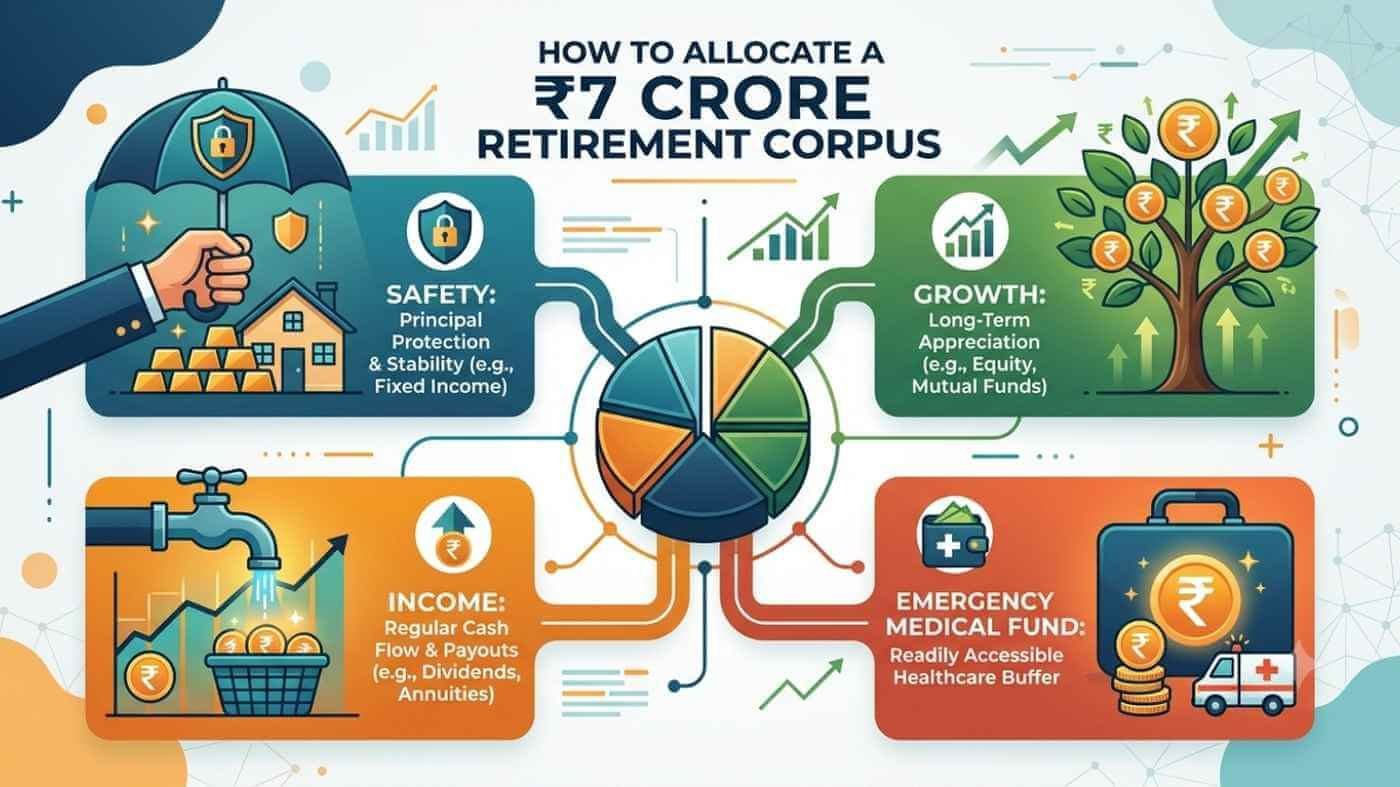
Building a ₹7 crore retirement corpus is a remarkable achievement. But here is the truth most people miss: accumulating the money is only half the battle. The real challenge begins the moment you retire.
How you allocate your ₹7 crore retirement corpus determines whether your money lasts 20 years or 35 years. Get it right, and you live comfortably without ever worrying about outliving your savings. Get it wrong, and even ₹7 crore can run dry faster than you expect.
In this guide, we break down a practical, step-by-step allocation strategy designed specifically for Indian retirees. Whether you are retiring at 58 or 65, these principles will help you protect your wealth, generate steady income, and stay ahead of inflation.
Why a ₹7 Crore Retirement Corpus Needs a Clear Plan
Many retirees make the mistake of parking all their money in a fixed deposit and calling it a day. While FDs feel safe, they rarely keep pace with inflation. At an average inflation rate of 6% per year, the purchasing power of your money halves in roughly 12 years.
In other words, what costs ₹1,00,000 today will cost approximately ₹2,00,000 in 12 years. If your corpus does not grow, you will slowly find yourself unable to maintain your current lifestyle, even with ₹7 crore in the bank.
Therefore, the goal of any smart retirement corpus allocation strategy is not just safety. It is a
careful balance between generating income, preserving capital, and growing wealth to beat inflation over time.
Step 1: Understand Your Monthly Income Requirement
Before allocating a single rupee, you must know how much you need every month. This is your foundation. Without this number, no allocation strategy will work.
How to Calculate Your Retirement Monthly Expenses
- List all current monthly expenses: rent or maintenance, groceries, utilities, travel, and entertainment.
- Add healthcare costs. Medical expenses rise sharply after 60, so budget generously here.
- Factor in any loan EMIs that will continue into retirement.
- Add a buffer of 15 to 20% for unexpected costs.
For example, if your current monthly expense is ₹80,000, plan for at least ₹95,000 to ₹1,00,000 per month in retirement. Over a 25-year retirement, with 6% annual inflation, your total expense requirement could exceed ₹7 crore on its own. This is exactly why your ₹7 crore retirement corpus must work hard for you, not just sit idle.
Step 2: Divide Your Corpus into Three Clear Buckets
The most effective retirement corpus allocation strategy for Indian investors is the three-bucket approach. Each bucket serves a different purpose and holds different types of investments. Together, they balance safety, income, and growth.
| Bucket | Purpose | Suggested Allocation | Suggested Instruments | Time Horizon |
|---|---|---|---|---|
| Bucket 1: Safety | Immediate income for daily expenses | 15% (approx. ₹1.05 Cr) | Savings account, liquid funds, short-term FDs | 0 to 2 years |
| Bucket 2: Income | Regular income for medium-term needs | 45% (approx. ₹3.15 Cr) | Senior Citizen Savings Scheme (SCSS), RBI Bonds, debt mutual funds, POMIS | 2 to 10 years |
| Bucket 3: Growth | Beat inflation and grow wealth long-term | 40% (approx. ₹2.80 Cr) | Equity mutual funds, balanced advantage funds, index funds | 10+ years |
This structure ensures you never have to sell equity investments during a market downturn to meet monthly expenses. Your Bucket 1 handles immediate needs. Bucket 2 replenishes Bucket 1 over time. Bucket 3 grows quietly in the background to fund your later retirement years.
Step 3: Build Bucket 2 with Reliable Income Sources
Bucket 2 is the engine of your retirement income. For most Indian retirees, this bucket will carry the heaviest load. Here are the key instruments to consider for this portion of your ₹7 crore retirement corpus allocation strategy.
Senior Citizen Savings Scheme (SCSS)
SCSS is one of the best options for retirees aged 60 and above. It currently offers around 8.2% per annum, paid quarterly. The maximum investment limit is ₹30 lakh per individual (₹60 lakh for a couple). It is government-backed, so the risk is minimal.
RBI Floating Rate Savings Bonds
These bonds offer interest linked to the National Savings Certificate rate plus 0.35%. Interest is paid half-yearly. They are safe, liquid after the lock-in period, and suitable for medium-term income.
Post Office Monthly Income Scheme (POMIS)
POMIS offers guaranteed monthly income. The current rate is around 7.4% per annum. The maximum investment limit is ₹9 lakh individually or ₹15 lakh jointly. It is a dependable option for supplementing monthly cash flow.
Debt Mutual Funds
For retirees in lower tax brackets, debt mutual funds offer tax-efficient returns. Unlike FDs, where interest is taxed annually as per your slab, debt fund gains are now taxed as per your income slab on redemption. However, they still offer greater flexibility and often better post-tax returns for those with lower taxable income.
Step 4: Allocate Smartly to Bucket 3 for Long-Term Growth
Many retirees avoid equity entirely. This is understandable, but it is also one of the biggest risks to a long retirement. With life expectancy rising, a 60-year-old today may need their corpus to last 30 years or more. Without some equity exposure, inflation will quietly erode purchasing power.
However, equity in retirement must be handled carefully. The goal is growth, not speculation.
Recommended Equity Instruments for Retirees
- Balanced Advantage Funds (BAFs): These funds dynamically shift between equity and debt based on market valuations. They reduce downside risk while still capturing long-term equity growth. They are a practical choice for conservative retirees who still need growth.
- Large-Cap or Index Funds: If you have a longer time horizon (10 or more years for this portion), large-cap or Nifty 50 index funds offer stable, diversified equity exposure with lower volatility compared to mid or small-cap funds.
- Equity Savings Funds: These funds combine equity, debt, and arbitrage positions. They aim to provide moderate returns with lower volatility, making them a good bridge between pure debt and pure equity.
Most importantly, do not time the market. Bucket 3 is meant to be left undisturbed for 10 or more years. The right fund choice depends entirely on your individual risk profile, health situation, and other income sources. A personalised review with a trusted advisor at VSJ FinMart can help you identify which equity funds belong in your retirement portfolio and in what proportion.
Step 5: Account for Taxes and Healthcare Costs
A robust ₹7 crore retirement corpus allocation strategy must account for two often-overlooked drains: taxes and healthcare. Ignoring either of these can significantly reduce your effective income.
Tax Planning in Retirement
In the new tax regime, basic exemption is ₹3 lakh for individuals below 60 and ₹3 lakh for senior citizens as well. However, interest income from FDs, SCSS, and bonds adds to your taxable income. Large interest income can push you into higher tax slabs quickly.
Plan your income sources so that your total taxable income stays within the most efficient tax band. Mix interest-bearing instruments with growth-oriented instruments (like mutual funds) that generate returns without annual taxable income.
| Income Source | Tax Treatment | Notes |
|---|---|---|
| SCSS Interest | Taxable as per slab | TDS applies if interest exceeds ₹50,000 per year for senior citizens |
| POMIS Interest | Taxable as per slab | No TDS, but must be declared in ITR |
| RBI Bond Interest | Taxable as per slab | TDS applicable |
| Equity Mutual Fund Gains (held over 1 year) | LTCG at 12.5% above ₹1.25 lakh | Tax-efficient for long holding periods |
| Debt Mutual Fund Gains | Taxable as per slab | More tax-efficient than FD for those in lower slabs |
Healthcare Planning
Healthcare is often the single largest expense retirees underestimate. Even with ₹7 crore, a serious medical event without adequate insurance can drain your corpus rapidly.
- Maintain comprehensive health insurance coverage of at least ₹25 to ₹50 lakh, ideally with a super top-up plan.
- Set aside a dedicated emergency medical fund of ₹10 to ₹15 lakh in a liquid instrument. This sits within or alongside your Bucket 1.
- Review your insurance cover annually. Medical costs in India have been rising at 10 to 15% per year in many cities.
A Practical Example: How Ramesh Allocated His ₹7 Crore Retirement Corpus
Ramesh retired at 62 with a ₹7 crore retirement corpus. His monthly expense requirement was ₹1,00,000. Here is how he allocated his savings following this strategy.
| Allocation | Instrument | Amount | Expected Annual Return | Annual Income |
|---|---|---|---|---|
| Bucket 1 (Safety) | Liquid Fund + Savings Account | ₹75 lakh | 5 to 6% | ₹4.25 lakh |
| Bucket 2 (Income) | SCSS (₹60L) + POMIS (₹15L) + RBI Bonds (₹90L) + Debt Funds (₹50L) | ₹2.15 Cr | 7.5 to 8% | ₹16.5 lakh |
| Bucket 3 (Growth) | Balanced Advantage Funds + Large-Cap Index Funds | ₹2.80 Cr | 10 to 12% (target) | Reinvested, not withdrawn |
| Emergency Medical Fund | Liquid Funds | ₹30 lakh | 5 to 6% | Available on demand |
Ramesh’s Bucket 2 generates approximately ₹16.5 lakh per year, or roughly ₹1.37 lakh per month. This comfortably covers his ₹1 lakh monthly requirement. His Bucket 3 remains untouched, growing steadily to fund his 75-plus years when other income sources may taper.
Ramesh worked to identify the right balanced advantage funds and index fund combination for his Bucket 3. Instead of relying on generic online recommendations, he received a personalised plan built around his health needs, tax situation, and family goals. That clarity made all the difference.
Common Mistakes to Avoid When Allocating a Retirement Corpus
Even with ₹7 crore, the following mistakes can seriously damage your retirement plan. Avoid them at all costs.
- Over-relying on fixed deposits: FD interest rates often lag inflation. A corpus parked entirely in FDs will shrink in real terms over a 20- to 25-year retirement.
- Withdrawing from equity during market downturns: If you need to sell equity funds during a market crash to meet expenses, you lock in losses permanently. Your bucket strategy prevents this.
- Ignoring estate planning: A ₹7 crore corpus without a will, nominee designations, and a proper estate plan can lead to serious legal and financial complications for your family.
- Not reviewing your allocation annually: Your needs and market conditions will change. A strategy set at 62 may need adjustment at 70. Annual reviews keep your plan aligned with reality.
- Underestimating healthcare inflation: Medical costs are rising faster than general inflation in India. Plan generously, not conservatively, for this category.
How Often Should You Review Your Retirement Allocation?
Your ₹7 crore retirement corpus allocation strategy is not a set-and-forget plan. You should review it at least once a year, and also whenever a major life event occurs, such as a health change, a new dependent, or a significant shift in interest rates or tax laws.
During each review, ask these questions:
- Is Bucket 1 adequately funded for the next 12 to 24 months?
- Is Bucket 2 generating the income I projected, or have rates changed?
- Has my Bucket 3 grown enough to rebalance or take some profits?
- Has my monthly expense requirement increased due to inflation or new needs?
- Do my insurance covers still match my healthcare risk?
At VSJ FinMart, we help retired investors run these annual reviews systematically, adjusting the mutual fund portfolio as life evolves. The right guidance at this stage is not a luxury. It is what protects decades of hard work.
Final Words: Make Your ₹7 Crore Work as Hard as You Did
A ₹7 crore retirement corpus is the result of years of discipline, sacrifice, and smart saving.
You have earned the right to a comfortable, worry-free retirement. But that comfort does not come from leaving money idle. It comes from a clear, well-structured allocation that balances safety, income, and long-term growth.
Remember the core principles: divide your corpus into three buckets, secure near-term income first, protect against healthcare costs, plan for taxes, and give a meaningful portion time to grow in equity. Most importantly, review and adjust every year.
Choosing the right instruments for your unique situation, your health, your family, your tax
bracket, and your goals is where most retirees need expert support. At VSJ FinMart, we work with you to build a personalised retirement allocation plan that does not rely on guesswork.
Reach out for a one-on-one conversation and let us help you make every rupee of your retirement corpus count.
Frequently Asked Questions
Is ₹7 crore enough to retire comfortably in India?
For most Indian households with monthly expenses of ₹80,000 to ₹1,20,000, ₹7 crore is a strong retirement corpus if allocated wisely. The key is ensuring the corpus grows faster than inflation and generates reliable monthly income. A structured three-bucket allocation approach makes this achievable.
How much monthly income can a ₹7 crore retirement corpus generate?
With a mix of SCSS, POMIS, RBI Bonds, and debt funds, a ₹7 crore corpus allocated thoughtfully can generate ₹1.2 to ₹1.5 lakh per month without touching the growth bucket. The exact figure depends on your allocation mix and prevailing interest rates.
Should retirees invest in equity mutual funds?
Yes, in most cases. Retirees with a 25 to 30-year horizon need some equity exposure to beat
inflation. Balanced advantage funds and large-cap index funds are practical, lower-volatility
options. The right allocation depends on individual risk capacity and other income sources.
What is the biggest risk for someone with a ₹7 crore retirement corpus?
Inflation is the biggest long-term risk. If the corpus does not grow at or above the inflation rate, purchasing power erodes steadily. Sequence-of-returns risk, which means experiencing poor market performance in the early years of retirement, is the second major risk. The bucket strategy addresses both directly.
How often should I rebalance my retirement portfolio?
An annual review is the minimum recommended frequency. Rebalance when any bucket drifts significantly from its target allocation (more than 5 to 10 percentage points), or when interest rates, tax laws, or personal circumstances change. A qualified advisor can help you decide when and how to rebalance.
Disclaimer
The information provided in this blog is for educational and informational purposes only and should not be construed as investment advice. Please consult a qualified financial advisor before making any investment decisions. Shashikant Chanderkumar Mudaliar (ARN: 319377), operating under the brand name VSJ FinMart, is an AMFI-registered Mutual Fund Distributor (MFD) and does not provide investment advisory services. Mutual fund investments are subject to market risks. Past performance is not indicative of future results. Please read all scheme-related documents carefully before investing. Registration details can be verified at www.amfiindia.com/locate-distributor.