

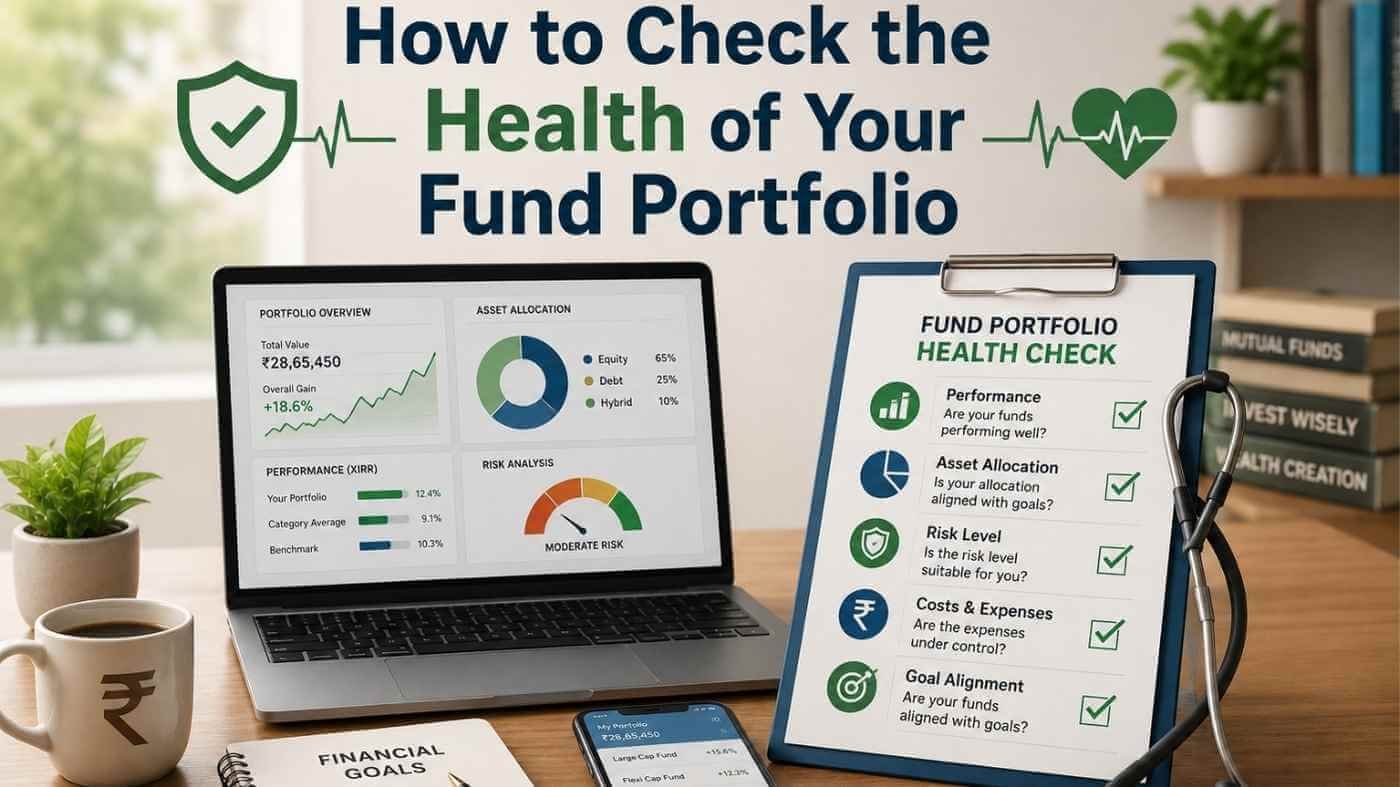
When was the last time you checked your mutual fund portfolio’s health? Most investors start a SIP, set a reminder, and then forget about it for months. That is a common habit, but it can quietly work against your long-term goals. A portfolio that looked great two years ago may be overweight in one sector, drifting away from your risk comfort zone, or simply underperforming its benchmark today.
The good news is that reviewing your mutual fund portfolio does not have to be complicated. With the right approach and a few clear metrics, you can spot problems early and make confident decisions. In this guide, we walk you through five practical steps to check mutual fund portfolio health, understand what the numbers mean, and take action when something is off.
Why Checking Your Mutual Fund Portfolio Health Matters
Your financial goals change over time. A 30-year-old saving for retirement has very different needs compared to a 50-year-old approaching that same goal. Markets also change. What performed well in a bull cycle may lag in a sideways or volatile market. If you never review your mutual fund portfolio, you may not notice these shifts until it is too late to course-correct.
Regular mutual fund portfolio health checks help you:
- Stay aligned with your original financial goals
- Identify funds that are consistently underperforming
- Catch over-concentration in one sector or asset class
- Rebalance your asset allocation before drift becomes a problem
- Make informed decisions rather than emotional ones
Think of it like a health checkup. You do not wait for symptoms to become serious before seeing a doctor. The same logic applies to your investments.
Step 1: Review Fund Performance Against the Right Benchmark
The first thing most investors look at is absolute returns. “My fund gave me 12% this year” sounds great, until you learn its benchmark index returned 18% in the same period.
Every mutual fund has a benchmark, a standard index it is compared against. For example, a large-cap fund may be benchmarked to the Nifty 50 or the BSE Sensex. An equity-linked savings scheme (ELSS) fund may benchmark against the Nifty 500.
How to Compare Properly
- Always compare returns over at least 3 to 5 years, not just 1 year
- Check whether the fund has beaten its benchmark consistently, not just in one good year
- Also compare against its peer category average, not just the index
If a fund has underperformed its benchmark for three consecutive years, that is a warning sign worth taking seriously. However, one bad year alone is not enough reason to exit.
Use the AMFI website to pull up benchmark-adjusted returns for any fund in your portfolio.
Step 2: Check Your Asset Allocation and Diversification
Asset allocation is the split between equity, debt, and other instruments in your portfolio. Over time, market movements shift this balance without you doing anything. This is called allocation drift, and it can silently change your risk profile.
Example
Imagine Priya started investing in 2021 with a 70:30 equity-to-debt split. The equity markets did well over the next two years. By 2023, her portfolio had shifted to 85:15, which is far more aggressive than she intended. If markets correct sharply, she could see a much steeper fall than she originally planned for.
Regular rebalancing, ideally once a year, brings your allocation back to the original target. In addition, diversification within equity matters too.
What Good Diversification Looks Like
- A mix of large-cap, mid-cap, and flexi-cap funds
- No single sector, such as banking or IT, making up more than 25–30% of your equity holdings.
- At least one debt or hybrid fund for stability if your goal is within 5 years
- No more than 5 to 7 funds in total (more funds does not always mean better diversification)
Owning ten funds that all hold the same top 20 stocks gives you the illusion of diversification, not the reality of it. This overlap is one of the most common issues found during a mutual fund portfolio health check.
Step 3: Analyse Key Fund Health Metrics
Beyond returns, several key metrics give you a clearer picture of how your fund is performing and whether the fund manager is adding real value. These numbers are available on any major fund analysis platform.
| Metric | What It Measures | Healthy Range (Equity Funds) |
|---|---|---|
| Alpha | Excess return over benchmark | Positive; higher is better |
| Beta | Volatility relative to market | Less than 1 for lower risk |
| Sharpe Ratio | Return earned per unit of risk | Above 1 is good; above 2 is excellent |
| Standard Deviation | How much returns fluctuate | Lower means more stable returns |
| Expense Ratio | Annual fund management cost | Under 1.5% for equity regular plans |
| Portfolio Turnover Ratio | How often the fund buys/sells stocks | Lower is generally preferable |
You do not need to master all of these overnight. Start with Alpha and Sharpe Ratio. If a fund has negative alpha and a Sharpe Ratio below 0.5 for three or more years, it is worth questioning whether it belongs in your portfolio.
Watch the Expense Ratio
The expense ratio is the annual cost charged by the fund house to manage your money. Even a small difference compounds significantly over 15 to 20 years. A fund with a 2.5% expense ratio versus one at 1.2% can make a meaningful difference to your final corpus.
The real value, however, is not just in minimising cost. It is in finding a fund that earns returns well above its cost, which is where personalised guidance from an advisor like VSJ FinMart can help you make a well-informed choice based on your specific goals.
Step 4: Identify Red Flags and Underperforming Funds
Not every underperformance is a red flag. Sometimes a fund takes a short-term hit because of its investment style or sector exposure. However, some patterns deserve attention.
Red Flags to Watch For
- Consistent underperformance: The fund has trailed its benchmark and category average for 3 or more years in a row
- Fund manager change: A new manager may have a different investment philosophy, which could shift the fund’s risk-return profile
- Sudden style drift: A large-cap fund that starts holding small-cap stocks is no longer what you signed up for
- AUM shrinkage: A rapidly falling assets under management (AUM) can signal that institutional investors are exiting the fund
- High cash holdings in a rising market: A fund sitting on 15–20% cash when markets are climbing may miss the upside unnecessarily
- Excessive concentration: If the top 5 stocks make up more than 50% of the portfolio, you are taking on more stock-specific risk than you may realise
Finding one red flag does not mean you should immediately exit. However, two or more flags appearing together, especially alongside consistent underperformance, is a strong signal to reassess.
The Overlap Problem
Use a portfolio overlap tool to check whether multiple funds in your portfolio hold the same stocks. Overlap above 60% between two funds means you are not getting the diversification benefit you think you are. In that case, it often makes more sense to hold one stronger fund rather than two overlapping ones.
Step 5: Rebalance and Set a Review Calendar
Once you have identified what is working and what is not, the next step is to take action. Rebalancing is the process of bringing your portfolio back in line with your target allocation and removing consistently poor performers.
When to Rebalance
- At least once a year, ideally at the start of a financial year in April
- Whenever your equity-debt split drifts by more than 5 percentage points from your target
- After major life events such as marriage, a child’s birth, a job change, or approaching a financial goal
- When a fund triggers two or more red flags consistently
Tax Considerations While Rebalancing
In India, equity mutual fund gains held for more than one year are treated as long-term capital gains (LTCG), currently taxed at 12.5% above Rs 1.25 lakh per year (as per the Finance Act 2024). Gains within one year attract a short-term capital gains (STCG) tax of 20%.
Therefore, before redeeming a fund, check how long you have held those units. Timing your exit smartly can save you a meaningful amount in taxes. This is one more reason why a personalised review, rather than a generic checklist, adds real value.
How Often Should You Check?
A common mistake is checking too frequently. Logging into your portfolio every day creates anxiety and invites emotional decisions. Instead:
- Do a light review every quarter: check broad performance and whether your SIPs are running correctly
- Do a full health check once a year: cover all five steps above
- Do a goal-based review three years before any major milestone: ensure the portfolio is de-risking on schedule
If you are unsure how to interpret the metrics or which changes to make, speaking with a trusted advisor is a practical step. At VSJ FinMart, our advisors help you read your mutual fund portfolio numbers clearly and make changes that align with your actual goals, not just general market trends.
Building a Habit of Portfolio Hygiene
Checking your mutual fund portfolio health is not a one-time event. It is an ongoing habit, like reviewing your household budget or tracking your fitness. The investors who build wealth over the long run are not necessarily the ones who pick the best funds at the start. They are the ones who stay engaged, spot problems early, and keep their portfolios aligned with their evolving life goals.
You do not need to be a finance expert to do this well. You need a clear process, a few reliable data sources, and the discipline to review regularly. The five steps above give you that process.
Most importantly, avoid making reactive changes based on short-term market news. A fund that drops 10% in a volatile month is not automatically bad. Context, history, and fundamentals matter far more than any single data point.
Final Words
Your mutual fund portfolio is a living reflection of your financial goals. Like any living thing, it needs regular attention to stay healthy. By checking performance against benchmarks, reviewing asset allocation, understanding key metrics, spotting red flags, and rebalancing with a tax-aware approach, you take meaningful control of your financial future.
The goal is not to chase perfect returns. The goal is a portfolio that fits your life, your risk appetite, and your timeline.
If you would like a second pair of eyes on your mutual fund portfolio, the team at VSJ FinMart is here to help. We review your existing funds, explain what the numbers mean in plain language, and work with you to build a plan that is genuinely tailored to your goals. Reach out today for a no-pressure conversation.
Frequently Asked Questions
How often should I check my mutual fund portfolio health?
A quarterly light review and a full annual health check are a good rhythm for most investors. Avoid daily checking, as it tends to lead to emotional decisions. If a major life event occurs, such as a job change or an upcoming financial goal, schedule an additional review at that point.
What is a good Sharpe Ratio for an equity mutual fund?
A Sharpe Ratio above 1 is generally considered good. A ratio above 2 is excellent. It measures the return earned per unit of risk taken. When comparing two funds with similar returns, the one with a higher Sharpe Ratio is the more efficient choice.
How do I check if my funds overlap too much?
Log in to the VSJ FinMart app for free to review this. It has a built-in portfolio overlap tool where you can enter the names of two funds and instantly see what percentage of their stock holdings are common. If the overlap between two equity funds comes out above 60%, it’s a sign they aren’t diversifying your portfolio as much as you might think, and it may be worth getting personalised guidance from a VSJ FinMart advisor on restructuring your mutual fund portfolio.
What should I do if a fund has been underperforming for 2 years?
First, compare it to its benchmark and category peers, not just in absolute terms. Check if there has been a fund manager change or a style drift. If the fund has underperformed its benchmark and category average for three or more consecutive years, it may be worth switching to a better-suited fund. An advisor can help you weigh the tax implications before making any move.
Is rebalancing taxable in India?
Yes, redeeming mutual fund units to rebalance can trigger capital gains tax. Equity fund gains held for more than one year are taxed as LTCG at 12.5% above Rs 1.25 lakh per year. Gains within one year attract STCG tax at 20%. Planning your rebalancing around these thresholds can help reduce your tax outgo meaningfully.
Disclaimer
The information provided in this blog is for educational and informational purposes only and should not be construed as investment advice. Please consult a qualified financial advisor before making any investment decisions. Shashikant Chanderkumar Mudaliar (ARN: 319377), operating under the brand name VSJ FinMart, is an AMFI-registered Mutual Fund Distributor (MFD) and does not provide investment advisory services. Mutual fund investments are subject to market risks. Past performance is not indicative of future results. Please read all scheme-related documents carefully before investing. Registration details can be verified at www.amfiindia.com/locate-distributor.