

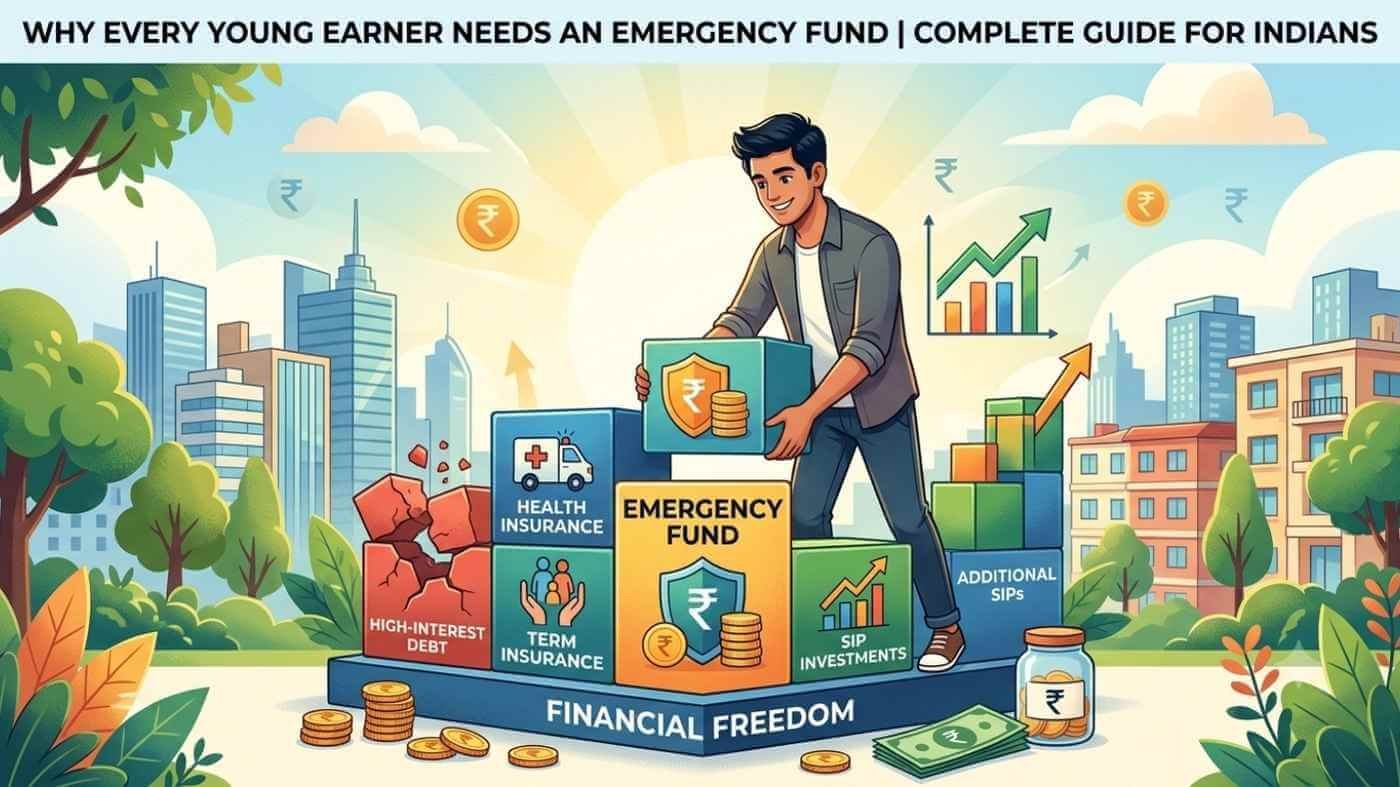
You just got your first salary. SIPs, NPS, stocks; the investing excitement is real. But before any of that, there is one thing that matters more: an emergency fund.
Most young earners skip it. They think they are too young for emergencies, or that they will handle things when the time comes. That logic is expensive.
An emergency fund is the financial cushion that keeps everything else intact when life goes sideways: a job loss, a hospitalisation, an urgent repair. Without it, you panic-sell investments at losses, take high-interest loans, or borrow from family. With it, you handle the crisis and move on.
Why the Emergency Fund Comes Before Investing
Arnav is 26, earns Rs. 70,000 per month, and has been investing diligently: SIPs, NPS, even some stocks; no emergency fund.
His father is hospitalised. Emergency surgery: Rs. 2.5 lakh. Arnav does not have Rs. 2.5 lakh in cash.
His options without an emergency fund: take a personal loan at 12-14% interest (Rs. 35,000 in interest over two years), redeem his SIPs at a 15% early withdrawal loss, or borrow from family at awkward terms.
His option with an emergency fund: withdraw, pay the bill, and resume investing the following month.
Arnav did not have that option. He is now paying the price of skipping the first step.
This is not a rare scenario. Job losses, medical bills, sudden repairs: these happen at 26 as readily as at 46. Young earners are actually more vulnerable because they have less accumulated wealth to absorb a shock, fewer years of savings behind them, and more career volatility than someone 20 years into their profession.
How Much Do You Actually Need?
The standard guideline is 3 to 6 months of monthly living expenses. The right number depends on your income stability and family obligations.
3 months: minimum for a salaried professional with stable income and no dependants.
6 months: better for anyone supporting parents, paying a home loan, or whose income could realistically disappear for several months.
9-12 months: appropriate for freelancers, business owners, or anyone with genuinely variable monthly income.
Use this table to calculate your target.
| Situation | Monthly Expenses | Target Emergency Fund |
| Salaried, single, low expenses | Rs. 40,000 | Rs. 1.2 lakh (3 months) to Rs. 1.6 lakh (4 months) |
| Salaried, married, medium expenses | Rs. 80,000 | Rs. 2.4 lakh (3 months) to Rs. 4 lakh (5 months) |
| Freelancer or self-employed | Rs. 60,000 | Rs. 3.6 lakh (6 months) to Rs. 7.2 lakh (12 months) |
| Salaried, supporting parents or dependants | Rs. 1 lakh | Rs. 3 lakh (3 months) to Rs. 6 lakh (6 months) |
To calculate your own target: list every monthly expense (rent, EMI, groceries, utilities, insurance, transport, subscriptions) and add them up. Multiply by the number of months appropriate for your situation.
Where to Keep It: The Right Instruments
The emergency fund must be safe (no risk of losing principal), liquid (accessible within 24-48 hours), and earn at least 4-6% rather than sit idle. It should never be in equity funds or stocks.
| Instrument | Return | Access Time | Best Use |
| Savings Account | 2-4% | Instant | First Rs. 30,000-50,000. Smallest emergencies: a pharmacy bill, a broken appliance. |
| Liquid Mutual Fund | 6-7% | Same day or 1 business day | The main body of your emergency fund. Best balance of safety, returns, and liquidity. |
| Short-Duration Debt Fund | 6-7% | 1-2 business days | Suitable for the portion beyond 2-3 months of expenses. Slightly higher return than liquid funds. |
| Fixed Deposits (FD) | 6.5-7.5% | Breakable with small penalty | Appropriate for the upper tier of a well-funded emergency corpus (beyond 4-5 months). |
The Recommended Split for Most Young Earners
Rs. 30,000-50,000 in a savings account for immediate access.
Rest of the target (e.g. Rs. 1.5 lakh-3 lakh) in a liquid mutual fund earning 6-7%.
If the corpus is large (above Rs. 4 lakh), park the excess in a short-duration debt fund or FD.
What to avoid: Equity, stocks, real estate, or any asset that can fall in value at exactly the wrong moment.
How to Build It: A Month-by-Month Plan
Start immediately. Rs. 5,000 per month is fine to begin. Consistency matters more than the starting amount. Here is a realistic build timeline.
| Timeline | Milestone | What to Do |
| Month 1-2 | Target 1 month of expenses fast | Open a dedicated savings account or liquid fund. Auto-debit Rs. 8,000-12,000 on salary day. This is your immediate buffer. |
| Month 3-6 | Reach 3 months of expenses | Maintain the auto-debit. Move any windfalls (bonus, cash gifts) directly to the fund rather than spending. |
| Month 6-12 | Extend to 4-6 months | Begin SIPs if not already started, but keep the emergency fund auto-debit running until fully funded. |
| After target reached | Protect and maintain | Redirect the monthly contribution to SIPs. If the fund is used, rebuild before increasing SIPs again. |
The one rule: never skip refilling after a withdrawal. If you use Rs. 80,000 of your emergency fund, restart the monthly contribution to that account immediately. The fund only works as a safety net if it is always funded.
The Correct Priority Order for Young Earners
The emergency fund is not in competition with SIPs. It is the foundation that makes SIPs sustainable. Here is the correct sequence.
| # | Step | What | Why It Comes Here |
| 1 | Emergency Fund | 3-6 months of expenses in a liquid fund or savings account | Foundation. Everything else depends on this. |
| 2 | Health Insurance | Individual or family floater, Rs. 5-10 lakh minimum | Prevents a medical bill from draining the emergency fund itself. |
| 3 | Term Insurance | If anyone depends on your income: 15-20x annual income | Protects dependants if your income stops permanently. |
| 4 | SIP Investments | Rs. 3,000-5,000 per month minimum to start, automated | Long-term wealth building begins here. Compounding starts day one. |
| 5 | High-Interest Debt | Credit cards and personal loans at 18%+ cleared first | Paying off 24% debt is mathematically better than any available investment return. |
| 6 | Additional SIPs | Step up with every salary increment | Accelerate wealth building once the foundation is secure. |
The key insight: skipping Step 1 to reach Step 4 faster does not accelerate wealth building. It exposes every SIP and investment to the risk of forced redemption at the worst possible moment. The emergency fund is what lets you stay invested through every market cycle.
5 Common Mistakes Young Earners Make
• ‘I’m too young for emergencies.’ Accidents, medical bills, layoffs, and sudden family crises do not check your age. A 26-year-old is as likely to face a Rs. 2 lakh medical bill as a 56-year-old.
• Investing the emergency fund in equity. An equity mutual fund that drops 30% when you need the money most is not an emergency fund. It is a problem compounding a problem.
• Keeping it in a zero-interest current account. Idle money at 0% loses purchasing power every year. A liquid mutual fund pays 6-7% on the same money with the same accessibility.
• Setting an unrealistically large target. If you set a Rs. 12 lakh target when your expenses are Rs. 30,000 per month, you will delay starting SIPs for years. Start with 3 months and expand gradually.
• Using it for non-emergencies. A holiday, a new phone, or a sale item is not an emergency. Using the fund for these means it will not be there when you genuinely need it.
Final Words: Build This First, Invest Better Because of It
An emergency fund does not feel exciting. It does not appear on a compounding chart. Nobody posts about it on social media. But it is the single financial decision that determines whether every other financial decision you make can survive real life.
Start with one month of expenses. Rs. 5,000 per month if that is what you can manage. Keep it separate, keep it liquid, and never touch it for anything that is not a genuine emergency.
The moment you have it fully funded: investing becomes calmer, SIPs become permanent, and every market crash becomes something you watch rather than something that forces your hand. An AMFI-registered distributor like VSJ FinMart can help you set up the right liquid fund for your emergency corpus and build a SIP plan alongside it with personalised guidance.
Frequently Asked Questions
Q: Can I start SIPs before my emergency fund is fully built?
Yes, if you are disciplined about it. A practical split while building the fund: 60-70% of monthly surplus to the emergency fund, 30-40% to SIPs. Do not delay SIPs entirely, but the emergency fund must take priority. Once the fund reaches your target, redirect the full surplus to SIPs and investment goals.
Q: My emergency fund is in a fixed deposit. Can I access it quickly in a crisis?
Yes, but with a small interest penalty (typically 0.5-1%). FDs can be broken before maturity. For genuinely urgent needs (same-day hospitalisation, for example), it is better to keep at least one month of expenses in a savings account or liquid fund that settles instantly rather than relying entirely on an FD.
Q: What counts as a genuine emergency?
Job loss (covering living expenses until re-employed), hospitalisation or medical emergency, urgent home repair (roof damage, water damage), or a car breakdown that prevents getting to work. A holiday, a sale item, a birthday gift, or a new phone are not emergencies. If in doubt, wait 48 hours before withdrawing. Most doubts resolve themselves.
Q: Can health insurance replace my emergency fund?
No. Insurance and an emergency fund serve different purposes. Health insurance covers hospitalisation bills. Your emergency fund covers living expenses, rent, and EMIs during a job loss or income interruption, which health insurance does not. You need both. One protects against high medical costs; the other protects against income disruption of any kind.
Q: I used Rs. 80,000 of my emergency fund for a medical bill. What now?
Resume the emergency fund auto-debit immediately at the same amount you were building it with before. Do not reduce it to top up SIPs faster. Rebuild the fund to its target first, then return to the full SIP contribution. The sequence only works if the fund is always maintained at its target level.
Disclaimer
The information provided in this blog is for educational and informational purposes only and should not be construed as investment advice. Please consult a qualified financial advisor before making any investment decisions.
Shashikant Chanderkumar Mudaliar (ARN: 319377), operating under the brand name VSJ FinMart, is an AMFI-registered Mutual Fund Distributor (MFD) and does not provide investment advisory services. Mutual fund investments are subject to market risks. Past performance is not indicative of future results. Please read all scheme-related documents carefully before investing. Registration details can be verified at www.amfiindia.com/locate-distributor.