

The new tax regime promises lower tax rates and less paperwork. But before you make the switch, you need to know one important truth: several deductions not allowed in the new tax regime could cost you more than the lower rates save you. Understanding what you give up is just as important as knowing what you gain.
India’s income tax system now offers two choices. The old regime lets you reduce your taxable income using a wide range of deductions and exemptions. The new regime offers reduced slab rates but removes most of those benefits. For many salaried individuals, professionals, and investors, the deductions they claim every year are significant. Losing them without realising the full impact is a costly mistake.
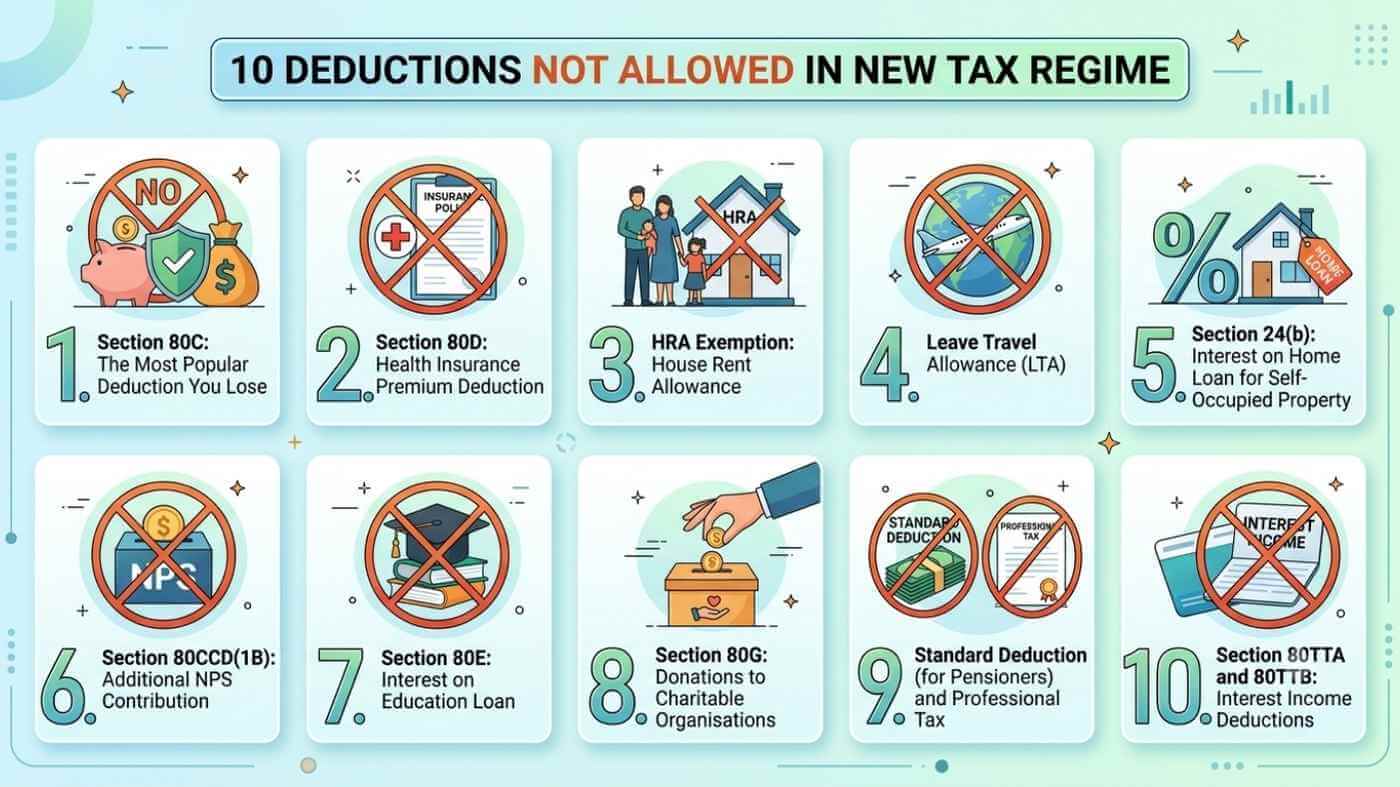
In this guide, we walk you through the ten deductions not allowed under the new tax regime, so you can make a clear and informed decision.
Why the New Tax Regime Looks Attractive at First Glance
The government introduced the new tax regime under Section 115BAC to simplify the tax filing process and bring more people into the tax net. The revised slab rates for FY 2024-25 are genuinely lower for many income brackets. There is also a rebate under Section 87A, which makes income up to Rs 7 lakh effectively tax-free under the new regime.
However, lower rates do not always mean lower tax. If you currently claim multiple deductions under the old regime, your actual taxable income could be much lower than your gross income. Switching to the new regime without doing the numbers can result in paying more tax, not less.
The key question to ask is: how much do my current deductions save me every year? The answer determines which regime is better for you.
10 Key Deductions Not Allowed in the New Tax Regime
1. Section 80C: The Most Popular Deduction You Lose
Section 80C is perhaps the most widely used deduction in India. It allows you to reduce your taxable income by up to Rs 1.5 lakh per year by investing in specific instruments.
Under the new tax regime, Section 80C deductions are completely disallowed. This means the following investments and payments no longer reduce your tax:
- Employee Provident Fund (EPF) contributions
- Public Provident Fund (PPF) contributions
- Equity Linked Savings Scheme (ELSS) mutual fund investments
- Life insurance premiums
- National Savings Certificate (NSC)
- Five-year tax-saving fixed deposits
- Sukanya Samriddhi Yojana contributions
- Tuition fees for children
- Principal repayment on home loan
For someone in the 30% tax bracket, losing Rs 1.5 lakh in 80C deductions alone means paying Rs 46,800 more in tax annually.
2. Section 80D: Health Insurance Premium Deduction
Section 80D allows you to deduct premiums paid for health insurance for yourself, your spouse, children, and parents. The limit goes up to Rs 25,000 for self and family, and an additional Rs 25,000 to Rs 50,000 for parents, depending on their age.
Under the new tax regime, this deduction is not available. Given rising healthcare costs in India, health insurance is no longer a luxury. But switching to the new regime means your premium payments no longer reduce your tax liability.
3. HRA Exemption: House Rent Allowance
If you are a salaried employee living in a rented home, the House Rent Allowance (HRA) component in your salary can be partially or fully exempt from tax under the old regime. This is calculated based on your actual rent paid, your salary, and the city you live in.
Under the new tax regime, HRA exemption is not available. For someone paying Rs 20,000 per month in rent in a metro city, this could mean losing an exemption worth Rs 1.2 lakh or more per year.
4. Leave Travel Allowance (LTA)
Leave Travel Allowance allows salaried employees to claim exemption on travel expenses within India, twice in a block of four years. Many employers include LTA as part of the salary structure specifically for this benefit.
This exemption is not available under the new tax regime. If LTA is a significant part of your salary package, this is a real loss worth factoring into your decision.
5. Section 24(b): Interest on Home Loan for Self-Occupied Property
Under the old regime, if you have a home loan on a self-occupied property, you can claim a deduction of up to Rs 2 lakh per year on the interest paid. This is one of the biggest deductions available to middle-class homeowners.
Under the new tax regime, this deduction is not allowed for self-occupied property. For someone paying Rs 30,000 per month in home loan EMI, the interest component alone in the early years can be Rs 25,000 to Rs 28,000 per month, translating to a deduction loss of Rs 2 lakh annually.
This single deduction, combined with Section 80C, often makes the old regime significantly more beneficial for homeowners.
6. Section 80CCD(1B): Additional NPS Contribution
Section 80CCD(1B) allows an additional deduction of Rs 50,000 over and above the Rs 1.5 lakh limit under Section 80C, for contributions made to the National Pension System (NPS). This is a popular tool for retirement planning and tax saving.
This benefit is not available under the new tax regime. Note that the employer’s contribution to NPS under Section 80CCD(2) is still available as a deduction even in the new regime, but the employee’s own voluntary contribution benefit is lost.
7. Section 80E: Interest on Education Loan
If you or your child has taken an education loan for higher studies, Section 80E allows you to deduct the entire interest paid during the year, with no upper cap. This can be a significant relief during the repayment years.
Under the new tax regime, the Section 80E deduction is not available. Families repaying education loans while also managing other expenses will feel this loss acutely.
8. Section 80G: Donations to Charitable Organisations
Section 80G allows deductions for donations made to approved charitable institutions and funds. Depending on the organisation, you can claim 50% or 100% of the donated amount as a deduction.
This deduction is not allowed under the new tax regime. If you regularly support charitable causes and benefit from this deduction, it is a factor worth considering.
9. Standard Deduction (for Pensioners) and Professional Tax
From FY 2023-24 onwards, the standard deduction of Rs 50,000 has been made available under the new tax regime for salaried individuals and pensioners. However, professional tax, which can be up to Rs 2,400 per year, remains unavailable as a deduction under the new regime.
While the standard deduction is now available under both regimes, this parity does not extend to all salary-related exemptions. Many other salary components that were exempt under the old regime, such as children’s education allowance, hostel allowance, and transport allowance, remain taxable under the new regime.
10. Section 80TTA and 80TTB: Interest Income Deductions
Section 80TTA allows individuals below 60 years to deduct up to Rs 10,000 of interest earned on savings bank accounts. Section 80TTB extends this benefit to senior citizens up to Rs 50,000, covering interest from savings accounts, fixed deposits, and post office deposits.
Both deductions are unavailable under the new tax regime. For senior citizens especially, who often rely on fixed deposit interest income, losing the 80TTB benefit of Rs 50,000 is a material financial disadvantage.
Quick Comparison: What You Keep vs What You Lose
| Deduction / Exemption | Old Tax Regime | New Tax Regime | Max Benefit (approx.) |
|---|---|---|---|
| Section 80C (EPF, PPF, ELSS, etc.) | Available | Not Available | Rs 1,50,000 |
| Section 80D (Health Insurance) | Available | Not Available | Rs 25,000 to Rs 1,00,000 |
| HRA Exemption | Available | Not Available | Varies by salary and city |
| Leave Travel Allowance (LTA) | Available | Not Available | Varies by employer |
| Section 24(b) Home Loan Interest (Self-Occupied House) | Available | Not Available | Rs 2,00,000 |
| Section 80CCD(1B) NPS | Available | Not Available | Rs 50,000 |
| Section 80E (Education Loan Interest) | Available | Not Available | No cap |
| Section 80G (Donations) | Available | Not Available | 50% to 100% of donation |
| Section 80TTA / 80TTB (Savings Interest) | Available | Not Available | Rs 10,000 to Rs 50,000 |
| Standard Deduction (Salaried & Pensioners) | Available | Available (from FY 2023-24) | Rs 50,000 (Old) / Rs 75,000 (New) |
A Practical Indian Example: Old vs New Regime
Consider Priya, a salaried professional in Mumbai earning ₹12 lakh per year. She pays rent of ₹15,000 per month, has an ELSS SIP investment, pays a health insurance premium, and has an education loan for her postgraduate degree.
Under the old tax regime, her deductions might look like this:
- Standard deduction: ₹50,000
- Section 80C (ELSS SIP): ₹1,50,000
- HRA exemption (estimated): ₹90,000
- Section 80D (health insurance): ₹25,000
- Section 80E (education loan interest): ₹60,000
Total deductions: approximately ₹3,75,000. Her taxable income reduces from ₹12 lakh to roughly ₹8.25 lakh. Her tax liability under the old regime comes to approximately ₹80,600, including cess.
Under the new tax regime, salaried taxpayers get a standard deduction of ₹75,000. Priya’s taxable income becomes ₹11.25 lakh. Because this falls below the ₹12 lakh threshold, she qualifies for the full Section 87A rebate. Her tax liability under the new regime works out to zero.
This is the part many taxpayers miss. It feels natural to assume that more deductions mean the old regime wins. For Priya, the opposite is true. Even with genuine 80C, 80D, HRA, and 80E claims, the new regime saves her the entire ₹80,600 that she would have paid under the old one. The right choice depends entirely on her individual numbers, and that is exactly where personalised guidance helps.
At VSJ FinMart, we help clients like Priya run the exact numbers based on their salary structure, investments, and goals, so they never pay more tax than they need. to.
Who Should Consider the New Tax Regime?
The new tax regime is not always the wrong choice. For certain individuals, it does make sense. Here is a quick guide:
The New Regime May Work Better If:
- You are a young earner who has not yet built up significant investments in 80C instruments.
- You live in your own home and do not pay rent or have a home loan.
- Your salary has very few allowances or exemption components.
- You prefer simplicity in tax filing and do not want to manage multiple investment proofs.
- Your income is below Rs 7 lakh, and the Section 87A rebate wipes out your tax entirely.
The Old Regime Likely Works Better If:
- You fully utilise Section 80C investments every year.
- You pay significant rent and claim HRA exemption.
- You have a home loan on a self-occupied property.
- You have a health insurance policy, an education loan, or both.
- You are a senior citizen with substantial fixed deposit income.
How to Decide: A Simple 3-Step Approach
Choosing between the two tax regimes does not have to be overwhelming. Follow these three steps:
- List your total deductions. Add up every deduction and exemption you currently claim: 80C, 80D, HRA, home loan interest, NPS, and any others.
- Calculate tax under both regimes. Use the applicable slab rates for each regime and compute your total tax outgo under both.
- Compare and choose. The regime where your total tax liability is lower is the right one for your current financial situation.
Keep in mind that your situation can change every year. Getting a home loan, starting a health insurance policy, or increasing your SIP contributions can shift the balance. Review your choice every financial year before the deadline for submitting your investment declaration to your employer.
A quick conversation with a VSJ FinMart advisor can make this comparison effortless. We look at your complete financial picture and recommend the regime that truly works best for you, not just on paper, but in practice.
Common Mistakes People Make When Switching Regimes
Many taxpayers switch to the new regime without fully understanding the consequences. Here are some of the most common errors:
- Assuming lower rates always mean lower tax. This is incorrect if your deductions are substantial.
- Not accounting for HRA. Many salaried employees underestimate how much HRA saves them.
- Forgetting home loan interest. The Section 24(b) deduction of Rs 2 lakh is one of the largest available and is often overlooked in regime comparisons.
- Ignoring the senior citizen impact. The loss of Section 80TTB is particularly painful for retirees who depend on interest income.
- Switching without calculating. Many people switch based on what they read online without applying the numbers to their own income. Generic advice is never a substitute for personal calculation.
Final Thoughts
The deductions not allowed in the new tax regime represent a real cost for many taxpayers. Section 80C, HRA, home loan interest, health insurance premiums, and education loan interest are not minor items on a tax form. For millions of salaried Indians, these deductions reduce their tax bill by Rs 50,000 to Rs 2 lakh or more every year.
Before you switch, do the math. Compare your total deductions under the old regime against the tax savings from the lower rates under the new regime. The right answer is different for every individual.
Most importantly, do not let the promise of simplicity cost you money. A slightly more complex tax filing is worth it if it saves you Rs 1 lakh in taxes every year.
At VSJ FinMart, we help you make exactly this kind of decision. Whether it is choosing the right tax regime, planning your mutual fund investments for maximum efficiency, or building a long-term wealth strategy, we are here to guide you every step of the way. Reach out to us for a personalised assessment tailored to your goals.
Frequently Asked Questions
Are all deductions removed under the new tax regime?
No. Not all deductions are removed under the new tax regime. Salaried employees and pensioners can claim a standard deduction of Rs 75,000. In addition, the employer’s contribution to the National Pension System (NPS) under Section 80CCD(2) remains eligible for deduction. Certain other benefits and exemptions also continue to be available in specific cases.
However, most popular tax-saving deductions and exemptions, including Section 80C, Section 80D, House Rent Allowance (HRA), Leave Travel Allowance (LTA), and the deduction for interest on a self-occupied home loan under Section 24(b), are not available under the new tax regime.
Can I switch between the old and new tax regime every year?
Salaried individuals can switch between the two regimes every financial year when filing their income tax return. However, those with business income have more restricted options and can switch back to the old regime only once in their lifetime. Salaried employees should inform their employer at the start of the year about their preferred regime for TDS purposes.
Is ELSS still worth investing in under the new tax regime?
ELSS loses its tax-saving advantage under the new regime since Section 80C deductions are not available. However, ELSS remains an excellent equity mutual fund option for long-term wealth creation, regardless of the tax regime you choose. The investment decision and the tax decision should be evaluated separately.
What happens to my PPF and EPF contributions if I choose the new regime?
Your PPF and EPF contributions continue as normal. You do not lose the money. You simply do not get a tax deduction on those contributions for that year. The maturity proceeds of PPF and EPF remain tax-free regardless of which regime you choose.
How do I know which tax regime saves me more money?
The only reliable way to know is to calculate your tax liability under both regimes using your actual income, salary structure, and current deductions. Generic online comparisons may not account for your specific HRA, rent, home loan, or investment details. Speaking with a qualified financial advisor gives you a precise answer based on your real numbers.
Disclaimer
The information provided in this blog is for educational and informational purposes only and should not be construed as investment advice. Please consult a qualified financial advisor before making any investment decisions. Shashikant Chanderkumar Mudaliar (ARN: 319377), operating under the brand name VSJ FinMart, is an AMFI-registered Mutual Fund Distributor (MFD) and does not provide investment advisory services. Mutual fund investments are subject to market risks. Past performance is not indicative of future results. Please read all scheme-related documents carefully before investing. Registration details can be verified at www.amfiindia.com/locate-distributor.