

Losing your job in India means more than a lost salary. It means EMIs that do not pause, a health insurance policy that expires with your employment letter, and a financial plan built for different circumstances.
Panic is the most expensive response. Most people who struggle financially after a job loss do not struggle because they have too little money. They struggle because they made reactive decisions in the first week.
This guide covers the 10 financial steps after a job loss that protect your credit score, your investments, and your financial runway while you work toward re-employment.
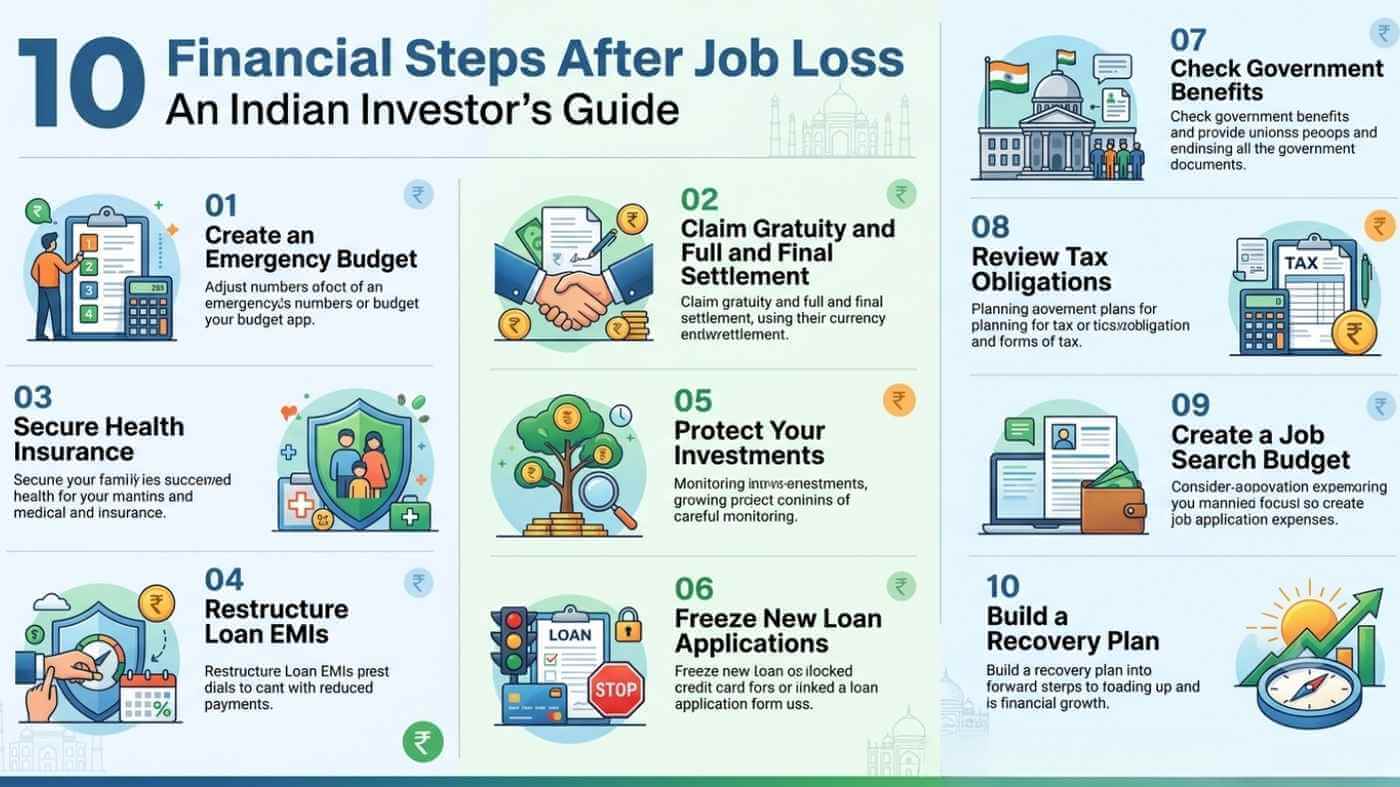
The 10 Financial Steps After Job Loss
The table below maps every step to a timeline and priority level. Steps 1 to 3 are non-negotiable and must happen within the first 48 hours.
| # | Step | When | Priority | What to Do |
| 01 | Create an Emergency Budget | Day 1 | CRITICAL | List all monthly expenses. Separate essential (rent, food, EMIs) from non-essential (subscriptions, dining, memberships). Cut non-essentials immediately to extend your financial runway. |
| 02 | Claim Gratuity and Full and Final Settlement | Week 1 | CRITICAL | Follow up with HR immediately: gratuity (if service is over 5 years), unused leave encashment, unpaid bonus, expense reimbursements, and PF balance. This may be your largest single cash inflow. |
| 03 | Secure Health Insurance | Week 1 | CRITICAL | Employer coverage ends with employment. Buy an individual family floater of Rs. 5 to 10 lakh within the first 48 hours. One hospitalisation without cover can erase months of savings. |
| 04 | Restructure Loan EMIs | Week 1-2 | HIGH | Call your bank proactively. Request a 3 to 6-month moratorium on home loan EMIs. Always get written approval. Moratoriums do not hurt your CIBIL score; missed payments do. |
| 05 | Protect Your Investments | Week 1-2 | HIGH | Do not panic-sell mutual funds or equity. Suspend new SIPs temporarily. Keep emergency corpus in liquid funds only. Withdraw from long-term investments only as a genuine last resort. |
| 06 | Freeze New Loan Applications | Immediately | HIGH | Each credit application creates a hard inquiry that lowers your CIBIL score. Wait until you have been in new employment for at least three to six months before applying for any credit. |
| 07 | Check Government Benefits | Week 1-4 | MEDIUM | Explore Ayushman Bharat for health cover, state unemployment allowances where available, the EPFO portal for PF withdrawal, and skill development stipends in your state. |
| 08 | Review Tax Obligations | Month 1 | MEDIUM | Your annual income is now prorated to your last working day. This likely puts you in a lower tax bracket. Consult a CA about revised TDS, a potential refund, and pausing NPS contributions. |
| 09 | Create a Job Search Budget | Week 1 onwards | MEDIUM | Allocate Rs. 15,000 to Rs. 30,000 for the job search: LinkedIn Premium, relevant online certifications, and resume help. Network first because referrals cost nothing and have the highest success rate. |
| 10 | Build a Recovery Plan | Month 1-2 | ONGOING | Plan the first six months after re-employment: rebuild the emergency fund, resume EMI payments, restart SIPs at 50%, then scale back to 100% by month six. |
3 Steps Worth Going Deeper On
Step 01: Calculate Your Real Financial Runway
Your financial runway is the most important number to know on Day 1. It tells you how many months you can survive without income.
Formula: (Emergency fund + Expected F&F settlement + Any liquid savings) divided by monthly burn rate after cuts.
Example: Priya had Rs. 4 lakh in savings and expected Rs. 2 lakh in F&F settlement. After cutting subscriptions and dining, her monthly burn dropped from Rs. 65,000 to Rs. 50,000. Runway: Rs. 6 lakh divided by Rs. 50,000 equals 12 months. That is a genuinely comfortable position from which to job hunt.
If your runway is under six months, treat this as urgent. Cut expenses further, contact your bank immediately, and consider temporary gig income. If it is over 12 months, you have time to be selective and strategic about the next role.
Step 03: Health Insurance Is Non-Negotiable
Employer health cover ends the day your employment does. Many people discover this gap only when they face a medical situation, by which point it is too late.
Buy an individual family floater of at least Rs. 5 lakh within 48 hours of job loss. Most insurers allow purchase without a medical examination if you apply promptly. The annual premium for a healthy 30- 35-year-old is roughly Rs. 10,000 to Rs. 18,000, a small fraction of what one hospitalisation costs without cover.
Example: Ashok, 42, was diagnosed with appendicitis six weeks after a job loss. His Rs. 2.5 lakh hospital bill wiped out his entire emergency fund because he had delayed buying personal health cover. The same policy would have cost him under Rs. 20,000 per year.
Step 05: Do Not Panic-Sell Your Investments
This is the most financially costly mistake Indian investors make after a job loss. Selling equity mutual funds during a period of market uncertainty locks in losses permanently and destroys years of compounding.
The correct sequence: first use the liquid emergency fund, then reduce expenses, then consider a bank moratorium on EMIs, then consider gig income. Equity mutual funds and SIPs should be the last thing you touch, not the first.
Example: Vikram had Rs. 15 lakh in mutual funds. He withdrew Rs. 5 lakh when the markets were down 15%. Six months later, markets recovered 20%. That Rs. 5 lakh would have become Rs. 6 lakh. His panic cost him Rs. 1.75 lakh. If he had used his liquid savings instead and contacted his bank for a moratorium, the withdrawal would have been unnecessary.
What to Claim in Your Full and Final Settlement
Your F&F settlement may be the largest single cash inflow during this period. Follow up with HR in writing within the first week. Do not assume the company will process everything automatically.
| What to Claim | Details |
| Gratuity | Half a month’s salary per year of service (eligible after 5 years of continuous service) |
| Leave Encashment | All unused earned and casual leave paid at the current salary rate |
| Pending Bonus | Any unpaid variable pay or performance-linked incentive |
| Expense Reimbursements | Outstanding travel, phone, laptop, or other approved expense claims |
| PF Balance | Full provident fund balance; can be withdrawn via the EPFO portal after 60 days of unemployment. |
Note: PF withdrawal is tax-free if the total service exceeds five years. For service under five years, the employer’s contribution is taxable as income.
Your First 72 Hours Checklist
Print this. Complete it in order. The faster these actions happen, the more control you retain.
| Action | When |
| Create a monthly expense budget and identify immediate cuts | Day 1 |
| Request a full and final settlement breakdown from HR in writing | Day 1 |
| Get health insurance quotes and buy a policy within 48 hours | Day 1-2 |
| Call the bank to request an EMI moratorium; get written confirmation | Day 2-3 |
| Calculate your financial runway: emergency fund divided by monthly burn rate | Day 2-3 |
| Freeze all new loan or credit card applications | Immediately |
| Suspend SIPs temporarily to preserve cash | Day 3-5 |
| Update LinkedIn and contact your top 10 professional connections | Day 3-7 |
| Check the EPFO portal for PF balance and the withdrawal process | Week 1 |
| Consult a CA about the revised tax liability for the current financial year | Week 1 |
Your Post-Employment Recovery Timeline
Once you have secured a new job, this six-month recovery plan rebuilds what job loss disrupted, systematically and without rushing.
| Timeline | Action |
| Months 1-2 after re-employment | Rebuild emergency fund to 3 months of expenses. Resume all paused EMIs at normal rates. |
| Month 3-4 | Restart SIPs at 50% of pre-job-loss amounts. Getting guidance from an AMFI-registered distributor like VSJ FinMart helps realign each SIP to your updated goals. |
| Month 4-5 | Rebalance investment portfolio. Review asset allocation based on current age and goals. |
| Month 5-6 | Resume full SIP contributions. Increase SIP by 10% if income has grown. |
| Month 6 onwards | Target a 9 to 12-month emergency fund. Consider a step-up SIP to accelerate wealth recovery. |
5 Rules That Protect You Through Job Loss
Protect your CIBIL score above everything. A damaged score takes seven years to recover. Pay at least the minimum on every credit obligation, every month, without exception.
Never touch long-term investments unless it is truly the last option. The sequence: emergency fund first, then expense cuts, then moratorium, then gig income, then investments.
Get everything in writing. Every conversation with HR about F&F, every moratorium approval from your bank. Written records protect you.
Your previous salary is not the floor for the next job. Income is more important than pride right now. You can renegotiate upward after six to twelve months in stable employment.
Most people find a new role within three to six months. Plan conservatively for nine months. Anything beyond that is manageable if you have followed Steps 1 to 5.
Final Words: Action Beats Panic Every Time
Job loss is painful. It is also temporary. Thousands of Indian professionals face it every year and recover completely, most within six to twelve months.
The difference between a fast recovery and a prolonged one is almost always what happens in the first 72 hours. Protect your credit score. Secure your health cover. Know your runway. Pause your SIPs rather than break them. Do not sell equity in a panic.
Start today: open a spreadsheet, list every expense, and calculate your runway. That single action clarifies everything that follows.
For PF withdrawal and EPFO services, visit EPFO India, the official Employees’ Provident Fund Organisation portal.
Frequently Asked Questions
Q: Can I withdraw my entire PF balance after a job loss?
Yes. Once employment ends, you can claim your full PF balance via the EPFO portal using your UAN. Funds are typically credited within 10 to 15 working days. If your total service is under five years, the employer’s contribution is taxable as income. If service exceeds five years, the entire withdrawal is tax-free.
Q: Will a bank moratorium hurt my CIBIL score?
No. A bank-approved moratorium is a formal restructuring and does not appear as a default on your credit report. What damages your CIBIL score is a missed or delayed payment without prior arrangement. Always request the moratorium proactively, before a payment is due, and get written confirmation from your bank.
Q: Should I stop all SIPs immediately after a job loss?
Suspend them temporarily, not permanently. SIPs can be paused for one to three months without penalty on most platforms. Stopping them protects cash flow during the transition. Restart as soon as income is stable, ideally resuming at 50% of the previous amount in the first month and scaling back to 100% by month three or four.
Q: What if my emergency fund runs out before I find a job?
Escalate in this order: reduce rent by moving temporarily, ask family for a short-term interest-free loan, sell non-essential physical assets, explore gig work such as freelancing or tutoring, and consider a secured loan against an FD or gold as a last resort. Avoid unsecured personal loans at 15% or more interest.
Q: How long does a job loss affect my ability to get a home loan?
Banks will not approve a home loan during unemployment. After re-employment, most banks require a minimum of three to six months of payslips and stability proof before approving a new home loan. If your CIBIL score is intact and your income is steady, home loan eligibility typically restores within one year of stable re-employment.
Disclaimer
The information provided in this blog is for educational and informational purposes only. Please consult a qualified financial advisor before making investment decisions. VSJ FinMart is an AMFI-registered Mutual Fund Distributor (MFD) and does not offer investment advisory services. Mutual fund investments are subject to market risks. Please read all scheme-related documents carefully before investing.