

If you switched to the new tax regime expecting zero deductions, you may be pleasantly surprised. Several deductions available in the new tax regime still exist, and many salaried taxpayers are missing out simply because they are not aware of them. Understanding what you can still claim helps you plan smarter and keep more of your hard-earned money.
The new tax regime was introduced to simplify income tax filing. It offers lower slab rates in exchange for giving up most of the traditional deductions. However, “most” does not mean “all.” A handful of important deductions and exemptions still apply, and they can make a meaningful difference to your final tax liability.
In this guide, we walk you through all 7 deductions still available in the new tax regime, explain how each one works, and show you how to make the most of them.
Understanding the New Tax Regime: A Quick Overview
The new tax regime, introduced under Section 115BAC of the Income Tax Act, became the default regime for individuals from the financial year 2023–24 onwards. Unless you actively opt out, the government will apply the new regime to your income.
The new regime offers lower tax rates across slabs. For example, income up to Rs 3 lakh attracts zero tax, and the rates rise gradually to 30% above Rs 15 lakh. From FY 2023–24, a rebate under Section 87A also ensures that individuals with taxable income up to Rs 7 lakh pay no tax at all.
However, the trade-off is that you lose access to popular deductions like Section 80C, Section 80D, HRA exemption, and LTA. This is where many people assume there is nothing left to claim. That assumption is incorrect.
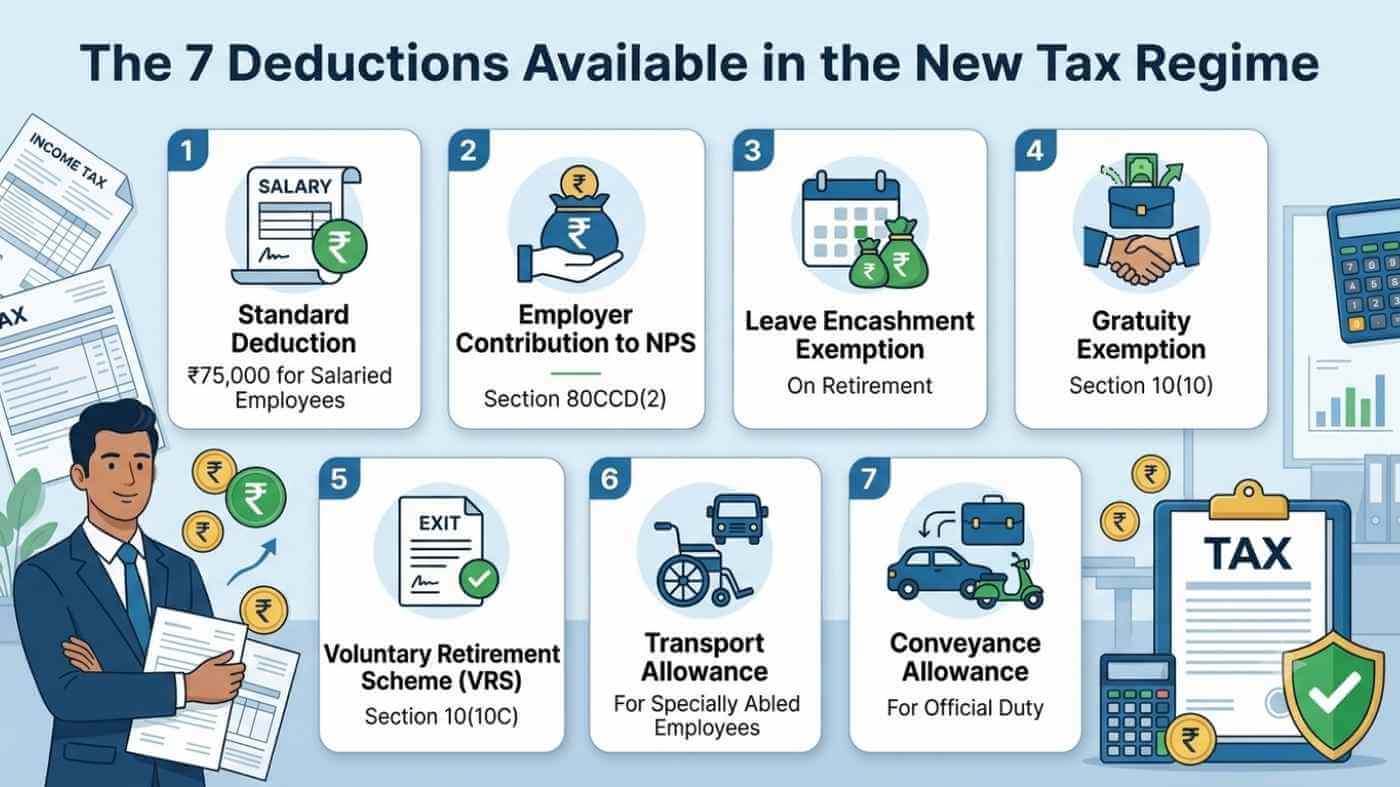
The 7 Deductions Available in the New Tax Regime
1. Standard Deduction of Rs 75,000 for Salaried Employees
From FY 2024–25 onwards, salaried employees and pensioners can claim a standard deduction of Rs 75,000 under the new tax regime. This was increased from Rs 50,000 as part of the Union Budget 2024 announcements.
This deduction applies automatically. You do not need to submit any proof or declaration. It reduces your gross salary income before tax calculation begins, which directly lowers your taxable income.
For a person earning Rs 10 lakh annually, this single deduction alone brings the taxable income down to Rs 9.25 lakh, saving a meaningful amount at their applicable slab rate.
2. Employer Contribution to NPS under Section 80CCD(2)
This is one of the most valuable deductions available under the new tax regime and one of the least understood. If your employer contributes to your National Pension System (NPS) account, you can deduct the eligible contribution from your taxable income.
The limit is:
- 14% of salary (Basic Salary + Dearness Allowance) for Central Government employees.
- 14% of salary (Basic Salary + Dearness Allowance) for other employees who opt for the new tax regime.
Importantly, this deduction applies only to the employer’s contribution, not your own voluntary NPS contribution. Your own additional NPS contribution under Section 80CCD(1B) is not available under the new tax regime.
For example, if your Basic Salary + Dearness Allowance is Rs 6 lakh per year and your employer contributes 14% to your NPS account, the contribution amounts to Rs 84,000. Under Section 80CCD(2), you can claim the entire Rs 84,000 as a deduction from your taxable income, provided it is within the prescribed limits.
Besides lowering your tax liability, the employer’s contribution also helps build your retirement corpus, giving you both an immediate tax benefit and long-term financial security.
3. Leave Encashment Exemption on Retirement
When a non-government employee retires or otherwise leaves employment and receives leave encashment, an exemption is available under Section 10(10AA). This exemption continues to be available under the new tax regime.
For non-government employees, the maximum exemption is Rs 25 lakh during their lifetime, subject to the prescribed conditions. Government employees are generally entitled to a full tax exemption on leave encashment received at the time of retirement.
This benefit is particularly valuable for employees nearing retirement. Planning your leave balance and the timing of leave encashment can help maximize the tax-free amount you receive.
4. Gratuity Exemption under Section 10(10)
Gratuity received at retirement or on leaving a job after five or more years of service continues to be exempt from tax, even under the new tax regime.
For government employees, the entire gratuity amount is tax-free. For non-government employees covered under the Payment of Gratuity Act, the exemption is the least of:
- The actual gratuity received
- 15 days’ salary for each completed year of service
- Rs 20 lakh (the current ceiling)
This exemption is automatic; it applies at the time your employer processes the gratuity payment. No filing or declaration is needed from your end for the basic exemption.
5. Voluntary Retirement Scheme (VRS) Compensation under Section 10(10C)
Employees who opt for voluntary retirement under a scheme that meets prescribed conditions can claim an exemption of up to Rs 5 lakh on the compensation received. This is available under the new tax regime as well.
To qualify, the VRS scheme must be framed as per Rule 2BA of the Income Tax Rules. Both public sector and private sector employees can benefit from this, provided the scheme meets the required criteria.
If you are considering early retirement, this is an important exemption to factor into your financial planning before you make any decisions.
6. Transport Allowance for Specially Abled Employees
A transport allowance of Rs 3,200 per month (Rs 38,400 per year) remains exempt from tax under the new regime for employees who are specially abled (differently abled). This applies to individuals with specified disabilities who require transport for commuting to work.
This allowance is specifically not available to regular employees under the new regime (general transport allowance exemption was removed). However, specially abled employees continue to receive this benefit.
If this applies to you or a family member in employment, ensure your employer is including this exemption in the payslip structure to avoid unnecessary tax deduction at source.
7. Conveyance Allowance for Official Duty
An allowance granted by an employer to meet expenses incurred wholly, necessarily, and exclusively in the performance of official duties remains exempt from tax. This is different from the daily commute between home and the workplace. It applies only to travel undertaken for official work during the course of employment.
For example, if a sales executive receives an allowance to visit clients, attend meetings, or travel between office locations as part of their job, the amount spent for these official duties is exempt from tax. The exemption is limited to the actual expenses incurred, and the employer should clearly identify the allowance as being for official duties.
This exemption continues to be available under the new tax regime, making it a useful tax benefit for employees whose roles require frequent official travel.
Note: This guidance is technically accurate for FY 2025–26 / AY 2026–27 and reflects the current tax rules. It also avoids confusion with the discontinued fixed conveyance allowance exemption, which was replaced by the standard deduction and is no longer available as a separate tax benefit.
Quick Comparison: What You Keep vs What You Lose
| Deduction / Exemption | Old Regime | New Regime |
|---|---|---|
| Standard Deduction (Salary) | Rs 50,000 | Rs 75,000 (from FY 2024–25) |
| Section 80C (PPF, ELSS, LIC, etc.) | Up to Rs 1.5 lakh | Not available |
| Section 80D (Health Insurance) | Up to Rs 25,000–50,000 | Not available |
| HRA Exemption | Available | Not available |
| Employer NPS Contribution (80CCD(2)) | Available | Available |
| Gratuity Exemption | Available | Available |
| Leave Encashment (Retirement) | Available | Available |
| VRS Compensation (10(10C)) | Available | Available |
| Transport Allowance (Specially Abled) | Available | Available |
| Conveyance Allowance (Official Duty) | Available | Available |
| Section 80E (Education Loan Interest) | Available | Not available |
| Home Loan Interest (Section 24b) | Up to Rs 2 lakh | Not available (self-occupied) |
Who Should Still Choose the New Tax Regime?
The new tax regime makes sense for most salaried individuals who do not have large deductions to claim. First-time earners, young professionals, and employees without home loans or significant Section 80C investments often find the new regime more beneficial.
However, if you have a home loan with significant interest outgo, pay high health insurance premiums, or maximise Section 80C investments every year, the old regime may still save you more tax overall. The decision is not universal — it depends entirely on your individual numbers.
A practical way to decide is to calculate your tax liability under both regimes using the same income figure and then compare. Most tax filing portals offer a built-in comparison tool. Alternatively, a quick conversation with a financial advisor can save you time and avoid a costly mistake.
A Practical Example: Salaried Employee in Mumbai
Consider Priya, a software professional in Mumbai earning Rs 12 lakh per year. Her employer contributes 10% of her basic salary (Rs 5 lakh) to NPS, which amounts to Rs 50,000.
Under the new tax regime, her taxable income works out as follows:
- Gross salary: Rs 12,00,000
- Less standard deduction: Rs 75,000
- Less employer NPS contribution (80CCD(2)): Rs 50,000
- Net taxable income: Rs 10,75,000
Without these two deductions, her taxable income would have been Rs 12 lakh. By simply using the deductions available in the new tax regime, she reduces her taxable income by Rs 1.25 lakh. At a 20% slab rate, that saves her Rs 25,000 in tax. No investments required. No paperwork. Just awareness.
How to Maximise the Deductions You Still Have
Knowing the deductions is only the first step. Here is how to make the most of them:
- Ask your employer about NPS: If your company offers an employer NPS contribution option, enrol immediately. This is one of the best remaining deductions in the new regime and helps build your retirement corpus at the same time.
- Verify your salary structure: Ensure your payslip correctly reflects the standard deduction and any applicable allowances. Many employees discover errors only at the time of filing.
- Plan your retirement timeline: If you are nearing retirement, plan when to take leave encashment and gratuity payouts. Timing can affect the tax treatment in some cases.
- Keep official travel records: If your role involves official conveyance, maintain records that your employer can reference when structuring your allowances.
- Review your regime choice every year: The best regime for you this year may not be the best next year. Review your deductions annually, especially after life events like buying a home, taking an education loan, or changing jobs.
The Bigger Picture: Tax Saving vs Wealth Building
Many Indians focus so much on saving tax that they forget to build wealth. Section 80C, for example, is popular because it reduces tax — but some of the instruments under it, like certain insurance-linked savings products, offer poor long-term returns.
In the new tax regime, you lose those deductions. But that could actually be an opportunity. Without the pressure to invest just to save tax, you are free to choose investments purely based on what suits your financial goals, risk appetite, and time horizon.
Mutual funds, for example, do not offer tax deductions in the new regime (other than ELSS under the old regime). But equity mutual funds have historically delivered strong long-term returns, helping you grow your wealth significantly over 10, 15, or 20 years.
At VSJ FinMart, we help you build a mutual fund investment plan that works around your tax situation, not against it. Whether you are in the old regime or the new one, the right fund choices can make a far greater impact on your financial future than any single deduction. Our advisors understand your individual goals and help you invest with a clear, personalised plan rather than a one-size-fits-all approach.
Common Mistakes to Avoid in the New Tax Regime
Even taxpayers who have switched to the new regime often make avoidable errors. Here are the most common ones:
- Forgetting the standard deduction: Some employees assume the new regime has no deductions at all. The Rs 75,000 standard deduction is automatic but must be reflected correctly in your Form 16 and ITR.
- Missing employer NPS benefit: Many employees do not realise their employer offers NPS contributions. Check your CTC breakup or HR documentation.
- Not opting out when it does not suit you: The new regime is default, but it is not mandatory. If the old regime saves you more money, you can opt out when filing your return (for non-business income).
- Assuming both regimes are identical every year: Tax rules change with each Union Budget. Always verify the current rules before filing.
- Ignoring regime impact on investments: Switching regimes affects how you should think about tax-saving investments. Do not continue making 80C investments blindly if you are now in the new regime.
Final Words
The new tax regime may have simplified tax filing, but it has not eliminated every deduction. These 7 deductions available in the new tax regime, from the enhanced standard deduction to employer NPS contributions and gratuity exemptions, can together reduce your tax outgo meaningfully if you use them well.
The key is awareness and planning. Most of these benefits are already embedded in your employment structure. You simply need to verify that they are being applied correctly and, where possible, negotiate your salary structure to maximise them.
Beyond tax savings, the real goal is building financial security over time. If you are in the new regime and looking to invest the money you save, choosing the right mutual fund for your specific goals matters far more than picking any random option. At VSJ FinMart, we work with you to cut through the complexity and help you invest with purpose and confidence in mutual funds. Reach out to us for a personalised plan that fits your income, your goals, and your future.
Frequently Asked Questions
Can I claim Section 80C deductions in the new tax regime?
No. Section 80C deductions, including investments in PPF, ELSS, LIC premiums, and NSC, are not available under the new tax regime. If Section 80C is important to your tax planning, you may want to evaluate whether the old regime suits you better.
Is the standard deduction of Rs 75,000 available to pensioners too?
Yes. The standard deduction of Rs 75,000 under the new tax regime is available to both salaried employees and pensioners from FY 2024–25 onwards. It applies automatically to pension income as well.
What is the difference between Section 80CCD(1B) and 80CCD(2) in the new regime?
Section 80CCD(1B) covers your own voluntary NPS contribution of up to Rs 50,000 and is NOT available in the new regime. Section 80CCD(2) covers your employer’s contribution to NPS and IS available in the new regime, making it one of the most valuable deductions you can still use.
Can I switch between the old and new tax regimes every year?
Salaried individuals with no business income can switch between regimes every financial year. Business owners and self-employed individuals, however, can switch only once and cannot revert easily. Always check the current rules at the time of filing.
Does the new tax regime benefit everyone?
Not necessarily. The new regime benefits those who have fewer deductions to claim. However, for individuals with large home loan interest payments, significant 80C investments, and HRA claims, the old regime may still result in lower tax. Always calculate your liability under both regimes before deciding.
Disclaimer
The information provided in this blog is for educational and informational purposes only and should not be construed as investment advice. Please consult a qualified financial advisor before making any investment decisions.
Shashikant Chanderkumar Mudaliar (ARN: 319377), operating under the brand name VSJ FinMart, is an AMFI-registered Mutual Fund Distributor (MFD) and does not provide investment advisory services. Mutual fund investments are subject to market risks. Past performance is not indicative of future results. Please read all scheme-related documents carefully before investing. Registration details can be verified at www.amfiindia.com/locate-distributor.