

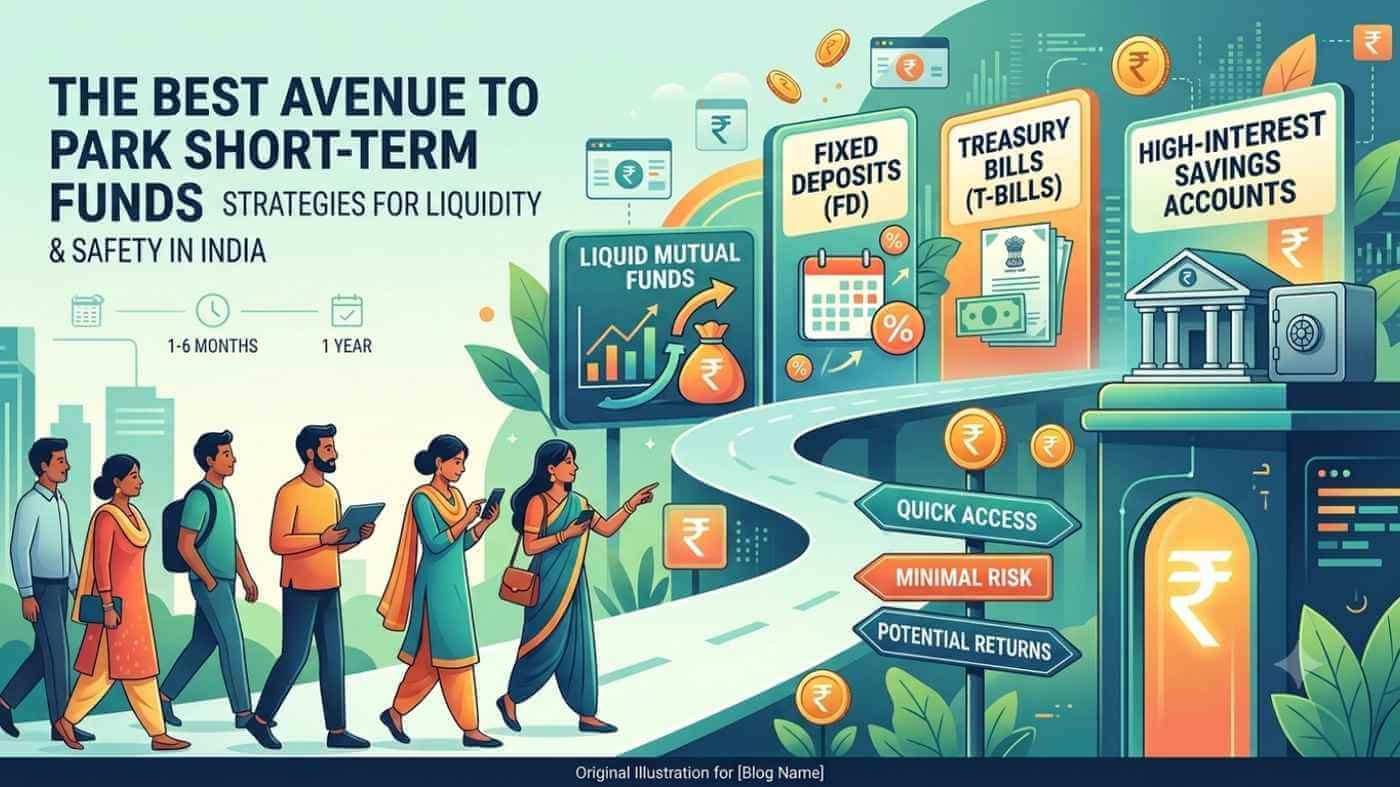
When you have money sitting idle for a few weeks or months, you want it to work for you without taking unnecessary risks. Finding the best avenue to park short-term funds is a common challenge for salaried professionals, business owners, and first-time investors alike. Park it too conservatively and you lose to inflation. Take too much risk, and you may not get your money back when you need it.
This guide walks you through the most practical avenues available in India today. You will understand what each option offers, what it costs you, and which one suits your specific need. Most importantly, you will leave with a clear action plan.
What Counts as a Short-Term Horizon?
Before comparing options, it helps to define the time frame. In personal finance, short term typically means anywhere from one week to three years. However, the right avenue depends on how soon you need the money back.
- Very short term: 1 day to 3 months (emergency buffer, upcoming expense)
- Short term: 3 months to 1 year (vacation fund, advance tax payment, insurance premium)
- Medium-short term: 1 year to 3 years (down payment saving, gadget upgrade, wedding fund)
Each bucket has its own ideal parking spot. Mixing up these horizons is one of the most common mistakes investors make.
Why Your Savings Account Is Not Enough
Most people default to leaving surplus money in their savings account. It feels safe and accessible. However, a typical savings account pays 2.5% to 4% interest per year. After accounting for inflation at around 5% to 6%, your money is quietly shrinking in real value.
You are not taking any risk, yet you are still losing purchasing power. There are better options that offer higher returns with comparable or only slightly higher risk, and they deserve your attention.
The Best Options for Short-Term Funds in India
Here is a practical look at the most widely used avenues, how they work, and where they fit.
1. Liquid Mutual Funds
Liquid funds are debt mutual funds that invest in instruments maturing within 91 days. These include treasury bills, commercial papers, and certificates of deposit. They are among the most popular choices for the best option for short-term funds, especially for individuals and businesses with surplus cash.
- Typical returns: 6% to 7.5% per year (varies with interest rate cycle)
- Redemption: credited to your bank account within 1 business day (T+1)
- Risk: very low, but not zero
- Ideal for: 1 week to 3 months
For example, suppose you receive your annual bonus of Rs. 2 lakh in March and plan to use it for home renovation in May. Instead of leaving it idle, investing in a liquid fund for those two months can earn you approximately Rs. 2,000 to Rs. 2,500 extra, with full flexibility to redeem anytime.
2. Ultra-Short Duration Funds
These funds invest in debt instruments with a Macaulay duration between 3 and 6 months. They carry marginally more interest rate sensitivity than liquid funds but still remain relatively stable.
- Typical returns: 6.5% to 7.5% per year
- Redemption: T+1 to T+2
- Risk: low to moderate
- Ideal for: 3 to 6 months
These are a good upgrade from liquid funds when you can afford to stay invested for at least three months and want slightly better potential returns.
3. Money Market Funds
Money market funds invest in instruments with maturities up to one year. They include treasury bills, commercial papers, and call money. They sit between liquid and ultra-short duration funds in terms of risk and return.
- Typical returns: 6.5% to 7.5% per year
- Redemption: T+1 to T+2
- Risk: low
- Ideal for: 3 to 12 months
4. Arbitrage Funds
Arbitrage funds exploit price differences between the cash and futures segments of the stock market. They are classified as equity funds for tax purposes, which makes them highly tax-efficient for investors in higher tax brackets.
- Typical returns: 6% to 7% per year
- Redemption: T+2 to T+3 (equity settlement cycle)
- Risk: very low (market-neutral strategy)
- Ideal for: 6 months to 1 year
- Tax advantage: gains held over 1 year taxed at 12.5% (LTCG); under 1 year at 20% (STCG)
For someone in the 30% tax bracket, arbitrage funds can be more tax-efficient than bank FDs, even if gross returns are similar. This is one of the least-known but most effective short-term parking options.
5. Fixed Deposits (FDs)
Bank fixed deposits remain one of the most familiar avenues. They offer guaranteed returns and capital protection (up to Rs. 5 lakh per depositor per bank under DICGC insurance).
- Typical returns: 6% to 8% per year (varies by bank and tenure)
- Premature withdrawal: allowed with a penalty, usually 0.5% to 1%
- Risk: very low
- Ideal for: 3 months to 3 years
However, FD interest is fully taxable at your income tax slab rate. For someone in the 30% bracket, a 7.5% FD effectively yields around 5.25% post-tax. That changes the math considerably.
6. Recurring Deposits (RDs)
If you are building a short-term corpus through monthly contributions rather than a lump sum, a recurring deposit works well. You commit a fixed amount each month, and the bank compounds interest quarterly.
- Typical returns: similar to FD rates for the same tenure
- Risk: very low
- Ideal for: 6 months to 2 years (when building a corpus systematically)
The limitation is the same as FDs. Interest is taxable, which reduces post-tax yield for those in higher brackets.
7. Short Duration Debt Funds
These funds invest in instruments with a Macaulay duration between 1 and 3 years. They are suitable for a medium-short horizon and can deliver better returns than FDs, though they carry moderate interest rate risk.
- Typical returns: 7% to 8% per year (varies with the rate cycle)
- Redemption: T+1 to T+2
- Risk: moderate
- Ideal for: 1 to 3 years
If you are saving for a goal that is 18 to 36 months away, such as a car purchase or a down payment, short duration funds deserve serious consideration.
Comparing Your Short-Term Funds Parking Options at a Glance
| Option | Ideal Horizon | Approx. Return | Risk Level | Tax Treatment |
|---|---|---|---|---|
| Savings Account | Anytime | 2.5% to 4% | Negligible | Taxable (slab) |
| Liquid Fund | 1 week to 3 months | 6% to 7.5% | Very Low | Taxable (slab) |
| Ultra-Short Duration Fund | 3 to 6 months | 6.5% to 7.5% | Low | Taxable (slab) |
| Money Market Fund | 3 to 12 months | 6.5% to 7.5% | Low | Taxable (slab) |
| Arbitrage Fund | 6 months to 1 year | 6% to 7% | Very Low | Equity (LTCG/STCG) |
| Fixed Deposit | 3 months to 3 years | 6% to 8% | Very Low | Taxable (slab) |
| Recurring Deposit | 6 months to 2 years | 6% to 7.5% | Very Low | Taxable (slab) |
| Short Duration Debt Fund | 1 to 3 years | 7% to 8% | Moderate | Taxable (slab) |
Key Factors to Consider Before You Choose
Knowing your options is only the first step. Selecting the right one requires you to weigh a few personal factors.
Liquidity Needs
How quickly might you need this money back? If there is any chance you will need it within a week, liquid funds or a savings account are your only practical choices. Fixed deposits and recurring deposits may penalise premature withdrawal.
Tax Bracket
Your income tax slab significantly affects post-tax returns. Someone in the 30% bracket will find FD returns considerably lower after tax. Arbitrage funds and certain debt funds may therefore offer a better effective yield for them.
Amount Involved
For smaller amounts (under Rs. 50,000), the convenience of an FD or savings account might outweigh the marginal benefit of exploring fund options. For larger amounts (Rs. 5 lakh and above), optimising even 1% to 2% in post-tax returns creates meaningful value.
Goal Clarity
A defined goal with a fixed date, such as an advance tax payment due in December, suits an FD or liquid fund. An open-ended goal with no fixed withdrawal date suits a liquid or ultra-short duration fund for maximum flexibility.
Common Mistakes to Avoid
- Leaving large sums idle in a savings account for months, missing out on 2% to 3% additional returns.
- Chasing returns in equity for a short-term goal. Markets can fall 20% to 30% in a short period. Equity is never appropriate for money you need within three years.
- Ignoring tax impact. Two products with the same gross return can have very different net returns depending on how they are taxed.
- Locking money in long-tenure FDs for short goals. If you need the money early, the penalty erodes your return.
- Treating all debt funds as risk-free. While most short-term debt funds are low risk, they are not guaranteed. Credit events in the underlying portfolio can affect returns.
A Practical Example: Ravi’s Three-Month Bonus
Ravi, a 34-year-old IT professional in Mumbai, receives a performance bonus of Rs. 3 lakh in October. He plans to use it for a family trip in January, about three months away. He is in the 30% tax bracket.
He compares his options:
- Savings account at 3.5%: Earns approximately Rs. 2,625 over three months. Fully taxable, so post-tax gain is around Rs. 1,838.
- FD at 7% for 3 months: Earns approximately Rs. 5,250. Post-tax at 30% slab: around Rs. 3,675.
- Liquid fund at 7%: Earns approximately Rs. 5,250. Taxable at slab rate, giving similar post-tax return to FD but with daily liquidity and no penalty for early exit.
Ravi chooses a liquid fund. He gets similar returns to an FD, the flexibility to exit any day without penalty, and a T+1 redemption timeline that fits his needs perfectly.
The right choice often depends on this kind of comparison. Rather than defaulting to one product, thinking through your specific situation makes a real difference. At VSJ FinMart, we help investors like Ravi map their short-term surpluses to the right option based on goals, timeline, and tax profile, so no rupee sits idle or takes unnecessary risk.
How to Get Started
Getting started with any of these options is relatively simple today. Here is a general step-by-step path:
- Define your goal and timeline. Know when you need the money back.
- Estimate your tax bracket. This helps you compare post-tax returns accurately.
- Shortlist 2 to 3 options based on the comparison table above.
- Check the fund’s track record and credit quality if you are choosing a debt fund.
- Start with the amount you can afford to keep invested for the full planned horizon.
Most importantly, resist the urge to time markets or hunt for the highest possible return on short-term money. Stability and accessibility matter far more than marginal yield here.
Final Words: Choose Smart, Not Just Safe
The best avenue to park short-term funds is not a single universal answer. It depends on your timeline, your tax bracket, your goal, and how quickly you might need access to the money. Liquid funds and arbitrage funds offer strong flexibility and tax efficiency. FDs provide simplicity and capital protection. Short duration debt funds reward investors who can stay the course for one to three years.
What matters most is not leaving your money to idle away in a low-yield account when better, comparably safe options are available. Each percentage point of additional return on a large short-term corpus adds up to real money over time.
If you are unsure which option fits your situation best, the team at VSJ FinMart can help you make that call quickly and confidently. A personalised mutual fund investment plan, built around your goals and tax situation, is always more effective than a generic one-size-fits-all approach.
FAQs
1. Which is better for short-term parking: liquid funds or fixed deposits?
Both are low-risk and offer similar gross returns. Liquid funds have the edge in flexibility since there is no lock-in or premature withdrawal penalty. FDs offer the comfort of guaranteed returns. For investors who are certain about their timeline, FDs work well. For those who may need funds before the planned date, liquid funds are more practical.
2. Are liquid funds completely safe?
Liquid funds invest in high-quality, very short-maturity instruments, making them among the safest mutual fund categories. However, they are not guaranteed like bank FDs. In rare cases, a credit event in the underlying portfolio can affect returns. Choosing funds from reputed AMCs with strong credit quality helps manage this risk.
3. How are short-term mutual fund gains taxed?
For debt funds, gains are taxed at your applicable income tax slab rate, regardless of the holding period. For arbitrage funds, which are treated as equity, gains held for more than one year are taxed at 12.5% (LTCG) and for under one year at 20% (STCG). This makes arbitrage funds particularly tax-efficient for investors in the 20% to 30% slab.
4. Can I use a short duration debt fund for a 6-month goal?
Short duration funds typically suit a 1 to 3 year horizon. For a 6-month goal, ultra-short duration funds or money market funds are more appropriate. Short duration funds carry slightly more interest rate sensitivity, which can affect returns over a shorter period if rates move against the portfolio.
5. What is the minimum amount I can invest in a liquid fund?
Most liquid funds allow investments starting at Rs. 500 to Rs. 1,000. Some fund houses also offer instant redemption up to Rs. 50,000 per day, making them as accessible as a savings account for everyday surplus management.
Disclaimer
The information provided in this blog is for educational and informational purposes only and should not be construed as investment advice. Please consult a qualified financial advisor before making any investment decisions. Shashikant Chanderkumar Mudaliar (ARN: 319377), operating under the brand name VSJ FinMart, is an AMFI-registered Mutual Fund Distributor (MFD) and does not provide investment advisory services. Mutual fund investments are subject to market risks. Past performance is not indicative of future results. Please read all scheme-related documents carefully before investing. Registration details can be verified at www.amfiindia.com/locate-distributor.