

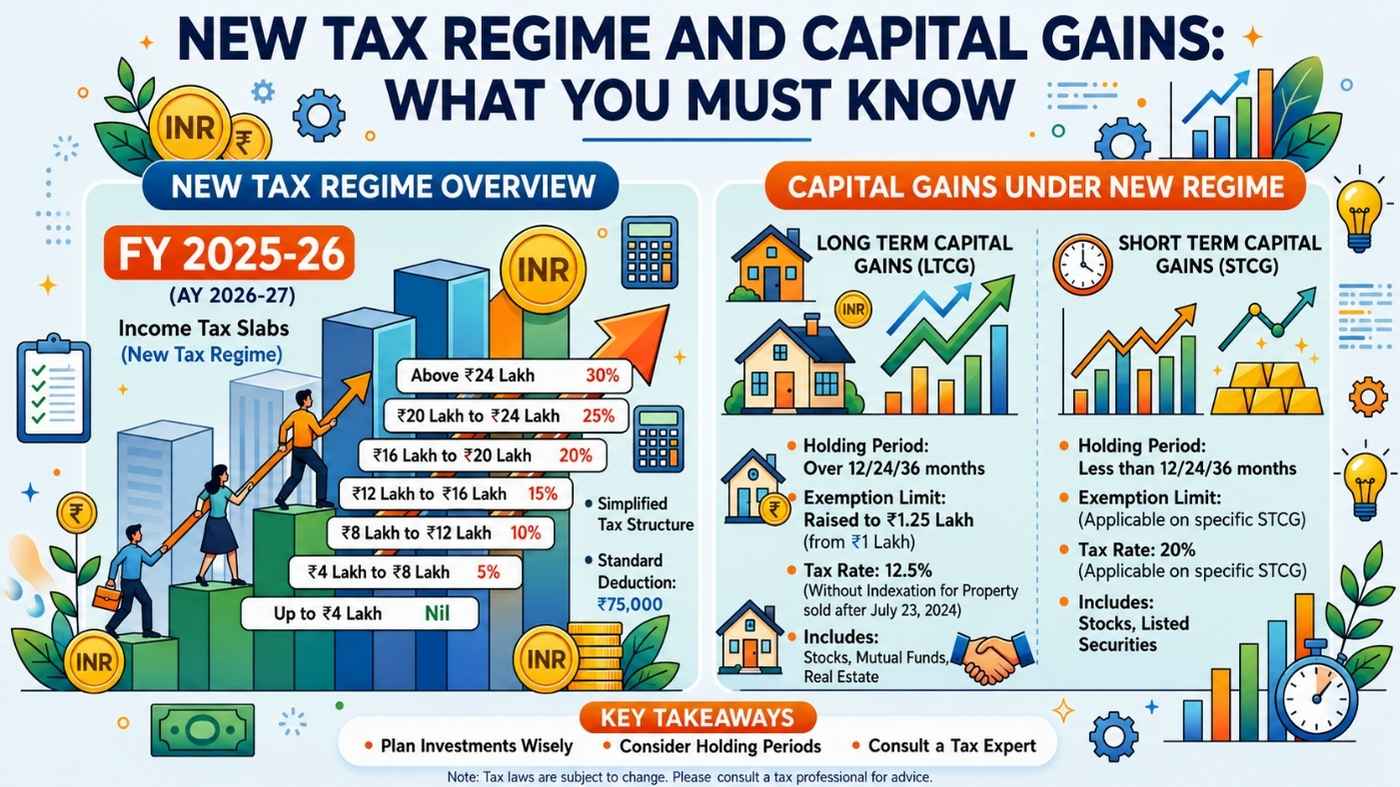
The capital gains tax rules under the new tax regime have become one of the most important areas of tax planning for Indian investors. Whether you invest in mutual funds, shares, real estate, or other capital assets, understanding how capital gains are taxed is essential for making informed investment decisions.
The Union Budget 2024 introduced significant changes to the taxation of capital gains. These revisions affect investors across the board, from first-time SIP investors to experienced individuals managing diversified portfolios. The changes impact tax rates, holding periods for certain assets, and the way investment returns are taxed.
It is also important to understand that capital gains tax operates separately from the slab-based income tax applicable under the old and new tax regimes. In many cases, capital gains are taxed at specific rates prescribed under the Income-tax Act, irrespective of the tax regime you choose for your salary or business income. This makes understanding the capital gains rules even more important when planning your investments.
In this guide, we explain the latest capital gains tax provisions in simple language, highlight the key changes introduced by the Union Budget 2024, compare the taxation of different asset classes, and share practical strategies to help you manage your tax liability while keeping your long-term financial goals on track.
What Are Capital Gains and Why Do They Matter?
A capital gain is the profit you earn when you sell a capital asset for more than its purchase price. Capital assets include equity shares, mutual fund units, real estate, gold, bonds, and other investments. The profit earned on the sale of these assets is taxable under the Income-tax Act.
It is important to understand that capital gains tax is separate from the income tax slabs under the old and new tax regimes. Even if you opt for the new tax regime, capital gains are generally taxed at the rates specifically prescribed for each type of asset. Therefore, every investor should understand how these rules work before making investment decisions.
For example, suppose you invested ₹1,00,000 in an equity mutual fund and later redeemed it for ₹1,50,000. Your capital gain is ₹50,000. Whether this gain is taxed as a short-term capital gain (STCG) or a long-term capital gain (LTCG) depends on how long you held the investment before selling it.
Short-Term vs Long-Term Capital Gains
The holding period determines whether your gain is classified as short-term or long-term. In general, assets held for a shorter period attract short-term capital gains tax. In comparison, assets held for a longer period qualify for long-term capital gains tax, which may be taxed at a different rate depending on the asset class.
| Asset Type | Short-Term Capital Asset | Long-Term Capital Asset |
|---|---|---|
| Equity Shares (Listed) / Equity Mutual Funds | Up to 12 months | More than 12 months |
| Debt Mutual Funds* | Tax treatment depends on the date of investment and applicable provisions | Tax treatment depends on the date of investment and applicable provisions |
| Real Estate | Up to 24 months | More than 24 months |
| Gold / Gold ETFs | Up to 24 months | More than 24 months |
| Listed Bonds / Debentures | Up to 12 months | More than 12 months |
Note: The taxation of debt mutual funds has undergone significant changes for investments made on or after 1 April 2023. Depending on the nature of the scheme and the date of investment, the tax treatment may differ. Always verify the applicable provisions before calculating your tax liability.
Understanding the distinction between short-term and long-term capital gains is the foundation of effective tax planning. Simply holding an investment for a little longer can sometimes result in a different tax treatment, making the timing of your sale an important part of your overall investment strategy.
Key Changes to Capital Gains Under the New Tax Regime
The Union Budget 2024 introduced significant changes to the taxation of capital gains. These changes apply irrespective of whether you choose the old or new tax regime for your salary or business income. Capital gains are generally taxed under separate provisions of the Income-tax Act, making it important to understand these rules as part of your overall tax planning.
1. Higher Short-Term Capital Gains (STCG) Tax on Equity
Short-term capital gains arising from the sale of listed equity shares, equity-oriented mutual funds, and units of a business trust on which Securities Transaction Tax (STT) has been paid are now taxed at 20%.
This increased rate applies to transfers made on or after 23 July 2024, replacing the earlier 15% rate.
The higher tax rate particularly affects investors who:
- Frequently trade in equities.
- Redeem equity mutual funds within one year.
- Regularly switch between equity schemes.
Longer holding periods may now be even more valuable from a tax perspective.
2. Long-Term Capital Gains (LTCG) Tax on Equity Increased
Long-term capital gains on listed equity shares, equity-oriented mutual funds, and business trust units are now taxed at 12.5%.
At the same time, the annual tax-free exemption has increased from ₹1,00,000 to ₹1,25,000.
As a result:
- Long-term gains up to ₹1.25 lakh in a financial year remain tax-free.
- Gains exceeding this threshold are taxed at 12.5%.
For many long-term investors, the higher exemption partially offsets the increase in the tax rate.
3. Indexation Benefit Removed for Many Long-Term Assets
Another major change is the removal of the indexation benefit for several long-term capital assets transferred on or after 23 July 2024.
Instead of paying tax after adjusting the purchase price for inflation, many such assets are now taxed at a flat 12.5% on long-term capital gains without indexation.
This change affects several non-equity assets, including certain transfers of:
- Immovable property
- Gold
- Other specified capital assets covered by the revised provisions
However, there is an important transitional relief.
For land or buildings acquired before 23 July 2024, resident individuals and Hindu Undivided Families (HUFs) may be eligible to choose between:
- 20% tax with indexation, or
- 12.5% tax without indexation,
where the law permits. This option allows taxpayers to select the method that results in the lower tax liability.
4. Higher Annual LTCG Exemption for Equity Investments
The annual exemption for long-term capital gains on eligible equity investments has increased to ₹1.25 lakh.
This means that if your total eligible long-term capital gains during a financial year do not exceed ₹1.25 lakh, no tax is payable on those gains.
Investors can also improve tax efficiency by planning redemptions across multiple financial years where appropriate, allowing better utilisation of the annual exemption limit.
5. Debt Mutual Fund Taxation Remains Unchanged
The taxation of debt mutual funds introduced from 1 April 2023 continues to apply.
For investments covered by these provisions, capital gains are generally taxed according to the investor’s applicable income tax slab rate, regardless of the holding period. As a result, these investments generally do not receive the concessional long-term capital gains treatment available to many equity-oriented investments.
Investors considering debt mutual funds should evaluate them primarily on factors such as:
- Investment objectives
- Risk profile
- Liquidity needs
- Portfolio diversification
rather than expecting preferential long-term tax treatment.
These changes highlight the importance of reviewing your investment strategy regularly. Since capital gains taxation now differs significantly across asset classes, understanding the applicable rules before buying or selling an investment can help you make more informed financial decisions and potentially improve your post-tax returns.
Capital Gains Tax Rates at a Glance
The table below provides a quick overview of the applicable capital gains tax rates for major asset classes. These rates apply under the relevant provisions of the Income-tax Act and are generally independent of whether you opt for the old or new tax regime for your salary or business income.
| Asset Category | Short-Term Capital Gains (STCG) | Long-Term Capital Gains (LTCG) | Annual Exemption |
|---|---|---|---|
| Equity Shares (Listed) / Equity Mutual Funds* | 20% | 12.5% | ₹1.25 lakh |
| Debt Mutual Funds** | Taxed at your applicable income tax slab rate | Taxed at your applicable income tax slab rate | None |
| Real Estate | Taxed at your applicable income tax slab rate | 12.5% (without indexation) or 20% with indexation for eligible resident individuals and HUFs on qualifying properties acquired before 23 July 2024 | None |
| Gold / Gold ETFs / Gold Mutual Funds | Taxed at your applicable income tax slab rate | 12.5% | None |
| International / Overseas Mutual Funds | Taxed at your applicable income tax slab rate | 12.5% (subject to the applicable provisions) | None |
* For listed equity shares, equity-oriented mutual funds, and specified business trust units where the applicable conditions, including Securities Transaction Tax (STT), are satisfied.
** For debt mutual fund investments covered by the provisions introduced from 1 April 2023, gains are generally taxed at the investor’s applicable income tax slab rate irrespective of the holding period.
Important: The above rates are base tax rates. Health and Education Cess at 4% and applicable surcharge, wherever relevant, are charged in addition. Consequently, your effective tax liability may be higher than the rates shown in the table.
How Does the New Tax Regime Affect Capital Gains Reporting?
Many taxpayers assume that choosing the new tax regime changes how their capital gains are taxed. In reality, these are two separate parts of the Income-tax Act.
Your choice between the old and new tax regime mainly affects income such as:
- Salary
- Business or professional income
- House property income
- Eligibility for various deductions and exemptions
Capital gains, however, are governed by their own set of provisions. Whether you choose the old regime or the new regime, capital gains are generally taxed at the rates prescribed for the specific asset and holding period, not at the slab rates applicable to your salary or business income.
This means that switching to the new tax regime does not change the tax rates applicable to your equity investments, mutual funds, real estate, gold, or other capital assets.
Reporting Capital Gains in Your Income Tax Return (ITR)
Every taxpayer who earns capital gains should report them correctly in their Income Tax Return, even if the gains are fully covered by the available exemption limit or result in no tax liability.
Here are some practical steps to ensure accurate reporting:
- Download your Capital Gains Statement from your mutual fund registrar (such as CAMS or KFintech) or your investment platform after the end of the financial year.
- Reconcile the figures with your broker or demat account statements to ensure all purchase and sale transactions have been captured correctly.
- Choose the correct ITR form. Individuals with capital gains are generally required to file ITR-2 (or another applicable return form, depending on their overall income and circumstances). ITR-1 cannot be used if you have taxable capital gains.
- Report Short-Term Capital Gains (STCG) and Long-Term Capital Gains (LTCG) separately under the appropriate schedules in your Income Tax Return.
- Retain supporting documents, including purchase records, sale statements, contract notes, and capital gains reports, in case the Income Tax Department seeks clarification later.
Capital Losses Can Reduce Your Tax Liability
If you incur a capital loss during the financial year, you may be able to use it to reduce your tax liability, subject to the provisions of the Income-tax Act.
The broad rules are:
- Short-Term Capital Loss (STCL) can be set off against both Short-Term Capital Gains (STCG) and Long-Term Capital Gains (LTCG).
- Long-Term Capital Loss (LTCL) can be set off only against Long-Term Capital Gains (LTCG).
- If the entire loss cannot be adjusted during the same financial year, the unabsorbed loss can generally be carried forward for up to eight assessment years, provided you file your Income Tax Return within the prescribed due date.
Proper reporting of both gains and losses not only ensures compliance but can also help you minimise your overall tax liability through legitimate tax planning.
A Practical Example: SIP Investor Under the New Rules
Let us look at a practical example to understand how the revised capital gains tax rules work for a long-term SIP investor.
Seema is a 32-year-old working professional in Pune. She has been investing ₹5,000 per month in an equity mutual fund through a Systematic Investment Plan (SIP) for the past three years. In March 2026, she redeems some of her units to fund a family vacation. Her total long-term capital gain (LTCG) from the redemption is ₹80,000.
Since ₹80,000 is below the annual ₹1.25 lakh LTCG exemption limit for equity shares and equity-oriented mutual funds, Seema does not have to pay any tax on the gain. However, she should still report the transaction in her Income Tax Return (ITR-2), even though no tax is payable.
Now consider a different situation. Later in the same financial year, Seema redeems additional units from her mutual fund portfolio. Her total long-term capital gains from equity investments for the year increase to ₹1,80,000.
Her tax calculation would be as follows:
| Particulars | Amount (₹) |
|---|---|
| Total Long-Term Capital Gain | 1,80,000 |
| Less: Annual LTCG Exemption | 1,25,000 |
| Taxable LTCG | 55,000 |
| LTCG Tax @ 12.5% | 6,875 |
| Health & Education Cess @ 4% | 275 |
| Total Tax Payable | 7,150 |
This example highlights two important points:
- The first ₹1.25 lakh of eligible long-term capital gains from equity investments remains tax-free each financial year.
- Only the gains exceeding this threshold are taxed at 12.5%, along with the applicable Health and Education Cess.
For disciplined SIP investors who stay invested for the long term, the revised capital gains tax rules remain relatively tax-efficient. Thoughtful planning of redemption timing can further improve tax efficiency by making the best use of the annual exemption limit.
Smart Tips to Manage Capital Gains Tax Efficiently
Paying tax on investment gains is part of investing, but careful planning can help you minimise your tax liability legally. Here are some practical strategies every investor should consider.
Tip 1: Hold Equity Investments for More Than 12 Months
For listed equity shares and equity-oriented mutual funds, the holding period makes a significant difference.
- Investments held for 12 months or less are generally taxed as Short-Term Capital Gains (STCG) at 20% (subject to applicable conditions).
- Investments held for more than 12 months qualify as Long-Term Capital Gains (LTCG) and are taxed at 12.5% after the annual exemption of ₹1.25 lakh.
If you invest through a SIP, many of your instalments will naturally qualify for long-term treatment as your investment matures.
Tip 2: Utilise the ₹1.25 Lakh Annual LTCG Exemption
Eligible long-term capital gains on equity investments up to ₹1.25 lakh in a financial year are exempt from tax.
Many long-term investors use a strategy commonly known as tax harvesting, where they:
- Redeem investments up to the available exemption limit.
- Reinvest the proceeds into suitable investments.
This can help reset the purchase cost for future tax calculations while making efficient use of the annual exemption. Before implementing such a strategy, ensure it aligns with your investment objectives and consider seeking professional advice.
Tip 3: Avoid Unnecessary Portfolio Churning
Frequently buying and selling investments can increase your tax liability.
Repeatedly switching between mutual funds or trading shares may:
- Trigger Short-Term Capital Gains Tax.
- Increase transaction costs.
- Reduce your long-term compounding potential.
Unless there is a clear investment rationale, remaining invested is often more beneficial than reacting to short-term market movements.
Tip 4: Use Capital Losses to Offset Capital Gains
Capital losses can reduce your tax burden when used correctly.
- Short-Term Capital Loss (STCL) can be adjusted against both Short-Term and Long-Term Capital Gains.
- Long-Term Capital Loss (LTCL) can be adjusted only against Long-Term Capital Gains.
If eligible losses cannot be fully adjusted during the current financial year, they can generally be carried forward for up to eight assessment years, provided your Income Tax Return is filed within the prescribed due date.
Tip 5: Plan Redemptions Around Financial Goals
Every redemption has potential tax implications.
Instead of withdrawing investments randomly, align your redemptions with planned financial goals such as:
- Children’s education
- Buying a home
- Retirement income
- Major family expenses
A goal-based withdrawal strategy helps you remain disciplined while also improving tax efficiency.
Tip 6: Review Your Tax Position Before Large Redemptions
Before redeeming a significant investment, review:
- Your total capital gains already realised during the financial year.
- The available ₹1.25 lakh LTCG exemption.
- Any carried-forward capital losses that can be utilised.
- The tax impact of redeeming now versus waiting until the next financial year.
Splitting large redemptions across financial years may, in some cases, help you make better use of available exemptions and reduce your overall tax liability.
Tip 7: Seek Professional Advice for Complex Situations
Capital gains taxation can become more complicated when your portfolio includes multiple asset classes such as:
- Equity mutual funds
- Debt mutual funds
- Listed shares
- Real estate
- Gold
- International investments
Your overall tax outcome depends on factors such as your holding period, realised gains, carried-forward losses, and the applicable tax provisions. If you are planning a major redemption or restructuring your portfolio, personalised guidance can help you make informed decisions while remaining fully compliant with tax laws.
Thoughtful tax planning should support your long-term investment goals, not drive them. The best investment decisions balance tax efficiency with diversification, risk management, and wealth creation over time.
Common Mistakes to Avoid With Capital Gains Tax
Many investors end up paying more tax than necessary simply because of avoidable mistakes. Being aware of these common errors can help you stay compliant and improve your post-tax returns.
1. Not Tracking the Purchase Date of Each SIP Instalment
Each SIP instalment is treated as a separate investment with its own purchase date and cost of acquisition. Consequently, every instalment has a different holding period.
When you redeem units, mutual funds follow the First-In, First-Out (FIFO) method, meaning the units purchased earliest are considered sold first.
To avoid reporting errors:
- Keep a record of your SIP instalments.
- Download your capital gains statement from CAMS, KFintech, or your investment platform.
- Verify that the holding period and capital gains have been calculated correctly before filing your Income Tax Return.
2. Ignoring Dividend Taxation
Many investors assume that mutual fund dividends are tax-free. This is no longer the case.
Dividends received from mutual funds are generally:
- Added to your total income.
- Taxed according to your applicable income tax slab.
For investors in higher tax brackets, the Growth Option may often be more tax-efficient than the Income Distribution cum Capital Withdrawal (IDCW) option, as taxation is deferred until units are redeemed. The choice should, however, be based on your income needs and investment objectives.
3. Not Reporting Capital Gains Because They Are Below the Exemption Limit
A common misconception is that capital gains below the exemption threshold do not need to be reported.
Even if your eligible long-term capital gains are fully covered by the ₹1.25 lakh annual exemption, you should still disclose the transactions in the appropriate schedule of your Income Tax Return whenever applicable.
Proper reporting helps maintain accurate tax records and reduces the likelihood of future notices or queries from the Income Tax Department.
4. Missing the Income Tax Return Filing Deadline
Filing your Income Tax Return after the prescribed due date can have several consequences, including:
- Late filing fees where applicable.
- Interest on outstanding tax liability.
- Loss of certain tax benefits, including the ability to carry forward eligible capital losses.
Filing your return on time is particularly important if you wish to carry forward unadjusted capital losses to future years.
5. Confusing the New Tax Regime With Capital Gains Tax Rules
This is one of the most common misunderstandings among investors.
The old and new income tax regimes mainly determine:
- Tax rates on salary and business income.
- Eligibility for deductions and exemptions.
Capital gains, however, are generally taxed under separate provisions of the Income-tax Act.
Choosing the new tax regime does not reduce or change the tax rates applicable to:
- Equity shares
- Mutual funds
- Real estate
- Gold
- Other capital assets
Always evaluate capital gains taxation independently of your choice between the old and new income tax regimes.
6. Not Maintaining Proper Investment Records
Retaining accurate records can save considerable time during tax filing and in the event of an enquiry.
Keep copies of:
- Purchase confirmations.
- Redemption statements.
- Contract notes.
- Capital gains reports.
- Demat and broker statements.
Well-organised records make it easier to verify your cost of acquisition, holding period, and taxable gains.
7. Redeeming Investments Without Considering the Tax Impact
Before redeeming a large investment, review:
- Your total gains already realised during the financial year.
- The available annual LTCG exemption.
- Any capital losses available for set-off.
- Whether postponing the redemption to the next financial year would improve tax efficiency.
A little planning before redeeming investments can often reduce your overall tax liability while keeping your financial goals on track.
Final Words
Understanding the capital gains tax rules is an essential part of becoming a smarter investor. While the recent changes have altered tax rates and exemptions for several asset classes, the core principles remain the same: invest with a long-term perspective, understand the tax implications before you sell, and plan your redemptions thoughtfully.
Remember that capital gains tax operates independently of the old and new income tax regimes. Whether you choose the old regime or the new regime for your salary or business income, the taxation of capital gains continues to follow its own provisions under the Income-tax Act. Keeping these two frameworks separate will help you make better financial decisions.
Most importantly, tax efficiency should support your investment strategy, not dictate it. The primary objective should always be to build a diversified portfolio that aligns with your financial goals, investment horizon, and risk tolerance. A well-structured portfolio held over the long term often delivers greater value than making frequent investment decisions solely to save tax.
Frequently Asked Questions
1. Does choosing the new income tax regime affect my capital gains tax rate?
No. Your choice between the old and new income tax regime does not change the tax rates applicable to capital gains. Capital gains on assets such as equity shares, mutual funds, real estate, gold, and other capital assets are taxed under separate provisions of the Income-tax Act, irrespective of the tax regime you select for your salary or business income.
2. Is the ₹1.25 lakh LTCG exemption available every financial year?
Yes. The ₹1.25 lakh annual exemption for eligible long-term capital gains on listed equity shares and equity-oriented mutual funds is available for each financial year. The exemption resets at the beginning of every new financial year, allowing long-term investors to make use of it annually as part of a well-planned investment strategy.
3. What happens if I switch from one mutual fund scheme to another?
A switch between mutual fund schemes is treated as a redemption of the existing units and a fresh investment into the new scheme.
This means:
- Capital gains are calculated on the units being redeemed.
- If the redeemed equity fund units have been held for 12 months or less, any gains are generally taxed as Short-Term Capital Gains (STCG) at the applicable rate.
- If the holding period exceeds 12 months, the gains qualify as Long-Term Capital Gains (LTCG) and are taxed according to the prevailing LTCG provisions after considering the available annual exemption.
Always evaluate the tax impact before switching funds, particularly if the switch is driven by short-term market movements rather than a long-term investment objective.
4. Can I adjust capital losses against capital gains?
Yes. The Income-tax Act permits eligible capital losses to be set off against capital gains, subject to certain conditions.
- Short-Term Capital Loss (STCL) can be adjusted against both Short-Term Capital Gains (STCG) and Long-Term Capital Gains (LTCG).
- Long-Term Capital Loss (LTCL) can be adjusted only against Long-Term Capital Gains (LTCG).
If eligible losses cannot be fully adjusted during the same financial year, they can generally be carried forward for up to eight assessment years, provided your Income Tax Return is filed within the prescribed due date.
5. How can I obtain my mutual fund capital gains statement?
You can download a consolidated capital gains statement from the registrar that services your mutual fund investments.
The two primary registrars are:
- CAMS, which services many mutual fund houses.
- KFin Technologies (KFintech), which services several others.
You can access your statement using your PAN and the required authentication details. Alternatively, your mutual fund distributor or financial advisor can also help you obtain the statement at the end of the financial year. The statement provides details of your purchase transactions, redemption transactions, holding periods, and the corresponding short-term and long-term capital gains, making it easier to prepare your Income Tax Return accurately.
Disclaimer
The information provided in this blog is for educational and informational purposes only and should not be construed as investment advice. Please consult a qualified financial advisor before making any investment decisions. Shashikant Chanderkumar Mudaliar (ARN: 319377), operating under the brand name VSJ FinMart, is an AMFI-registered Mutual Fund Distributor (MFD) and does not provide investment advisory services. Mutual fund investments are subject to market risks. Past performance is not indicative of future results. Please read all scheme-related documents carefully before investing. Registration details can be verified at www.amfiindia.com/locate-distributor.