

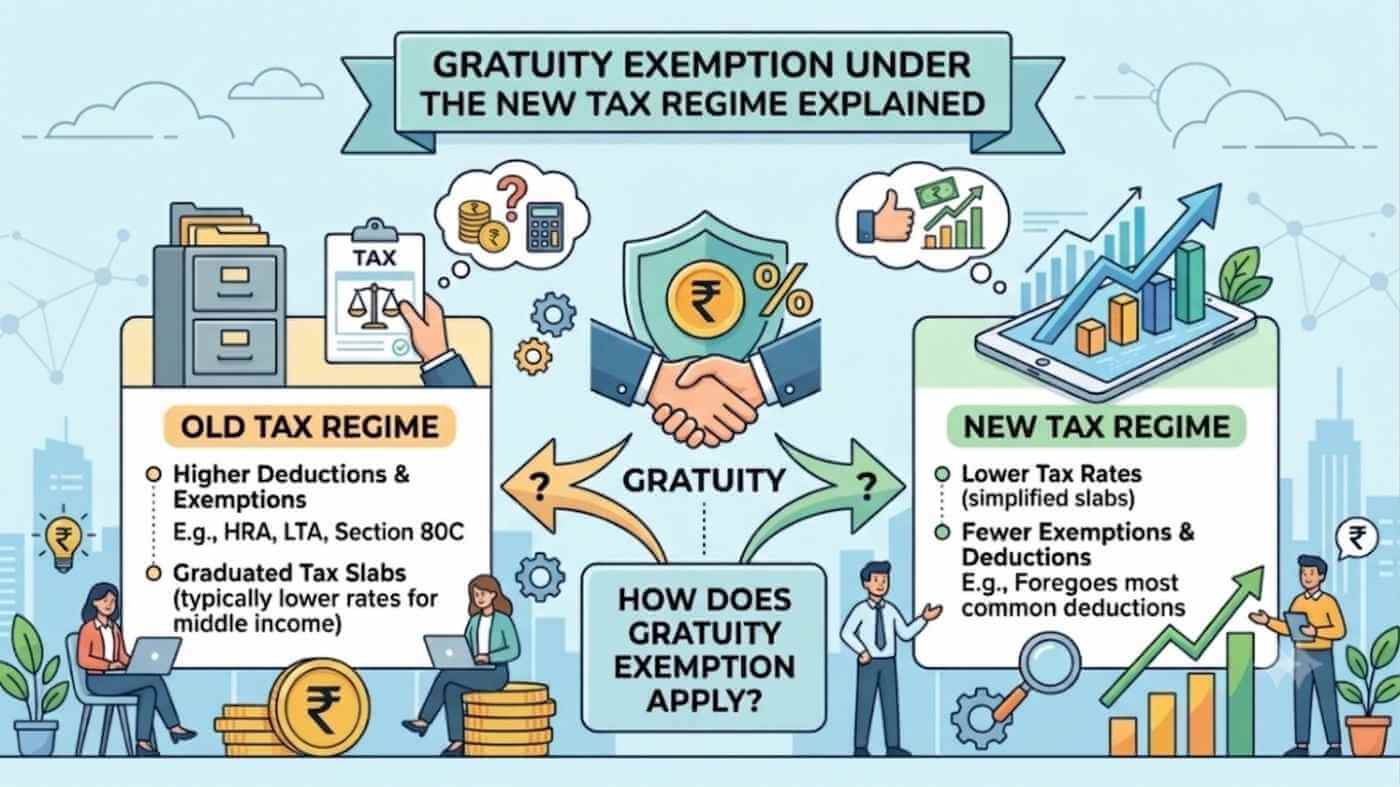
If you have recently switched to the new tax regime or are thinking about it, you may be wondering what happens to your gratuity exemption. The gratuity exemption in the new tax regime is a topic that confuses many salaried employees in India, and for good reason. The rules around which exemptions survive under the new regime and which ones disappear are not always clear. In this blog, we break it all down in plain language so you can make an informed decision before your next tax filing.
Gratuity is an important retirement benefit paid by an employer in recognition of an employee’s long years of service. Understanding how gratuity is taxed, which exemptions continue to be available, and how the rules apply under the new tax regime can help you make informed financial and tax-planning decisions before retirement or separation from employment.
What Is Gratuity and Who Qualifies for It?
Gratuity is a lump sum payment made by an employer to an employee as a token of appreciation for their long-term service. In India, it is governed by the Payment of Gratuity Act, 1972. Most salaried employees in the organised sector qualify for gratuity once they complete at least five continuous years of service with the same employer.
However, there are a few important exceptions. If an employee passes away or suffers a disability due to an accident or illness, the five-year rule does not apply. Their nominee or legal heir still receives the gratuity amount.
Who Is Covered Under the Payment of Gratuity Act?
- Employees in factories, mines, oilfields, plantations, ports, and railway companies
- Employees in shops and commercial establishments with ten or more workers
- Central and state government employees
- Employees in educational institutions with ten or more staff members
In addition, some employers voluntarily pay gratuity even if they are not legally required to. In such cases, the tax treatment may differ slightly, which we will cover below.
How Is Gratuity Calculated in India?
The calculation depends on whether your employer is covered under the Payment of Gratuity Act or not.
For Employees Covered Under the Act
The formula is: Last drawn salary × 15/26 × Number of completed years of service.
Here, salary means basic pay plus dearness allowance. The number 26 represents working days in a month, and 15 represents the number of days of salary paid for each year of service.
For Employees Not Covered Under the Act
The formula is: Last drawn salary × 15/30 × Number of completed years of service.e
In this case, 30 is used instead of 26, which means the payout is slightly lower.
For example, if Ramesh has a basic salary of Rs. 50,000 per month and has worked at his company for 20 years, his gratuity under the Act would be: 50,000 × 15/26 × 20 = Rs. 5,76,923 approximately.
Gratuity Exemption New Tax Regime: What Actually Changes?
This is the key question for many salaried employees.
Under the Income-tax Act, gratuity received by eligible employees is exempt from tax under Section 10(10), subject to the applicable conditions and limits. For non-government employees, the exemption is generally the least of the actual gratuity received, the amount calculated under the prescribed rules, and the notified statutory ceiling (currently Rs. 20 lakh). For eligible government employees, gratuity is generally fully exempt under the applicable provisions of Section 10(10).
The important point is that this exemption continues to be available under the new tax regime. Unlike deductions such as those under Sections 80C and 80D or exemptions such as HRA, the gratuity exemption under Section 10(10) has not been withdrawn merely because you opt for the new tax regime.
In other words, choosing the new tax regime does not by itself affect your eligibility for gratuity exemption. If your gratuity qualifies for exemption under Section 10(10), you can continue to claim that exemption even under the new tax regime.
Why Does This Matter?
Many salaried employees hesitate to switch to the new tax regime because they worry about losing valuable tax benefits. However, the continuation of the gratuity exemption under Section 10(10) is an important exception. Unlike many deductions and exemptions that are unavailable under the new tax regime, the gratuity exemption continues to apply, subject to the conditions and limits prescribed under the Income-tax Act.
As a result, choosing the new tax regime does not, by itself, affect the tax treatment of an eligible gratuity payment. Depending on the amount of gratuity received, and the applicable exemption rules, all or part of the gratuity may continue to remain exempt from tax.
Understanding the Exemption Limits: A Quick Comparison
| Category of Employee | Exemption Limit (Old Regime) | Exemption Limit (New Regime) |
|---|---|---|
| Government employees | Fully exempt (no cap) | Fully exempt (no cap) |
| Private sector employees covered under the Act | Up to Rs. 20 lakh | Up to Rs. 20 lakh |
| Private sector employees NOT covered under the Act | Up to Rs. 20 lakh (least of three: actual, half month salary per year, Rs. 20 lakh) | Up to Rs. 20 lakh (same rule applies) |
| Gratuity received on death or disability | Fully exempt | Fully exempt |
As you can see, the exemption limits are identical under both regimes. The new tax regime takes away deductions like 80C, 80D, and HRA, but it does not touch the gratuity exemption.
Which Tax Exemptions Survive Under the New Regime?
Since we are discussing the gratuity exemption new tax regime, it helps to understand the broader picture. The new regime removes most deductions and exemptions, but a specific set of exemptions under Section 10 of the Income Tax Act still apply.
Exemptions That Continue Under the New Tax Regime
- Gratuity (Section 10(10)): Exempt up to Rs. 20 lakh for private employees; fully exempt for government employees
- Leave encashment on retirement (Section 10(10AA)): Exempt up to Rs. 25 lakh for non-government employees.
- Voluntary Retirement Scheme (VRS) compensation (Section 10(10C)): Exempt up to Rs. 5 lakh
- Death-cum-retirement gratuity for government employees: Fully exempt
- EPF lump sum on retirement: Exempt subject to conditions
- Life insurance maturity proceeds (Section 10(10D)): Exempt subject to premium conditions
Key Exemptions That Are NOT Available Under the New Regime
- House Rent Allowance (HRA) under Section 10(13A)
- Leave Travel Allowance (LTA)
- Children’s education allowance
- Standard deduction on salary was earlier not available, though from FY 2024-25, a standard deduction of Rs. 75,000 is now available under the new regime.
- Most deductions under Chapter VI-A such as Section 80C, 80D, 80E, and 80G
Therefore, when it comes to gratuity specifically, employees under the new regime face no disadvantage at all. The exemption stays intact.
Practical Example: How Gratuity Is Taxed Under the New Regime
Let us consider the example of Priya, a private sector employee covered by the Payment of Gratuity Act, 1972. She has worked for the same company for 25 years and retires during the financial year in which she has opted for the new tax regime. Her last drawn salary for gratuity purposes (Basic Salary plus Dearness Allowance, if applicable) is Rs. 80,000 per month.
Her gratuity calculation: 80,000 × 15/26 × 25 = Rs. 11,53,846 approximately.
Since the amount eligible for exemption is below the current statutory ceiling of Rs. 20 lakh, the entire gratuity is exempt from tax under Section 10(10). Choosing the new tax regime does not affect this exemption.
Now suppose Priya receives Rs. 22 lakh as gratuity. For a non-government employee, the exemption under Section 10(10) is the least of:
- the actual gratuity received,
- the amount calculated under the prescribed formula, and
- the notified statutory ceiling (currently Rs. 20 lakh).
Any gratuity that does not qualify for exemption under these rules becomes taxable in the year of receipt, irrespective of whether the employee has opted for the old or the new tax regime.
Tips to Make the Most of Your Gratuity Exemption
Understanding the rule is only the first step. Here are some practical tips to ensure you benefit fully from the gratuity exemption in the n new tax regime or old regime, whichever you choose.
1. Do Not Break Your Service Unnecessarily
Gratuity eligibility requires five continuous years with the same employer. Changing jobs frequently before crossing the five-year mark means you forfeit your gratuity entirely. Think carefully before making that move.
2. Verify Your Employer’s Coverage Under the Act
Confirm whether your employer falls under the Payment of Gratuity Act. If they do not, the formula and the cap calculation work slightly differently. This affects how much of your gratuity is actually exempt.
3. Check Your Salary Definition
For gratuity calculation, only basic pay and dearness allowance count. Special allowances, bonuses, and other components do not form part of the salary for this purpose. Knowing your exact basic salary helps you estimate your gratuity payout in advance.
4. Keep Records of Your Service Duration
Maintain clear records of your date of joining and date of leaving. Any ambiguity around completed years of service can affect your gratuity amount. Keep your appointment letter, pay slips, and Form 16 safely.
5. Plan Your Year of Receipt Carefully
If your gratuity exceeds Rs. 20 lakh, the taxable portion will add to your income in the year of receipt. Plan your other investments and income sources for that year to manage your total tax liability efficiently.
We work with many salaried employees who are approaching retirement and need clarity on how their gratuity, provident fund, and other retirement benefits will be taxed. A personalised mutual fund plan can help you retire with more confidence and fewer tax surprises.
Should You Choose the New or Old Regime After Considering Gratuity?
Since the gratuity exemption remains the same under both regimes, gratuity alone should not be the deciding factor. Your choice between the old and new tax regime should depend on your overall financial picture.
Factors That May Favour the Old Regime
- You make significant investments under Section 80C (PPF, ELSS, life insurance, home loan principal)
- You pay health insurance premiums for yourself and your parents (Section 80D)
- You live in a rented house and claim HRA
- You have a home loan and claim interest deduction under Section 24
Factors That May Favour the New Regime
- Your total deductions and exemptions (other than gratuity) are relatively low.
- You prefer simplicity without tracking multiple investments and receipts
- You are early in your career with fewer financial commitments
- Your income falls in the lower-middle slab range where the new regime’s lower rates offer a clear benefit
The right answer varies for every individual. If you are unsure, a conversation with a VSJ FinMart advisor can help you run the numbers and decide which regime actually saves you more tax, keeping your gratuity, salary structure, and investments all in mind.
Common Myths About Gratuity and the New Tax Regime
Several myths circulate about how gratuity is treated under the new regime. Let us clear up the most common ones.
Myth 1: Gratuity Is Fully Taxable Under the New Regime
False. Gratuity exemption under Section 10(10) applies equally under both regimes. Nothing changes.
Myth 2: Only Government Employees Get Gratuity Exemption
False. Private sector employees also receive the exemption, subject to the Rs. 20 lakh cap and the Act coverage criteria.
Myth 3: If Your Gratuity Is Below Rs. 20 Lakh, You Still Need to Report It
Clarification needed. You must disclose the gratuity received in your income tax return. However, the exempt portion is shown under the exempt income schedule. You do not pay tax on the exempt amount, but you must still report it.
Myth 4: Switching to the New Regime Mid-Career Affects Your Gratuity Accumulation
False. Your tax regime choice does not affect how gratuity accumulates. It only affects how the payout is taxed when you actually receive it.
Final Words
The gratuity exemption in the new tax regime is one of the most reassuring aspects of India’s revised tax structure. Unlike HRA, LTA, or Section 80C deductions, the gratuity exemption under Section 10(10) is fully preserved under the new regime. Whether you are a government employee with full exemption or a private sector worker eligible for up to Rs. 20 lakh in exemption, your gratuity payout remains protected regardless of your tax regime choice.
The key takeaways are simple: complete your five years of service, understand the calculation formula applicable to your employment, keep your records in order, and file your return correctly showing the exempt gratuity amount. If your gratuity exceeds Rs. 20 lakh, plan for the taxable portion in advance.
Retirement planning involves more than just knowing about gratuity. It includes understanding how your EPF, NPS, pension, and investments all come together. We help you build a complete, personalised mutual fund investment plan that makes the most of every rupee you have earned over your working years. Reach out to us today and retire with a plan, not just a prayer.
Frequently Asked Questions
1. Is gratuity exempt from tax under the new tax regime in India?
Yes. Gratuity exemption under Section 10(10) of the Income Tax Act continues to apply under the new tax regime. Private sector employees can claim exemption up to Rs. 20 lakh, while government employees receive full exemption with no upper limit.
2. What is the maximum gratuity exemption limit for private sector employees?
The maximum gratuity exemption for private sector employees is Rs. 20 lakh. Any amount received above this limit is added to taxable income and taxed at the applicable slab rate under whichever tax regime you have chosen.
3. Does switching to the new tax regime affect my gratuity payout?
No. Your tax regime choice does not affect the gratuity amount your employer pays you. It also does not affect the exemption limit. The Rs. 20 lakh exemption applies under both regimes.
4. Do I need to report gratuity in my income tax return even if it is fully exempt?
Yes. You must disclose the gratuity received in your income tax return under the exempt income schedule. However, you do not pay any tax on the portion that qualifies for exemption under Section 10(10).
5. What happens to my gratuity if I resign before completing five years?
In most cases, you forfeit your gratuity if you resign before completing five continuous years of service. The only exceptions are death or permanent disability, in which case the five-year requirement is waived, and the gratuity is paid to the nominee or legal heir.
Disclaimer
The information provided in this blog is for educational and informational purposes only and should not be construed as investment advice. Please consult a qualified financial advisor before making any investment decisions. Shashikant Chanderkumar Mudaliar (ARN: 319377), operating under the brand name VSJ FinMart, is an AMFI-registered Mutual Fund Distributor (MFD) and does not provide investment advisory services. Mutual fund investments are subject to market risks. Past performance is not indicative of future results. Please read all scheme-related documents carefully before investing. Registration details can be verified at www.amfiindia.com/locate-distributor.