

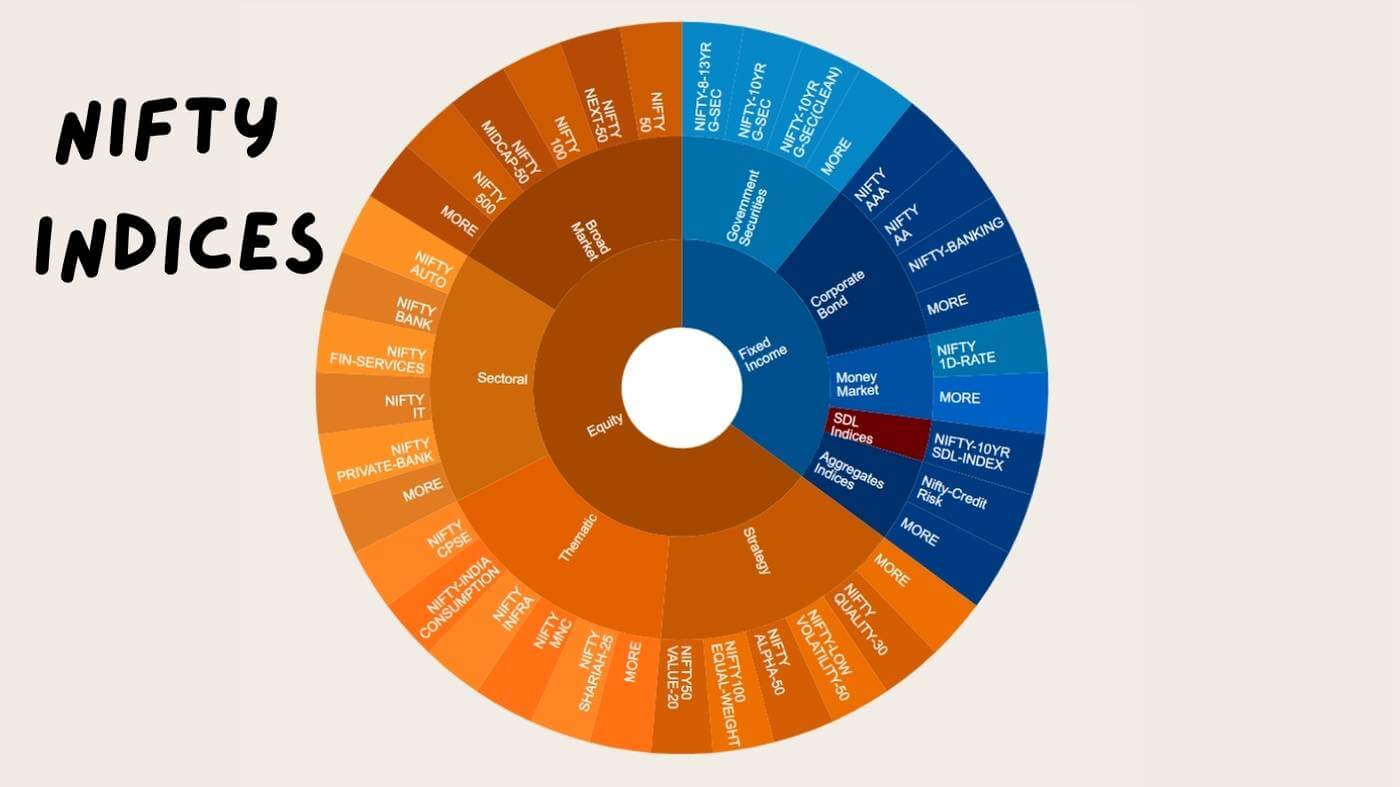
Most Investors Stop at NIFTY 50. Should You?
Ask any new investor in India about index funds, and they will almost certainly mention one name: NIFTY 50. Rightly so. It tracks the 50 largest companies by market capitalisation on the NSE, costs almost nothing to own, and does what it promises. For most people starting, it is the right choice.
But it is not the only choice.
India’s index fund ecosystem has grown significantly over the past decade. Today, investors have access to mid-cap index funds, small-cap index funds, factor-based strategies, total market indices, and international equity funds. Each serves a different purpose and carries a different risk profile.
This guide maps out the full universe of index investing available through Indian mutual funds, so you can decide whether going beyond the NIFTY 50 makes sense for your goals.
What Is Index Investing and Why Does It Work?
An index fund is a mutual fund or ETF that passively mirrors a market index, buying the same stocks in the same proportion. No fund manager picks stocks. The fund simply follows the index.
This passive approach has three advantages that have made it popular globally:
• Lower costs: Expense ratios of 0.05% to 0.50%, compared to 0.8% to 2.5% for active funds
• Consistency: Returns track the market, not the judgment calls of an individual manager
• Transparency: You always know exactly what you own, since index composition is public
| The Core InsightMost actively managed equity funds in India fail to consistently beat their benchmark index over 10 years, particularly after fees. Index funds capture market returns reliably, and over the long run, market returns compound into meaningful wealth. |
Starting Point: What Does NIFTY 50 Index Investing Give You?
The NIFTY 50 index represents the 50 largest, most liquid companies listed on the NSE. Together they account for roughly 65 to 70 percent of the total free-float market capitalisation of NSE-listed stocks.
Sector exposure includes financial services (typically 30 to 35 percent), IT, consumer goods, oil and gas, automobiles, healthcare, and telecom. Over the past 15 years, NIFTY 50 has delivered approximately 12 to 13 percent CAGR (illustrative, based on historical data).
Strengths of NIFTY 50 Index Funds
• Very low expense ratios, as low as 0.05%
• High liquidity across all underlying stocks
• Excellent diversification within large-cap India
• Suitable as a core, long-term holding for any investor
Limitations of Stopping at NIFTY 50
• Misses the mid-cap and small-cap growth story, which has historically generated meaningful returns over long periods
• Concentrated exposure to financial services (30 percent plus) creates an implicit sector tilt
• No access to factor premiums like value, momentum, or low volatility
• No international diversification
The Full Universe of Index Funds Available in India
Here is what the broader index investing landscape actually looks like, grouped by type.
1. Broad Market Indices: The Foundation Layer
| NIFTY 50 India’s Flagship Large-Cap Index: The starting point for every index investor. Tracks the 50 most liquid large-cap companies on the NSE. Works well as the core holding in any long-term portfolio. Covers: 50 stocks Best For: All investors Risk: Low to Medium Typical Expense Ratio: 0.05 to 0.20% |
| NIFTY Next 50 The Future NIFTY 50: Tracks the next 50 large-cap companies after the NIFTY 50: those ranked 51 to 100. Often called the farm team for the main index, as successful companies graduate upwards. Historically delivered higher long-term returns than NIFTY 50 but with greater volatility. Covers: 50 stocks. Best For: Long-term growth seekers. Risk: Medium Typical Expense Ratio: 0.10 to 0.30% |
| NIFTY 100 Combined Large-Cap Universe: Combines NIFTY 50 and NIFTY Next 50 in a single fund. A convenient one-stop large-cap index option. Covers: 100 stocks. Best For: Broader large-cap exposure Risk: Low to Medium Typical Expense Ratio: 0.10 to 0.25% |
| NIFTY 500 India’s Total Market Index: Covers the top 500 companies by market cap, spanning large, mid, and small-cap stocks in a single fund. The closest thing to a total India market index. Ideal for investors who want one diversified fund and nothing else. Covers: 500 stocks. Best For: One-fund portfolio Risk: Medium Typical Expense Ratio: 0.10 to 0.30% |
2. Mid and Small Cap Indices: The Growth Layer
| NIFTY Midcap 150 India’s Mid-Cap Growth Engine: Tracks 150 mid-cap companies that have graduated beyond small-cap but are still growing fast. Has historically delivered higher long-term returns than large caps, with correspondingly higher volatility. Best suited for a 7 to 10+ year horizon. Covers: 150 stocks. Best For: Growth investors, 7 to 10 year horizon. Risk: Medium to High Typical Expense Ratio: 0.20 to 0.40% |
| NIFTY Smallcap 250 High-Growth, High-Risk Small Caps: Tracks 250 small-cap companies: the highest potential, highest volatility segment of Indian equity. Should be a satellite allocation only, for investors who can hold for 10 or more years and stomach significant drawdowns along the way. Covers: 250 stocks. Best For: Aggressive investors, 10+ year horizon. Risk: High Typical Expense Ratio: 0.20 to 0.50% |
| NIFTY LargeMidcap 250 Best of Both Worlds: A blend of the top 100 large-cap and 150 mid-cap companies. Provides diversification across the two most important segments of Indian equity in a single fund. Growing in popularity among SIP investors. Covers: 250 stocks. Best For: Balanced growth Risk: Medium Typical Expense Ratio: 0.15 to 0.35% |
3. Factor-Based (Smart Beta) Index Funds: The Strategy Layer
Factor investing is where index investing gets more sophisticated. Instead of tracking all companies by market cap, factor indices select stocks based on a specific characteristic that research suggests leads to better risk-adjusted returns over time.
| NIFTY Alpha 50 Momentum-Driven Factor Index: Selects 50 stocks with the highest alpha relative to the market over the past year. Tends to do well in trending bull markets but can underperform sharply during reversals. Best used as a small tactical allocation, not a core holding. Covers: 50 stocks (high alpha) Best For: Tactical, experienced investors Risk: Medium to High Typical Expense Ratio: 0.30 to 0.50% |
| NIFTY Value 20 Deep Value Factor Index: Selects 20 fundamentally undervalued stocks based on earnings yield, book value, and dividend yield. Value investing has a long track record globally but requires patience, as value cycles can last years. Covers: 20 value stocks. Best For: Patient, long-term investors. Risk: Medium. Typical Expense Ratio: 0.30 to 0.50% |
| NIFTY Low Volatility 50 Defensive Factor Index: Selects 50 stocks with the lowest historical price volatility. Tends to outperform in bear markets and deliver smoother returns. Well-suited for conservative investors who want equity exposure with lower drawdowns. Covers: 50 low-vol stocks. Best For: Conservative, near-retirement investors Risk: Low to Medium Typical Expense Ratio: 0.30 to 0.50% |
| NIFTY Quality 30 Quality Factor Index: Selects 30 companies with high return on equity, low debt, and stable earnings growth. Often holds up better during economic downturns. A good long-term choice for investors who prioritise business quality over growth at any price. Covers: 30 quality stocks. Best For: Conservative growth investors. Risk: Medium Typical Expense Ratio: 0.30 to 0.50% |
4. Sectoral and Thematic Index Funds: The High-Conviction Layer
Sectoral index funds track a specific industry or theme. They concentrate exposure and carry a higher risk, but also the potential for significantly higher returns if the sector performs well over your horizon.
| Important Caution on Sectoral FundsSectoral funds are not suitable as core holdings. They should represent at most 10 to 15 percent of your total equity portfolio, and only if you have a genuine conviction in the long-term growth of that sector. They require more monitoring and a stronger tolerance for volatility. |
• NIFTY IT Index: Top 10 IT companies, benefit from global tech spending and digital transformation
• NIFTY Bank Index: Banking sector exposure, sensitive to interest rate cycles and credit growth
• NIFTY India Manufacturing Index: Plays the Make in India theme and PLI scheme beneficiaries
• NIFTY Infrastructure Index: Tracks power, telecom, and transport infrastructure companies
• NIFTY Pharma Index: Pharmaceutical sector, defensive in nature, with healthcare spending tailwinds
• NIFTY Consumption Index: Consumer-facing businesses riding India’s middle-class spending story
5. International Index Funds: The Global Diversification Layer
India-domiciled mutual funds now allow investors to access global equity indices, adding international diversification to their portfolio.
• Nasdaq 100 Index Funds: Top 100 non-financial Nasdaq companies, heavily tech-weighted (Apple, Microsoft, Nvidia, Google). High growth, high volatility, USD-denominated
• S&P 500 Index Funds: 500 largest US companies, the gold standard of global equity indices, and a core international holding for diversification
• MSCI World or Emerging Market Index Funds: Broader global or emerging market exposure beyond just US equities
| Why International Index Funds Matter for Indian Investors: The Indian rupee has historically depreciated against the US dollar over the long run. International index funds denominated in USD provide a natural hedge against rupee depreciation, while also diversifying away from India-specific economic and political risks. |
Quick Reference: India’s Key Index Funds at a Glance
Use this table to compare the key indices across risk levels, coverage, and suitability.
| Index | No. of Stocks | Market Cap Focus | Risk Level | Ideal For | Expense Ratio |
| NIFTY 50 | 50 | Large Cap | Low to Medium | All investors, core holding | 0.05 to 0.20% |
| NIFTY Next 50 | 50 | Large Cap (emerging) | Medium | Long-term + some growth | 0.10 to 0.30% |
| NIFTY 100 | 100 | Large Cap | Low to Medium | Broader large-cap exposure | 0.10 to 0.25% |
| NIFTY Midcap 150 | 150 | Mid Cap | Medium to High | Growth-oriented, 5 to 10 yr | 0.20 to 0.40% |
| NIFTY Smallcap 250 | 250 | Small Cap | High | Aggressive, long horizon only | 0.20 to 0.50% |
| NIFTY 500 | 500 | Large + Mid + Small | Medium | Total market, set-and-forget | 0.10 to 0.30% |
| NIFTY Alpha 50 | 50 | Factor (Momentum) | Medium to High | Tactical, experienced investors | 0.30 to 0.50% |
| NIFTY Value 20 | 20 | Factor (Value) | Medium | Value-oriented, long-term | 0.30 to 0.50% |
| NIFTY Low Vol 50 | 50 | Factor (Low Volatility) | Low to Medium | Conservative, near-retirement | 0.30 to 0.50% |
| Nifty IT Index | 10 | Sectoral (IT) | High | Tech conviction, tactical | 0.40 to 0.60% |
| NIFTY Infra Index | 30 | Sectoral (Infra) | High | The infrastructure theme plays | 0.40 to 0.60% |
Note: Expense ratios are indicative ranges. Actual figures may vary by fund house. Always verify on the AMC website or AMFI.
How to Build a Multi-Index Portfolio: 3 Blueprint Examples
Here is how to combine index funds based on your investor profile and goals.
Blueprint 1: The Simple Beginner Portfolio (2 Funds)
| Index Fund | Allocation | Why |
| NIFTY 50 Index Fund | 80% | Core large-cap India equity exposure. Low cost, low maintenance. |
| NIFTY Next 50 Index Fund | 20% | Adds some mid-large cap growth without excessive complexity. |
Ideal for first-time investors, those who want simplicity above all, or anyone with a 10 to 30 year horizon who wants to set up an automated SIP and let it run.
Blueprint 2: The Growth-Oriented Portfolio (3 Funds)
| Index Fund | Allocation | Why |
| NIFTY 100 Index Fund | 50% | Broad large-cap base covering NIFTY 50 and NIFTY Next 50. |
| NIFTY Midcap 150 Index Fund | 30% | Mid-cap growth engine. 7 to 10-year compounding focus. |
| Nasdaq 100 or S&P 500 Fund | 20% | International diversification and USD appreciation benefit. |
Ideal for professionals aged 25 to 40 with a 10 to 20 year horizon, comfortable with moderate volatility, and looking for meaningful wealth creation.
Blueprint 3: The Seasoned All-Weather Portfolio (5 Funds)
| Index Fund | Allocation | Why |
| NIFTY 50 Index Fund | 35% | Core India large-cap anchor. |
| NIFTY Midcap 150 Index Fund | 20% | Growth satellite captures mid-cap returns over time. |
| NIFTY Low Volatility 50 Fund | 15% | Defensive buffer smooths overall portfolio volatility. |
| S&P 500 or Nasdaq 100 Fund | 20% | Global diversification and rupee hedge. |
| Sectoral Fund (1 theme) | 10% | High-conviction thematic bet (IT, Manufacturing, Infra, etc.). |
Ideal for investors aged 30 to 50 with 15 or more years to retirement who want a diversified index portfolio with strategic tilts.
Important Considerations Before Going Beyond NIFTY 50
Expanding your index portfolio comes with real trade-offs every investor needs to understand.
• More funds do not mean better diversification: Adding five mid-cap funds when one is sufficient only adds complexity without benefit. Keep it clean.
• Factor funds can lag for years: Value indices, for instance, can underperform the market for three to five years before rewarding patient investors. You need to be able to hold through that.
• Sectoral funds require conviction and monitoring: Unlike broad index funds, sectoral funds are cyclical and need more active attention.
• International funds have SEBI investment limits: Fund houses may occasionally pause fresh investments in international funds when industry-wide limits are reached, as per RBI and SEBI guidelines.
• Expense ratios vary significantly: Broad index funds can be extraordinarily cheap. Factor and sectoral funds cost more. Always check the Total Expense Ratio before investing.
• Rebalancing discipline is essential: A multi-fund portfolio drifts over time. Rebalancing once a year is sufficient to maintain your target allocation.
Building a multi-index portfolio the right way depends on your goals, your income, and your timeline. At VSJ FinMart, we help investors map out exactly which combination of index funds fits their specific situation, so you are not guessing; you are investing with a clear plan.
Should You Go Beyond NIFTY 50? A Quick Decision Guide
| Stick with NIFTY 50 if you: | Go Beyond NIFTY 50 if you: |
| Are you a first-time investor who wants simplicity | Have a 10+ year investment horizon |
| Have an investment horizon under 5 years | Want to capture mid-cap or small-cap growth |
| Prefer zero-maintenance, fully automated investing | Wish to diversify internationally for rupee hedging |
| Are uncomfortable monitoring multiple funds | Are interested in smart-beta or factor strategies |
| Have a larger corpus and want targeted sector exposure. |
5 Practical Tips for Multi-Index Portfolio Investors
1. Start with NIFTY 50 as your core, always. Build complexity only after you have a solid core position.
2. Add funds one at a time. Start with NIFTY Next 50, then mid-cap, then international. Not all at once.
3. Use SIPs for each fund separately, with individual auto-debits to maintain discipline and avoid decision fatigue.
4. Review your portfolio once a year, not more. Over-monitoring leads to emotional decisions. Annual rebalancing is enough.
5. Get guidance before adding complexity. A personalised review from an advisor at VSJ FinMart can tell you whether expanding your portfolio actually improves your expected outcome, or whether you are adding noise.
Frequently Asked Questions
Is the NIFTY 50 index fund enough for long-term wealth creation?
For most retail investors, yes. A NIFTY 50 index fund invested through regular SIPs over 15 to 20 years creates substantial wealth through compounding. Adding more indices makes sense if you want broader exposure or mid-cap growth, not because NIFTY 50 is inadequate.
What is the difference between NIFTY 50 and NIFTY Next 50?
NIFTY 50 tracks the 50 largest companies on the NSE by market cap. NIFTY Next 50 tracks the next 50, ranked 51 to 100. Companies graduate from NIFTY Next 50 into NIFTY 50 as they grow. Historically, NIFTY Next 50 has delivered higher long-term returns but with greater volatility.
What are factor funds and smart beta index funds in India?
Factor index funds select stocks based on a specific investment characteristic rather than market cap alone. Common factors include momentum (strong recent performers), value (fundamentally cheap stocks), quality (high ROE, low debt), and low volatility. Each has historically been associated with better risk-adjusted returns over long periods, but all require patience.
Should I invest in international index funds like the Nasdaq 100 from India?
International index funds like the Nasdaq 100 or S&P 500 are a valuable addition for investors with a 10-year or more horizon. They provide geographic diversification, exposure to global technology leaders, and a natural hedge against INR depreciation. Keep them at 15 to 25 percent of your equity portfolio, not the core.
How many index funds should I hold in my portfolio?
Two to four is the right range for most investors. A simple two-fund portfolio of NIFTY 50 (70 to 80 percent) and NIFTY Next 50 or NIFTY Midcap 150 (20 to 30 percent) is effective and low-maintenance. Beyond four or five funds, the marginal diversification benefit decreases rapidly while complexity increases. Avoid holding eight or ten index funds that largely overlap each other.
Disclaimer
The information provided in this blog is for educational and informational purposes only and should not be construed as investment advice. Please consult a qualified financial advisor before making any investment decisions. Shashikant Chanderkumar Mudaliar (ARN: 319377), operating under the brand name VSJ FinMart, is an AMFI-registered Mutual Fund Distributor (MFD) and does not provide investment advisory services. Mutual fund investments are subject to market risks. Past performance is not indicative of future results. Please read all scheme-related documents carefully before investing. Registration details can be verified at www.amfiindia.com/locate-distributor.