

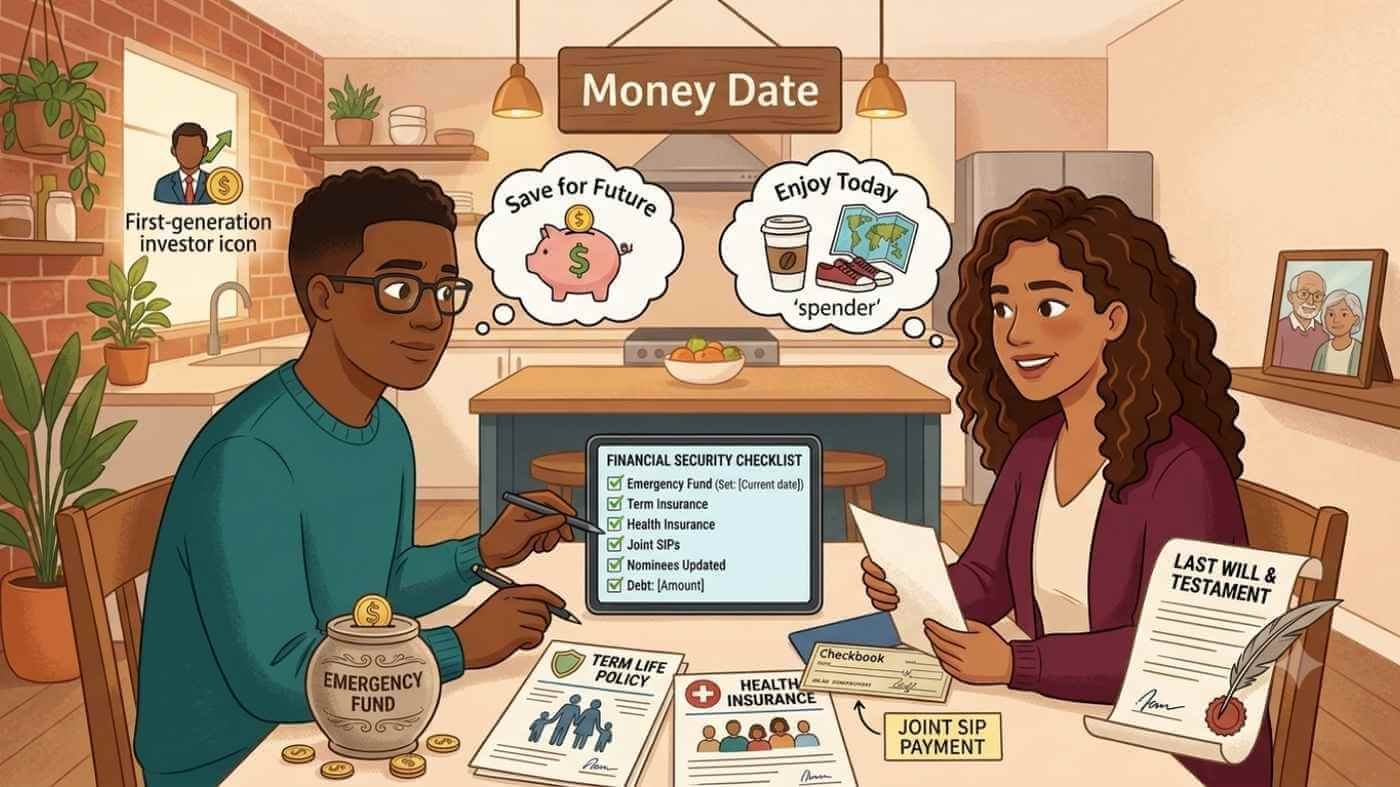
Rahul and Sneha had been married for three years. Both earned well, both considered themselves financially responsible, and neither had ever sat down with the other, without a crisis or a deadline, to talk openly about money.
They did not know each other’s exact salary. Sneha was quietly sending money to her parents every month. Rahul had increased his SIP without mentioning it. Their finances worked in the sense that bills got paid, but they were running two parallel financial lives under one roof. This is the default for most Indian couples.
A money date for couples is the antidote: a scheduled, calm, collaborative conversation about your shared financial life. Couples who practise it report stronger financial outcomes and significantly higher relationship satisfaction. Here is how it works.
What a Money Date Is, and Is Not
A money date is a scheduled, recurring conversation between partners, monthly, quarterly, or annually, focused on your shared financial life. It has a beginning, an agenda, and produces specific action items.
A Money Date IS / IS NOT
IS: a calendar event, a collaborative review, a goal-setting conversation, a safe space for honesty, a celebration of wins, proactive.
IS NOT: a fight about who spent what, a blame session, a lecture, a crisis response, a one-sided review by whoever manages the accounts.
Money is the most common source of conflict in Indian marriages, ahead of parenting and extended family dynamics. The cause is rarely a shortage of money. It is almost always a shortage of conversation. Problems a ten-minute conversation could resolve in Year 1 become entrenched resentments by Year 5.
5 Money Personality Types in Couples
The most financially compatible couples are not those who share the same money personality. They are those who understand and respect each other’s type. Here are the five most common, and what each needs from a money date.
| Type | How They See Money | Blind Spot | What They Need at a Money Date |
| Security Seeker | Money = safety. Disciplined saver, excellent emergency fund, never misses insurance. | Can underinvest for growth out of caution; may become controlling about shared spending. | Show the numbers first. Confirm stability before proposing any new risk. |
| Freedom Spender | Money = experiences. Generous, spends intentionally on what matters, brings balance to frugal households. | May undersave for long-term goals; resists SIPs as locking away money. | Frame investing as more freedom later, not less spending now. Automate before it reaches a spendable account. |
| Status Projector | Money = achievement. Strong earner, motivated by visible markers of success. | Lifestyle inflation tracks income growth, limiting wealth accumulation; resists humble investments. | Connect SIPs to visible milestones: the corpus that funds the holiday or the child’s premium education. |
| The Avoider | Money = anxiety. Delegates all decisions, avoids checking balances or renewals. | Financial dependency creates vulnerability if the managing partner is unavailable. | Gentle, non-judgmental education in small doses. One concept per money date. |
| Wealth Builder | Money = compounding. Tracks returns, maximises tax efficiency, thinks in decades. | Can come across as controlling or preachy; may under-invest in present quality of life. | Present ideas as options, not obvious correct answers. Leave space for a partner’s different priorities. |
Money Date Agenda: Monthly, Quarterly, Annual
A money date needs a clear agenda. Winging it leads to either superficial chats or accidental conflict. Start with the monthly format and build the habit before adding the deeper sessions.
| Cadence | Duration | When | Core Agenda |
| Monthly | 45-60 min | First Sunday | One win, one worry, last month’s spending and SIP check, this month’s planned expenses, one goal progress check, two action items. |
| Quarterly | 90-120 min | Every 3 months | Portfolio review (SIPs, allocation drift, rebalancing), insurance audit (term and health, nominees), debt review, deeper goal assessment. |
| Annual | 3-4 hours | Every April | Financial year review, net worth calculation, comprehensive goal and SIP recalibration, full insurance review, tax planning (80C, 80D, NPS 80CCD(1B)), will and nominee update, vision for next year. |
The DOs and DON’Ts of a Money Date
These golden rules determine whether a money date builds trust or accidentally creates a new source of conflict.
| DO | DON’T |
| Set a recurring date in both calendars | Start with blame: ‘You spent too much on X’ |
| Choose a relaxed setting, home, or a favourite cafe | Bring up money issues for the first time on the date itself |
| Come prepared: review your own accounts beforehand | Check phones or allow interruptions |
| Celebrate progress, however little | Make major decisions impulsively; use a 72-hour rule |
| Listen with curiosity, not to defend | Let one partner dominate, regardless of who earns more |
| End with one action item each, with a deadline | Skip a date because ‘things are fine’. Consistency is the value. |
8 India-Specific Money Situations
Indian couples face financial dynamics that much generic financial advice does not address. Here is how to bring each one into the money date directly.
| India-Specific Situation | How to Handle It at a Money Date |
| Unequal incomes | Contributions proportional to income (e.g., 60:40), not a 50-50 split. Avoids power imbalance. |
| Support to parents/in-laws | Treat as a fixed, mutually agreed budget line. Prevents silent resentment. |
| Lower-earning spouse excluded | Both partners get full visibility into every account, SIP, and policy. Non-negotiable. |
| Pre-existing debt brought into marriage. | Disclosed fully before the system starts. Shared repayment plan, not shame. |
| Different spending cultures (saver vs. spender) | Name the difference explicitly. Neither is wrong. Design a system that works for both. |
| Salary disclosure discomfort | Full transparency is foundational. Secrecy destroys the trust the system depends on. |
| Parents giving unsolicited financial advice. | Agree on clear boundaries: major decisions are the couple’s alone, communicated politely. |
| First-generation investor anxiety | Start with the basics: emergency fund first, then an NIFTY index fund SIP. Build knowledge together. |
The Couples Financial Foundations Checklist
Work through this checklist at your first annual money date, and revisit it every year to confirm nothing has lapsed.
| Foundation | What to Confirm |
| Emergency Fund | 6 months of combined expenses in a liquid fund or FD |
| Term Insurance | Both earning partners are covered at 15-20x annual income |
| Health Insurance | Family floater of at least Rs. 10 lakh, with top-up if needed |
| Joint Goal SIPs | Dedicated SIPs for home, child education, and retirement |
| Individual SIPs | Each partner has at least one personal SIP |
| Nominees Updated | All accounts, funds, and policies are checked annually |
| Will / Nominations | Basic will be in place, or nominations will be current across all assets |
| Debt Tracker | All loans tracked: outstanding, EMI, end date, in one shared sheet |
How to Start Your First Money Date This Week
1. Pick a date and put it in both calendars. Make it recurring. Saturday evening or Sunday morning works for most couples.
2. Choose the right environment. Home after a relaxed meal, or a quiet cafe. Not during travel, not when either partner is tired or stressed.
3. Start with the monthly format. Do not attempt the annual template first. Build comfort with 45 minutes before going deeper.
4. Prepare individually beforehand. Each partner reviews their own accounts and spending for the past month before sitting down together.
5. Set one rule: no blame, only curiosity. If a category ran over, the question is ‘what happened?’, not ‘why did you do that?’
6. End with two action items, one each. Without concrete next steps, the conversation stays pleasant but unproductive.
7. Schedule the next one before this one ends. Continuity is the entire value. The first money date is interesting. The twelfth is transformative.
Final Words: The Best Investment You Will Make This Month
A portfolio review by a financial adviser costs money. A money date costs nothing and takes an hour. Couples who practise it consistently are not wealthier because they have found better funds. They are wealthier because they stayed aligned, decisions were made together rather than in parallel, and problems were addressed while small.
Start tonight. Message your partner: ‘I read something interesting about couples and money. Want to try a Money Date this Sunday? Just an hour, I’ll explain when we sit down.’ If you want a structured starting point for your joint goals, an AMFI-registered distributor like VSJ FinMart can help translate your money date decisions into an actual SIP plan with personalised guidance.
For investor education and SIP calculators, visit AMFI India.
Frequently Asked Questions
Q: What is a Money Date, and how often should couples have one?
A money date is a scheduled, recurring conversation between partners about shared finances, following a structured agenda covering spending, savings, investments, and goals. For most Indian couples: a monthly 45- 60-minute date for spending and SIP review, a quarterly 90- 120-minute date for portfolio and insurance review, and an annual 3-4-hour date for tax planning and goal alignment. Start monthly and build the habit before adding the deeper sessions.
Q: What should couples talk about during a Money Date?
Monthly dates cover last month’s spending, SIP confirmations, upcoming expenses, and one goal check. Quarterly dates add portfolio performance, insurance status, and debt review. Annual dates cover net worth, tax planning, insurance adequacy, and a shared vision for the year ahead. The tone should always be collaborative and curious, not blame-driven, and every date should end with at least one action item per partner.
Q: What if my partner refuses to talk about money or gets defensive?
This is common and often rooted in childhood anxiety or shame around money, not unwillingness to be a good partner. Start with the smallest version: 20-30 minutes, one win shared, SIP statements reviewed together. Frame it as ‘we are building something together’ rather than a review of their spending. Avoid starting during an active conflict. Patience and a calm first session matter more than the agenda.
Q: How do Indian couples handle financial support to parents during a Money Date?
Both partners should disclose any monthly transfers to parents or family as part of the shared household budget, not a private side arrangement. Agree on a sustainable amount the household can afford as a fixed line item without compromising its own goals, and discuss both sets of parents with equal consideration. The goal is not to eliminate family support; it is to make it a conscious joint decision rather than a silent obligation one partner carries alone.
Q: Should couples have joint or separate bank accounts in India?
The most effective structure combines both: a joint account for shared household expenses funded by agreed contributions from each partner’s salary, and individual accounts for personal discretionary spending. For investments, joint folios for shared goals (home, child education) plus individual folios with updated joint nominations work well. The key requirement is that both partners have complete visibility into every account and folio, regardless of whose name it is in.
Disclaimer
The information provided in this blog is for educational and informational purposes only. Please consult a qualified financial advisor before making investment decisions. VSJ FinMart is an AMFI-registered Mutual Fund Distributor (MFD) and does not offer investment advisory services. Mutual fund investments are subject to market risks. Please read all scheme-related documents carefully before investing.