

Ramesh and Suresh both retire at 60 with Rs. 1 crore in equity mutual funds. Both withdraw Rs. 6 lakh per year. Both expect 10% average annual returns. By every standard retirement calculation, both should have enough money for 25 to 30 years.
Fifteen years later, Ramesh has Rs. 63 lakh, and his money is growing. Suresh has Rs. 37 lakh and is running out of money.
Same corpus. Same withdrawals. Same average market return. The only difference was the order in which those returns arrived.
This is the sequence of returns risk, the single most underappreciated financial risk facing Indian retirees. This article explains what it is, why it matters, and how the 3-bucket strategy eliminates it.
What is the Sequence of Returns Risk?
During your working years, the order in which investment returns arrive does not matter. If your portfolio earns -20%, +30%, +15% over three years, you end up in roughly the same place regardless of the sequence. You are adding money, not removing it.
The moment you start withdrawing in retirement, sequence matters enormously. Withdrawing during a market downturn forces you to sell more units at lower prices to meet the same withdrawal amount. Those sold units are gone permanently and cannot participate in the recovery.
The Critical Difference
Accumulation phase (working years): market falls let you buy more units cheaply. Bad early returns are compensated for by buying at lower prices. Sequence does not matter.
Distribution phase (retirement): market falls force you to sell more units cheaply to fund withdrawals. Bad early returns permanently destroy units that cannot recover. Sequence matters critically.
The SIP mechanic works in your favour during accumulation. Without the right structure, it works against you in retirement.
The Ramesh vs. Suresh Simulation
Both start with Rs. 1 crore and withdraw Rs. 6 lakh per year. The returns are the same over 15 years, just reversed. The divergence is stark.
| Year | Ramesh Return | Suresh Return | Ramesh Corpus | Suresh Corpus | Annual Withdrawal |
| 1 | 15% | -20% | Rs. 88.5L | Rs. 74.0L | Rs. 6 lakh |
| 2 | 12% | -15% | Rs. 93.1L | Rs. 56.9L | Rs. 6 lakh |
| 3 | 18% | 10% | Rs. 1.04Cr | Rs. 56.6L | Rs. 6 lakh |
| 4 | 10% | 20% | Rs. 1.08Cr | Rs. 61.9L | Rs. 6 lakh |
| 5 | -5% | 18% | Rs. 97.6L | Rs. 67.1L | Rs. 6 lakh |
| 7-9 | Varies | Varies | Rs. 68-93L | Rs. 73-75L | Rs. 6 lakh |
| 13 | – | Adverse | Rs. 55.0L | Rs. 35.5L | Rs. 6 lakh |
| 15 | 15% | 18% | Rs. 63.0L | Rs. 37.2L | Rs. 6 lakh |
What the numbers show: in Years 1 and 2, Suresh’s market fell by -20% and -15% while he was withdrawing Rs. 6 lakh. His corpus dropped from Rs. 1 crore to Rs. 56.9 lakh in two years. Those units sold at distressed prices were gone permanently. Ramesh, with strong early returns, had a much larger base benefiting from the same subsequent recovery.
Safe Withdrawal Rates for Indian Retirees
The safe withdrawal rate is the maximum annual percentage of retirement corpus you can draw without depleting it. For Indian retirees, the 4% global benchmark needs downward adjustment given higher domestic inflation and longer life expectancy.
| Rate | Annual Draw on Rs. 1Cr | Assessment for Indian Retirees |
| 3.0% | Rs. 3L/yr per crore | Very conservative. Suitable where EPF and NPS cover most expenses and the portfolio is a supplement. |
| 3.5% | Rs. 3.5L/yr per crore | Conservative and sustainable. Recommended for retirees aged 55-60 with a 30+ year horizon. |
| 4.0% | Rs. 4L/yr per crore | The global benchmark. Broadly applicable at age 60-65 with a balanced equity-debt portfolio. |
| 5.0% | Rs. 5L/yr per crore | Moderately aggressive. Requires willingness to reduce withdrawals in bad market years. |
| 6.0%+ | Rs. 6L+ per crore | High risk of corpus depletion in adverse return sequences. Not recommended without supplementary income. |
Note: if EPF and NPS income covers 40-50% of retirement expenses, the investment portfolio withdrawal rate can be higher without proportional risk.
The 3-Bucket Retirement Strategy
The bucket strategy is the most practical solution to the sequence of returns risk. It divides your retirement corpus into three separate pools so that a market crash in equity never forces you to sell at distressed prices to meet living expenses.
The key insight: if your immediate expenses are funded from a cash and debt bucket completely separate from equity, a 40% equity crash does not threaten your ability to pay this month’s bills. Your equity recovers while you live off the safety bucket.
| Bucket | Allocation | Horizon | Instruments | Purpose and Role |
| Bucket 1: Safety | 15-20% of corpus | Years 1-3 | Liquid Mutual Funds, Ultra-Short Duration Funds, Bank FDs | Funds all monthly expenses. Zero equity exposure. Never invested in equity. Refilled from Bucket 2 each year. |
| Bucket 2: Stability | 30-40% of corpus | Years 4-10 | Short to Medium Duration Debt Funds, Conservative Hybrid Funds, Sovereign Gold Bonds | Generates income and protects against volatility. Refill Bucket 1 annually. Provides 7-10 years of runway so Bucket 3 can recover from any correction. |
| Bucket 3: Growth | 40-55% of corpus | Years 10+ | Diversified Equity Mutual Funds (Index + Active Flexicap), International Funds | Not touched for 10+ years. Delivers inflation-beating growth. Transfers to Bucket 2 every 5-7 years. The engine of corpus longevity. |
How the Buckets Refill Each Year
Good market year: transfer from Bucket 3 to Bucket 2, and from Bucket 2 to Bucket 1. Sell equity at fair or favourable prices.
Bad market year: do NOT sell from Bucket 3. Draw from Bucket 2 to refill Bucket 1. Bucket 3 stays intact through the downturn and participates in the recovery.
Suresh, had he used the bucket strategy, would never have needed to sell equity in Years 1 and 2. His outcome would have looked much more like Ramesh’s.
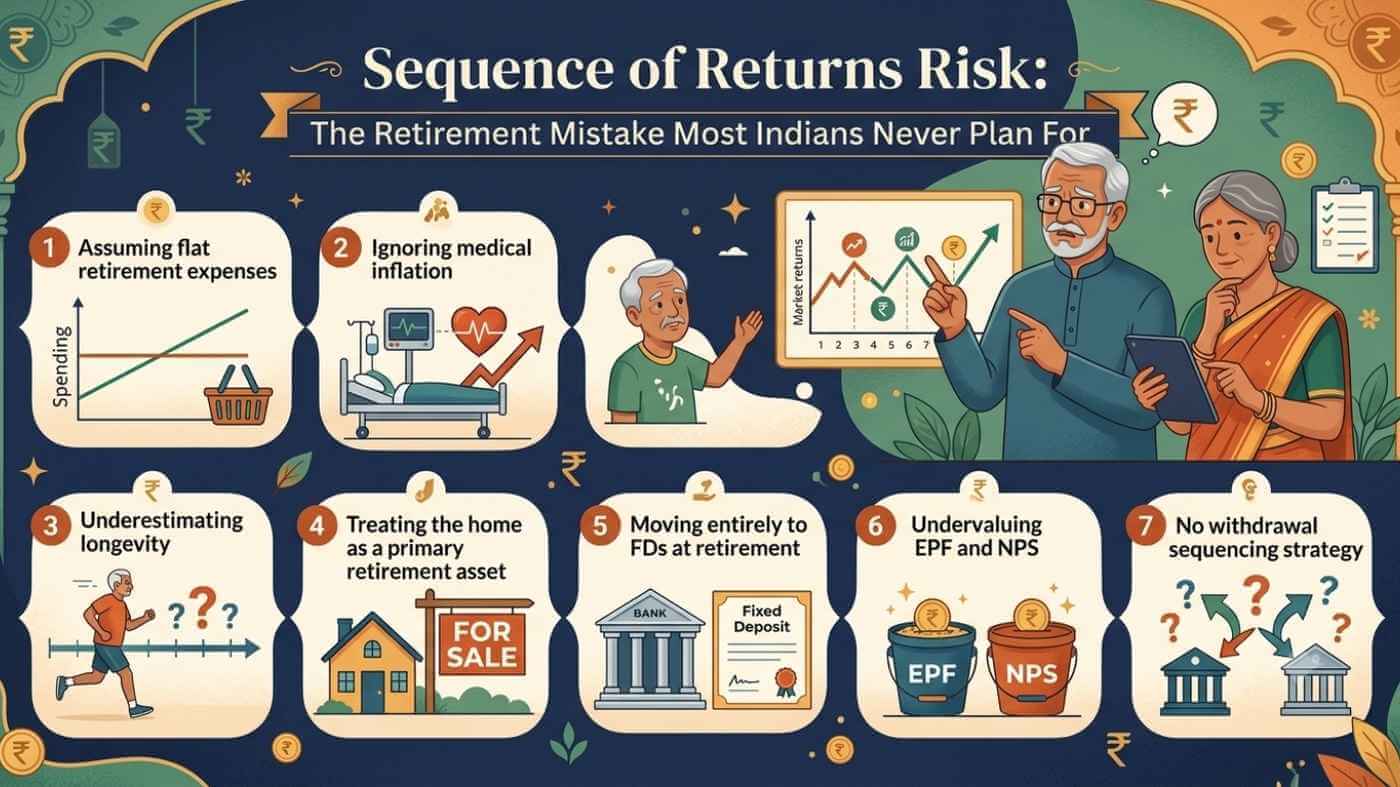
7 Retirement Planning Mistakes That Derail Indian Investors
Sequence of returns risk sits within a broader set of retirement planning errors. Here are the seven most consequential.
| The Mistake | Why It Derails Retirements |
| Assuming flat retirement expenses | Retirement expenses change significantly decade by decade: higher lifestyle spending at 60-70, steady at 70-80, higher medical at 80+. A single flat estimate systematically underestimates some periods. |
| Ignoring medical inflation | India’s healthcare costs rise at 12-14% annually. A Rs. 5 lakh hospitalisation today costs Rs. 30-40 lakh in 20 years. No retirement plan is complete without a separate, higher-inflation medical estimate. |
| Underestimating longevity | Urban Indian life expectancy at 60 is now 80-85 years. Planning for only 15-20 years of retirement is increasingly inadequate. Use 25-30 years as the baseline. |
| Treating the home as a primary retirement asset | Property is illiquid, emotionally difficult to sell, and often legally complicated. A home that cannot reliably be converted to income should not be counted as a core retirement funding source. |
| Moving entirely to FDs at retirement | FDs at 6-7% against 6-7% general inflation and 12-14% medical inflation generate near-zero real returns. Purchasing power erodes silently over 20 years. Some equity exposure (30-50%) must continue through retirement. |
| Undervaluing EPF and NPS | EPF’s EEE tax status and compounding over 30+ years make it one of the most efficient retirement instruments available. Many investors do not calculate the actual monthly income it will provide, leading to poor corpus planning. |
| No withdrawal sequencing strategy | Having no plan for which account to draw from first, and when, leads to tax inefficiency and equity sales at the wrong time. A written withdrawal protocol is as important as the accumulation strategy. |
Your Retirement Risk Action Plan
The good news: every mistake above is identifiable and fixable if addressed before retirement, not during it.
1. Calculate your real corpus requirement. Estimate three phases: active years (age 60-70, higher lifestyle), moderate years (70-80, stable), late years (80+, higher medical). Apply 6% inflation to lifestyle and 12% to medical. The result will be larger than a single-rate calculation suggests.
2. Measure your sequence of returns exposure. Calculate what percentage of retirement expenses come from portfolio withdrawals versus guaranteed income (EPF, NPS, rental). The higher the portfolio dependency, the more urgently you need the bucket strategy.
3. Build the buckets three to five years before retirement. Begin shifting the corpus toward Bucket 1 and Bucket 2 in your final working years. Do not restructure on retirement day.
4. Set a conservative withdrawal rate. Use 3 to 3.5% if your horizon is 30 years or more. Review every three to five years and adjust.
5. Maintain equity exposure throughout retirement. A 30 to 40% equity allocation in Bucket 3 is what sustains purchasing power over 25 to 30 years. Without it, FD returns at 6.5% against 6-7% general inflation generate near-zero real returns.
6. Secure comprehensive health insurance before retirement. An individual cover of at least Rs. 25 to 50 lakh with a super top-up should be in place by age 55 to 58. Premiums rise sharply after 60, and employer ESIC coverage ends at retirement.
7. Write a Retirement Income Policy Statement. Document your income from each source, your withdrawal rate target, your bucket refill rules, and your bad-year protocol. What will you do if equity falls 30% in Year 1? Write that answer now, while you are calm. Working with an AMFI-registered distributor like VSJ FinMart helps you build and maintain this structure with ongoing, personalised guidance.
Final Words: The Mistake Has a Name and a Solution
Ramesh and Suresh were financially identical at age 60. Fifteen years later, one had Rs. 63 lakh is growing steadily. The other had Rs. 37 lakh heading toward zero. Neither made a poor investment choice. Neither was undisciplined. The difference was entirely structural.
The sequence of returns risk is not a mystery. It is a mathematical reality of portfolio-funded retirement with a well-documented, practical solution. The investors who suffer from it are those who never knew it existed.
You now know it. Build the buckets. Know your withdrawal rate. Keep equity in Bucket 3. Get the health insurance. Write the plan.
For NPS investment details and contribution guidance, visit NPS Trust India.
Frequently Asked Questions
Q: What is the sequence of returns risk in retirement planning?
Sequence of returns risk is the danger that poor returns early in retirement permanently deplete your corpus, even if long-term average returns match expectations. When you withdraw money during a market downturn, you sell units at low prices permanently. Those units cannot participate in the recovery. The same crash at Year 1 versus Year 15 produces completely different retirement outcomes, even with identical average returns.
Q: What is a safe withdrawal rate for Indian retirees?
The global benchmark is 4%. For Indian retirees, 3 to 3.5% is more appropriate given higher domestic inflation, especially medical inflation at 12-14% annually, and longer life expectancy. If EPF and NPS income covers 40-50% of retirement expenses, the investment portfolio withdrawal rate can be higher without proportional risk.
Q: How does the 3-bucket retirement strategy work?
Bucket 1 holds two to three years of living expenses in liquid, zero-equity instruments. Bucket 2 holds medium-term debt investments that refill Bucket 1 each year. Bucket 3 holds long-term equity for growth. In a market crash, only Buckets 1 and 2 are used. Bucket 3 stays invested and recovers, so equity is never sold at distressed prices.
Q: How much retirement corpus do I need in India?
A common starting rule: multiply expected annual retirement expenses by 25 to 33 (corresponding to a 3 to 4% withdrawal rate). Add a separate medical corpus of Rs. 50 lakh to Rs. 1 crore for healthcare, growing at 12% inflation. Subtract guaranteed income from EPF, NPS, and rental. Plan for a 25 to 30-year retirement, not the traditional 20 years.
Q: Should I shift entirely to FDs after retirement?
No. FDs at 6-7% against 6-7% general inflation and 12-14% medical inflation produce near-zero or negative real returns. Purchasing power erodes steadily over 20-25 years. A 30 to 40% equity allocation in Bucket 3, untouched for 10+ years, is what sustains the corpus long-term. The bucket strategy protects against market risk without sacrificing the growth equity it provides.
Disclaimer
The information provided in this blog is for educational and informational purposes only. Please consult a qualified financial advisor before making investment decisions. VSJ FinMart is an AMFI-registered Mutual Fund Distributor (MFD) and does not offer investment advisory services. Mutual fund investments are subject to market risks. Please read all scheme-related documents carefully before investing.