

The standard deduction in the new tax regime is one of the most talked-about changes in recent Indian tax history. For salaried employees and pensioners, this flat deduction can meaningfully reduce your taxable income without requiring you to collect a single bill or proof. If you have switched to the new tax regime or are thinking about it, understanding exactly what you get here is essential. In this guide, we break down every important detail in clear, plain language.
What Is the Standard Deduction Under the New Tax Regime?
The standard deduction is a flat amount deducted from your salary or pension income before your income tax is calculated. You do not need to submit bills, invoices, or proof of expenses to claim it. Eligible salaried employees and pensioners receive this deduction automatically.
For FY 2025–26 (AY 2026–27), the standard deduction under the new tax regime is Rs 75,000. This amount was increased from Rs 50,000 in the Union Budget 2024, making the new tax regime even more attractive for salaried taxpayers and pensioners.
The standard deduction was first extended to the new tax regime from FY 2023–24 at Rs 50,000. The subsequent increase to Rs 75,000 further enhanced the tax relief available under the new regime.
Who Is Eligible for This Deduction?
- Salaried employees receiving salary income from an employer.
- Pensioners receiving a pension from a former employer, as such pension is taxed under the head “Salaries.”
Family pensioners are not eligible for the standard deduction. Instead, they can claim a deduction under Section 57(iia) equal to the lower of Rs 25,000 or one-third of the family pension received.
If you are a freelancer, business owner, or self-employed professional, the standard deduction does not apply because it is available only against income taxable under the head “Salaries.”
How the Standard Deduction New Tax Regime Actually Works
Understanding how the standard deduction works can help you estimate your tax liability more accurately. Here’s a simple example.
Suppose your gross annual salary for FY 2025–26 is Rs 12,00,000. Under the new tax regime, you automatically receive a standard deduction of Rs 75,000, reducing your taxable salary to Rs 11,25,000. You do not need to submit any documents or make a separate claim. In most cases, your employer considers this deduction while calculating Tax Deducted at Source (TDS).
The new tax regime also provides an enhanced rebate under Section 87A. For FY 2025–26, eligible resident individuals with a taxable income of up to Rs 12 lakh can effectively pay zero income tax, subject to the prescribed conditions. As a result, a salaried employee with a gross salary of up to approximately Rs 12.75 lakh, assuming no other income or adjustments, may not have any income tax liability under the new tax regime.
New Tax Regime Slabs for FY 2025–26
| Taxable Income Slab | Tax Rate (New Regime) |
|---|---|
| Up to Rs. 4,00,000 | Nil |
| Rs. 4,00,001 to Rs. 8,00,000 | 5% |
| Rs. 8,00,001 to Rs. 12,00,000 | 10% |
| Rs. 12,00,001 to Rs. 16,00,000 | 15% |
| Rs. 16,00,001 to Rs. 20,00,000 | 20% |
| Rs. 20,00,001 to Rs. 24,00,000 | 25% |
| Above Rs. 24,00,000 | 30% |
The standard deduction of Rs 75,000 is deducted from your eligible salary or pension income before your taxable income is calculated under the new tax regime. As a result, the deduction reduces the portion of your income that is subject to tax, increasing the overall tax savings available to salaried employees and pensioners.
Standard Deduction: New Regime vs Old Regime Compared
Many taxpayers are unsure whether to remain in the old tax regime or switch to the new one. While the standard deduction is an important factor, it is only one part of the overall comparison. Here’s how the two regimes compare for FY 2025–26:
| Feature | Old Tax Regime | New Tax Regime (FY 2025–26) |
|---|---|---|
| Standard Deduction Amount | Rs. 50,000 | Rs. 75,000 |
| HRA Exemption | Yes (subject to conditions) | No |
| Section 80C Deductions | Yes (up to Rs. 1.5 lakh) | No |
| Section 80D (Health Insurance) | Yes | No |
| Home Loan Interest (Self-Occupied) | Yes (up to Rs. 2 lakh) | No |
| Section 87A Rebate Limit | Up to Rs. 5 lakh taxable income | Up to Rs. 12 lakh taxable income (subject to prescribed conditions) |
| Default Regime | Opt-in required | Default from FY 2023–24 |
The new tax regime offers a higher standard deduction of Rs 75,000, but it removes most popular deductions and exemptions. For taxpayers who do not claim significant deductions such as HRA, Section 80C investments, or home loan interest, the new tax regime often results in a lower tax liability.
On the other hand, if you claim substantial deductions under Section 80C, Section 80D, HRA, or interest on a self-occupied home loan, the old tax regime may still be the more tax-efficient choice. Comparing your tax liability under both regimes before the financial year begins is the best way to determine which option works better for you.
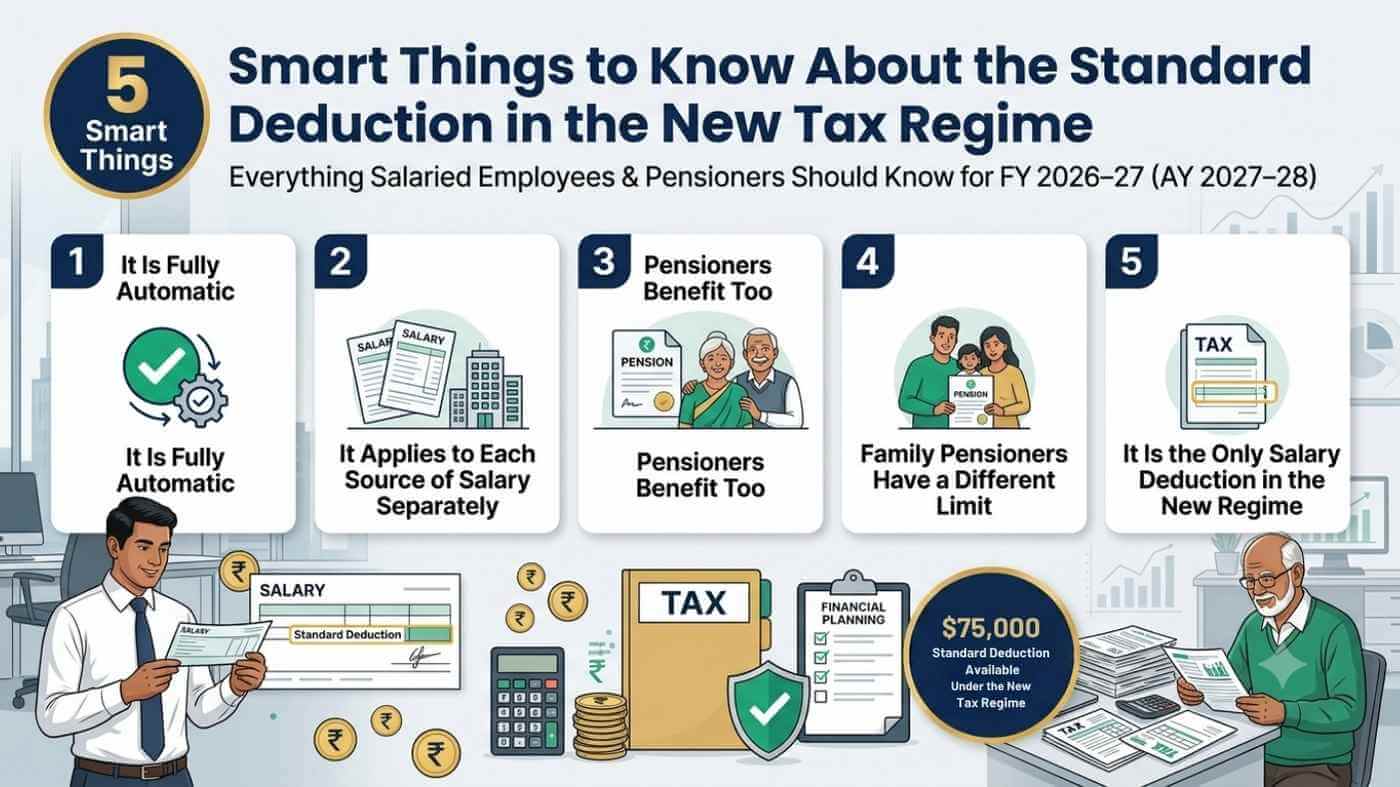
5 Smart Things to Know About the Standard Deduction New Tax Regime
1. It Is Fully Automatic
You do not file any claim or submit any document. The standard deduction under the new tax regime is generally considered by your employer while computing TDS. If you file your own ITR, the deduction appears directly in the income computation. There is no action required on your part.
2. It Applies to Each Source of Salary Separately
If you changed jobs during the financial year, you receive a salary from two employers. In this case, the standard deduction applies once per year, not once per employer. When you file your ITR and consolidate both Form 16s, the total standard deduction remains Rs. 75,000 for the year, regardless of how many employers you had.
3. Pensioners Benefit Too
If you receive a pension from a former employer, whether in the private or public sector, you are generally eligible for the same Rs 75,000 standard deduction as salaried employees because such pension is taxed under the head “Salaries.” This provides meaningful tax relief for retired individuals who continue to receive a taxable pension from their former employer.
However, this benefit does not apply to family pension, which is taxed under the head “Income from Other Sources.” Family pensioners are instead eligible for a separate deduction under Section 57(iia), subject to the prescribed limits.
4. Family Pensioners Have a Different Limit
If you receive a family pension (the pension received by a spouse or dependent after the pensioner’s death), the standard deduction available is Rs. 25,000 or one-third of the family pension, whichever is lower. This limit is different from the Rs. 75,000 available to salaried employees and pensioners.
5. It Is the Only Salary Deduction in the New Regime
For most salaried employees, the standard deduction is the primary deduction available against salary income under the new tax regime. Most salary-related exemptions, such as House Rent Allowance (HRA), Leave Travel Allowance (LTA), children’s education allowance, and the deduction for professional tax, are not available. However, certain benefits, such as the deduction for the employer’s contribution to the National Pension System (NPS) under Section 80CCD(2) and a few specified exemptions, continue to be available where the prescribed conditions are satisfied.
The new tax regime is designed to simplify tax compliance by offering lower tax rates while significantly reducing the number of deductions and exemptions available.
How the Standard Deduction Affects Your Effective Tax Rate
The Rs 75,000 standard deduction reduces your taxable salary before the applicable tax slabs are applied. As a result, the actual tax saving depends on your highest applicable tax rate under the new tax regime.
| Marginal Tax Rate | Tax Saving from Rs 75,000 Standard Deduction* |
| 5% | Rs 3,750 |
| 10% | Rs 7,500 |
| 15% | Rs 11,250 |
| 20% | Rs 15,000 |
| 25% | Rs 18,750 |
| 30% | Rs 22,500 |
*Figures are before the addition of surcharge (where applicable) and Health & Education Cess.
For example, if your taxable income falls in the 20% tax slab, the Rs 75,000 standard deduction can reduce your income tax by approximately Rs 15,000. If you fall in the 30% slab, the same deduction can reduce your tax by approximately Rs 22,500, before surcharge and cess.
In addition to reducing taxable income, the standard deduction can also help some taxpayers qualify for the rebate under Section 87A, further reducing or even eliminating their income tax liability if they satisfy the prescribed conditions.
Common Mistakes to Avoid When Claiming This Deduction
Even though the standard deduction is automatic, there are a few areas where people go wrong.
- Claiming it twice after a job change: Some taxpayers mistakenly assume they can claim Rs. 75,000 from each employer. The limit is per person per year, not per employer.
- Forgetting to check Form 16: Always verify that your employer has correctly applied the standard deduction in your Form 16 before filing your ITR.
- Confusing standard deduction with professional tax: Professional tax deducted by your employer is a separate item in your salary computation. It is not the same as the standard deduction.
- Not revisiting the regime choice each year: Your income and investments change each year. The regime that worked best last year may not be optimal this year. Review your situation before each filing season.
Should You Switch to the New Tax Regime for This Benefit?
The standard deduction alone should not be the deciding factor. The right choice between the old and new regime depends on your complete financial picture. Here is a practical way to think about it.
Start by listing all the deductions and exemptions you currently claim under the old regime: 80C investments, HRA, home loan interest, health insurance premiums, NPS contributions, and any others. Add them up. If the total exceeds the combined value of switching benefits, the old regime may still serve you better.
However, if you find yourself claiming very few deductions, paying no HRA, or not servicing a home loan, the new regime with its higher standard deduction and lower slab rates often results in less tax.
This is exactly where personalised guidance makes a real difference. We work with salaried investors to look at the complete picture, including how your tax savings from the old regime could be redirected into goal-based mutual fund investments under the new regime. The right plan is always specific to your goals and income structure.
What the Standard Deduction Means for Your Investment Planning
There is a broader point worth making here. The new tax regime, with its higher standard deduction, simplifies compliance for most salaried taxpayers. Fewer people now need to make forced investments just to save tax.
Under the old regime, many people invested in instruments like ELSS, PPF, or tax-saving FDs primarily to claim Section 80C deductions, not because those instruments aligned with their actual financial goals. With the new regime, that pressure reduces.
This is actually an opportunity. When you invest because you want to build wealth rather than just save tax, your portfolio becomes far more aligned with your life goals. Whether your goal is buying a home in ten years, funding your child’s education, or building a retirement corpus, a disciplined SIP in the right mutual fund can do far more for you than a tax-linked investment made under compulsion.
If you are wondering which funds suit your goals, timeline, and risk comfort, a conversation with a VSJ FinMart advisor can help you build a personalised mutual fund investment plan that works regardless of which tax regime you choose.
Final Words
The standard deduction under the new tax regime is one of the simplest and most valuable tax benefits available to salaried employees and eligible pensioners. At Rs 75,000 for FY 2025–26, it is the highest standard deduction ever provided under the Income-tax Act. It applies automatically, requires no supporting documents, and reduces your taxable income before your tax liability is calculated.
The tax savings increase with your applicable marginal tax rate, making the deduction especially valuable for higher-income taxpayers. In addition, the standard deduction can help eligible resident individuals qualify for the enhanced Section 87A rebate, which may reduce their income tax liability to zero, subject to the prescribed conditions.
While the higher standard deduction makes the new tax regime more attractive, choosing between the old and new regimes should always be based on your overall financial situation, including your income, investments, eligible deductions, and long-term financial goals.
Frequently Asked Questions
Is the standard deduction available under the new tax regime for FY 2024–25?
Yes. The standard deduction of Rs 75,000 is available under the new tax regime for FY 2025–26 (AY 2026–27). It applies automatically to eligible salaried employees and pensioners and does not require any separate claim or supporting documents.
Can I claim both the standard deduction and 80C deductions under the new tax regime?
No. Under the new tax regime, deductions under Section 80C are not available. However, the Rs 75,000 standard deduction continues to be available for eligible salaried employees and pensioners. Certain other benefits, such as the deduction for the employer’s contribution to the National Pension System (NPS) under Section 80CCD(2), may also be available if the prescribed conditions are satisfied.
What happens if I change jobs mid-year? Do I get two standard deductions?
No. The standard deduction is limited to Rs 75,000 per person per financial year, regardless of how many employers you work for during the year. When you file your Income Tax Return (ITR), only one standard deduction is allowed against your total eligible salary income.
Does the standard deduction apply to pension income?
Yes. Pension received from a former employer is generally taxable under the head “Salaries”, making eligible pensioners entitled to the Rs 75,000 standard deduction. Family pension, however, is taxed under “Income from Other Sources” and does not qualify for the standard deduction. Instead, family pensioners may claim a deduction under Section 57(iia) equal to the lower of Rs 25,000 or one-third of the family pension received.
Should I choose the new tax regime just because the standard deduction is higher?
Not necessarily. The standard deduction is only one factor to consider. Before choosing a tax regime, compare your overall tax liability under both options by considering your income, eligible deductions, exemptions, investments, HRA, home loan interest, and other tax-saving benefits. The regime that results in the lower overall tax liability will generally be the better choice.
Disclaimer
The information provided in this blog is for educational and informational purposes only and should not be construed as investment advice. Please consult a qualified financial advisor before making any investment decisions. Shashikant Chanderkumar Mudaliar (ARN: 319377), operating under the brand name VSJ FinMart, is an AMFI-registered Mutual Fund Distributor (MFD) and does not provide investment advisory services. Mutual fund investments are subject to market risks. Past performance is not indicative of future results. Please read all scheme-related documents carefully before investing. Registration details can be verified at www.amfiindia.com/locate-distributor.