

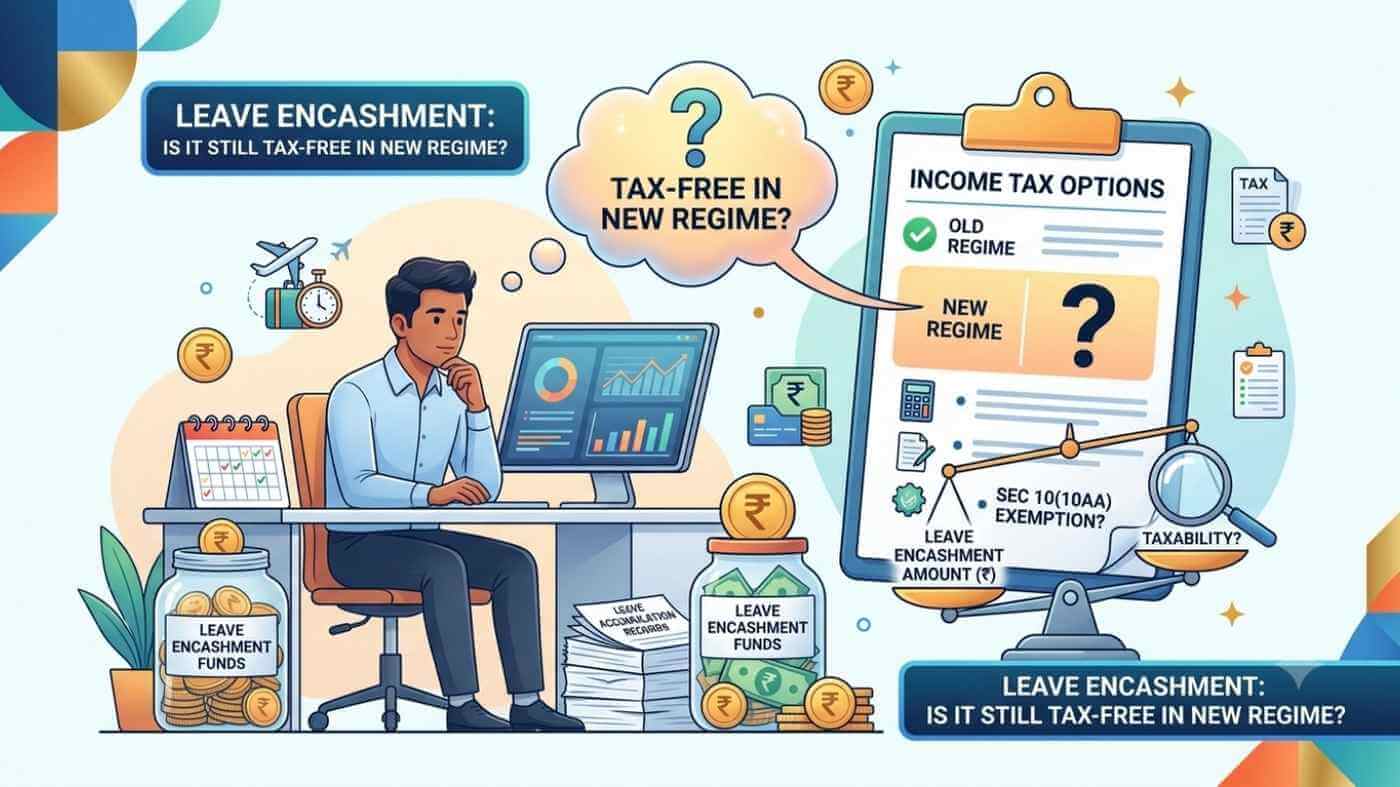
If you are a salaried employee in India, you have probably accumulated leave over the years without thinking much about what happens to it when you retire or resign. That is where leave encashment tax exemption becomes important. The rules changed significantly in 2023, and understanding them correctly can save you a meaningful amount of money. In this guide, we break down exactly how leave encashment is taxed, what exemptions apply under both the old and new tax regimes, and what you should do to make the most of it.
What Is Leave Encashment?
Leave encashment is simply the amount of money your employer pays you in exchange for unused earned leave. Most companies in India allow employees to carry forward a certain number of leave days each year. When you retire, resign, or sometimes even while still employed, you can convert these accumulated leave days into cash.
For example, if you earn Rs. 60,000 per month and you have 30 days of unused leave, your employer may pay you Rs. 60,000 (one month’s salary equivalent) as leave encashment. The question is: how much of this amount is taxable?
Types of Leave Encashment
- Leave encashment during service: Received while you are still employed. This is fully taxable in the year of receipt, regardless of tax regime.
- Leave encashment at retirement or resignation: This is where the exemption rules come into play. Government and private sector employees are treated differently here.
Leave Encashment Tax Exemption: The Old Rules vs the New Limit
For many years, the tax exemption limit for leave encashment received by non-government employees at the time of retirement was capped at Rs. 3 lakh. This limit had remained unchanged since 2002 and had become outdated given the significant increase in salary levels over the years.
To address this, the Government announced in the Union Budget 2023 that the exemption limit would be increased. Subsequently, the Central Board of Direct Taxes (CBDT) notified the revised limit, increasing the maximum tax exemption for eligible non-government employees from Rs. 3 lakh to Rs. 25 lakh for leave encashment received on or after 1 April 2023.
This revision provides substantial tax relief for eligible private sector employees retiring with accumulated earned leave, allowing a much larger portion of their leave encashment to qualify for tax exemption, subject to the conditions prescribed under the Income-tax Act.
Government vs Private Sector Employees
| Category | Tax Treatment of Leave Encashment at Retirement |
|---|---|
| Central/State Government Employees | Fully exempt under Section 10(10AA), subject to the applicable provisions of the Income-tax Act. |
| Non-Government / Private Sector Employees | Exemption is available under Section 10(10AA). The exempt amount is the least of: (i) actual leave encashment received, (ii) Rs. 25 lakh (lifetime limit), (iii) 10 months’ average salary, and (iv) the cash equivalent of unavailed earned leave, subject to the prescribed rules. Any balance amount is taxable. |
| Employees who received leave encashment from multiple employers | The overall lifetime exemption limit of Rs. 25 lakh applies, subject to the provisions of Section 10(10AA). |
| Leave encashment during active service | Generally fully taxable for both government and non-government employees. The exemption under Section 10(10AA) applies only to leave encashment received at the time of retirement, resignation, superannuation, or otherwise leaving employment, subject to the applicable conditions. |
For example, suppose a private sector employee receives Rs. 20 lakh as leave encashment on retirement. If the amount qualifies under the exemption formula prescribed in Section 10(10AA), the entire amount may be exempt from tax. Similarly, if an employee receives Rs. 30 lakh, the exemption cannot exceed the amount determined under the statutory formula and, in any case, cannot exceed the lifetime ceiling of Rs. 25 lakh. Any amount that does not qualify for exemption is taxable.
Is Leave Encashment Tax Exemption Available Under the New Tax Regime?
This is one of the most common questions salaried employees ask, and the answer is yes. The leave encashment exemption under Section 10(10AA) continues to be available under both the old and the new tax regimes.
Most deductions and exemptions, such as HRA, LTA, and deductions under Section 80C, are generally not available to taxpayers who opt for the new tax regime under Section 115BAC. However, the exemption for eligible leave encashment under Section 10(10AA) has been specifically retained.
In other words, opting for the new tax regime does not by itself affect your eligibility for leave encashment exemption. If your leave encashment qualifies for exemption under Section 10(10AA) and satisfies the prescribed conditions and limits, you can claim the exemption irrespective of the tax regime you choose.
How Is the Exempt Amount Calculated for Private Employees?
For non-government employees, the exemption under Section 10(10AA) is the least of the following four amounts:
- The actual leave encashment received.
- Rs. 25 lakh, being the current lifetime exemption limit.
- Ten months’ average salary.
- The cash equivalent of the earned leave standing to the employee’s credit at the time of retirement or termination of employment, subject to the prescribed rules, including the maximum accumulation of 30 days’ earned leave for each completed year of service.
For this calculation, salary generally includes:
- Basic Salary,
- Dearness Allowance, to the extent it forms part of retirement benefits, and
- Commission, if it is payable as a fixed percentage of the employee’s turnover.
Allowances such as HRA, special allowance, bonus, and most other perquisites are generally not included while computing the exemption.
A Practical Example
Let us consider the example of Ramesh, who retires from a private company after 25 years of service. For simplicity, assume that his salary for Section 10(10AA) consists only of Basic Salary, with no Dearness Allowance forming part of retirement benefits and no eligible commission.
His average salary for the last 10 months is Rs. 80,000 per month. He has 240 days of earned leave standing to his credit, and his employer pays him Rs. 6,40,000 as leave encashment.
The exemption under Section 10(10AA) is the least of the following:
- Actual leave encashment received: Rs. 6,40,000
- Statutory ceiling: Rs. 25,00,000
- Ten months’ average salary: Rs. 80,000 × 10 = Rs. 8,00,000
- Cash equivalent of earned leave: 240 days × (Rs. 80,000 ÷ 30) = Rs. 6,40,000
The lowest of these four amounts is Rs. 6,40,000. Therefore, Ramesh’s entire leave encashment qualifies for exemption under Section 10(10AA) and is not taxable, irrespective of whether he has opted for the old tax regime or the new tax regime.
5 Smart Tips to Maximise Your Leave Encashment Tax Benefit
Now that you understand the rules, here are five practical steps you can take to make the most of your leave encashment tax exemption.
Tip 1: Do Not Encash Leave While Still in Service Unless Necessary
For most non-government employees, leave encashment received during active service is fully taxable. The exemption under Section 10(10AA) generally applies only to leave encashment received at the time of retirement or otherwise on termination of employment. Therefore, unless you have a genuine need for the money, allowing earned leave to accumulate may be more tax-efficient.
Tip 2: Know the Lifetime Cap of Rs. 25 Lakh
The Rs. 25 lakh ceiling is a lifetime limit, not a per-employer limit. If you have worked with multiple employers over your career and received leave encashment from more than one of them, the combined exempt amount across all employers cannot exceed Rs. 25 lakh. Keep records of any leave encashment you have previously received so you can calculate your remaining exemption correctly.
Tip 3: Time Your Retirement Strategically
If you have the flexibility to choose your exact retirement date, consider ending your service in a financial year when your other income is relatively lower. Since any taxable portion of leave encashment (above Rs. 25 lakh) is added to your income, receiving it in a year with lower total income means it gets taxed at a lower slab rate.
Tip 4: Combine It With Your Gratuity Planning
Gratuity and leave encashment are governed by separate exemption provisions under the Income-tax Act. Reviewing both together before retirement can help you understand your overall tax position and retirement cash flows. Planning both together can significantly reduce your total tax outgo at retirement. Speak with a financial advisor to understand how the two interact in your specific situation.
Tip 5: Invest the Tax-Free Amount Wisely
Receiving a lump sum at retirement presents an opportunity to strengthen your long-term financial security. Depending on your income needs, investment horizon, and risk tolerance, you may consider allocating the proceeds across appropriate investment options, including mutual funds where suitable. A well-planned investment strategy can help your retirement corpus support your future financial goals, while recognising that all investments carry risk.
Leave Encashment Tax Exemption and the New Tax Regime: Key Differences
Many salaried employees choose the new tax regime because of its simplified structure and lower tax rates. Before deciding which regime is more suitable, it is helpful to compare how they treat leave encashment and other common tax benefits.
| Tax Benefit | Old Tax Regime | New Tax Regime |
|---|---|---|
| Leave Encashment Exemption (Sec 10(10AA)) | Available, subject to the conditions and limits prescribed under Section 10(10AA), including the lifetime exemption ceiling of Rs. 25 lakh | Available on the same terms as the old regime |
| Gratuity Exemption (Sec 10(10)) | Available | Available |
| HRA Exemption | Available, subject to prescribed conditions | Not available |
| Section 80C Deduction | Available (up to Rs. 1.5 lakh) | Not available |
| Standard Deduction | Rs. 50,000 | Rs. 75,000 |
| LTA Exemption | Available, subject to prescribed conditions | Not available |
As the comparison shows, the leave encashment exemption under Section 10(10AA) is one of the few significant tax benefits that continues to be available under both tax regimes. Therefore, choosing the new tax regime does not, by itself, affect the tax treatment of eligible leave encashment received on retirement or termination of employment.
Common Mistakes to Avoid
Many salaried employees miss out on the full benefit of the leave encashment exemption simply because they are unaware of the rules. Here are some of the most common mistakes.
- Assuming leave encashment during service is exempt: For most non-government employees, leave encashment received during service is generally taxable. The exemption under Section 10(10AA) generally applies only to leave encashment received on retirement or otherwise at the termination of employment.
- Not verifying the exemption while filing the ITR: Ensure that the leave encashment received and the eligible exemption under Section 10(10AA), as reflected in your Form 16 (where applicable), are correctly considered while filing your Income Tax Return.
- Ignoring the four-way calculation: Some employees assume the entire Rs. 25 lakh is automatically exempt. In reality, the exempt amount is the least of the four amounts prescribed under Section 10(10AA), subject to the lifetime exemption limit.
- Forgetting previous exemption claims: The Rs. 25 lakh limit is a lifetime ceiling for non-government employees. If you have claimed an exemption on leave encashment from an earlier employer, that amount reduces your remaining exemption limit.
- Confusing different types of leave: The exemption under Section 10(10AA) is based on earned (privilege) leave standing to your credit. Casual leave and sick leave are generally not considered for this calculation, although the leave rules themselves depend on your employer’s policy and applicable service regulations.
What Should You Do With the Tax-Free Amount?
Receiving a lump sum at retirement, particularly one that is largely or fully tax-free, is a significant financial milestone. Rather than leaving the money idle in a savings account or making rushed investment decisions, it is worth taking the time to create a structured plan that aligns with your retirement goals.
A practical way to think about the amount is to divide it into three broad buckets:
- Liquidity bucket: Keep six to twelve months’ worth of essential living expenses in readily accessible options, such as a bank savings account or other suitable low-risk investments, to help meet emergency needs.
- Income bucket: If you require regular cash flows during retirement, you may consider allocating a portion of your corpus to investment options that are consistent with your income needs and risk profile. Depending on suitability, this may include certain debt-oriented or hybrid mutual funds. However, returns are market-linked and are not guaranteed.
- Growth bucket: If you have a long investment horizon and are comfortable with market fluctuations, you may consider allocating a portion of your retirement corpus to investments with long-term growth potential, such as suitable hybrid or equity-oriented mutual funds, based on your financial objectives and risk tolerance.
The ideal allocation across these buckets depends on factors such as your age, existing income sources, healthcare needs, financial responsibilities, investment horizon, and willingness to take risk.
We help investors build retirement mutual fund investment plans based on their individual financial goals and suitability before recommending any investment solution.
Final Words
The leave encashment tax exemption is one of the most valuable tax benefits available to salaried employees in India. With the exemption limit for non-government employees increased to Rs. 25 lakh from 2023, and the benefit continuing under both the old and new tax regimes, it is an important aspect of retirement tax planning.
To summarise the key takeaways:
- Eligible leave encashment received on retirement or termination of employment is exempt from tax under Section 10(10AA), subject to the prescribed conditions and limits.
- For non-government employees, the exemption is subject to a lifetime ceiling of Rs. 25 lakh.
- Central and State Government employees generally enjoy full exemption for leave encashment received at retirement.
- For most non-government employees, leave encashment received during service is generally taxable.
- The exemption is available under both the old and the new tax regimes.
- The exempt amount for non-government employees is the least of the four amounts prescribed under Section 10(10AA); it is not automatically Rs. 25 lakh.
- The Rs. 25 lakh exemption limit is a lifetime limit that applies across eligible leave encashment received from one or more employers.
Tax planning, however, is only one part of retirement planning. Equally important is ensuring that your retirement corpus is managed in a way that supports your long-term financial goals, income needs, and risk tolerance.
Frequently Asked Questions
Is leave encashment tax-free under the new tax regime in 2024?
Yes. The exemption under Section 10(10AA) continues to be available under both the old and the new tax regimes. For non-government employees, eligible leave encashment received on retirement or otherwise at the termination of employment may qualify for exemption, subject to the prescribed conditions and the lifetime exemption limit of Rs. 25 lakh.
What is the maximum leave encashment exemption for private sector employees?
The lifetime exemption limit for non-government employees is Rs. 25 lakh. However, the actual exempt amount is the least of the following four amounts:
- The actual leave encashment received.
- Rs. 25 lakh.
- Ten months’ average salary.
- The cash equivalent of earned leave standing to the employee’s credit, computed in accordance with the prescribed rules.
Is leave encashment received during service taxable?
For most non-government employees, yes. Leave encashment received during active employment is generally taxable. The exemption under Section 10(10AA) generally applies only to eligible leave encashment received on retirement or otherwise at the termination of employment.
Can I claim the leave encashment exemption if I have worked with multiple employers?
Yes. However, the Rs. 25 lakh exemption is a lifetime limit for non-government employees. If you have claimed an exemption on leave encashment from a previous employer, that amount reduces the exemption available on any future eligible leave encashment.
Does the leave encashment exemption apply to all types of leave?
No. The exemption under Section 10(10AA) is based on earned (privilege) leave standing to your credit. Casual leave, sick leave, and similar categories of leave are generally not considered for this calculation, although the leave that can be encashed depends on your employer’s leave policy and the applicable service rules.
Disclaimer
The information provided in this blog is for educational and informational purposes only and should not be construed as investment advice. Please consult a qualified financial advisor before making any investment decisions. Shashikant Chanderkumar Mudaliar (ARN: 319377), operating under the brand name VSJ FinMart, is an AMFI-registered Mutual Fund Distributor (MFD) and does not provide investment advisory services. Mutual fund investments are subject to market risks. Past performance is not indicative of future results. Please read all scheme-related documents carefully before investing. Registration details can be verified at www.amfiindia.com/locate-distributor.