

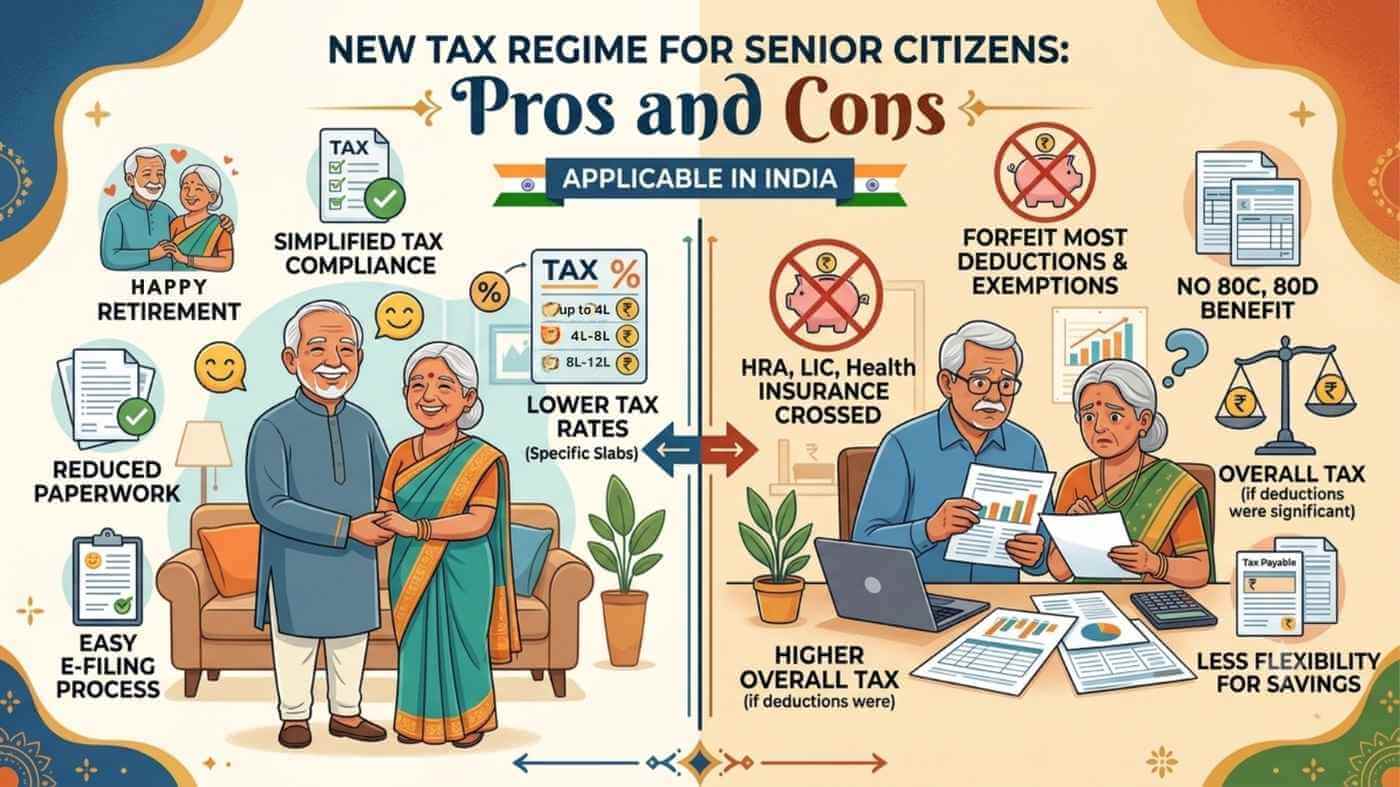
Every financial year, millions of senior citizens in India face the same question: Which tax regime should I choose? Since its introduction, the new tax regime has generated considerable discussion, and each Union Budget has brought further changes. While the lower tax rates are appealing, many retirees are concerned about giving up familiar deductions that they have relied on for years, such as those under Section 80C, Section 80D, and certain home loan benefits.
This guide explains the new tax regime for senior citizens in simple, practical language. You will learn how the new regime works, how it compares with the old regime, which deductions and exemptions continue to be available, and how to decide which option best suits your income, investments, and retirement goals for FY 2025–26 (AY 2026–27).
What Is the New Tax Regime? A Quick Overview
India currently offers taxpayers a choice between two income tax regimes.
The old tax regime allows taxpayers to claim a wide range of deductions and exemptions, such as those under Sections 80C and 80D, in exchange for comparatively higher tax rates.
The new tax regime, introduced in the Union Budget 2020 and subsequently revised, offers lower tax rates but generally disallows most deductions and exemptions. From FY 2025–26, it continues to be the default tax regime. Unless an eligible taxpayer opts for the old regime, income tax is computed under the new regime.
Understanding how the new regime works is particularly important for senior citizens because the choice of tax regime can significantly affect their overall tax liability.
Who Qualifies as a Senior Citizen for Income Tax Purposes?
For income tax purposes:
- Senior Citizen: An individual who is 60 years or more but less than 80 years of age at any time during the relevant financial year.
- Super Senior Citizen: An individual who is 80 years of age or above at any time during the relevant financial year.
Why Does This Classification Matter?
Under the old tax regime, senior citizens and super senior citizens enjoy higher basic exemption limits than taxpayers below 60 years of age.
However, under the new tax regime, there is no separate basic exemption limit based on age. The same tax slabs apply to all individual taxpayers, whether they are below 60 years, senior citizens, or super senior citizens.
This is one of the most important differences between the two tax regimes and should be considered carefully before making your choice.
New Tax Regime Slab Rates for Senior Citizens (FY 2024-25)
Under the new tax regime, the income tax slab rates are identical for all individual taxpayers, including senior citizens and super senior citizens. Unlike the old tax regime, there are no age-based basic exemption limits.
The applicable slab rates for FY 2025–26 (AY 2026–27) are as follows:
| Total Income | New Tax Regime Rate |
|---|---|
| Up to Rs. 4,00,000 | Nil |
| Rs. 4,00,001 to Rs. 8,00,000 | 5% |
| Rs. 8,00,001 to Rs. 12,00,000 | 10% |
| Rs. 12,00,001 to Rs. 16,00,000 | 15% |
| Rs. 16,00,001 to Rs. 20,00,000 | 20% |
| Rs. 20,00,001 to Rs. 24,00,000 | 25% |
| Above Rs. 24,00,000 | 30% |
For comparison, the old tax regime continues to provide higher basic exemption limits based on age:
| Category | Basic Exemption Limit |
| Individual below 60 years | Rs. 2,50,000 |
| Senior Citizen (60 years to below 80 years) | Rs. 3,00,000 |
| Super Senior Citizen (80 years and above) | Rs. 5,00,000 |
Section 87A Rebate Under the New Tax Regime
The new tax regime also provides the benefit of Section 87A for eligible resident individuals. For FY 2025–26, eligible taxpayers with taxable income up to the prescribed limit can claim the rebate available under the Act, which can substantially reduce or even eliminate their income tax liability, subject to the applicable conditions and the provisions relating to marginal relief.
Although senior citizens are eligible to claim this rebate if they satisfy the prescribed conditions, the rebate is available only to resident individuals and is subject to the provisions of Section 87A.
Key Benefits of the New Tax Regime for Senior Citizens
The new regime continues to offer several advantages. For many retirees, especially those without large deductible investments, it can result in lower tax liability and a much simpler filing experience.
1. Lower Tax Rates Across Most Income Levels
The new tax regime offers concessional slab rates that benefit many middle-income taxpayers. Compared with the old regime, senior citizens with moderate pension or interest income often pay less tax, particularly if they do not claim substantial deductions.
2. Zero Tax on Taxable Income Up to Rs. 12 Lakh
One of the biggest changes from Budget 2025 is the enhanced rebate under Section 87A. Resident individuals opting for the new tax regime can now pay zero income tax if their taxable income does not exceed Rs. 12 lakh (excluding income taxed at special rates such as certain capital gains).
For pensioners eligible for the standard deduction, this effectively means a gross pension of up to Rs. 12.75 lakh can result in zero tax, subject to the applicable conditions.
3. Standard Deduction of Rs. 75,000 for Pensioners
Pensioners continue to receive a standard deduction of Rs. 75,000 under the new tax regime. This deduction automatically reduces taxable income without requiring any investment or documentation.
4. Simpler Tax Filing
Many retirees find the old regime paperwork burdensome. Tracking Section 80C investments, maintaining health insurance receipts, and preserving supporting documents each year can be time-consuming. The new regime removes most of these compliance requirements, making return filing much simpler.
5. Freedom to Invest Based on Financial Goals
Under the old regime, many senior citizens invested in tax-saving products primarily to claim deductions. The new regime shifts the focus from tax-saving to goal-based investing. You can now choose investments based on your income needs, liquidity requirements, and risk tolerance rather than simply for tax benefits.
6. Better for Many Pensioners Without Major Deductions
If you do not claim significant deductions such as Section 80C investments, Section 80D health insurance premiums, or home loan interest, the new tax regime may result in a lower overall tax liability. Running a comparison under both regimes each year remains the best way to determine which option works for your specific situation.
Note: The old tax regime may still be beneficial for senior citizens who claim substantial deductions under Sections 80C, 80D, home loan interest provisions, or other eligible exemptions. Always compare both regimes before making your final choice.
Key Cons of the New Tax Regime for Senior Citizens
The new regime is not automatically the better choice. For many retirees, the loss of deductions and exemptions can outweigh the benefit of lower slab rates.
1. No Section 80C Deduction
The new regime does not allow deductions under Section 80C, including investments in PPF, ELSS, NSC, five-year tax-saving fixed deposits, and life insurance premiums. Senior citizens who actively use these deductions may find the old regime more beneficial.
2. No Deduction for Health Insurance Premiums Under Section 80D
The deduction available under Section 80D for health insurance premiums paid for self, spouse, and eligible parents is not available under the new regime. Since healthcare costs generally increase with age, this can be a significant drawback.
3. No Deduction Under Section 80TTB
Senior citizens cannot claim the deduction of up to Rs. 50,000 on eligible interest income under Section 80TTB when opting for the new tax regime. Those who depend heavily on fixed deposit or savings account interest should compare both regimes carefully.
4. Uniform Basic Exemption Limit
Unlike the old regime, where senior citizens and super senior citizens enjoy higher basic exemption limits, the new regime applies the same tax slabs to all individual taxpayers, irrespective of age. While the enhanced Section 87A rebate now provides substantial relief for lower-income taxpayers, very senior citizens who benefit from the higher exemption limit under the old regime should still compare both options before deciding.
5. No HRA or Self-Occupied Home Loan Interest Deduction
The new regime does not allow:
- House Rent Allowance (HRA) exemption.
- Deduction for interest on a self-occupied home loan under Section 24(b).
Although these may not affect many retirees, they remain relevant for senior citizens who continue to work or are repaying a housing loan.
6. Limited Flexibility for Those with Business or Professional Income
Senior citizens who have business or professional income cannot switch freely between the two tax regimes every year. Once they opt out of the new regime, the rules for switching back are restricted under Section 115BAC. Pensioners and individuals without business income, however, can generally choose the most beneficial regime each financial year while filing their return.
A Practical Example: Which Regime Works Better?
Mr. Ramesh Iyer is a 65-year-old retiree from Pune. During the financial year, he receives:
- Pension income: Rs. 8,00,000
- Interest income from bank fixed deposits: Rs. 1,50,000
His total income is Rs. 9,50,000.
He also:
- Pays Rs. 35,000 towards health insurance premiums for himself and his spouse.
- Invests Rs. 1,50,000 in Public Provident Fund (PPF).
- Qualifies for the deduction under Section 80TTB on interest income.
Tax Comparison
| Particulars | Old Tax Regime (Rs.) | New Tax Regime (Rs.) |
|---|---|---|
| Gross Income | 9,50,000 | 9,50,000 |
| Standard Deduction | 50,000 | 75,000 |
| Section 80C Deduction | 1,50,000 | Not Available |
| Section 80D Deduction | 35,000 | Not Available |
| Section 80TTB Deduction | 50,000 | Not Available |
| Taxable Income | 5,65,000 | 8,75,000 |
| Estimated Tax (before cess) | Approx. Rs. 8,450 | Rs. 0* |
*Assuming there is no income taxed at special rates, such as certain capital gains.
What Does This Example Tell Us?
At first glance, the old tax regime appears attractive because it allows deductions under Sections 80C, 80D, and 80TTB. These deductions reduce Mr. Iyer’s taxable income substantially.
However, under the latest tax provisions for FY 2025-26, the new tax regime provides an enhanced rebate under Section 87A. Since Mr. Iyer’s taxable income after the standard deduction is Rs. 8.75 lakh, which is below the eligible rebate threshold of Rs. 12 lakh, his income tax liability becomes zero under the new regime (subject to the rebate conditions and excluding special-rate income).
This example highlights an important point. A lower taxable income under the old regime does not automatically mean lower tax payable. The enhanced rebate available under the new regime can make it more beneficial even when deductions are not available.
When Could the Old Regime Still Be Better?
The old tax regime may continue to be a better option if you:
- Have substantial deductions under Sections 80C, 80D, and 80TTB.
- Earn income that is taxed at special rates and does not qualify for the Section 87A rebate.
- Have a combination of deductions and income sources that results in a lower overall tax liability than the new regime.
Every retiree’s financial situation is different. Pension income, interest income, rental income, capital gains, and available deductions all influence the final tax outcome.
Instead of assuming one regime is always better, compare your tax liability under both options before filing your return. A personalised calculation can help you legally minimise your tax while keeping your retirement income working efficiently.
How to Decide: Old Regime vs New Tax Regime for Senior Citizens
There is no one-size-fits-all answer. The right tax regime depends on your income, deductions, exemptions, and the latest tax provisions. The following framework can help you make an informed decision for FY 2025-26 (AY 2026-27).
Choose the New Tax Regime If:
- Your total taxable income is up to Rs. 12 lakh (excluding income taxed at special rates), as you may be eligible for the enhanced rebate under Section 87A, resulting in zero tax liability.
- You receive mainly pension income and do not claim significant deductions under Sections 80C, 80D, or 80TTB.
- You prefer a simpler tax filing process with fewer documents and compliance requirements.
- You do not have a self-occupied home loan for which you wish to claim interest deductions.
- Your investments are driven by financial goals rather than tax-saving benefits.
Choose the Old Tax Regime If:
- Your deductions under Sections 80C, 80D, 80TTB, home loan interest, and other eligible provisions are substantial enough to reduce your overall tax liability below what you would pay under the new regime.
- You regularly invest in tax-saving instruments such as PPF, ELSS, NSC, or life insurance to claim deductions.
- You earn significant interest income from bank or post office deposits and wish to claim the deduction under Section 80TTB.
- You are a super senior citizen (80 years or above) who benefits from the higher basic exemption limit of Rs. 5 lakh available only under the old regime.
- Your tax calculation shows that the available deductions outweigh the benefit of the lower slab rates under the new regime.
Compare Before You Decide
The enhanced rebate under the new tax regime has changed the tax planning landscape for many senior citizens. While the new regime can eliminate tax liability for many retirees with income up to the eligible threshold, the old regime may still be more beneficial if you claim substantial deductions and exemptions.
Before choosing a regime, compare your tax liability under both options using your expected income, deductions, and investments for the financial year. A simple comparison can help you select the option that legally minimises your tax while supporting your long-term financial goals. Even a rough calculation using your last year’s income and investment data can point you clearly in the right direction.
Important Deductions Lost Under the New Regime: A Summary
The new tax regime offers lower tax rates but removes many popular deductions and exemptions. The table below compares the key benefits available under both regimes for FY 2025-26 (AY 2026-27).
| Deduction / Exemption | Old Tax Regime | New Tax Regime |
|---|---|---|
| Section 80C (PPF, ELSS, LIC, NSC, etc.) | Up to Rs. 1,50,000 | Not available |
| Section 80D (Health Insurance Premium) | Up to Rs. 50,000 for senior citizens | Not available |
| Section 80TTB (Interest on Bank/Post Office Deposits) | Up to Rs. 50,000 | Not available |
| Standard Deduction (Pension/Salary) | Rs. 50,000 | Rs. 75,000 |
| House Rent Allowance (HRA) | Available, subject to conditions | Not available |
| Home Loan Interest on Self-Occupied Property [Section 24(b)] | Up to Rs. 2,00,000 | Not available |
| Basic Exemption Limit for Super Senior Citizens (80 years and above) | Rs. 5,00,000 | Same as other individuals under the new regime |
| Section 87A Rebate | Available subject to the prescribed income limit and conditions | Available subject to the enhanced income limit and conditions |
What This Means
The new tax regime can significantly reduce tax liability for many senior citizens because of its lower slab rates and enhanced rebate. However, if you regularly claim deductions such as Section 80C, Section 80D, Section 80TTB, or the home loan interest deduction, the old regime may still result in lower overall tax.
The most effective approach is to calculate your tax liability under both regimes each financial year before making your choice.
Tips to Make the Most of Whichever Regime You Choose
Choosing the right tax regime is important, but it is only one part of effective retirement planning. The following practical tips can help you minimise taxes while keeping your finances on track.
1. Compare Both Regimes Before Making a Decision
Do not assume that one regime is automatically better than the other. Calculate your tax liability under both the old and new tax regimes using your expected pension, interest income, rental income, capital gains, and eligible deductions before making your choice.
2. Invest for Your Financial Goals, Not Just for Tax Savings
Tax benefits are valuable, but they should not drive every investment decision. Choose investments that match your retirement income needs, risk tolerance, and long-term financial goals. A well-diversified portfolio is usually more beneficial than investing solely to claim deductions.
3. Maintain Adequate Health Insurance
Even though the new tax regime does not allow a deduction under Section 80D, health insurance remains one of the most important financial protections for senior citizens. Rising healthcare costs make adequate coverage essential, regardless of the available tax benefits.
4. Monitor TDS on Interest and Pension Income
Banks may deduct Tax Deducted at Source (TDS) on fixed deposit interest, while pension payments may also be subject to TDS. Regularly verify your Form 26AS and Annual Information Statement (AIS) to ensure all TDS credits are correctly reflected before filing your Income Tax Return.
5. File Your Income Tax Return on Time
Even if your tax liability is nil because of the Section 87A rebate or available deductions, filing your Income Tax Return on time is a good financial practice. It creates a documented income record that can be useful for loans, visa applications, and other financial transactions.
6. Focus on Your Overall Retirement Cash Flow
Reducing taxes is important, but it should not be your only objective. Your retirement plan should also consider regular income, inflation, medical expenses, emergency liquidity, and long-term wealth preservation. A balanced financial plan often delivers better outcomes than focusing on tax savings alone.
Retirement Planning Goes Beyond Tax Saving
The choice between the old and new tax regime is only one part of retirement planning. Managing your retirement corpus, generating sustainable income, protecting against rising healthcare costs, and investing wisely all play an equally important role.
Final Words: Making the Right Tax Choice in Retirement
The new tax regime for senior citizens is not automatically better or worse than the old one. It is simply different, designed for a different type of taxpayer profile.
If you have built your retirement finances around instruments like PPF, fixed deposits, and health insurance, the old regime likely saves you more money. If you are a simpler investor with modest income and fewer deductions, the new regime can reduce your tax and your paperwork in one step.
Most importantly, do not choose by default. The government has made the new regime the default, but that does not mean it is the right fit for everyone. Take thirty minutes each April to compare both regimes against your actual income and deduction numbers. That small effort can save you thousands of rupees every year.
We work with retirees and pre-retirees to build financial plans that account for tax efficiency, investment returns, and peace of mind. If you would like a clearer picture of how your retirement finances are structured, we are happy to help you think it through.
Frequently Asked Questions
1. Can a senior citizen switch between the old and new tax regime every year?
Yes. If your income consists of pension, interest, rent, capital gains, or other non-business income, you can choose between the old and new tax regimes every financial year while filing your Income Tax Return. However, if you have income from a business or profession, the switching rules are much more restrictive under the Income-tax Act.
2. Is the Section 80TTB interest deduction available under the new regime?
No. Section 80TTB, which allows senior citizens to claim a deduction of up to Rs. 50,000 on eligible interest income from banks, post offices, and cooperative banks, is not available under the new tax regime. Senior citizens who earn significant interest income should compare both tax regimes carefully before making a decision.
3. What is the effective tax-free income limit for senior citizens under the new regime?
For FY 2025-26, a resident individual, including a senior citizen, can effectively pay zero income tax under the new tax regime if their taxable income qualifies for the enhanced Section 87A rebate. Pensioners also continue to receive the standard deduction of Rs. 75,000. Depending on the nature of income and eligibility, many pensioners can have a gross pension income of up to Rs. 12.75 lakh and still have no tax liability. Always calculate your actual taxable income before relying on this limit.
4. Does the new tax regime benefit super senior citizens (aged 80 and above)?
It depends on your income profile and deductions. Under the old tax regime, super senior citizens enjoy a higher basic exemption limit of Rs. 5 lakh, whereas under the new regime the basic exemption limit is the same as for other individuals. However, the lower slab rates and higher rebate available under the new regime may still make it beneficial for some super senior citizens. A comparison based on your actual income and deductions is essential.
5. Is it possible that the new regime becomes more beneficial in the future?
Yes. Tax laws, rebate limits, deductions, and personal financial circumstances can change from one financial year to the next. Pension income, interest earnings, medical expenses, and investment patterns may also vary. Reviewing both tax regimes annually helps ensure you choose the option that results in the lowest tax liability while supporting your overall financial goals.
Disclaimer
The information provided in this blog is for educational and informational purposes only and should not be construed as investment advice. Please consult a qualified financial advisor before making any investment decisions. Shashikant Chanderkumar Mudaliar (ARN: 319377), operating under the brand name VSJ FinMart, is an AMFI-registered Mutual Fund Distributor (MFD) and does not provide investment advisory services. Mutual fund investments are subject to market risks. Past performance is not indicative of future results. Please read all scheme-related documents carefully before investing. Registration details can be verified at www.amfiindia.com/locate-distributor.