

If you pay health insurance premiums every year, you may be wondering how the Section 80D deduction works under the new tax regime. Since the government revised the income tax structure, this has become one of the most commonly searched questions among salaried taxpayers.
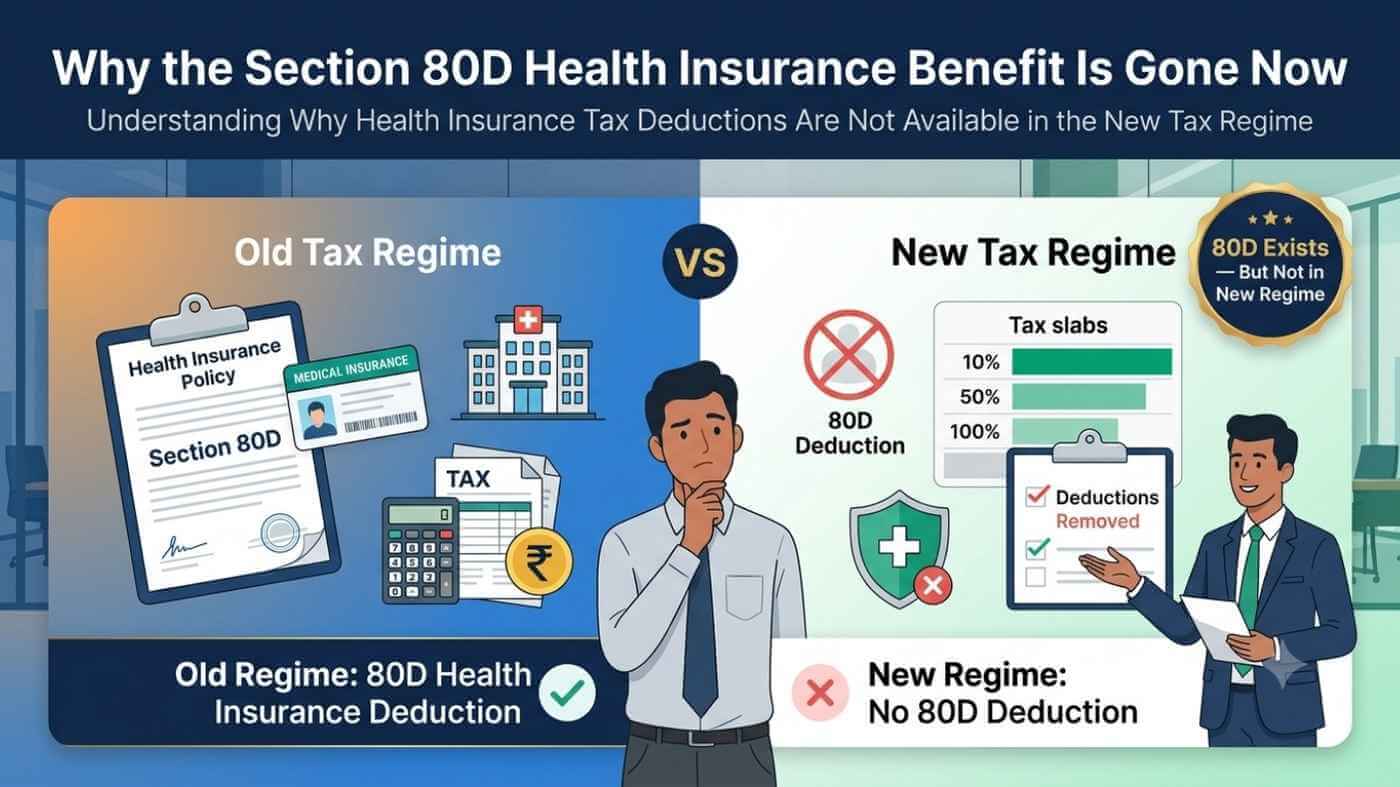
The short answer is this: The Section 80D deduction is not available under the new tax regime. If you opt for the new tax regime, you cannot claim a deduction for health insurance premiums paid for yourself, your family, or dependent parents under Section 80D.
This change is an important consideration when comparing the old and new tax regimes. For many individuals, health insurance premiums were a key part of their tax-saving strategy, and their removal under the new regime can affect overall tax planning. Understanding this difference is essential while choosing the right tax regime and planning your finances in 2025 and beyond.
What Is Section 80D and Why Did It Matter?
Section 80D of the Income Tax Act allowed individuals to claim deductions on premiums paid for health insurance policies. This included coverage for yourself, your spouse, children, and dependent parents. The deduction was available over and above the Section 80C limit of Rs 1.5 lakh, making it one of the most widely used tax-saving provisions under the old tax regime.
Here is a quick summary of how Section 80D worked under the old tax regime:
- Up to Rs 25,000 per year for premiums paid for self, spouse, and children (if all are below 60 years of age)
- An additional Rs 25,000 for premiums paid for parents (if parents are below 60 years)
- The limit increases to Rs 50,000 if the insured person or the parents are senior citizens (60 years and above)
- A maximum total deduction of Rs 1,00,000 is possible if both the taxpayer and the parents are senior citizens (Rs 50,000 each)
- Preventive health check-up expenses up to Rs 5,000 are included within the overall limit
In simple terms, a taxpayer with senior citizen parents could reduce taxable income by up to Rs 1 lakh per year through health insurance premiums and preventive check-ups. However, this benefit is not available under the new tax regime, where Section 80D deductions are not allowed.
The 80D Deduction New Tax Regime: What Changed and Why
The new tax regime was introduced in Budget 2020 and made the default regime from Assessment Year 2024–25 onwards. It is built on a simple principle: offer lower tax rates in exchange for removing most deductions and exemptions.
Under the new tax regime, several commonly used deductions and exemptions are not available, including:
- Section 80C (PPF, ELSS, life insurance premiums, home loan principal, etc.)
- Section 80D (health insurance premiums)
- Section 80E (education loan interest)
- Section 80G (donations)
- House Rent Allowance (HRA) exemption
- Leave Travel Allowance (LTA) exemption
In return, the new tax regime provides lower slab rates and an enhanced rebate under Section 87A, which can significantly reduce or even eliminate tax liability for eligible taxpayers. The overall impact depends on income level, available deductions, and individual financial circumstances.
For taxpayers who regularly pay health insurance premiums, the removal of Section 80D can be a meaningful loss, especially if they previously relied on it for tax savings. However, whether this loss is offset by lower tax rates varies from person to person and requires a case-by-case comparison.
Old Tax Regime vs New Tax Regime: A Clear Comparison
Before you decide which regime works better for you, it is important to understand the slab structure.
| Old Tax Regime Slabs (FY 2025–26) | |
| Annual Taxable Income | Tax Rate |
| Up to ₹2,50,000 | Nil |
| ₹2,50,001 – ₹5,00,000 | 5% |
| ₹5,00,001 – ₹10,00,000 | 20% |
| Above ₹10,00,000 | 30% |
Note: Rebate under Section 87A applies for eligible income up to ₹5 lakh (as per old regime rules).
| New Tax Regime Slabs (FY 2025–26) | |
| Annual Taxable Income | Tax Rate |
| Up to ₹4,00,000 | Nil |
| ₹4,00,001 – ₹8,00,000 | 5% |
| ₹8,00,001 – ₹12,00,000 | 10% |
| ₹12,00,001 – ₹16,00,000 | 15% |
| ₹16,00,001 – ₹20,00,000 | 20% |
| ₹20,00,001 – ₹24,00,000 | 25% |
| Above ₹24,00,000 | 30% |
Note: Section 87A rebate may apply for eligible resident individuals, reducing tax liability at lower income levels.
The new tax regime also provides a rebate under Section 87A for eligible resident individuals with a taxable income of up to Rs 12 lakh (subject to the applicable conditions and marginal relief provisions), which can reduce their income tax liability to zero. Once taxable income exceeds the rebate threshold, the comparison between the old and new tax regimes becomes more nuanced and depends on your income, deductions, exemptions, and overall financial situation.
A Practical Indian Example: Should Priya Switch Regimes?
Let us take a real-world scenario to make this concrete.
Priya is 35 years old and earns Rs 12 lakh per year. She pays Rs 25,000 annually as a health insurance premium for her family. Her parents are senior citizens, and she pays another Rs 50,000 for their health insurance. She also invests Rs 1.5 lakh under Section 80C through PPF and ELSS.
Under the Old Tax Regime
- Gross Income: Rs 12,00,000
- Less: Standard Deduction: Rs 50,000
- Less: Section 80C: Rs 1,50,000
- Less: Section 80D (self + senior citizen parents): Rs 75,000
- Net Taxable Income: Rs 9,25,000
- Approximate tax: Rs 1,01,400 (including 4% cess)
Under the New Tax Regime
- Gross Income: Rs 12,00,000
- Less: Standard Deduction: Rs 75,000 (enhanced from FY 2024-25)
- Net Taxable Income: Rs 11,25,000
- Approximate tax liability: Rs 54,600 (including 4% cess)
In Priya’s case, the new tax regime results in a significantly lower tax outgo of approximately Rs 46,800 compared to the old regime. However, she also loses the benefit of deductions such as Section 80C and Section 80D, which previously encouraged disciplined savings and health insurance coverage.
This example clearly shows that the better regime depends on the individual’s income structure, investment behaviour, and financial priorities. A person with higher deductions or a home loan may still find the old regime more beneficial.
Does Losing the 80D Benefit Mean You Should Skip Health Insurance?
Absolutely not. This is the most important point in this entire blog.
Health insurance is not a tax-saving instrument. It is financial protection. Medical costs in India have been rising at 12–14% per year, far ahead of general inflation. A single hospitalisation for a serious illness can cost Rs 5–10 lakh or more in a metro city. Without insurance, that cost comes directly from your savings or investments.
Here is the right way to think about it:
- The Section 80D deduction was a bonus, not the reason to buy insurance.
- Health insurance protects your financial plan from being destroyed by an unexpected medical emergency.
- Even without the tax benefit, the premium you pay is far smaller than the financial damage an uninsured illness can cause.
- A family floater plan of Rs 10 lakh cover for a family of four might cost Rs 20,000–30,000 per year. That is a very reasonable cost for the protection it provides.
In addition, many employers provide group health insurance. However, group cover ends when your employment ends. Maintaining a personal health policy alongside your employer’s cover is still wise financial planning.
How to Rethink Your Tax Planning Without Section 80D
The removal of 80D under the new regime forces a healthier mindset around tax planning. Instead of buying financial products purely for deductions, you now invest or insure based on genuine need.
Step 1: Run the Numbers for Your Specific Situation
Do not assume the new regime is always better. Calculate your tax liability under both regimes using your actual income, deductions, and exemptions. Many online calculators are available for this. Your taxable income level, HRA amount, home loan interest, and 80C investments all affect the final answer.
Step 2: Separate Insurance from Tax Saving
Buy health insurance because you need it, not to claim 80D. Assess your family’s needs: your age, number of dependants, pre-existing conditions, the city you live in, and your access to quality hospitals. Choose a sum insured that genuinely covers a serious medical event.
Step 3: Explore Top-Up and Super Top-Up Plans
If your employer already provides base health cover, consider a top-up or super top-up plan to extend coverage at a lower additional premium. These plans offer high sum insured at relatively affordable rates and are practical for salaried employees.
Step 4: Consider a Critical Illness Rider or Policy
A critical illness policy pays a lump sum on diagnosis of specified illnesses such as cancer, heart attack, or kidney failure. This amount helps cover income loss during treatment and recovery, not just hospital bills. This type of cover is especially relevant for people with a family history of lifestyle diseases.
Step 5: Review Your Overall Financial Plan Annually
Tax laws change. Your income changes. Your family situation changes. A good practice is to review your insurance coverage, tax regime choice, and investment portfolio together at least once a year, ideally before the start of a new financial year.
The right approach is not about picking the cheapest product or saving the most in tax this year. It is about building a resilient financial plan that holds up over the long term.
What the Government May Do in the Future
There has been ongoing discussion among industry bodies, financial experts, and taxpayers about whether certain health-related tax benefits, such as a Section 80D-like deduction, could be reintroduced under the new tax regime to encourage health insurance adoption.
While such ideas are occasionally debated in policy circles, there is currently no official provision for health insurance premium deductions under the new tax regime.
As of FY 2025–26 (AY 2026–27), Section 80D benefits remain available only under the old tax regime.
Tax planning should always be based on existing laws rather than potential future policy changes, as tax provisions may or may not be introduced in future Union Budgets.
The Real Cost of Not Having Health Insurance
Consider a scenario without any health insurance. A medical emergency requiring hospitalisation, surgery, and follow-up treatment could cost Rs 8–12 lakh. If you have been investing in a SIP of Rs 10,000 per month for three years, your corpus of approximately Rs 4–4.5 lakh gets wiped out in one event. You set your financial journey back by years.
On the other hand, if you pay Rs 25,000 per year as a premium for a Rs 10 lakh family floater, your insurance company covers that Rs 8–12 lakh cost. Your investments stay intact. Your financial plan continues without interruption.
This is why financial advisors consistently rank health insurance as a non-negotiable part of any financial plan, regardless of whether a tax benefit is attached to it.
Key Takeaways at a Glance
- The 80D deduction is not available under the new tax regime.
- The new regime offers lower slab rates but removes most deductions, including 80D.
- Whether the new regime is better for you depends entirely on your income and deduction profile.
- Health insurance remains essential regardless of the tax regime you choose.
- Buy insurance for protection, not for the tax benefit.
- Review your regime choice every financial year as your income and circumstances change.
- Senior citizen parents’ health premiums were worth up to Rs 50,000 in deductions under the old regime. That incentive is gone in the new regime.
- Group health cover from employers is not a substitute for personal health insurance.
Final Words: Plan Smart, Insure Well, Invest Wisely
The loss of the 80D deduction under the new tax regime is a real change that affects millions of taxpayers. However, it does not change the fundamental importance of health insurance in your financial plan. Medical inflation in India is relentless, and a single health emergency can undo years of disciplined savings.
The 80D deduction new tax regime shift is best viewed as an opportunity to think more clearly about why you buy the financial products you buy. When tax incentives are removed, only the genuinely useful products survive in your portfolio. Health insurance is absolutely one of them.
If you are unsure whether the old or new tax regime works better for your specific situation, or if you want help reviewing your insurance and investment portfolio together, we are here to help. We bring clarity, personalised guidance, and honest advice to every client conversation.
Frequently Asked Questions
Can I claim Section 80D if I choose the new tax regime?
No. Section 80D deductions are not available under the new tax regime. This applies to premiums paid for self, spouse, children, and parents. The new regime offers lower slab rates in place of most deductions.
Should I switch back to the old tax regime just to claim 80D?
It depends on the total value of your deductions. If your combined deductions under 80C, 80D, HRA, and other sections are substantial, the old regime may still result in lower overall tax. Calculate both scenarios using your actual numbers before deciding.
Is health insurance still worth buying without the 80D tax benefit?
Yes, without question. Health insurance protects you from catastrophic medical expenses that can wipe out years of savings in a single event. The tax benefit was always secondary. The protection it provides is the primary reason to maintain adequate health cover.
What is the maximum 80D deduction available under the old regime?
Under the old tax regime, the maximum deduction under Section 80D is Rs 1,00,000. This applies when both the taxpayer and their parents are senior citizens (60 years and above), with Rs 50,000 allowed for each group.
Can I switch between old and new tax regime every year?
Salaried individuals with no business income can switch between the old and new tax regime every financial year. Business owners and professionals face restrictions on switching once they opt out of the new regime. Always confirm with a tax professional for your specific case.
Disclaimer
The information provided in this blog is for educational and informational purposes only and should not be construed as investment advice. Please consult a qualified financial advisor before making any investment decisions. Shashikant Chanderkumar Mudaliar (ARN: 319377), operating under the brand name VSJ FinMart, is an AMFI-registered Mutual Fund Distributor (MFD) and does not provide investment advisory services. Mutual fund investments are subject to market risks. Past performance is not indicative of future results. Please read all scheme-related documents carefully before investing. Registration details can be verified at www.amfiindia.com/locate-distributor.