

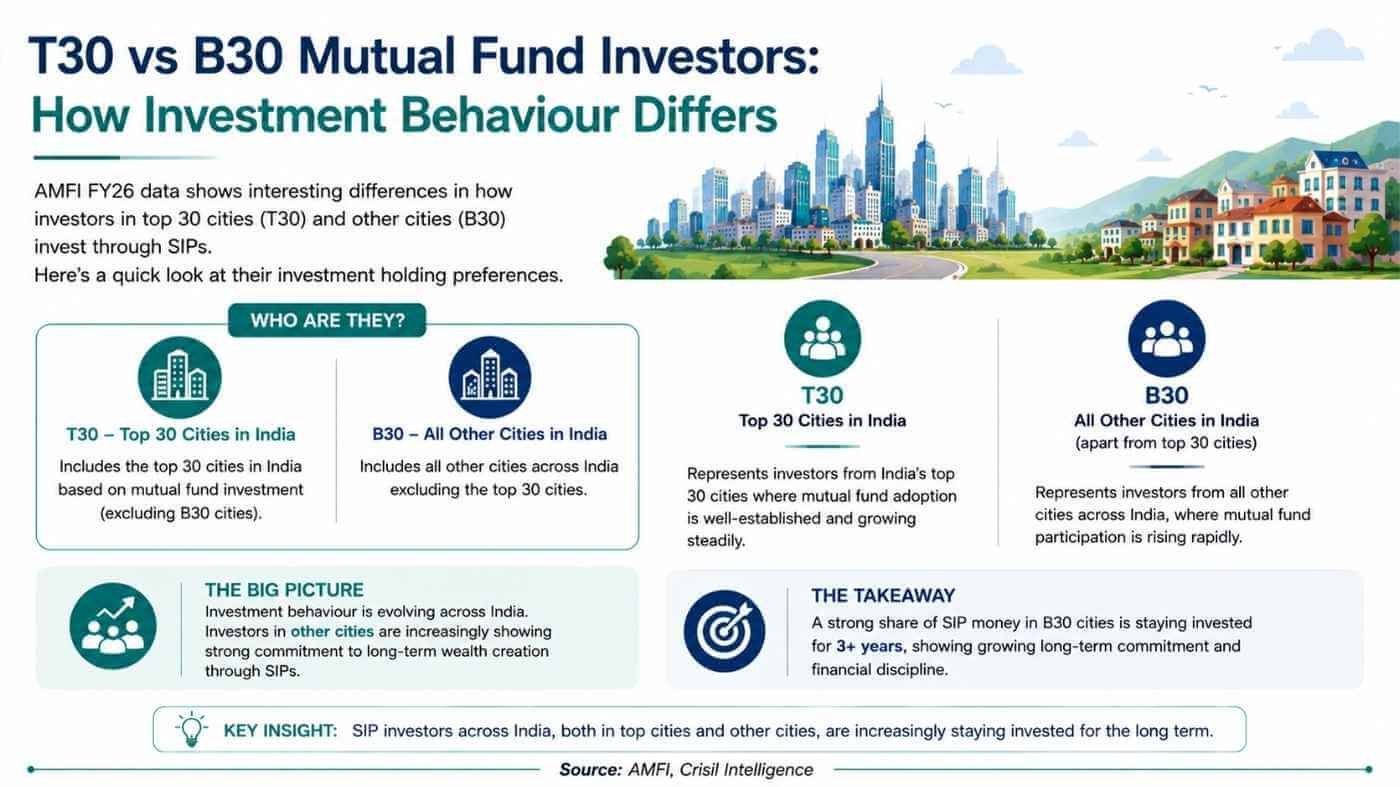
Investors from India’s largest cities and investors from its smaller towns are often lumped together as one homogenous group in mutual fund commentary. They are not. Beyond the well-known gap in average investment size, AMFI and industry data show real, measurable differences in how T30 and B30 investors choose plans, react to market falls, and behave once markets turn volatile.
One number sums this up starkly: during five months in early 2025, SIP account closures in B30 direct plans ran 2.6 times higher than closures in B30 regular plans. Understanding why requires looking at how these two investor groups actually behave, not just where they live.
T30 vs B30, a Quick Refresher
AMFI classifies Indian cities into two groups for reporting purposes. T30 covers the top 30 cities by mutual fund AUM, essentially India’s largest metros and major urban centres. B30 covers everywhere else: smaller cities, towns, and semi-urban and rural areas.

This classification exists specifically to let AMFI, AMCs, and regulators track how mutual fund participation and behaviour differ once you move beyond a small number of large cities.
Difference 1: Average Investment Size
The most visible difference between the two groups is how much each investor typically puts in.
| City Group | Average Retail Ticket Size |
|---|---|
| T30 cities | ~₹2.73 lakh |
| B30 cities | ~₹1.05 lakh |
A B30 investor’s average retail ticket size runs at less than half of what a typical T30 investor invests. This gap has persisted for years and reflects differences in income levels, financial literacy, and how recently many B30 investors have entered formal investing, rather than any difference in commitment to investing itself.
Difference 2: Direct vs Regular Plan Preference
Every mutual fund scheme offers two versions. A direct plan is bought straight from the AMC with no distributor involved, which keeps costs lower but leaves fund selection and ongoing decisions entirely to the investor. A regular plan is bought through a distributor or advisor, who earns a commission built into the plan’s costs in exchange for guidance on fund selection and staying invested.
| Feature | Direct Plan | Regular Plan |
|---|---|---|
| Bought from | AMC directly | Distributor or advisor |
| Cost | Lower expense ratio | Slightly higher (includes distributor commission) |
| Guidance | None; investor manages fund selection alone | Ongoing support from a distributor or advisor |
| Best suited for | Investors comfortable managing decisions independently | Investors who want professional guidance and coaching |
T30 and B30 investors do not use these two options in the same proportion, and the gap shows up clearly in how each group behaves once markets get volatile.
Difference 3: How Each Group Reacts to Volatility
This is where the behavioural gap becomes measurable rather than theoretical. Business Standard reporting on SIP account data for the first five months of 2025 found that B30 direct plan accounts fell 19 percent, from 2.41 crore in December 2024 to 1.95 crore by May, while B30 regular plan accounts fell just 6 percent over the same period, despite regular plans having a larger account base to begin with.
| Plan Type | Accounts (Dec 2024) | Accounts (May 2025) | Decline |
|---|---|---|---|
| B30 direct plan | 2.41 crore | 1.95 crore | -19% |
| B30 regular plan | ~3.22 crore | 3.03 crore | -6% |
The gap is not small. B30 investors using direct plans closed their SIPs at roughly two and a half times the rate of B30 investors using regular plans during the same window. Whatever caused investors to step back during that period, it affected direct plan investors far more severely than regular plan investors in the same B30 markets.
Why the Direct Plan Gap Matters So Much in B30
Industry professionals who track this data point to a specific difference in how DIY and advisor-guided investors approach fund selection in the first place. Direct plan investors, particularly newer ones, often gravitate towards recently high-performing funds without fully appreciating the volatility or concentration risk that produced those returns, including niche thematic or sectoral schemes that move through long, sharp cycles.
Regular plan investors, working with a distributor or advisor, tend to get a different kind of support: help interpreting a correction while it is happening, and a habit of staying invested that has been actively reinforced over time rather than left to individual willpower alone. That guidance appears to matter most exactly when it is hardest to provide it to yourself, in the middle of a market fall.
Difference 4: Institutional vs Individual Money
T30 and B30 also differ sharply in who is actually behind the money, not just how it is invested.
| Investor Type | Share from T30 | Share from B30 |
|---|---|---|
| Individual investors (June 2025) | ~72.6% | ~27.4% |
| Institutional investors (June 2025) | ~95.4% | ~4.6% |
Institutional assets, money from corporates, trusts, and similar large entities, are overwhelmingly concentrated in T30 locations. B30 assets are almost entirely individual money. This matters for interpreting any T30 versus B30 comparison: T30’s headline AUM numbers are inflated by corporate treasury management in ways that B30’s are not, which is one reason individual investor AUM, rather than total AUM, is usually the fairer basis for comparing the two groups.
How Regulation Is Responding
SEBI reset the distributor incentive structure for B30 inflows at the end of 2025, with a new framework effective from March 2026. Rather than a broad incentive on all B30 inflows, the new structure targets a more specific outcome: bringing genuinely new investors into the mutual fund system.
The revised incentive pays distributors 1 percent of the investment amount, capped at 2,000 rupees per new investor, specifically for onboarding first-time investors from B30 cities and first-time women investors from anywhere in the country, T30 or B30. The incentive is only paid after the investor completes a full year in the fund, tying the reward to whether the investor actually stayed invested rather than simply opened an account. The funding for this incentive comes from each AMC’s investor education and awareness corpus, not from the scheme’s own expense ratio.
This shift reflects the same behavioural pattern the SIP closure data shows: simply getting a new investor to start is not enough. The industry, and now the regulator, is increasingly focused on whether that investor actually stays invested, which is precisely where the direct versus regular plan gap in B30 becomes most relevant.
What This Means for You as an Investor
None of this data tells you which plan type or investment amount is right for your specific situation, but it does offer useful context depending on where you fall in this comparison.
| If You Are… | What This Data Suggests |
|---|---|
| A B30 investor using a direct plan | Worth honestly assessing whether you have the time and market knowledge to manage volatility on your own, since this group showed the sharpest SIP closures recently. |
| A B30 investor using a regular plan | The data suggests your advisor relationship has measurably helped you stay invested through volatility compared to DIY peers. |
| A T30 investor | Your city’s mutual fund base includes far more institutional money, so individual investor data is the fairer comparison point for your own behaviour. |
| Considering switching from regular to direct | Consider whether you would maintain the same discipline without ongoing guidance, not just the cost difference. |
If you are a B30 investor currently using a direct plan, the data does not mean direct plans are wrong for everyone, but it does suggest checking honestly whether you have the market knowledge, time, and discipline to manage fund selection and market volatility entirely on your own, particularly during a correction. If you are already working with a distributor or advisor, the data on regular plan resilience suggests that relationship has measurable value beyond simply picking funds.
Whether you are investing from a metro or a smaller town, and whether you currently use a direct or regular plan, a conversation with a VSJ FinMart advisor can help you assess honestly whether your current setup is actually suited to how you behave when markets get volatile, not just how it looks on paper when markets are calm.
Frequently Asked Questions on T30 vs B30 Investor Behaviour
| Question | Answer |
|---|---|
| What is the difference between T30 and B30 in mutual funds? | T30 refers to India’s top 30 cities by mutual fund AUM; B30 refers to every other city, town, and region beyond that. |
| Do B30 investors panic more than T30 investors during market falls? | The data doesn’t show a simple T30 vs B30 panic gap. It shows a plan-type gap within B30 itself, where direct plan investors closed SIPs at roughly 2.6 times the rate of regular plan investors during early 2025. |
| Are direct plans a bad choice for B30 investors? | Not inherently. Direct plans suit investors who can manage fund selection and stay disciplined through volatility on their own; the data simply shows this group has struggled more with that discipline recently. |
| Why is institutional money concentrated in T30 cities? | Corporate treasuries and large institutions are typically headquartered in major cities, so their mutual fund investments are recorded there, inflating T30’s total AUM relative to individual investor activity. |
| Has SEBI changed how B30 investment is incentivised? | Yes. From March 2026, distributor incentives shifted from a broad B30 uplift to a targeted reward for genuinely new B30 investors and first-time women investors, paid only after a year of continued investment. |
Final Words
T30 and B30 mutual fund investors differ in far more than average ticket size. B30 investors are more likely to close SIPs during volatility if they are using direct plans, T30 assets carry a much larger share of institutional money, and the two groups have responded differently to the same market conditions in ways the data can now actually measure.
None of this means one city type or plan type is inherently better for every investor. It means the right setup depends on how much guidance you actually need to stay invested when markets get difficult, which is a more useful question to answer honestly than simply choosing based on cost alone. A VSJ FinMart advisor can help you work through that question directly, whether you are investing from a metro or a town well beyond India’s top 30 cities.
Disclaimer
The information provided in this blog is for educational and informational purposes only and should not be construed as investment advice. Please consult a qualified financial advisor before making any investment decisions. Shashikant Chanderkumar Mudaliar (ARN: 319377), operating under the brand name VSJ FinMart, is an AMFI-registered Mutual Fund Distributor (MFD) and does not provide investment advisory services. Mutual fund investments are subject to market risks. Past performance is not indicative of future results. Please read all scheme-related documents carefully before investing. Registration details can be verified at www.amfiindia.com/locate-distributor.