

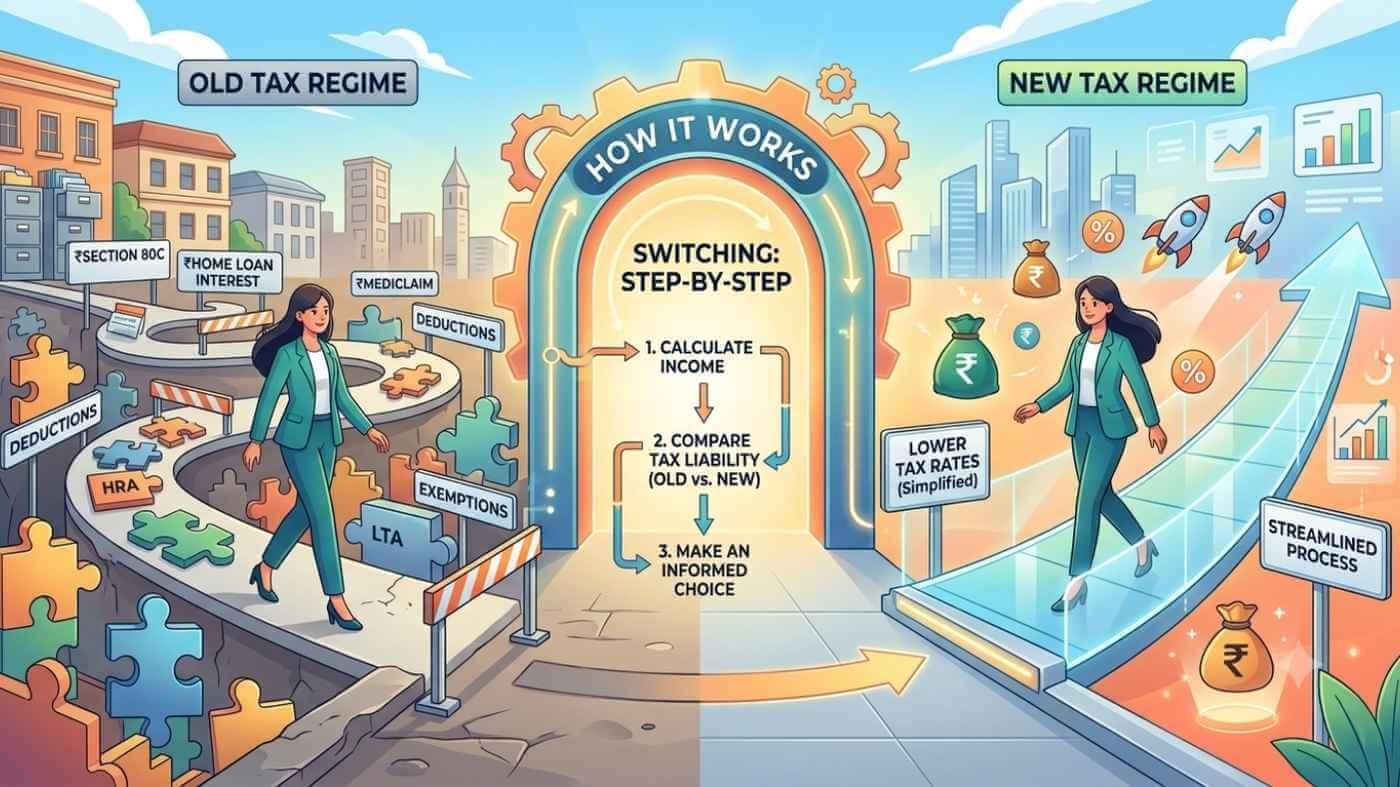
Every year, millions of Indian taxpayers face the same question: should I switch from the old tax regime to the new tax regime, or stay with my current choice?
The answer is not always simple. Both tax regimes have different slab rates, deductions, exemptions, and eligibility rules. Choosing the wrong option could mean paying more tax than necessary, while the right choice can help you reduce your tax liability and simplify your tax filing.
In this guide, you will learn how switching from the old to the new tax regime works, who can switch, the restrictions you should know about, the deductions you may lose, and how to decide which regime best suits your financial situation. Whether you are a salaried employee, a freelancer, a professional, or a business owner, this guide explains everything in simple language.
Switching From Old to New Tax Regime: What Are the Two Tax Regimes?
India currently offers two income tax regimes for individual taxpayers:
- Old Tax Regime
- New Tax Regime
The regime you choose determines the tax slab rates applicable to your income and the deductions and exemptions you can claim.
The Old Tax Regime
The old regime has been around for decades. It offers higher tax rates but allows a wide rThe old tax regime has been the traditional tax system in India for many years. It follows comparatively higher tax slab rates but allows taxpayers to reduce their taxable income by claiming several deductions and exemptions.
Some of the most commonly used tax benefits include:
- Section 80C deduction up to Rs 1.5 lakh for eligible investments such as EPF, PPF, ELSS, life insurance premiums, NSC, tax-saving fixed deposits, and repayment of home loan principal.
- Section 80D deduction for health insurance premiums.
- House Rent Allowance (HRA) exemption for eligible salaried employees.
- Leave Travel Allowance (LTA) exemption, subject to prescribed conditions.
- Home loan interest deduction under Section 24(b) for self-occupied house property, up to Rs 2 lakh annually.
- Standard deduction of Rs 75,000 for salaried employees and pensioners.
The old regime generally benefits taxpayers who actively claim deductions and exemptions. However, it requires proper documentation and proof to support those claims.
The New Tax Regime
The new tax regime was introduced in Budget 2020 and has been significantly enhanced over the years. It became the default tax regime from FY 2023-24, although taxpayers can still choose the old regime if they are eligible.
The new regime offers lower tax slab rates but removes most deductions and exemptions available under the old regime.
For FY 2025-26 (AY 2026-27), the new regime has become even more attractive because of:
- Revised tax slabs with lower rates for many taxpayers.
- Standard deduction of Rs 75,000 for salaried employees and pensioners.
- Enhanced Section 87A rebate, resulting in zero tax liability for eligible taxpayers with taxable income up to Rs 12 lakh under the new regime (subject to applicable conditions).
The new regime is generally suitable for taxpayers who:
- Have limited deductions and exemptions.
- Prefer a simpler tax filing process.
- Do not want to invest primarily for tax-saving purposes.
- Want to benefit from the lower tax slab rates available under the new regime.
Before deciding to switch, compare your tax liability under both regimes using your actual income, deductions, and exemptions. The best choice varies from one taxpayer to another and may change as your financial situation evolves.
Old vs New Tax Regime: Key Slab Comparison
Before switching from the old tax regime to the new tax regime, it is helpful to compare the tax slabs applicable under each regime. For FY 2025-26 (AY 2026-27), the slab rates are as follows:
| Annual Income | Old Tax Regime | New Tax Regime |
|---|---|---|
| Up to Rs 2,50,000* | Nil | Nil (up to Rs 4,00,000) |
| Rs 2,50,001 to Rs 4,00,000 | 5% | Nil |
| Rs 4,00,001 to Rs 5,00,000 | 5% | 5% |
| Rs 5,00,001 to Rs 8,00,000 | 20% | 5% |
| Rs 8,00,001 to Rs 10,00,000 | 20% | 10% |
| Rs 10,00,001 to Rs 12,00,000 | 30% | 10% |
| Rs 12,00,001 to Rs 16,00,000 | 30% | 15% |
| Rs 16,00,001 to Rs 20,00,000 | 30% | 20% |
| Rs 20,00,001 to Rs 24,00,000 | 30% | 25% |
| Above Rs 24,00,000 | 30% | 30% |
*Old regime basic exemption limit is:
- Rs 2.5 lakh for individuals below 60 years.
- Rs 3 lakh for senior citizens (60 years to below 80 years).
- Rs 5 lakh for super senior citizens (80 years and above).
Important Notes
The old regime continues to be beneficial for taxpayers who can claim substantial deductions and exemptions such as Section 80C, Section 80D, HRA, LTA, and home loan interest under Section 24(b).o income up to Rs 5 lakh.
The new tax regime is the default regime unless you opt for the old regime (subject to the applicable rules).
Salaried employees and pensioners can claim a standard deduction of Rs 75,000 under both regimes.
Under the new tax regime, eligible resident individuals with taxable income up to Rs 12 lakh can avail the enhanced Section 87A rebate, resulting in zero tax liability (excluding special rate income such as certain capital gains).
For salaried employees, the effective zero-tax threshold can extend to Rs 12.75 lakh gross salary, after considering the Rs 75,000 standard deduction, subject to the rebate conditions.
How Does the Switch from Old to New Tax Regime Actually Work?
The process of switching between the old and new tax regimes depends on whether you are a salaried employee or have business/professional income. Understanding the rules before making your choice can help you avoid unnecessary tax liability.
For Salaried Employees
If you are a salaried employee, your employer will generally ask you to declare your preferred tax regime at the beginning of the financial year so that the correct amount of Tax Deducted at Source (TDS) can be calculated from your salary.
However, this declaration is only for TDS purposes and is not final.
As a salaried taxpayer (without business or professional income), you can choose either the old or the new tax regime every financial year while filing your Income Tax Return (ITR). This means that even if your employer deducted TDS under one regime, you can opt for the other regime when filing your return if it results in a lower tax liability. Any excess TDS deducted can be claimed as a refund, or any shortfall must be paid before filing.
This flexibility allows salaried taxpayers to compare both regimes after the financial year ends and select the most tax-efficient one.
For Self-Employed Individuals and Business Owners
If you have income under the head “Profits and Gains of Business or Profession (PGBP),” the rules are different.
- The new tax regime is the default regime.
- If you wish to opt for the old tax regime, you must exercise the option by filing Form 10-IEA on or before the due date for filing your Income Tax Return.
- If you later switch back to the new regime, you generally cannot opt for the old regime again, except under the limited conditions prescribed under the Income-tax Act.
Because of these restrictions, taxpayers with business or professional income should carefully evaluate the long-term impact before changing their tax regime.
How to Switch Tax Regimes: Step by Step
- Calculate your total income for the financial year.
- Identify all deductions and exemptions available under the old tax regime.
- Compute your taxable income under both the old and new tax regimes.
- Compare the total tax liability, including rebate under Section 87A, surcharge, and health & education cess.
- If you are a salaried employee, inform your employer of your preferred regime for TDS purposes. Remember, you can still change your choice while filing your ITR.
- If you have business or professional income and wish to opt for the old regime, file Form 10-IEA within the prescribed due date.
- File your Income Tax Return under the regime that results in the lowest overall tax liability before the applicable due date.
Tip: Do not choose a tax regime based solely on lower tax slab rates. Always compare your actual tax liability under both regimes after considering deductions, exemptions, rebates, and your long-term financial goals. For many taxpayers, a simple tax comparison before filing can lead to significant savings.
Who Benefits from Switching to the New Regime?
The new regime is not suitable for everyone. It clearly benefits certain types of taxpayers more than others.
The New Regime Works Well If You:
- Earn less than Rs 7 lakh per year (you pay zero tax due to the rebate)
- Do not invest in 80C instruments like ELSS, PPF, or life insurance
- Do not have a home loan with significant interest deductions
- Do not pay rent in a city where HRA exemptions are large
- Prefer a simple filing process without collecting investment proofs
- Are young earners early in their careers with minimal tax-saving investments
A Practical Example
Suppose Ravi earns Rs 10 lakh per year as a salaried employee in Mumbai. He pays rent and has a home loan, invests Rs 1.5 lakh under 80C, and pays health insurance premiums of Rs 25,000.
Under the old regime, his taxable income after all deductions could come down to around Rs 7 lakh or less, keeping his tax liability low. In this case, the old regime saves him more money.
However, his colleague Priya earns Rs 10 lakh but lives with her parents, has no home loan, and makes no 80C investments. For Priya, the new regime with its lower slab rates is clearly the better choice. She pays less tax without needing to make any investments just for the sake of saving tax.
What You Give Up When You Switch to the New Regime
The new tax regime offers lower tax rates in exchange for giving up most of the deductions and exemptions available under the old regime. Before switching, it is important to understand which tax benefits you will no longer be able to claim.
Deductions and Exemptions Generally Not Available Under the New Regime
- Section 80C (up to Rs 1.5 lakh) for investments such as:
- Public Provident Fund (PPF)
- Equity Linked Savings Scheme (ELSS)
- National Savings Certificate (NSC)
- Life insurance premiums
- Employee Provident Fund (EPF)
- Home loan principal repayment
- Five-year tax-saving fixed deposits
- Section 80D (health insurance premiums)
- Section 80CCD(1B) (additional NPS contribution up to Rs 50,000 by the taxpayer)
- House Rent Allowance (HRA) exemption
- Leave Travel Allowance (LTA) exemption
- Section 24(b) deduction for interest on a self-occupied home loan
- Section 80E (interest on education loan)
- Most deductions under Chapter VI-A, unless specifically allowed under the new regime.
Benefits That Continue to Be Available Under the New Regime
Although many deductions are withdrawn, several important tax benefits are still available.
- Standard deduction of Rs 75,000 for salaried employees and pensioners.
- Employer’s contribution to the National Pension System (NPS) under Section 80CCD(2), subject to the prescribed limits.
- Deduction for employment of new employees under Section 80JJAA, where applicable.
- Certain deductions under Section 80CCH for eligible Agniveers.
- Certain donations under Section 80G, where specifically permitted under the Income-tax Act.
- Exemptions for gratuity, leave encashment, and voluntary retirement compensation (VRS), subject to the prescribed conditions.
- Interest deduction against income from a let-out house property, as permitted under the Act (although loss from house property cannot generally be set off against other income under the new regime).
A Simple Rule of Thumb
If you regularly claim deductions such as Section 80C, Section 80D, HRA, home loan interest, and education loan interest, compare both tax regimes carefully before switching. On the other hand, if your deductions are limited, the lower slab rates and simplified compliance under the new tax regime may result in a lower overall tax liability.
Note: The new tax regime is the default regime from FY 2023-24 onwards, but you should calculate your tax under both regimes each year before making your final choice. The regime with the lower overall tax liability is usually the better option.
Investing Smartly, Regardless of the Tax Regime You Choose
One of the biggest misconceptions is that your tax regime should determine your investment strategy. In reality, tax planning and investment planning serve different purposes.
The new tax regime may reduce or eliminate the need to invest in tax-saving products purely for deductions. However, that does not mean you should stop investing. Your investments should be driven by long-term financial goals such as buying a home, funding your children’s education, building a retirement corpus, or creating wealth, not just by tax benefits.
For example, if you opt for the new tax regime and no longer need to invest under Section 80C to save tax, you gain greater flexibility. Instead of choosing investments solely because they qualify for a deduction, you can build a portfolio based on your financial goals, investment horizon, and risk tolerance.
Whether you invest through Systematic Investment Plans (SIPs), mutual funds, equity, debt instruments, or other suitable investment options, the objective should always be to create long-term wealth while maintaining an appropriate level of risk.
Common Mistakes to Avoid When Switching Tax Regimes
Choosing between the old and new tax regimes should be based on careful calculation, not assumptions. Avoid these common mistakes to ensure you pay only the tax you legally owe.
1. Not Comparing Both Regimes Before Filing
Always calculate your tax liability under both the old and new tax regimes before making your final choice. Even a modest amount of deductions can change which regime is more tax-efficient.
2. Assuming the New Regime Always Saves More Tax
The new regime offers lower tax rates, but it also removes most deductions and exemptions. If you claim substantial deductions under Sections 80C, 80D, 24(b), HRA, or other provisions, the old regime may still result in a lower overall tax liability.
3. Stopping Investments Just Because Tax Benefits Are Gone
Many taxpayers discontinue investments such as ELSS, PPF, or NPS simply because they no longer receive a tax deduction under the new regime. This can be a costly mistake. Investments should be made to achieve long-term financial goals, while tax savings should be treated as an additional benefit rather than the primary objective.
4. Not Informing Your Employer About Your Preferred Tax Regime
If you do not declare your preferred tax regime to your employer, TDS will generally be deducted based on the default tax regime or the information available with the employer. While you can still choose a different regime when filing your Income Tax Return (subject to the applicable rules), incorrect TDS may result in either additional tax payable or a refund claim.
5. Missing the Form 10-IEA Deadline (For Taxpayers with Business or Professional Income)
Individuals having income under the head “Profits and Gains of Business or Profession” who wish to opt for the old tax regime must file Form 10-IEA within the prescribed due date. Failure to file the form on time may result in your income being taxed under the default new tax regime for that assessment year. Although there is no separate penalty for missing the form, it can affect your ability to choose your preferred tax regime.
Tip: Before filing your Income Tax Return, compare your tax liability under both regimes using your actual income, deductions, exemptions, and eligible rebates. A few minutes spent comparing the two options can lead to significant tax savings.
Tips for Making the Right Tax Regime Decision
There is no one-size-fits-all answer when choosing between the old and new tax regimes. The better option depends on your income, deductions, investments, and financial goals. These practical tips can help you make an informed decision.
1. Start with Your Gross Income
Calculate your total income for the financial year, including salary, business or professional income, rental income, interest income, capital gains, and any other taxable income. Your total income forms the foundation of your tax calculation.
2. List All Eligible Deductions and Exemptions
If you are considering the old tax regime, prepare a complete list of deductions and exemptions you can claim, such as:
- Section 80C investments (PPF, ELSS, EPF, life insurance, etc.)
- Section 80D (health insurance premiums)
- House Rent Allowance (HRA)
- Home loan interest under Section 24(b)
- Education loan interest under Section 80E
- Other eligible deductions and exemptions
The more deductions you can legitimately claim, the more attractive the old regime may become.
3. Compare Your Tax Liability Under Both Regimes
Use the official Income Tax Department tax calculator or a reliable tax calculator to compare your tax liability under both regimes. Base your comparison on your actual income and eligible deductions rather than assumptions.
4. Think Beyond Tax Savings
Do not choose investments solely for tax benefits. If the new tax regime is more beneficial, you can invest according to your financial goals instead of focusing only on tax-saving products. Your investment strategy should support long-term wealth creation, regardless of the tax regime you choose.
5. Consider Your Future Financial Plans
Major life events such as purchasing a home, taking a home loan, increasing retirement investments, or buying health insurance can significantly affect which tax regime is more beneficial. Choose a regime that aligns not only with your current situation but also with your upcoming financial plans.
6. Review Your Choice Every Financial Year
For salaried taxpayers, the most suitable tax regime can change as income, deductions, and financial commitments evolve. Reviewing both options every year ensures you continue paying only the tax that is legally due.
7. Seek Professional Advice When Needed
Tax planning is closely connected to your investment strategy, insurance coverage, retirement planning, and overall financial goals. If your finances involve multiple income sources, business income, capital gains, or significant deductions, professional guidance can help you make a more informed decision and avoid costly mistakes.
Remember: The best tax regime is not necessarily the one with the lowest tax rates. It is the one that results in the lowest overall tax liability after considering all eligible deductions, exemptions, and rebates, while supporting your long-term financial objectives.
Final Words
Switching from the old tax regime to the new tax regime is more than just a tax-saving decision. It is an important part of your overall financial planning. While the new tax regime offers lower tax rates, a higher standard deduction, and a simpler filing process, the old tax regime can still be more beneficial for taxpayers who claim substantial deductions and exemptions. There is no universally better option.
The right choice depends on your income, eligible deductions, investment pattern, home loan commitments, insurance premiums, and long-term financial goals. Before filing your Income Tax Return, calculate your tax liability under both regimes using your actual financial data. A few minutes of comparison can help you avoid paying unnecessary tax.
Most importantly, do not let tax benefits become the only reason you invest. Build your investment portfolio around your life goals, risk tolerance, and time horizon. Tax savings are an added advantage, but long-term wealth creation should always remain the primary objective.
Frequently Asked Questions
1. Can I switch between the old and new tax regime every year?
It depends on the type of income you earn.
- Salaried individuals and those without business or professional income can choose between the old and new tax regimes every financial year while filing their Income Tax Return (ITR).
- Individuals with business or professional income are subject to different rules. If they opt out of the default new tax regime and choose the old regime by filing Form 10-IEA, their ability to switch between regimes is restricted under the Income-tax Act. Therefore, they should evaluate their options carefully before making a decision.
2. Is the new tax regime better for everyone?
No. The new tax regime is generally more beneficial for taxpayers who claim few or no deductions and exemptions. If you regularly claim deductions such as Section 80C investments, health insurance under Section 80D, HRA, or home loan interest under Section 24(b), the old tax regime may result in a lower overall tax liability. The right choice depends on your income and eligible deductions.
3. What happens if I do not declare my tax regime to my employer?
If you do not inform your employer of your preferred tax regime for TDS purposes, tax is generally deducted based on the default new tax regime. However, if you are eligible, you can still choose a different tax regime while filing your Income Tax Return. This may result in either an additional tax payment or a refund, depending on your final tax liability.
4. Can I claim HRA if I choose the new tax regime?
No. The House Rent Allowance (HRA) exemption is not available under the new tax regime. If you receive a substantial HRA benefit and pay significant rent, the old tax regime may prove more tax-efficient.
5. Should I stop investing in ELSS or PPF if I choose the new tax regime?
No. Choosing the new tax regime should not change your long-term investment strategy. Although ELSS investments no longer qualify for a Section 80C deduction under the new regime, they continue to offer the potential for long-term wealth creation through equity markets. Similarly, Public Provident Fund (PPF) remains a government-backed investment that provides tax-free interest and tax-free maturity proceeds, making it a valuable long-term savings option. Invest based on your financial goals, risk tolerance, and investment horizon, not solely for tax benefits.
Remember: The best tax regime helps you minimise your tax liability, while the best investment strategy helps you achieve your financial goals. The two should complement each other, but they should never be treated as the same decision.
Disclaimer
The information provided in this blog is for educational and informational purposes only and should not be construed as investment advice. Please consult a qualified financial advisor before making any investment decisions. Shashikant Chanderkumar Mudaliar (ARN: 319377), operating under the brand name VSJ FinMart, is an AMFI-registered Mutual Fund Distributor (MFD) and does not provide investment advisory services. Mutual fund investments are subject to market risks. Past performance is not indicative of future results. Please read all scheme-related documents carefully before investing. Registration details can be verified at www.amfiindia.com/locate-distributor.