

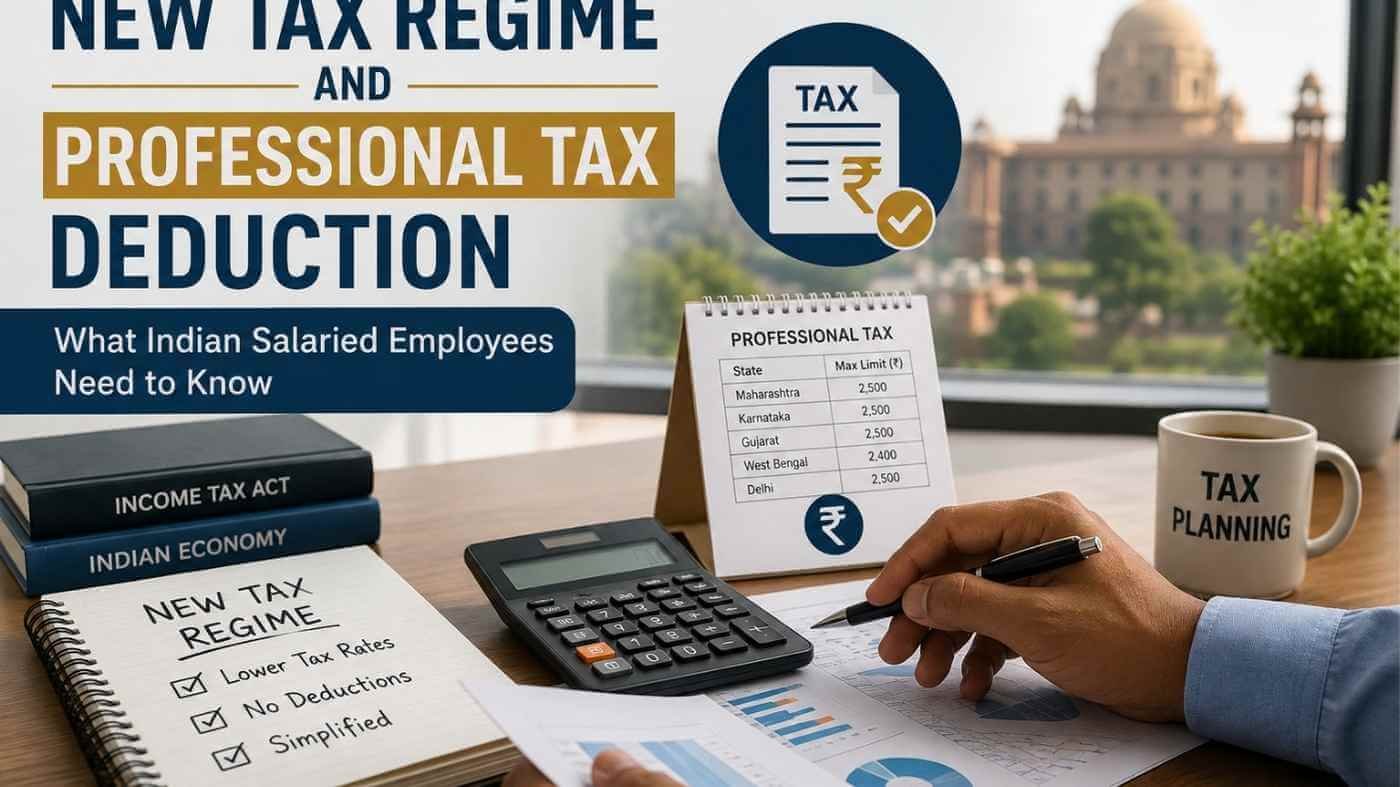
When you switch to the new tax regime, one of the first questions that comes up is: what happens to the professional tax deduction in the new regime? It is a fair question, and the answer matters for every salaried individual who pays professional tax every month. Understanding this one point can help you plan your salary structure and your taxes more clearly for the financial year ahead.
This guide walks you through everything you need to know, from what professional tax is, to how it is treated under the new regime, to how it affects your overall tax planning. No jargon, no confusion. Just clear, practical information.
What Is Professional Tax and Who Pays It?
Professional tax is a state-level tax levied by certain State Governments on individuals earning income from employment, trade, or a profession. For salaried employees, it is deducted by the employer from the monthly salary and deposited with the respective State Government on the employee’s behalf.
The maximum professional tax that a State Government can levy is Rs 2,500 per financial year, as provided under Article 276 of the Constitution of India. However, the rates, slabs, and applicability vary from one state to another. Some states, such as Maharashtra, Karnataka, West Bengal, Telangana, Andhra Pradesh, Tamil Nadu, Gujarat, and Madhya Pradesh, levy professional tax, while others, such as Delhi and Haryana, do not.
States That Levy Professional Tax
- Maharashtra
- Karnataka
- West Bengal
- Andhra Pradesh
- Telangana
- Tamil Nadu
- Gujarat
- Madhya Pradesh
If you work in a state where professional tax is applicable, your employer generally deducts it from your salary and deposits it with the respective State Government. You can verify the deduction in your monthly salary slip.
Old Regime vs New Regime: Key Differences at a Glance
Before we get into the professional tax deduction specifically, it helps to understand the broader difference between the two regimes. The old tax regime allows several deductions and exemptions, whereas the new tax regime offers lower tax rates but does not allow most of those deductions and exemptions.
| Feature | Old Tax Regime | New Tax Regime |
|---|---|---|
| Tax Slab Rates | Higher slab rates | Lower slab rates |
| Standard Deduction | Rs 50,000 | Rs 75,000 |
| Section 80C Deduction | Allowed (up to Rs 1.5 lakh) | Not allowed |
| HRA Exemption | Allowed | Not allowed |
| Professional Tax Deduction | Allowed under Section 16(iii) | Not allowed |
| Section 80D (Health Insurance) | Allowed | Not allowed |
| Leave Travel Allowance (LTA) | Allowed | Not allowed |
Notice the highlighted row. Unlike the old tax regime, the deduction for professional tax paid under Section 16(iii) is not available under the new tax regime. Therefore, if you opt for the new tax regime, the professional tax deducted from your salary cannot be claimed as a deduction while computing your taxable income.
Professional Tax Deduction in the New Regime: What the Law Says
Under Section 16(iii) of the Income-tax Act, 1961, professional tax paid by an employee is allowed as a deduction from salary income only under the old tax regime.
However, if you opt for the new tax regime under Section 115BAC, the deduction for professional tax under Section 16(iii) is not available. The new tax regime allows only specified deductions, such as the standard deduction of Rs 75,000 for salaried individuals and certain other limited deductions specifically permitted under the Act.
How the Deduction Works in Practice
Suppose you are a salaried employee in Maharashtra earning Rs 8 lakh per year, and your employer deducts Rs 200 per month as professional tax, totalling Rs 2,400 during the financial year.
Under the old tax regime, your taxable salary would be computed as follows:
- Gross Salary: Rs 8,00,000
- Less: Standard Deduction: Rs 50,000
- Less: Professional Tax [Section 16(iii)]: Rs 2,400
- Net Taxable Salary: Rs 7,47,600
Under the new tax regime, the computation would be:
- Gross Salary: Rs 8,00,000
- Less: Standard Deduction: Rs 75,000
- Net Taxable Salary: Rs 7,25,000
Since the deduction for professional tax is not available under the new tax regime, the amount deducted by your employer does not reduce your taxable income.
Why Professional Tax Is One of the Few Deductions Left in the New Regime
The new tax regime was introduced to simplify the tax system by offering lower tax rates in exchange for giving up most deductions and exemptions. As part of this framework, the deduction for professional tax under Section 16(iii) is not available if you opt for the new tax regime.
Although professional tax is a compulsory levy imposed by certain State Governments, the Income-tax Act does not permit its deduction while computing taxable salary under Section 115BAC. Therefore, the professional tax deducted from your salary does not reduce your taxable income under the new tax regime.
What Deductions and Exemptions Are Still Available Under the New Tax Regime?
A limited number of deductions and exemptions continue to be available under the new tax regime, including:
- Standard deduction of Rs 75,000 for salaried individuals and pensioners.
- Employer’s contribution to NPS under Section 80CCD(2), subject to the prescribed limits.
- Gratuity exemption under Section 10(10), subject to the prescribed conditions.
- Leave encashment exemption under Section 10(10AA), subject to the prescribed conditions.
- Retrenchment compensation exemption under Section 10(10B), subject to the prescribed conditions.
- Certain other exemptions specifically permitted under the Income-tax Act.
Most popular deductions and exemptions, such as Section 80C, Section 80D, HRA exemption, LTA exemption, and the professional tax deduction under Section 16(iii), are not available under the new tax regime. Therefore, taxpayers should compare their overall tax liability under both regimes before making a choice. deduction stands out as one of the few automatic benefits in the new regime.
Should You Choose the New Regime or the Old Regime?
This is the question most salaried individuals face at the start of each financial year. The answer depends on your income, eligible deductions and exemptions, salary structure, and overall financial situation. There is no single right answer for everyone.
When the New Regime May Work Better
- Your taxable income is within the limit eligible for the rebate under Section 87A.
- You do not have significant deductions and exemptions, such as those under Section 80C, Section 80D, HRA, or eligible home loan benefits.
- You prefer a simpler tax structure with fewer deductions to track.
- Your employer contributes to NPS under Section 80CCD(2), allowing you to claim the available deduction under the new tax regime.
When the Old Regime May Still Make Sense
- You claim a substantial HRA exemption.
- You have significant eligible home loan benefits.
- You regularly utilise deductions under Section 80C, Section 80D, and other eligible provisions.
- Your total eligible deductions and exemptions are high enough to reduce your overall tax liability below that under the new tax regime.
Before deciding, compare your total tax liability under both regimes using your actual salary structure and eligible tax benefits.
In addition, remember that the new tax regime is the default. If you do not inform your employer of your preferred tax regime for TDS purposes, tax will generally be deducted under the new tax regime. However, eligible salaried taxpayers without business or professional income can still choose a different regime when filing their income tax return, subject to the provisions of the Income-tax Act. You will automatically be placed under the new regime for TDS purposes.
A Practical Tax Calculation: Old vs New Regime for a Mumbai Professional
Let us take a practical example. Consider Ankit, a marketing manager in Mumbai, earning Rs 10 lakh per year. He pays Rs 2,500 in professional tax annually. He has also invested Rs 1.5 lakh under Section 80C and pays Rs 25,000 towards health insurance premiums.
| Item | Old Tax Regime (Rs) | New Tax Regime (Rs) |
|---|---|---|
| Gross Salary | 10,00,000 | 10,00,000 |
| Standard Deduction | 50,000 | 75,000 |
| Professional Tax [Section 16(iii)] | 2,500 | Not available |
| Section 80C | 1,50,000 | Not available |
| Section 80D | 25,000 | Not available |
| Net Taxable Income | 7,72,500 | 9,25,000 |
The tax payable under each regime depends on the applicable slab rates, rebate under Section 87A (where applicable), surcharge, and health and education cess. Therefore, it is advisable to calculate the liability using the latest tax slabs before deciding which regime is more beneficial.
If Ankit also has a substantial eligible home loan benefit or other deductions available under the old tax regime, the old regime may become more tax-efficient. The right choice depends on an individual’s overall tax position rather than any single deduction.
How to Ensure Your Professional Tax Deduction Is Correctly Reflected
If you have opted for the old tax regime, it is worth verifying that the professional tax deduction has been correctly considered.
Steps to Verify the Deduction
- Check your monthly salary slip for the professional tax deduction.
- Add up the total professional tax deducted during the financial year.
- Verify that the amount is reflected in Form 16.
- If you are filing your own income tax return under the old tax regime, ensure the deduction has been correctly considered while computing your taxable salary.
If you opt for the new tax regime, you cannot claim a deduction for professional tax under Section 16(iii).
What If You Are Self-Employed?
If you carry on a business or profession, such as a doctor, lawyer, or chartered accountant, and professional tax is payable under the applicable State law, the amount paid is generally allowable as a business expenditure while computing income under the head “Profits and Gains of Business or Profession,” subject to the provisions of the Income-tax Act. It is not claimed under Section 16(iii), which applies only to salaried employees.
Tax Planning Beyond Professional Tax: Building Long-Term Wealth
Professional tax may be a relatively small amount, but effective financial planning goes far beyond claiming or missing a single deduction. For most salaried individuals, the greater opportunity lies in building long-term wealth through disciplined investing that aligns with their financial goals.
If you have opted for the new tax regime, the unavailability of deductions such as Section 80C should not discourage you from investing. Instead, your investment decisions should be based on your financial goals, investment horizon, and risk appetite rather than tax savings alone.
For example, investing regularly through a Systematic Investment Plan (SIP) in suitable mutual funds can help you create long-term wealth. However, mutual fund investments are subject to market risks, and returns are not guaranteed. Taxation of capital gains depends on the type of mutual fund and the prevailing provisions of the Income-tax Act.
The right investment strategy varies from one individual to another. It should take into account your income, financial goals, time horizon, and ability to take investment risk. At VSJ FinMart, we help investors build personalised mutual fund investment plans that align with their long-term objectives rather than following a one-size-fits-all approach.
Frequently Asked Questions
1. Is professional tax deduction allowed in the new tax regime?
No. The deduction for professional tax under Section 16(iii) is not available if you opt for the new tax regime under Section 115BAC. It can be claimed only under the old tax regime.
2. How much professional tax can I deduct?
If you opt for the old tax regime, you can claim a deduction for the actual professional tax paid during the financial year. The maximum professional tax that a State Government can levy is Rs 2,500 per financial year, though the amount payable depends on the applicable State law.
3. Do I need to declare professional tax separately when filing my ITR?
If you are filing your return under the old tax regime, verify that the professional tax deduction has been correctly considered in your salary details and Form 16. If necessary, ensure it is correctly reflected while filing your return. No deduction is available under the new tax regime.
4. I live in Delhi. Do I pay professional tax?
No. Delhi does not levy professional tax. Therefore, if you are employed in Delhi, no professional tax is deducted from your salary. The same applies to certain other States and Union Territories that have not introduced professional tax.
5. Which regime is better for someone earning Rs 8 lakh with no major deductions?
The answer depends on the applicable tax slabs, rebate under Section 87A (where available), and your overall tax position for the relevant financial year. In many cases, taxpayers with few deductions may find the new tax regime more beneficial because of its lower tax rates and the Rs 75,000 standard deduction. However, you should compare your tax liability under both regimes before making a decision.
Disclaimer
The information provided in this blog is for educational and informational purposes only and should not be construed as investment advice. Please consult a qualified financial advisor before making any investment decisions. Shashikant Chanderkumar Mudaliar (ARN: 319377), operating under the brand name VSJ FinMart, is an AMFI-registered Mutual Fund Distributor (MFD) and does not provide investment advisory services. Mutual fund investments are subject to market risks. Past performance is not indicative of future results. Please read all scheme-related documents carefully before investing. Registration details can be verified at www.amfiindia.com/locate-distributor.