

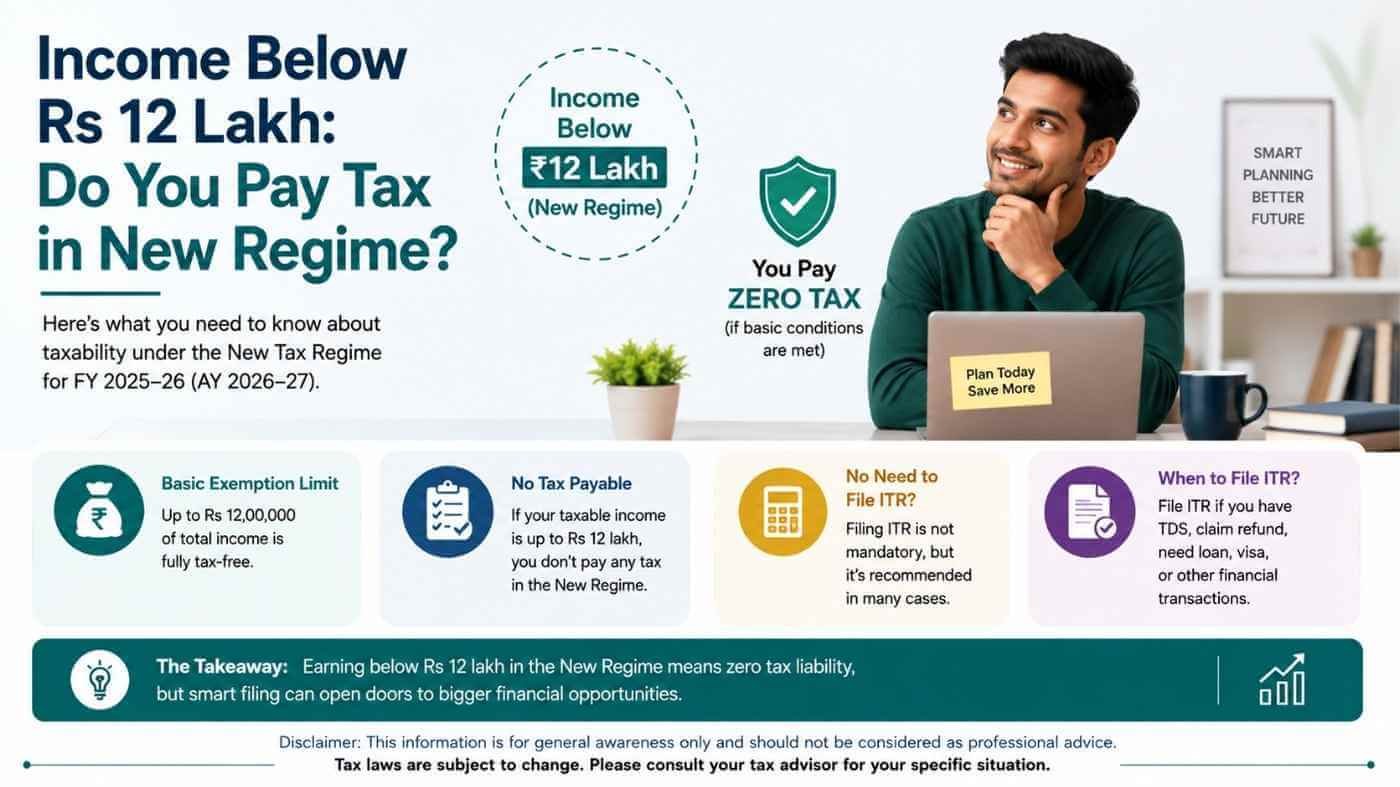
If you earn up to Rs. 12 lakh of taxable income in FY 2025-26, you may have heard the good news: you could pay zero tax under the new regime. But many people are still confused about exactly how this works, who qualifies, and whether income below Rs. 12 lakh is always completely tax-free. This guide clears all of that up in plain, simple language.
The Union Budget 2025 brought major relief for middle-class taxpayers in India. The government increased the Section 87A rebate under the new tax regime, making tax effectively zero for eligible individuals with taxable income up to Rs. 12 lakh. For salaried employees, the Rs. 75,000 standard deduction means gross salary of up to Rs. 12.75 lakh can potentially result in zero tax, subject to the applicable conditions.
In this post, we walk through how the new regime works, who can pay zero tax, who may still owe tax despite earning below Rs. 12 lakh, and what smart financial moves you can make alongside your tax planning.
What Changed in Budget 2025 for Taxpayers?
The Finance Minister announced in Budget 2025 that individuals with taxable income up to Rs. 12 lakh can effectively pay no income tax under the new tax regime, subject to the applicable conditions. This was achieved by significantly enhancing the rebate available under Section 87A.
Previously, the Section 87A rebate was capped at Rs. 25,000 and applied to taxable incomes up to Rs. 7 lakh. From FY 2025-26, the rebate was increased to up to Rs. 60,000 for eligible taxpayers with taxable income up to Rs. 12 lakh, effectively eliminating the tax liability calculated under the normal slab rates.
For salaried individuals, the effective limit can be even higher. With a Rs. 75,000 standard deduction under the new regime, a salaried employee with gross salary of up to Rs. 12.75 lakh can potentially have zero tax liability, assuming the income otherwise qualifies for the rebate.
How the Standard Deduction Helps Salaried Employees
Salaried individuals get a flat Rs. 75,000 standard deduction from salary income before taxable income is determined. This means that if your gross salary is Rs. 12.75 lakh and you have no other taxable income or special-rate income affecting the calculation, your taxable income can come down to Rs. 12 lakh, potentially qualifying for the full Section 87A rebate.
This is an automatic deduction. You do not need to submit bills or proofs to claim it.
How the Section 87A Rebate Works on Income Below 12 Lakh
Section 87A is a rebate, not a deduction. Understanding this difference is important.
- A deduction reduces your taxable income before tax is calculated.
- A rebate reduces your tax liability after tax is calculated.
Here is how it works in practice. Under the new tax regime, the slabs for FY 2025-26 are as follows:
| Income Slab (Rs.) | Tax Rate |
|---|---|
| Up to 4,00,000 | Nil |
| 4,00,001 to 8,00,000 | 5% |
| 8,00,001 to 12,00,000 | 10% |
| 12,00,001 to 16,00,000 | 15% |
| 16,00,001 to 20,00,000 | 20% |
| 20,00,001 to 24,00,000 | 25% |
| Above 24,00,000 | 30% |
For someone with Rs. 12 lakh of taxable income from normal slab-rate sources, the tax calculated under these slabs is Rs. 80,000. The enhanced Section 87A rebate of up to Rs. 60,000, together with the applicable marginal relief provisions, can reduce the tax liability to zero for eligible taxpayers with taxable income up to Rs. 12 lakh.
Therefore, eligible taxpayers with taxable income up to Rs. 12 lakh can generally have zero tax under the new regime, provided their income does not include amounts that are taxed at special rates and are excluded from the Section 87A rebate.
Who Still Pays Tax Even If Income Is Below 12 Lakh?
This is the part most people overlook. The enhanced Section 87A rebate under the new regime can eliminate tax on eligible income up to Rs. 12 lakh, but certain special-rate incomes are not eligible for the rebate.
Special Rate Incomes Can Still Result in Tax
If your total income includes certain types of income taxed at special rates, the Section 87A rebate does not reduce the tax payable on that portion. Examples include:
- Short-term capital gains (STCG) on specified equity shares and equity-oriented mutual funds, generally taxed at 20% for transfers on or after July 23, 2024.
- Long-term capital gains (LTCG) on specified equity investments above the applicable Rs. 1.25 lakh exemption threshold, generally taxed at 12.5%.
- Lottery winnings, certain game-show prizes, and similar specified income, generally taxed at a special rate of 30%.
For example, suppose your salary income is Rs. 9 lakh, and you also earn Rs. 3 lakh in STCG on specified equity investments. Your total income is Rs. 12 lakh, but the Section 87A rebate cannot be used to eliminate the tax on the special-rate STCG. You would therefore have tax on that capital gain, along with any applicable tax on your other income, subject to the detailed computation rules.
This is an important point for investors who assume that total income below Rs. 12 lakh automatically means zero tax.
What About Marginal Relief?
If your eligible taxable income slightly exceeds Rs. 12 lakh, marginal relief can reduce the additional tax burden. Broadly, the additional tax payable is restricted so that the tax does not exceed the amount by which eligible income exceeds Rs. 12 lakh, subject to the applicable conditions.
For example, if eligible taxable income is Rs. 12.10 lakh, marginal relief can prevent the tax liability from jumping disproportionately simply because the Rs. 12 lakh threshold has been crossed.in tax.
New Regime vs Old Regime: Which Works Better Below Rs 12 Lakh?
The old tax regime allows several deductions and exemptions, including Section 80C up to Rs. 1.5 lakh, HRA, LTA, Section 80D for health insurance, home loan interest, and more. The new regime removes most of these benefits but offers lower slab rates, a higher standard deduction, and an enhanced Section 87A rebate.
| Feature | New Regime | Old Regime |
|---|---|---|
| Section 80C Deduction | Not available | Up to Rs. 1.5 lakh |
| HRA Exemption | Not available | Available |
| Standard Deduction | Rs. 75,000 | Rs. 50,000 |
| Section 87A Rebate | Up to Rs. 60,000 for eligible taxable income up to Rs. 12 lakh | Up to Rs. 12,500 for eligible taxable income up to Rs. 5 lakh |
| Default Regime | Yes | Must opt in |
| Tax at Rs. 12 lakh taxable income | Generally zero for eligible normal-rate income | Depends on deductions claimed |
For many people with taxable income up to Rs. 12 lakh and without substantial deductions, the new regime is likely to be attractive in FY 2025-26. For eligible taxpayers, the Section 87A rebate can effectively eliminate tax on normal slab-rate income up to Rs. 12 lakh.
However, if you pay significant rent, have eligible home loan interest, or can claim substantial deductions under the old regime, it is still worth comparing both regimes before making a decision.k with a financial advisor before deciding.
Practical Indian Example: Rahul’s Tax Calculation
Let us take a simple example to make this concrete.
Rahul is a software professional in Pune. His gross annual salary is Rs. 12.75 lakh. He has no other income source, no capital gains, and no rental income.
- Gross salary: Rs. 12,75,000
- Less standard deduction: Rs. 75,000
- Net taxable income: Rs. 12,00,000
- Tax as per new regime slabs: Rs. 80,000
- Section 87A rebate and applicable marginal relief: Rs. 80,000
- Final tax payable: Zero
Now consider Amit, a freelance graphic designer in Mumbai. His professional income is Rs. 10 lakh, and he earned Rs. 2.5 lakh in short-term capital gains from selling equity mutual funds. His total income is Rs. 12.5 lakh.
- Professional income: Rs. 10,00,000
- STCG on specified equity funds: Rs. 2,50,000
- STCG tax at 20%: Rs. 50,000
- Health and education cess at 4%: Rs. 2,000
- Tax on STCG including cess: Rs. 52,000, before considering the detailed tax computation and any other applicable provisions
The Section 87A rebate cannot be used to eliminate the tax on the special-rate capital gains. Amit’s situation highlights why understanding capital gains taxation is just as important as knowing about income tax slabs.
Smart Financial Steps to Take Alongside Tax Planning
Paying zero tax is great. But what you do with the money you save matters just as much. Tax planning and investment planning should work together.
Start a SIP in Mutual Funds
If you are eligible for zero tax under the new regime and have additional cash flow available, consider redirecting some of that surplus into a Systematic Investment Plan, or SIP. Even a monthly SIP of Rs. 3,000 to Rs. 5,000, invested consistently over 10 to 15 years, can potentially create meaningful long-term wealth, depending on market performance.
The power of compounding rewards discipline. Starting early matters far more than starting with a large amount.
Build an Emergency Fund First
Before investing, ensure you have around 3 to 6 months of essential living expenses set aside in an accessible and suitable savings or low-risk instrument. This helps protect your long-term investments from forced withdrawals during emergencies.
Consider Health Insurance
Even under the new regime, adequate health insurance remains an important part of financial planning. A medical emergency can wipe out years of savings. Premium payments may also qualify for a deduction under Section 80D if you opt for the old regime and meet the applicable conditions.
Review Your Investment Portfolio Annually
As your income grows, your financial goals, investment horizon, and risk tolerance can change. A portfolio that works at Rs. 8 lakh income may not be ideal at Rs. 15 lakh. Periodic reviews help keep your investments aligned with your changing circumstances.
Common Mistakes to Avoid When Filing Tax Below Rs 12 Lakh
Even when your tax liability is zero, filing errors can cause problems. Here are some serious mistakes to avoid:
- Not filing a return when required: Even if your final tax liability is zero, you may still be required to file an ITR based on your income and other applicable conditions. A filed ITR can also be useful when applying for loans, visas, or maintaining your financial records.
- Ignoring capital gains income: Many investors forget to report mutual fund or share transactions. Capital gains generally need to be reported even when the overall tax liability is reduced or eliminated.
- Not reviewing your regime choice: Salaried employees can communicate their preferred regime to their employer for TDS purposes. However, the final tax regime can be selected while filing the ITR, subject to the rules applicable to the taxpayer.
- Missing the ITR filing deadline: For taxpayers whose return due date is July 31, missing the applicable deadline can result in a late filing fee and may affect the ability to carry forward certain losses, subject to the applicable rules.
- Assuming the rebate applies to all income types: Special-rate income, such as specified STCG and LTCG, is subject to separate tax treatment and may not qualify for the Section 87A rebate.
Final Words: Zero Tax Is Possible, but Plan Smart
For eligible salaried individuals and many self-employed professionals with taxable income up to Rs. 12 lakh, the new tax regime in FY 2025-26 can offer a genuine zero-tax outcome. The combination of revised slabs, the enhanced Section 87A rebate, and the standard deduction for salaried employees makes this possible without requiring additional tax-saving investments.
However, as we have seen, certain special-rate incomes, such as specified capital gains and lottery winnings, are treated differently and may not qualify for the Section 87A rebate. Understanding these exceptions is essential before assuming your entire tax bill will be zero.
Most importantly, use the tax savings wisely. Lower tax means more money available for your goals, whether that means building an emergency fund, starting a SIP, or planning for retirement. The right investments, chosen according to your goals, investment horizon, and risk profile, can help put this additional surplus to work.
Frequently Asked Questions
1. Is it compulsory to file an ITR if my income is below Rs. 12 lakh and I owe zero tax?
Not necessarily. An individual may still be required to file an ITR based on the applicable filing conditions, even when the final tax liability is zero. Filing an ITR can also be useful as income proof for loans, visa applications, and financial records. It is particularly important to file if you want to carry forward eligible capital losses.
2. Does the Rs. 12 lakh tax-free limit apply to everyone, including the self-employed?
The enhanced Section 87A rebate under the new regime is available to eligible resident individuals, including salaried taxpayers and individuals with business or professional income, subject to the applicable conditions. However, certain income taxed at special rates, such as specified capital gains, does not qualify for the rebate. Therefore, Rs. 12 lakh should not be treated as a blanket tax-free limit for every type of income.
3. What happens if my income is Rs. 12.5 lakh? Do I pay full tax or only on the excess?
You do not simply pay tax only on the Rs. 50,000 excess. Once taxable income exceeds Rs. 12 lakh, the Section 87A rebate is no longer available in the normal manner. However, marginal relief can apply where the income exceeds Rs. 12 lakh by a relatively small amount. This prevents the additional tax from being disproportionately higher than the amount by which your income exceeds the threshold, subject to the applicable conditions.
4. Can I switch from the new regime to the old regime every year?
Salaried individuals and other taxpayers without business or professional income can generally choose between the regimes each year, subject to the applicable rules. However, taxpayers with business or professional income face restrictions on changing regimes and cannot switch as freely. They should check the Form 10-IEA requirements and their eligibility before changing regimes.
5. I earned Rs. 9 lakh in salary and Rs. 2 lakh in long-term capital gains from equity mutual funds. Do I pay any tax?
The answer depends on the detailed computation. The Rs. 9 lakh salary, after the applicable standard deduction, may qualify for the Section 87A rebate. However, specified equity LTCG is taxed separately, and the Rs. 1.25 lakh annual exemption applies before the remaining LTCG is taxed at 12.5%. Therefore, the remaining Rs. 75,000 would generally result in Rs. 9,375 of LTCG tax, plus applicable cess, subject to the applicable rules and computation.
Disclaimer
The information provided in this blog is for educational and informational purposes only and should not be construed as investment advice. Please consult a qualified financial advisor before making any investment decisions. Shashikant Chanderkumar Mudaliar (ARN: 319377), operating under the brand name VSJ FinMart, is an AMFI-registered Mutual Fund Distributor (MFD) and does not provide investment advisory services. Mutual fund investments are subject to market risks. Past performance is not indicative of future results. Please read all scheme-related documents carefully before investing. Registration details can be verified at www.amfiindia.com/locate-distributor.