

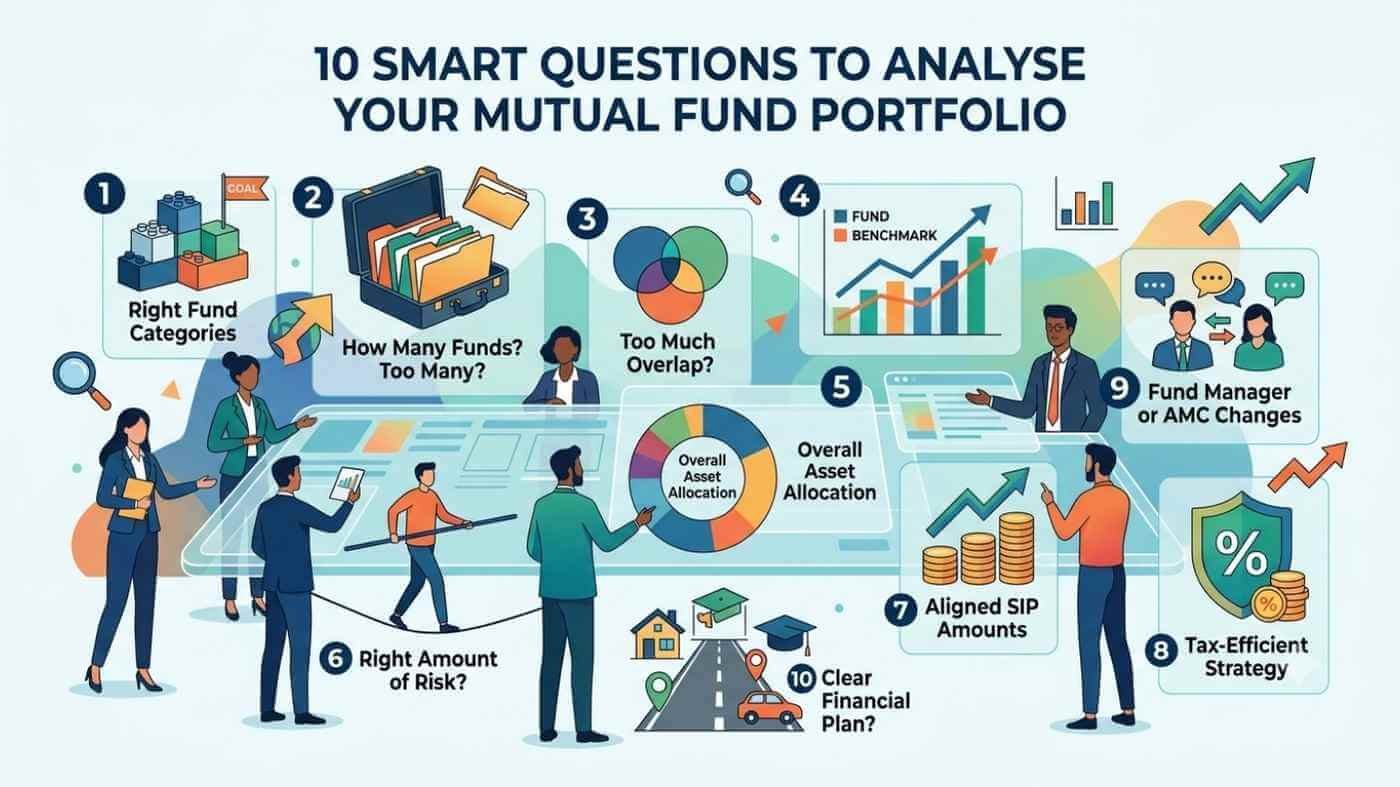
Most investors spend more time picking a mutual fund than they ever spend reviewing it afterwards. But knowing how to analyse your mutual fund portfolio regularly is what separates investors who build real wealth from those who simply hold funds and hope for the best. Whether you have been investing for six months or six years, these ten objective questions will give you a clear, honest picture of where your portfolio stands today.
You do not need a finance degree to do this. You need the right questions and the discipline to answer them honestly. Let us get started.
Why You Need to Analyse Your Mutual Fund Portfolio Regularly
A mutual fund portfolio is not a fixed deposit. Markets move, fund managers change, your income grows, and your goals evolve. A fund that served you well three years ago may no longer suit your needs today. Regular portfolio reviews help you stay aligned with your goals, manage risk, and avoid common traps like holding too many underperforming funds out of habit.
In addition, reviewing your portfolio gives you confidence. When you understand what you own and why, you make calmer, better decisions, especially during market downturns.
Most financial experts recommend a thorough portfolio review at least once every six months, with a lighter check-in every quarter.
Question 1: Am I Invested in the Right Fund Categories for My Goals?
Every mutual fund belongs to a category: large-cap, mid-cap, small-cap, hybrid, debt, ELSS, and so on. Each category serves a different purpose and carries a different level of risk. The first question to ask is whether the categories you hold actually match what you are trying to achieve.
For example, if you are saving for a goal that is three years away, holding a high percentage in small-cap funds may expose you to more risk than necessary. Conversely, if your goal is fifteen years away, sitting mostly in debt funds may slow your growth considerably.
A Simple Framework by Goal Type
- Short-term goals (under 3 years): Debt funds, liquid funds, ultra-short duration funds
- Medium-term goals (3 to 7 years): Hybrid funds, balanced advantage funds
- Long-term goals (over 7 years): Equity funds across large-cap, mid-cap, and small-cap categories
If your fund mix does not reflect this kind of alignment, it is time to review and rebalance.
Question 2: How Many Funds Do I Actually Hold, and Is That Too Many?
This is one of the most common issues in Indian retail portfolios. Many investors accumulate funds over the years, adding one during a bull market, another on a friend’s recommendation, and a few more just because they seemed popular. The result is a cluttered portfolio with twenty or more funds that largely overlap with each other.
Holding too many funds does not reduce risk. It dilutes your returns without giving you the diversification you think you have. In most cases, a well-chosen portfolio of five to eight funds across different categories is more than adequate for most individual investors.
Signs Your Portfolio Is Overcrowded
- You have three or more large-cap funds from different AMCs but with very similar holdings
- You struggle to remember why you added a particular fund
- Your overall portfolio return looks identical to a single index fund
- You cannot describe what role each fund plays in your portfolio
If any of these sound familiar, consolidation may be overdue.
Question 3: Is There Too Much Overlap Between My Funds?
Two funds from different fund houses can hold many of the same stocks. If your large-cap fund and your flexi-cap fund both hold HDFC Bank, Reliance, and Infosys as their top positions, you are not as diversified as you think. You are simply paying two expense ratios for what is essentially one portfolio.
Portfolio overlap analysis tools are available on platforms. These tools show you the percentage of common holdings between any two funds you own.
A healthy portfolio keeps overlap below 40% between any two equity funds. If your overlap is consistently above 60%, consider whether both funds are truly necessary.
Question 4: How Has Each Fund Performed Against Its Benchmark?
Returns alone do not tell the full story. A fund that returned 12% last year sounds impressive, until you learn that its benchmark index returned 15% in the same period. That fund has underperformed by 3 percentage points, and you have effectively paid an expense ratio for below-index results.
When you analyse your mutual fund portfolio, always compare each fund’s returns against its stated benchmark, not just against fixed deposit rates or general market returns.
What to Look For
| Comparison Period | Acceptable Fund Performance | Concern Signal |
|---|---|---|
| 1 Year | Within 1–2% of benchmark | Underperforms by more than 3% |
| 3 Years | Beats benchmark consistently | Lags benchmark in 2 of 3 years |
| 5 Years | Beats benchmark and category average | Below category average for 3+ years |
However, one bad year is not enough reason to exit a fund. Look at the pattern across multiple time periods before drawing any conclusions.
Question 5: What Is My Overall Asset Allocation Right Now?
Asset allocation refers to the split of your total investment between equity, debt, and other asset classes. Over time, market movements shift this balance naturally. If your equity funds have grown strongly over the past two years, your portfolio may now be far more equity-heavy than you originally intended.
For example, suppose you started with a 70% equity and 30% debt allocation. After a strong equity rally, your portfolio may now be 85% equity and 15% debt without you adding a single rupee. This increases your risk exposure considerably, especially if a market correction is around the corner.
Rebalancing, ideally once a year, brings your portfolio back to your target allocation. This disciplined process also naturally enforces a buy-low, sell-high habit.
Question 6: Am I Taking the Right Amount of Risk for My Age and Stage?
Risk tolerance is not static. A 25-year-old with no dependents and a stable job can comfortably ride out market volatility. A 52-year-old planning to retire in five years cannot afford the same risk. As your life situation changes, your portfolio should change with it.
A common starting point is the 100-minus-age rule: subtract your age from 100 to get a rough equity allocation percentage. So a 35-year-old might hold 65% in equity and 35% in debt. This is a broad guideline, not a rigid formula, but it gives you a useful benchmark to compare against your current allocation.
Life Events That Should Trigger a Portfolio Review
- Marriage
- Birth of a child
- A significant salary increase or job change
- Purchase of a home or a major loan
- Approaching retirement within ten years
Each of these events changes your financial picture and likely calls for adjustments to your fund mix and risk level.
Question 7: Are My SIP Amounts Still Aligned With My Goals?
Many investors start a SIP of Rs. 2,000 or Rs. 5,000 per month and never revise it, even as their income grows steadily over the years. This is a missed opportunity. If your salary has grown by 20% over three years but your SIP amount has not changed, you are essentially investing a smaller and smaller fraction of your income over time.
Most financial planners recommend increasing your SIP amount by at least 10% every year, a practice sometimes called a Step-Up SIP. This small annual increase, compounded over fifteen or twenty years, makes a remarkable difference to your final corpus.
As a practical example, consider Priya, a Mumbai-based software engineer who started a SIP of Rs. 10,000 per month at age 28. If she keeps this flat until age 48, she invests Rs. 24 lakhs in total. However, if she increases her SIP by 10% each year, she invests around Rs. 68 lakhs over the same period, giving her compounding a much larger base to work with.
Question 8: Do I Have a Tax-Efficient Strategy in Place?
Tax efficiency is an often-overlooked dimension when investors analyse their mutual fund portfolio. Two common areas deserve attention.
Long-Term Capital Gains (LTCG) vs Short-Term Capital Gains (STCG)
| Fund Type | Holding Period for LTCG | LTCG Tax Rate | STCG Tax Rate |
|---|---|---|---|
| Equity Funds | Over 1 year | 12.5% (above Rs. 1.25 lakh gain) | 20% |
| Debt Funds | Over 2 years (pre-April 2023) | As per income tax slab | As per income tax slab |
| ELSS Funds | 3-year lock-in | 12.5% (above Rs. 1.25 lakh gain) | Not applicable (lock-in) |
Redeeming equity funds before completing one year means you pay 20% STCG tax. Holding for more than one year brings this down to 12.5% on gains above Rs. 1.25 lakh. Planning your redemptions around these thresholds can save meaningful amounts over time.
In addition, ELSS funds provide a deduction of up to Rs. 1.5 lakh under Section 80C, making them a useful tool for tax planning alongside long-term wealth creation.
Question 9: Has Anything Changed With My Fund Manager or AMC?
In actively managed funds, the fund manager plays a central role in performance. When a strong, experienced fund manager leaves a fund, it can meaningfully affect the fund’s investment style and future returns. Similarly, if an AMC faces regulatory issues or significant redemption pressure, it may impact the fund’s day-to-day operations.
You do not need to panic every time a fund manager changes. However, you should note the change and monitor the fund’s performance and portfolio composition closely over the next two to three quarters. If the new manager alters the investment approach significantly, it may be worth reconsidering whether the fund still fits your strategy.
Question 10: Does My Portfolio Actually Reflect a Clear Financial Plan?
This is perhaps the most important question of all. Every fund in your portfolio should have a reason to be there. It should be linked to a specific goal, a specific time horizon, and a specific level of risk that you have consciously chosen.
If you cannot articulate why a particular fund is in your portfolio, that is a red flag. Investing without a plan is a little like driving without a destination: you keep moving, but you have no idea if you are getting closer to where you want to go.
A clear financial plan maps each fund to a goal. For example, your ELSS fund saves tax and builds wealth for retirement. Your large-cap fund covers your child’s higher education in fifteen years. Your liquid fund holds your emergency corpus. When every fund has a job, your portfolio has direction.
If your mutual fund portfolio lacks this structure, a conversation with a VSJ FinMart advisor can help you build one that fits your life, your goals, and your comfort with risk.
How to Use These 10 Questions Effectively
Do not treat this as a one-time checklist. Print it out or save it, and revisit it every six months. Use it alongside your portfolio statement from your fund platform or registrar. Answer each question honestly, and note where your portfolio falls short.
The goal is not to make dramatic changes every review cycle. Most of the time, you will find that one or two adjustments are all that is needed. Consistent, small course corrections over a long period beat reactive, emotional decisions every single time.
Quick Summary: 10 Questions to Ask at Every Portfolio Review
- Are my funds aligned with my financial goals?
- Do I hold too many funds?
- Is there significant overlap between my equity funds?
- Has each fund beaten its benchmark over 3 and 5 years?
- What is my current equity-to-debt ratio, and is it intentional?
- Is my risk level appropriate for my age and life stage?
- Have I increased my SIP amounts in line with income growth?
- Am I managing capital gains tax efficiently?
- Have there been any key changes at the fund or AMC level?
- Does every fund in my portfolio serve a clear purpose?
Final Words
Learning how to analyse your mutual fund portfolio is one of the most practical skills any investor can develop. It costs nothing but time and honesty. These ten questions strip away the noise and focus your attention on what truly matters: alignment with your goals, appropriate risk, tax efficiency, and a clean, purposeful portfolio structure.
Most importantly, remember that portfolio analysis is not about chasing performance. It is about staying on track. Markets go up and down. Your goals and timeline, however, remain your anchor.
If you find these questions revealing gaps or raising doubts you are not sure how to address, our team at VSJ FinMart is here to help. We work with you to build and maintain a personalised mutual fund investment plan that reflects your unique goals, not a generic template. Reach out to us, and let us review your portfolio together.
Frequently Asked Questions
How often should I analyse my mutual fund portfolio?
A full review every six months is a good habit. You can do a lighter check-in every quarter. Avoid reviewing your portfolio too frequently, such as weekly or daily, as this can lead to emotional, short-sighted decisions.
How many mutual funds should I hold in my portfolio?
For most individual investors, five to eight well-chosen funds across different categories is sufficient. Holding more than ten funds rarely improves diversification and often creates unnecessary complexity and overlap.
What does it mean if my fund is underperforming its benchmark?
If a fund consistently underperforms its benchmark over three to five years, it may not be the right fit for your portfolio. However, one bad year is not cause for alarm. Look at the pattern across multiple periods and compare the fund against its category average before making a decision.
Should I exit a fund if the fund manager has changed?
Not necessarily. Monitor the fund’s portfolio and investment style over the next two to three quarters after a manager change. If the new manager maintains a similar approach and the fund continues to perform in line with expectations, there may be no reason to exit.
Can I analyse my portfolio on my own, or do I need a financial advisor?
You can certainly use these ten questions to conduct your own review. However, a qualified advisor adds significant value by spotting issues you may miss, such as hidden overlaps, tax inefficiencies, and misalignment with your long-term goals. Personalised guidance often makes a bigger difference than most investors realise.
Disclaimer
The information provided in this blog is for educational and informational purposes only and should not be construed as investment advice. Please consult a qualified financial advisor before making any investment decisions. Shashikant Chanderkumar Mudaliar (ARN: 319377), operating under the brand name VSJ FinMart, is an AMFI-registered Mutual Fund Distributor (MFD) and does not provide investment advisory services. Mutual fund investments are subject to market risks. Past performance is not indicative of future results. Please read all scheme-related documents carefully before investing. Registration details can be verified at www.amfiindia.com/locate-distributor.