

Every investor wants their money to grow fast. But when you choose an aggressive portfolio, you are making a promise to yourself: you will stay invested long enough to let the strategy do its job. Aggressive portfolio long-term performance is not a myth. It is a mathematical reality, backed by decades of market data. However, many investors exit too early, panic during corrections, and miss the very returns they signed up for. This blog explains why aggressive portfolios need time, how they work, and what you must do to stay the course.
What Is an Aggressive Portfolio?
An aggressive portfolio is a collection of investments that tilts heavily toward high-growth, high-risk assets. In the Indian mutual fund context, this usually means a large allocation to equity, often 80% or more, spread across small-cap, mid-cap, flexi-cap, and thematic funds.
The goal is simple: generate returns that beat inflation and fixed-income instruments by a wide margin over time. However, this comes with significant short-term volatility. Prices can swing sharply in either direction, sometimes within the same week.
Typical Asset Allocation in an Aggressive Portfolio
| Asset Class | Allocation Range | Risk Level | Return Potential |
|---|---|---|---|
| Small-Cap Equity Funds | 20–30% | Very High | Very High |
| Mid-Cap Equity Funds | 20–25% | High | High |
| Flexi-Cap / Large & Mid-Cap Funds | 20–25% | Moderate-High | High |
| Sectoral / Thematic Funds | 10–15% | Very High | Very High |
| Debt / Liquid Funds | 5–10% | Low | Moderate |
In other words, an aggressive portfolio puts most of your money to work in parts of the market that grow fast but can also fall hard. This is exactly why time becomes the most important ingredient.
Why Aggressive Portfolio Long-Term Performance Requires Patience
The Indian equity market does not move in a straight line. It rises steeply, pulls back sharply, consolidates sideways, and then surges again. Small-cap and mid-cap stocks, which form the backbone of most aggressive portfolios, show this behaviour more dramatically than large-cap stocks.
Consider a simple historical pattern. Between 2018 and 2020, the Nifty Smallcap 100 index fell roughly 50% from its peak. Many investors who had entered in 2017 saw their portfolio value halve. Those who exited locked in heavy losses. Those who stayed and continued their SIPs saw the same index deliver extraordinary returns from 2020 to 2024.
This pattern repeats itself across market cycles. The lesson is not that aggressive portfolios are dangerous. The lesson is that they are dangerous only for investors who do not give them enough time.
The Compounding Effect Over 10 Years
Compounding is the engine that powers aggressive portfolio long-term performance. When your returns generate their own returns, your wealth does not grow in a straight line. It grows in a curve that bends sharply upward the longer you stay invested.
For example, a monthly SIP of Rs 10,000 in an equity fund earning 14% per annum would grow as follows:
| Investment Period | Total Amount Invested | Estimated Value at 14% p.a. | Wealth Gained |
|---|---|---|---|
| 5 Years | Rs 6,00,000 | Rs 8,88,236 | Rs 2,88,236 |
| 10 Years | Rs 12,00,000 | Rs 24,24,942 | Rs 12,24,942 |
| 15 Years | Rs 18,00,000 | Rs 53,58,067 | Rs 35,58,067 |
| 20 Years | Rs 24,00,000 | Rs 1,08,88,710 | Rs 84,88,710 |
Notice how the wealth gained nearly doubles between the 10-year and 15-year mark, and nearly triples between 15 and 20 years. This is compounding at work. Aggressive portfolios, given time, unlock this curve far more powerfully than conservative or balanced portfolios.
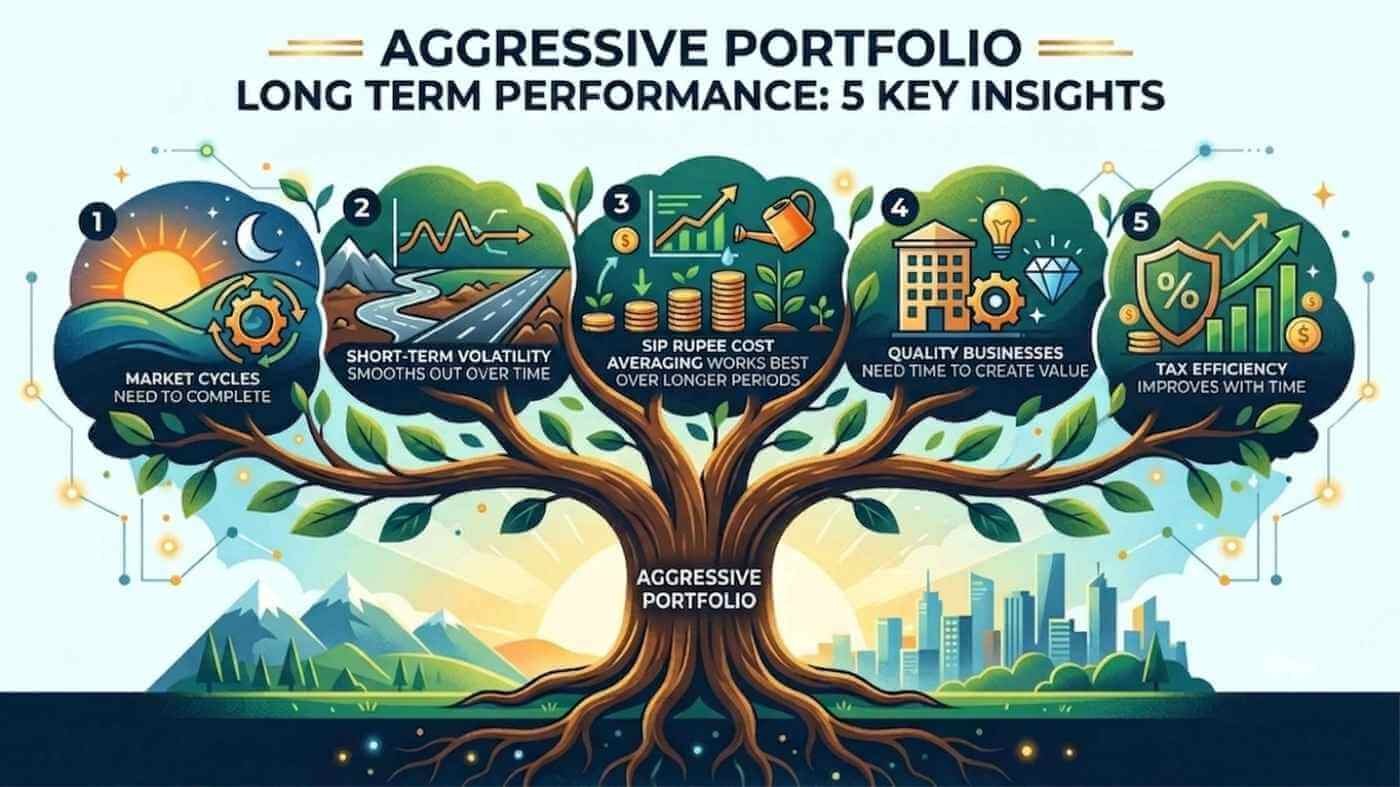
5 Key Reasons Aggressive Portfolios Need Time to Perform
1. Market Cycles Need to Complete
Every equity market goes through cycles: bull runs, corrections, bear markets, and recoveries. A full cycle can span anywhere from 5 to 10 years. If you exit during the correction or bear phase, you realise losses and miss the recovery entirely.
Aggressive portfolios, especially those heavy in small and mid-cap funds, experience deeper cuts during downturns. However, they also recover faster and higher when the market turns. Staying invested through an entire cycle is what turns volatility into wealth.
2. Short-Term Volatility Smooths Out Over Time
Volatility is not the enemy. It is simply the price of entry into high-growth assets. In the short term, an aggressive portfolio can show returns anywhere from -40% to +60% in a single year. However, when you zoom out to a 10-year or 15-year horizon, the annualised returns of well-chosen equity funds in India have historically settled in the range of 12% to 18% per annum.
Therefore, the longer you stay invested, the more short-term noise cancels out, leaving behind the underlying growth trajectory of businesses and the economy.
3. SIP Rupee Cost Averaging Works Best Over Longer Periods
When you invest through a SIP in an aggressive portfolio, you buy more units when prices fall and fewer units when prices rise. This is called rupee cost averaging. It is one of the most effective tools available to a retail investor.
However, rupee cost averaging needs time to work. Over two or three years, the averaging effect is limited. Over seven to ten years, it can significantly reduce your average cost of acquisition and boost your overall return. This is why aggressive SIP portfolios reward patient investors disproportionately.
4. Quality Businesses Need Time to Create Value
Mutual funds in an aggressive portfolio invest in companies, particularly smaller and emerging companies, that are building their businesses, expanding markets, and growing revenues. This process does not happen overnight.
A small-cap company that a fund manager identifies today may take three to five years to scale up, show consistent profitability, and attract wider market attention. When it does, the stock price reflects that growth and your fund NAV rises sharply. Exiting before that inflection point means walking away from the very opportunity you invested for.
5. Tax Efficiency Improves With Time
From a tax perspective, holding equity mutual funds for more than one year qualifies your gains as Long-Term Capital Gains (LTCG). Under current tax rules, LTCG on equity mutual funds above Rs 1.25 lakh per financial year is taxed at 12.5% without the benefit of indexation.
In contrast, selling within one year triggers Short-Term Capital Gains (STCG) taxed at 20%. Therefore, staying invested longer not only improves your returns but also reduces your tax outgo, making aggressive portfolio long-term performance even more compelling on an after-tax basis.
| Holding Period | Type of Gain | Tax Rate | Exemption Limit |
|---|---|---|---|
| Less than 1 year | Short-Term Capital Gain (STCG) | 20% | None |
| More than 1 year | Long-Term Capital Gain (LTCG) | 12.5% | Rs 1.25 lakh per year |
Common Mistakes That Kill Aggressive Portfolio Performance
Understanding why aggressive portfolios need time is one part of the equation. Knowing what to avoid is equally important. Most investors sabotage their own returns through a handful of predictable mistakes.
Panic Selling During Market Corrections
When a portfolio drops 20% or 30%, the emotional urge to exit is overwhelming. However, this is precisely the worst time to sell. Corrections in an aggressive portfolio are temporary. Locking in losses by exiting is permanent.
The most successful long-term investors do the opposite. They view corrections as an opportunity to invest more, bringing down their average cost and setting up stronger future returns.
Chasing Recent Returns
A common mistake is switching into whichever fund category has performed best in the last one or two years. By the time you read about last year’s best-performing sector fund, the cycle has often already peaked. Chasing performance leads to buying high and selling low, which is the exact opposite of wealth creation.
Checking the Portfolio Every Day
Frequent monitoring creates anxiety and tempts you to react to every market move. Aggressive portfolios are designed for long horizons. Reviewing them quarterly or semi-annually is enough. Daily monitoring is not an investment strategy. It is a recipe for poor decisions.
Underestimating Risk Appetite
Many investors build aggressive portfolios without honestly assessing their ability to tolerate a 30% to 40% drawdown. When that drawdown arrives, they exit in panic. Before building any aggressive portfolio, it is critical to match your actual risk tolerance, not just your return expectations, to the portfolio you choose.
This is where working with an experienced advisor adds real value. At VSJ FinMart, we sit with each investor to understand their goals, income stability, and emotional comfort with volatility before recommending any portfolio structure. The right portfolio is not the one with the highest potential return. It is the one you can actually stay invested in through difficult markets.
How to Build and Sustain an Aggressive Portfolio
Building an aggressive portfolio is not about picking the hottest funds. It is about constructing a disciplined, diversified equity allocation that aligns with your long-term financial goal.
Start with a Clear Goal and Timeline
Every aggressive portfolio should have a specific goal. Retirement in 20 years. Child’s higher education in 15 years. Building a business fund in 12 years. A clear goal and a fixed timeline remove the temptation to exit early, because you know exactly what you are building toward.
Diversify Across Market Caps
A well-structured aggressive portfolio does not put everything into a single fund or category. It spreads exposure across large-cap, mid-cap, small-cap, and flexi-cap funds. This way, when one category goes through a rough patch, others can support the overall portfolio.
Use SIP for Discipline and Consistency
SIP is the most practical tool for executing an aggressive portfolio strategy. It removes timing from the equation. You invest the same amount every month, regardless of market levels. Over time, this discipline compounds into significant wealth.
Review and Rebalance Annually
Once a year, review your portfolio to check whether your asset allocation has drifted from your original plan. If small-cap funds have grown to 50% of your portfolio due to a bull run, it may be time to trim and rebalance. Rebalancing keeps your risk level in check without requiring you to exit the market entirely.
Stay Educated and Informed
Markets change. Fund managers change. Economic cycles shift. Staying informed helps you make rational decisions rather than emotional ones. However, education does not mean acting on every piece of news. It means building a sound framework that you apply consistently over time.
The Right Time to Reduce Aggression
An aggressive portfolio is not meant to last forever. As you approach your financial goal, it makes sense to reduce equity exposure and shift toward more stable assets gradually. This process, often called the glide path, protects your accumulated wealth from a sudden market correction in the final years before your goal.
For example, if you have a 15-year goal, you might maintain an aggressive 85% equity allocation for the first 10 years. In years 11 to 13, you could reduce equity to 60%. By years 14 and 15, bringing equity down to 40% or less protects your corpus while still generating some growth.
This is not a one-size-fits-all approach. Your specific glide path depends on your goal, the size of your corpus, and your income situation at the time. A trusted advisor can help you plan this transition without disrupting your overall investment strategy.
Final Words
Aggressive portfolio long-term performance is not a gamble. It is a well-understood outcome of equity market behaviour, compounding, and disciplined investing. The mathematics are clear: high-risk, high-return assets need time to smooth out volatility and deliver on their potential. The investors who succeed with aggressive portfolios are not the smartest or the luckiest. They are the most patient.
If you are considering building an aggressive portfolio or are already invested in one and feeling uncertain, the most important thing you can do is stay the course. Do not let short-term noise distract you from your long-term goal.
At VSJ FinMart, we help investors build personalised, goal-based mutual fund portfolios that match their risk profile and time horizon. Whether you are just starting or looking to review an existing aggressive portfolio, a conversation with our team can bring clarity, structure, and confidence to your investment journey. Reach out to us today.
Frequently Asked Questions
How long should I stay invested in an aggressive portfolio?
Ideally, you should plan for a minimum of 7 to 10 years. Aggressive portfolios with significant small-cap and mid-cap exposure need time to ride out full market cycles and deliver on their return potential. The longer you stay, the more compounding works in your favour.
What is a good return expectation from an aggressive portfolio in India?
Historically, well-diversified aggressive equity portfolios in India have delivered annualised returns of 12% to 18% over 10-year periods. However, past performance does not guarantee future results. Your actual returns will depend on fund selection, market conditions, and the timing of your investment.
Should I stop my SIP when the market falls sharply?
No. Stopping your SIP during a market fall is one of the most common and costly mistakes investors make. A falling market means you are buying more units at lower prices, which is precisely how rupee cost averaging works in your favour. Continuing your SIP during corrections is what builds wealth over time.
Can I mix aggressive and conservative investments in one portfolio?
Yes. Many investors maintain an aggressive core portfolio for long-term wealth creation while keeping a separate conservative allocation for short-term needs and emergency funds. This approach balances growth potential with liquidity and stability.
How do I know if an aggressive portfolio is right for me?
An aggressive portfolio suits investors who have a long time horizon of at least 7 to 10 years, a stable income source, no immediate need for the invested funds, and a genuine ability to tolerate significant short-term portfolio fluctuations without panic. Assessing these factors honestly, ideally with the help of a financial advisor, is the right starting point.
Disclaimer
The information provided in this blog is for educational and informational purposes only and should not be construed as investment advice. Please consult a qualified financial advisor before making any investment decisions. Shashikant Chanderkumar Mudaliar (ARN: 319377), operating under the brand name VSJ FinMart, is an AMFI-registered Mutual Fund Distributor (MFD) and does not provide investment advisory services. Mutual fund investments are subject to market risks. Past performance is not indicative of future results. Please read all scheme-related documents carefully before investing. Registration details can be verified at www.amfiindia.com/locate-distributor.