

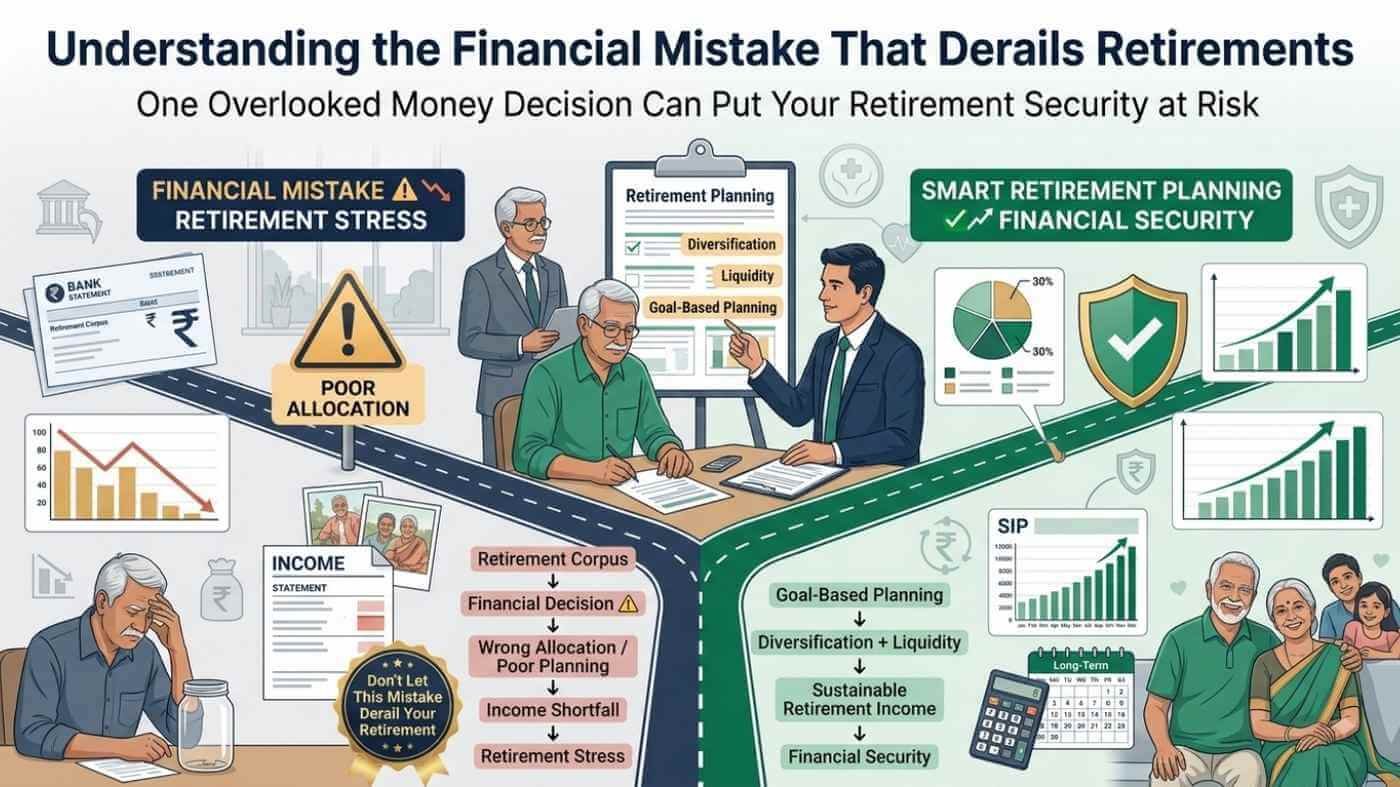
Most people spend decades building a career, raising a family, and managing a home. Yet when it comes to retirement, a single financial mistake or a series of common retirement planning errors can quietly erode years of hard work. These mistakes rarely announce themselves. They creep in through delayed decisions, misplaced assumptions, and a general sense that retirement is still far away. By the time the damage becomes visible, reversing it can be far harder.
This blog breaks down some of the most damaging financial mistakes Indian investors can make while planning for retirement, and more importantly, what you can do about each one. Whether you are 28 or 52, there is always a better path forward.
Why Retirement Planning Goes Wrong for Most Indians
India is changing fast. Joint families are smaller. Government pensions cover fewer people. Life expectancy is rising. A 60-year-old today can reasonably expect to live another 25 to 30 years. That is a long time to sustain a lifestyle without a monthly salary.
Yet most Indians still rely on a mix of EPF, a fixed deposit, and hope. That combination, while familiar, rarely holds up under the weight of medical costs, inflation, and longer lifespans. Understanding where retirement planning breaks down is the first step toward getting it right.
Financial Mistake 1: Starting Too Late and Underestimating the Cost of Delay
This is, by far, the most common retirement planning mistake in India. Many people in their 30s believe they have time. They plan to “get serious” about retirement savings in their 40s. By then, however, the compounding clock has already been ticking for a decade without them.
Consider a practical example. Suppose Aarav starts a monthly SIP of Rs. 5,000 at age 25. Assuming an annual return of 12%, his investment could grow to approximately Rs. 1.76 crore by age 60. Now, imagine his colleague Rohan starts the same Rs. 5,000 monthly SIP at age 35. Despite investing the same amount every month, Rohan would accumulate only around Rs. 52 lakh by age 60.
The difference? Just 10 years in starting the SIP. Yet, that decade could mean a gap of more than Rs. 1.2 crore in the final corpus. This is the power of starting early, and the potential cost of delaying your investments.
The fix is simple: start now, even with a small amount. A SIP of Rs. 2,000 today is worth far more than Rs. 10,000 planned for five years from now.
How Compounding Works in Your Favour
- Returns earned in early years generate their own returns in later years.
- The longer the investment horizon, the steeper the compounding curve.
- Even small, consistent contributions build a large corpus over 25 to 30 years.
Financial Mistake 2: Underestimating Retirement Expenses
A widespread belief is that expenses drop after retirement. In reality, they often shift rather than shrink. Medical costs rise sharply. Travel, leisure, and family events continue. Household help becomes more necessary. And inflation steadily increases the cost of everything you buy.
If your current monthly expenses are Rs. 60,000, and inflation averages 6% annually, your expenses will be approximately Rs. 2.3 lakh per month in 20 years. That means a retirement corpus that seems adequate today may fall far short two decades from now.
Always plan for inflation-adjusted expenses. A common rule of thumb is to assume your retirement corpus should generate at least 70 to 80 percent of your pre-retirement monthly income, adjusted for inflation every year.
Expenses That Catch Retirees Off Guard
- Medical costs, including hospitalisation, medicines, and long-term care.
- Higher utility bills as time at home increases.
- Children’s weddings or other large one-time events.
- Home repairs and maintenance that were previously deferred.
- Inflation on everyday groceries, fuel, and services.
Financial Mistake 3: Relying Too Heavily on a Single Instrument
Many Indian investors put most of their retirement savings into one or two products, typically an EPF and a fixed deposit. Both serve a purpose. However, relying entirely on them creates concentration risk and limits long-term growth.
Fixed deposits offer safety but rarely beat inflation after tax. EPF is valuable, but contribution limits mean the final corpus may not be enough to last 25 to 30 years of retirement. A well-built retirement portfolio needs multiple layers working together.
A diversified approach might look like this:
| Instrument | Role in Portfolio | Typical Return Range | Risk Level |
|---|---|---|---|
| EPF / PPF | Safe, tax-efficient base | 7%–8% per annum | Low |
| ELSS Mutual Funds | Equity growth with tax benefit | 10%–14% per annum (historical) | Moderate to High |
| Debt Mutual Funds | Stability and liquidity | 6%–8% per annum | Low to Moderate |
| NPS (National Pension System) | Structured pension corpus | 8%–10% per annum (historical) | Moderate |
| Equity Mutual Funds (SIP) | Long-term wealth creation | 10%–14% per annum (historical) | Moderate to High |
The right mix depends on your age, income, risk tolerance, and goals. There is no single formula that fits everyone.
Financial Mistake 4: Ignoring Inflation in Retirement Corpus Calculations
This is one of the most dangerous common retirement planning mistakes because it looks invisible on paper. Many people calculate how much they need in today’s money and stop there. However, a rupee in 2045 will not buy what a rupee buys today.
At 6% annual inflation, the purchasing power of Rs. 1 lakh today will fall to roughly Rs. 31,000 in 20 years. In other words, you would need over Rs. 3.2 lakh in 2045 to match today’s Rs. 1 lakh in buying power.
Therefore, your retirement planning must account for two separate inflation impacts. First, inflation between now and retirement, which increases the corpus you need to accumulate. Second, inflation during retirement, which erodes the value of the corpus you have already built.
How to Protect Against Inflation
- Include equity mutual funds in your retirement portfolio. Equities have historically outpaced inflation over long periods.
- Do not park all post-retirement money in fixed deposits. At least a portion should remain in assets that can grow.
- Review your plan every two to three years and adjust your SIP amounts accordingly.
Financial Mistake 5: Not Planning for Healthcare Costs
Healthcare is often the retirement cost that surprises people most. A single hospitalisation in a good private hospital can cost Rs. 3 lakh to Rs. 10 lakh or more. Without adequate health cover, one medical event can wipe out a year’s worth of savings.
Many Indians depend on employer-provided health insurance throughout their working years. After retirement, that cover disappears. Buying a comprehensive health insurance policy at 65 becomes extremely expensive, and pre-existing conditions may limit coverage. The solution is to secure adequate health insurance while you are still young and healthy, and to treat it as a non-negotiable part of retirement planning.
In addition to insurance, a dedicated health emergency fund of Rs. 5 lakh to Rs. 10 lakh, kept in a liquid instrument, provides a buffer for out-of-pocket costs not covered by insurance.
Financial Mistake 6: Withdrawing Retirement Savings Early
This mistake is more common than most people admit. When a financial need arises, whether it is a child’s education, a home renovation, or a family emergency, retirement savings often feel like an accessible pool of money. The logic seems sound: “I will replenish it later.”
However, early withdrawals do not just reduce the corpus. They break the compounding cycle. Every rupee withdrawn early loses not just its value but also all the future returns it would have generated. A withdrawal of Rs. 5 lakh at age 40 from a retirement fund could cost you Rs. 30 to 40 lakh by age 60, depending on your rate of return.
The better approach is to build a separate emergency fund and earmark retirement savings as untouchable. Label the account mentally as a future necessity, not a present resource.
Rules to Protect Your Retirement Corpus
- Maintain an emergency fund of three to six months of expenses in a separate account.
- Use a term loan or education loan rather than dipping into retirement savings.
- Automate your SIP so it runs without requiring a monthly decision.
- Set up a separate goal-based SIP for large one-time goals like a child’s education or a wedding.
Financial Mistake 7: Having No Written Retirement Plan
Many Indians “plan” for retirement in a vague sense. They intend to save more. They think about it occasionally. However, intention is not a plan. A plan has a target corpus, a timeline, a monthly savings rate, specific instruments, and a review schedule.
Without a written plan, most people either save too little, invest in the wrong mix, or make reactive decisions during market downturns. A written retirement plan creates accountability and clarity. It answers three essential questions: how much do I need, when do I need it, and how do I get there?
How to Avoid These Common Retirement Planning Mistakes: Actionable Steps
Knowing the mistakes is only half the work. Taking corrective action is what actually changes your retirement outcome. Here is a practical starting point:
- Calculate your retirement goal: Estimate your post-retirement monthly expenses, adjust for inflation, and calculate the corpus you need using a retirement calculator.
- Start a SIP today: Even Rs. 2,000 per month invested consistently in an equity mutual fund over 25 years can build a meaningful corpus.
- Diversify across instruments: Combine EPF, PPF, NPS, and mutual funds rather than relying on any single product.
- Buy adequate health insurance early: Secure a comprehensive family floater or individual health plan while premiums are still manageable.
- Review your plan every two years: As income grows, increase your SIP amount. Rebalance your asset allocation as you approach retirement.
- Never raid your retirement fund: Build separate goals for education, emergencies, and big purchases.
- Get a written plan in place: Work with someone who understands your personal situation, not a generic online tool.
The Real Value of Personalised Retirement Guidance
Retirement planning is not about picking a popular fund from a trending list. It is about building a strategy that accounts for your age, income level, family responsibilities, risk tolerance, and the specific life you want to live after you stop working.
Choosing the right fund for your retirement goal matters far more than chasing short-term returns or following generic advice. A quick conversation with a VSJ FinMart advisor can help you map out a mutual fund investment plan that is built around your life, not a template.
Final Words
Retirement may feel like a distant destination when you are in the middle of building a career and a family. However, the decisions you make in your 30s and 40s will determine the kind of retirement you have in your 60s. Common retirement planning mistakes like starting late, ignoring inflation, withdrawing savings early, or simply not having a plan at all can cost you far more than you realise.
The good news is that every one of these mistakes is avoidable. You do not need a large income or a finance degree to retire well. You need consistency, the right instruments, and a plan that grows with you.
Frequently Asked Questions
How much corpus do I need to retire comfortably in India?
A general rule is to accumulate a corpus that can generate at least 70 to 80 percent of your pre-retirement monthly income, adjusted for inflation. For most middle-income households, this means a corpus of Rs. 2 crore to Rs. 5 crore, depending on lifestyle, city, and expected retirement age. A personalised calculation is always more accurate than a generic number.
Is EPF enough for retirement?
EPF is a strong foundation, but it is rarely sufficient on its own. Contribution limits, withdrawal rules, and fixed returns mean it may not keep pace with inflation over a 25- to 30-year retirement. It works best as one layer of a diversified retirement plan that also includes equity mutual funds and health insurance.
When is it too late to start retirement planning?
It is never too late to start. However, the later you begin, the more aggressive your savings rate needs to be to close the gap. Someone starting at 45 may need to save three to four times as much per month as someone who started at 30. Starting now, even imperfectly, is always better than not starting at all.
How does inflation affect my retirement savings?
Inflation reduces the purchasing power of your money over time. If your corpus earns 7% per year but inflation runs at 6%, your real return is only about 1%. This is why including equity-oriented investments in your retirement plan matters. They have historically delivered returns that outpace inflation over long periods, helping your money actually grow in real terms.
Should I stop investing in equity mutual funds after retirement?
Not entirely. While it makes sense to reduce equity exposure as you approach and enter retirement, keeping a portion of your portfolio in equity-oriented funds can help combat inflation during a retirement that may last 25 to 30 years. The exact allocation depends on your age, health, income needs, and risk comfort, all of which a personalised plan should address.
Disclaimer
The information provided in this blog is for educational and informational purposes only and should not be construed as investment advice. Please consult a qualified financial advisor before making any investment decisions. Shashikant Chanderkumar Mudaliar (ARN: 319377), operating under the brand name VSJ FinMart, is an AMFI-registered Mutual Fund Distributor (MFD) and does not provide investment advisory services. Mutual fund investments are subject to market risks. Past performance is not indicative of future results. Please read all scheme-related documents carefully before investing. Registration details can be verified at www.amfiindia.com/locate-distributor.