

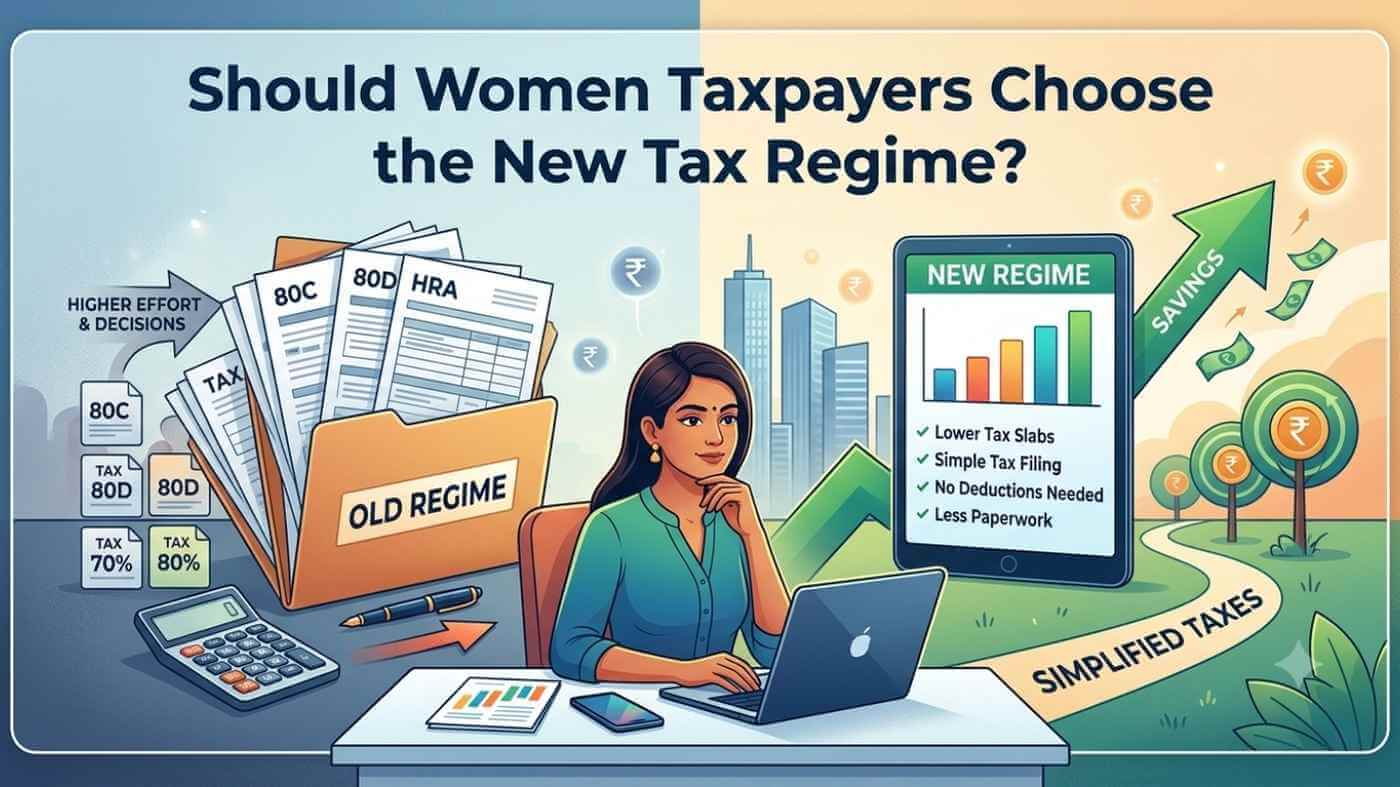
Every year, as the financial year closes and tax season begins, millions of women taxpayers across India face the same question: which tax regime is better for me? The new tax regime for women has gained significant attention since the government introduced lower slab rates with fewer deductions. However, deciding between the old and new regime is not always simple, and making the wrong choice can cost you thousands of rupees in unnecessary taxes.
This guide walks you through everything you need to know, from how both regimes work, to a clear comparison, to practical tips that help you make the right call for your unique financial situation.
Understanding the Two Tax Regimes in India
Before choosing a tax regime, it is important to understand how each one works. India currently offers two income tax systems: the old tax regime and the new tax regime.
The Old Tax Regime
The old tax regime follows the traditional tax structure with higher slab rates but allows taxpayers to claim a wide range of deductions and exemptions. Some of the most commonly used tax benefits include:
- Section 80C deduction of up to Rs. 1.5 lakh (PPF, ELSS, EPF, life insurance premiums, NSC, etc.)
- House Rent Allowance (HRA)
- Leave Travel Allowance (LTA)
- Health insurance deduction under Section 80D
- Home loan interest deduction under Section 24(b) for self-occupied property
- Interest deduction under Section 80E for education loans
- Donations under Section 80G
- Various other eligible deductions and exemptions
For women who actively invest in tax-saving instruments, pay health insurance premiums, or claim HRA or home loan benefits, the old regime can substantially reduce taxable income.
In simple terms, the more eligible deductions and exemptions you claim, the greater the potential tax savings under the old regime.
The New Tax Regime
The new tax regime is now the default tax regime for individual taxpayers. It offers lower tax rates but removes most deductions and exemptions available under the old regime.
For FY 2026-27, the tax slabs under the new regime are:
| Annual Taxable Income | Tax Rate |
|---|---|
| Up to Rs. 4 lakh | Nil |
| Rs. 4 lakh to Rs. 8 lakh | 5% |
| Rs. 8 lakh to Rs. 12 lakh | 10% |
| Rs. 12 lakh to Rs. 16 lakh | 15% |
| Rs. 16 lakh to Rs. 20 lakh | 20% |
| Rs. 20 lakh to Rs. 24 lakh | 25% |
| Above Rs. 24 lakh | 30% |
The new regime also provides:
- Standard deduction of Rs. 75,000 for salaried employees and pensioners.
- Rebate under Section 87A, making income up to the prescribed limit effectively tax-free (subject to the applicable provisions and conditions).
- Employer’s contribution to NPS under Section 80CCD(2), which continues to be available even under the new regime.
- Simpler tax filing with fewer deductions and exemptions to track.
Which Regime Is Better for Women?
There is no separate income tax slab or special exemption exclusively for women under either regime. Male and female taxpayers are taxed using the same slab rates.
However, women often have different financial priorities, such as career breaks, childcare expenses, home ownership, retirement planning, or investments for long-term financial security. Because of these factors, the most suitable tax regime depends on individual circumstances rather than gender.
Generally:
- The new tax regime may suit women who have limited deductions, prefer a simpler tax structure, or are early in their careers.
- The old tax regime may be more beneficial for women who actively claim deductions under Sections 80C, 80D, HRA, home loan interest, or other eligible provisions.
The right choice is not the same for everyone. Comparing your tax liability under both regimes before filing your return remains the most reliable way to identify the more tax-efficient option.
New Tax Regime vs Old Tax Regime: A Side-by-Side Look for Women Taxpayers
A clear comparison helps you see the difference at a glance. The table below shows the key points between both regimes for FY 2025-26.
| Feature | Old Tax Regime | New Tax Regime (Default) |
|---|---|---|
| Basic Exemption Limit | Rs 2.5 lakh | Rs 4 lakh |
| Rebate under Section 87A | Up to Rs 5 lakh income (tax = nil) | Up to Rs 12 lakh income (tax = nil) |
| Standard Deduction (Salaried) | Rs 50,000 | Rs 75,000 |
| Section 80C Deduction | Up to Rs 1.5 lakh | Not available |
| HRA Exemption | Available | Not available |
| Section 80D (Health Insurance) | Up to Rs 25,000 (Rs 50,000 for senior parents) | Not available |
| Home Loan Interest (Section 24b) | Up to Rs 2 lakh | Not available (self-occupied) |
| NPS Employer Contribution (Section 80CCD(2)) | Available | Available |
| Tax Filing Complexity | Higher (multiple proofs required) | Lower (fewer documents) |
As the table shows, the new tax regime for women is beneficial if you do not claim many deductions. However, if your deductions are substantial, the old regime can lower your tax liability considerably.
5 Smart Tips to Help Women Taxpayers Choose the Right Tax Regime
Choosing between the old and new tax regimes is not a one-size-fits-all decision. Your salary, investments, deductions, and financial goals all play an important role. Here are five practical tips to help you make the right choice.
Tip 1: Add Up All Your Deductions First
Start by listing every deduction and exemption you currently claim or plan to claim under the old tax regime, such as:
- Section 80C investments (PPF, ELSS, EPF, life insurance premiums, NSC, etc.) up to Rs. 1.5 lakh
- House Rent Allowance (HRA)
- Health insurance premiums under Section 80D
- Home loan interest under Section 24(b)
- Leave Travel Allowance (LTA)
- Additional NPS contribution under Section 80CCD(1B) up to Rs. 50,000
If your total deductions and exemptions are substantial, the old tax regime may result in a lower tax liability. If you claim only a few deductions, the new tax regime may be more beneficial.
Tip 2: Compare Your Tax Liability Under Both Regimes
There is no fixed deduction level at which one regime always becomes better than the other. The break-even point varies depending on your income and the deductions you claim.
Instead of relying on a thumb rule, calculate your tax under both regimes using your actual income and deductions.
For example, a salaried woman earning Rs. 12 lakh per year with a home loan, HRA exemption, health insurance premiums, and Section 80C investments may find the old regime more beneficial. On the other hand, someone with the same salary but very few deductions may pay less tax under the new regime.
Using an online tax calculator or consulting a tax professional can help you make an informed decision.
Tip 3: Consider Your Career Stage and Financial Goals
Your financial priorities change throughout your career, and so can the most suitable tax regime.
Early Career (20s)
If you have recently started working and have limited investments or deductions, the new tax regime often works well. For FY 2026-27, resident individuals with taxable income up to Rs. 12 lakh can effectively pay zero tax due to the enhanced Section 87A rebate. Salaried employees can have gross salary up to approximately Rs. 12.75 lakh after considering the standard deduction of Rs. 75,000.
Mid Career (30s and 40s)
At this stage, you may have a home loan, HRA exemption, ELSS or PPF investments, health insurance, and NPS contributions. These deductions can make the old regime more tax-efficient.
Later Career and Pre-Retirement
Higher EPF contributions, NPS investments, insurance premiums, and other deductions may continue to favour the old regime. However, it is still advisable to compare both regimes every year.
Tip 4: Review Your Salary Structure
Many salaried women receive benefits such as:
- House Rent Allowance (HRA)
- Leave Travel Allowance (LTA)
- Other tax-efficient salary components
Most of these exemptions are not available under the new tax regime.
Before choosing the new regime, understand how your salary is structured and whether losing these exemptions will increase your taxable income.
One important exception is the employer’s contribution to the National Pension System under Section 80CCD(2). This deduction remains available under both the old and the new tax regimes and can significantly reduce your taxable income.
Tip 5: Review Your Choice Every Financial Year
For salaried employees, the choice between the old and new tax regimes can generally be reviewed every financial year.
If you have business or professional income, the switching rules are more restrictive under the Income-tax Act. Therefore, business owners, freelancers, and consultants should evaluate their decision carefully before changing regimes.
Your income, investments, family responsibilities, and financial goals evolve. Reviewing your tax position at the beginning of every financial year ensures you continue to use the regime that offers the greatest benefit.
Key Takeaway
There is no universally better tax regime for women. The right choice depends on your income, deductions, and long-term financial objectives.
If you have substantial deductions through home loan interest, HRA, health insurance, and Section 80C investments, the old regime may still provide greater tax savings. If you have limited deductions and prefer a simpler tax structure with lower slab rates, the new regime could be the better option.
Before making your decision, calculate your tax liability under both regimes. A personalised comparison can help you maximise tax savings while keeping your investments aligned with your long-term financial goals.
Practical Indian Example: Two Women, Two Outcomes
The best way to understand the difference between the two tax regimes is through real-life examples. Let us consider two salaried women with different financial situations.
Scenario A: Priya, Salaried Software Engineer, Gross Salary Rs. 14 Lakh
Priya works for an IT company in Bengaluru. She:
- Pays rent of Rs. 20,000 per month and claims HRA exemption.
- Invests Rs. 1.5 lakh under Section 80C through ELSS, PPF, and EPF.
- Pays Rs. 25,000 towards health insurance under Section 80D.
- Has an employer contribution to NPS under Section 80CCD(2).
Because Priya claims several deductions and exemptions, her taxable income under the old regime reduces substantially. Although the new regime offers lower tax rates, the value of her deductions outweighs the benefit of those lower rates.
After comparing both regimes, Priya finds that the old tax regime results in a lower overall tax liability.
For taxpayers with significant deductions and exemptions, the old regime can still be the better choice.
Scenario B: Rekha, Junior Analyst, Gross Salary Rs. 11.50 Lakh
Rekha recently started her career in Ahmedabad.
She:
- Lives with her parents.
- Does not pay rent.
- Has no home loan.
- Makes only limited investments.
- Has very few deductions apart from the standard deduction.
Under the new tax regime, the standard deduction of Rs. 75,000 reduces her taxable income to Rs. 10.75 lakh.
Since her taxable income is below Rs. 12 lakh, she becomes eligible for the enhanced Section 87A rebate applicable for FY 2026-27. As a result, her income tax liability becomes nil (subject to applicable conditions).
Under the old regime, because she has very few deductions, her taxable income remains significantly higher, and she ends up paying more tax.
For Rekha, the new tax regime is clearly the better option.
What These Examples Teach Us
These two examples highlight an important principle.
- If you claim substantial deductions through HRA, Section 80C, Section 80D, home loan interest, or similar provisions, the old tax regime may continue to provide greater tax savings.
- If you have limited deductions and prefer a simpler tax structure, the new tax regime can significantly reduce or even eliminate your tax liability, especially if your taxable income does not exceed Rs. 12 lakh.
There is no single regime that is best for every woman taxpayer. The right choice depends on your income, deductions, investments, and financial goals. Reviewing both options every financial year helps ensure you pay only the tax that is legally due.
Common Mistakes Women Make When Choosing a Tax Regime
Many taxpayers rush into a decision without enough information. Here are the most common errors to avoid.
- Assuming the new regime is always better: The lower rates sound attractive, but for someone with significant deductions, the old regime often results in a lower tax bill overall.
- Forgetting to include all deductions: Women often overlook deductions like Section 80E (education loan interest), Section 80G (charitable donations), or Section 80TTA (interest income on savings accounts). Every rupee counts.
- Not accounting for employer benefits: HRA, LTA, and meal allowances are valuable. Ignoring them leads to an incorrect comparison.
- Treating the choice as permanent: Salaried taxpayers can change their choice every year. Do not feel permanently bound by a past decision.
- Deciding in isolation: Tax planning works best when it connects to your broader financial goals, including investments, insurance, and retirement planning.
Choosing the right fund or the right tax regime both come down to understanding your personal situation. We work with investors to build a clear, personalised financial plan that aligns tax efficiency with long-term wealth creation. The right guidance can make a meaningful difference to your net take-home and your investment portfolio over time.
New Tax Regime for Women: Key Takeaways
To summarise everything covered in this guide, here are the most important points to remember.
- There is no separate income tax slab for women. Both men and women are taxed under the same slab rates in the old and new tax regimes.
- The new tax regime generally works best if you have limited deductions and exemptions, prefer a simpler tax structure, or your taxable income falls within the enhanced rebate limits.
- The old tax regime may still be more beneficial if you actively claim deductions and exemptions such as HRA, home loan interest, Section 80C investments, Section 80D health insurance premiums, and other eligible tax benefits.
- Under the new tax regime for FY 2026-27, resident individuals with taxable income up to Rs. 12 lakh can benefit from the enhanced Section 87A rebate, resulting in zero income tax (subject to applicable conditions). Salaried women can also claim the Rs. 75,000 standard deduction, allowing a higher gross salary while remaining eligible for the rebate.
- Salaried women can choose between the old and new tax regimes every financial year. Reviewing your tax position annually ensures you continue to pay the lowest legally possible tax.
- Always compare your tax liability under both regimes using your actual income, deductions, and exemptions before making a decision. A personalised calculation is far more reliable than following a general rule.
- Tax planning and investment planning should complement each other. Even if the new tax regime does not provide a deduction for investments such as ELSS, you should continue investing based on your long-term financial goals, risk appetite, and wealth creation objectives rather than tax savings alone.
Choosing the right tax regime is not just about reducing this year’s tax bill. It is about creating a financial strategy that supports your career, family responsibilities, and long-term financial independence.
Final Words
Choosing between the old and new tax regime is not about selecting the option with lower tax rates. It is about selecting the option that results in the lowest overall tax liability based on your income, deductions, exemptions, and financial goals.
For many women with limited deductions, the new tax regime can be an excellent choice, especially with the enhanced Section 87A rebate and the Rs. 75,000 standard deduction available to salaried employees and pensioners. On the other hand, women who actively claim benefits such as HRA, Section 80C investments, Section 80D health insurance, home loan interest, and other eligible deductions may continue to find the old tax regime more rewarding.
The best approach is to review your tax position at the beginning of every financial year. As your income, career, family responsibilities, investments, and financial commitments evolve, the most tax-efficient regime may also change. A simple comparison each year can help you avoid paying more tax than necessary.
Frequently Asked Questions
1. Is there a special tax exemption limit for women in India?
No. There is no separate income tax exemption limit or tax slab for women under either the old or the new tax regime. Both men and women are taxed according to the same slab rates and tax provisions. The separate exemption limit for women was discontinued several years ago.
2. Can a salaried woman switch between the old and new tax regime every year?
Yes. Salaried taxpayers can choose between the old and new tax regimes every financial year. You can declare your preferred regime to your employer for TDS purposes at the beginning of the financial year and make the final choice while filing your Income Tax Return (ITR), subject to the applicable provisions of the Income-tax Act.
3. Is the new tax regime better for women earning under Rs 12 lakh?
For many women, yes. Under the new tax regime for FY 2026-27, resident individuals with taxable income up to Rs. 12 lakh can claim the enhanced Section 87A rebate, resulting in zero income tax, subject to the prescribed conditions. Salaried women can also claim the Rs. 75,000 standard deduction, making the new regime particularly attractive for those with limited deductions and exemptions. However, if you claim substantial deductions under the old regime, it is advisable to compare both options before deciding.
4. Does investing in ELSS mutual funds make sense if I choose the new tax regime?
Yes. Although ELSS investments no longer qualify for a deduction under Section 80C in the new tax regime, they can still be an effective long-term wealth creation tool. Investment decisions should be based on your financial goals, investment horizon, and risk appetite, rather than tax savings alone.
5. What happens to my home loan deduction if I switch to the new tax regime?
For a self-occupied residential property, the deduction for home loan interest under Section 24(b) is not available under the new tax regime. However, if you own a let-out property, the interest deduction against rental income continues to be available subject to the provisions of the Income-tax Act. If your home loan interest deduction is substantial, comparing the tax liability under both regimes before switching is advisable.
Disclaimer
The information provided in this blog is for educational and informational purposes only and should not be construed as investment advice. Please consult a qualified financial advisor before making any investment decisions. Shashikant Chanderkumar Mudaliar (ARN: 319377), operating under the brand name VSJ FinMart, is an AMFI-registered Mutual Fund Distributor (MFD) and does not provide investment advisory services. Mutual fund investments are subject to market risks. Past performance is not indicative of future results. Please read all scheme-related documents carefully before investing. Registration details can be verified at www.amfiindia.com/locate-distributor.